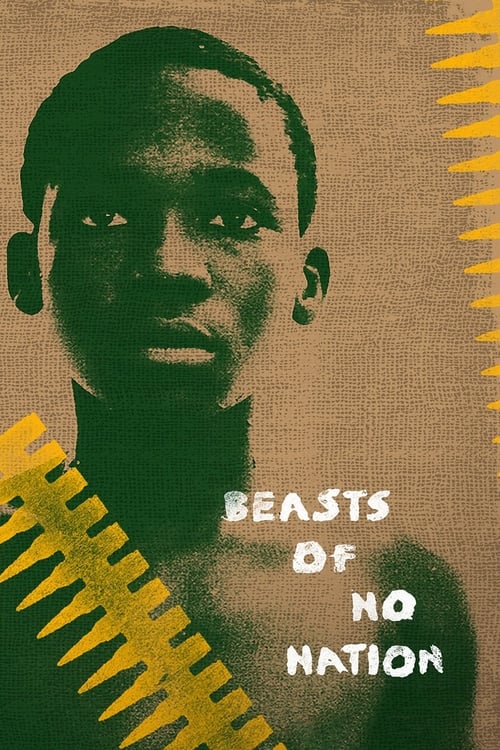
Beasts of No Nation
2015 · Cary Joji Fukunaga
For when you want cinema that confronts rather than comforts — a film to watch when you're ready to be shaken and to think hard about what you've seen. Not a casual pick; a demanding, rewarding one.
What it's about
In an unnamed West African country torn by civil war, a boy named Agu loses his family to the fighting and is absorbed into a guerrilla militia commanded by a charismatic, predatory leader who remakes children into soldiers. The film follows Agu's journey through the jungle campaign — a coming-of-age story where what he's coming of age into is the war itself.
The experience
Immersive and harrowing, with a strange, terrible beauty: the camera glides through violence that never stops feeling real. It grips you for two hours and leaves a bruise that lasts much longer.
Performances
Idris Elba is terrifying and magnetic as the Commandant, a father figure and monster in the same breath, while newcomer Abraham Attah carries the entire film on his young shoulders with a performance of astonishing rawness.
The craft
Cary Joji Fukunaga wrote, directed, and shot the film himself, and the unified vision shows — long fluid takes, saturated jungle color, an aestheticized camera set deliberately against unrelenting subject matter. It's visually gorgeous in a way that makes the horror land harder, and it rewards a big screen and full attention.
Why it matters
One of Netflix's first original feature films, released day-and-date in theaters and streaming in 2015 — a release that helped ignite the industry's streaming-versus-cinema debate — and a breakthrough showcase for Elba and Attah.
Snapshot
Beasts of No Nation is an immersive war drama that follows Agu, a boy in an unnamed West African country whose family is destroyed by civil conflict and who is absorbed into a guerrilla militia led by a charismatic, predatory Commandant. Adapted from Uzodinma Iweala's 2005 debut novel, the film is at once a coming-of-age nightmare and an anatomy of how war manufactures killers out of children. It occupies a singular place in industry history as one of the first original feature films distributed by Netflix, released day-and-date in a limited theatrical run and on the streaming platform in October 2015. Cary Joji Fukunaga directed, wrote the screenplay, and served as his own cinematographer, pairing an aestheticized, fluid camera with unrelenting subject matter. Idris Elba, as the Commandant, and newcomer Abraham Attah, as Agu, anchor the film; Attah's discovery and Elba's magnetic menace became the performances around which its reception organized. The film's importance is double: as a formally ambitious humanist war picture in the lineage of child-soldier narratives, and as an early, contested test case for whether streaming distribution could carry a prestige, awards-caliber feature.
Industry & production
The project originated with Fukunaga's long attachment to Iweala's novel, which he had wanted to adapt for years before it reached production. The finished film was independently financed and produced (with Fukunaga among the producers and Amy Kaufman producing), then acquired by Netflix for distribution — reportedly for a figure in the low eight figures, a deal widely covered at the time as a landmark for the streamer's move into original features. Netflix released the film simultaneously in a limited theatrical window and on its platform on October 16, 2015, following a competition premiere at the Venice Film Festival and a berth at Toronto.
That distribution model provoked the era's defining exhibition standoff: the major U.S. theater chains — among them AMC, Regal, Cinemark, and Carmike — declined to book the film because it broke the traditional theatrical exclusivity window. The boycott confined its theatrical footprint to independent and arthouse screens, effectively guaranteeing that the picture would be seen overwhelmingly as a streaming title. Netflix, consistent with its practice, did not release granular box-office or viewership data, so the film's audience reach is not documented in the conventional metrics; what is established is that the release became a reference point in ongoing arguments about windowing and the future of theatrical distribution.
Production took place principally in Ghana, and the shoot was, by the accounts Fukunaga and collaborators have given, physically arduous — remote locations, difficult conditions, and reports that Fukunaga himself fell ill during filming. The specific medical and logistical details beyond the broad picture of a demanding jungle production should be treated cautiously, as the granular record here is thinner than for the film's release history.
Technology
The film was shot digitally, a choice consistent with Fukunaga acting as his own director of photography and with the mobility the material demanded; the production's ability to move a compact camera package through jungle, village, and combat terrain depended on lightweight digital capture. It arrived at a moment when digital cinematography had become the default for this kind of location-heavy independent film, and its handheld immediacy is partly a product of that toolset. The most historically consequential technological fact about the film, however, is not its camera but its pipe: as an early Netflix original feature engineered for day-and-date streaming release, it was conceived from the outset for home viewing at scale, and its very existence is a marker of the transition from theatrical-first to platform-first distribution of prestige cinema.
Technique
Cinematography
Fukunaga's cinematography is the film's signature. He favors long, unbroken takes and a restless, embodied camera that stays close to Agu's eyeline, binding the audience to a child's disoriented vantage. The most cited passage is an extended battle sequence rendered in a sustained take that carries the viewer through chaos without the relief of a cut — a bravura set piece that also makes a moral argument by refusing to let the audience look away. Elsewhere Fukunaga's palette turns expressive: a notable stretch of combat is drenched in a magenta-pink filtered light, an unnaturalistic wash that estranges the violence and registers Agu's drug-altered, dissociated state. The compositions repeatedly place the small figure of the boy against overwhelming landscape and armed men, a scale relationship that does much of the film's thematic work visually.
Editing
Cut by Pete Beaudreau, the film modulates between the durational long take and more conventional coverage, using rhythm to track Agu's psychological descent. Where the camera holds, the effect is endurance and complicity; where the editing fragments, it conveys shock, confusion, and the numbing repetition of atrocity. The editorial strategy resists the propulsive momentum of the action genre, letting scenes breathe into dread and letting aftermaths linger.
Mise-en-scène / staging
The staging emphasizes authentic-feeling militia life: the improvised uniforms, amulets, and ritual of the fighting unit; the theater of the Commandant's authority, staged so that his men — and the boys — are arranged as an audience and an army at once. The unnamed setting is a deliberate compositional and political choice carried over from the novel, generalizing the story into a portrait of civil war as such rather than one nation's history. Villages, camps, and ruined roads are dressed for lived-in specificity while the country itself remains pointedly unlocatable.
Sound
Dan Romer's score — Romer having also scored the comparably lyrical-yet-brutal Beasts of the Southern Wild — blends orchestral and electronic textures with African musical elements, alternating tenderness for Agu's lost childhood with dissonance for the war. The sound design leans on immersive field ambience and the concussive report of gunfire to keep the viewer inside Agu's sensory world. The novel's most distinctive feature, its first-person pidgin-inflected voice, survives as Agu's voiceover narration, which threads the film with a child's grammar and moral bewilderment.
Performance
Abraham Attah, cast as a non-professional, delivers the film's center of gravity: an unforced, deeply interior performance that charts Agu's passage from frightened child to hollowed combatant, and it earned him the Marcello Mastroianni Award for a young performer at Venice. Idris Elba's Commandant is the counterweight — seductive, paternal, and monstrous, a man who weaponizes the need for belonging. Elba plays the role's charisma and its horror as inseparable, and the performance drove the film's awards conversation. The supporting ensemble of largely young and regional performers reinforces the documentary-adjacent texture.
Narrative & dramatic mode
The film's dramatic mode is subjective and experiential rather than expository. It is structured as a bildungsroman inverted into tragedy: the familiar arc of a boy's coming-of-age is hijacked and perverted into an initiation in killing. Agu's retained voiceover — often addressed, in the novel's spirit, toward God and his absent mother — gives the film a confessional, first-person interiority uncommon in the war genre. The narrative withholds geopolitical explanation almost entirely; we are given no factions to root for, no clarifying map of the conflict. This refusal is the point: the war is presented as a moral weather system that acts upon a child, and the drama is the erosion and possible survival of his interior self rather than the resolution of a political plot.
Genre & cycle
Beasts of No Nation belongs to the war film, and more specifically to the child-soldier subgenre that gained prominence in the 2000s and 2010s across cinema, literature, and journalism. It sits alongside films such as Johnny Mad Dog (2008) and War Witch (Rebelle, 2012) as part of a cycle reckoning with child combatants in African civil conflicts, and it draws on the broader tradition of children-in-war cinema reaching back to works like Come and See. It also participates in the auteur-driven, festival-launched prestige drama cycle, and — crucially for genre history — in the emerging category of the "streaming original prestige film," a class the picture helped inaugurate.
Authorship & method
The film is unusually singular in authorship: Fukunaga wrote the screenplay, directed, and photographed it, concentrating creative control in a way that recalls a total-cinema conception of the director. His method here extends the tendencies of his earlier work — the immersive location realism of Sin Nombre (2009), the atmospheric literary adaptation of Jane Eyre (2011), and the long-take, mood-saturated direction of the first season of True Detective (2014), whose celebrated single-take sequence prefigures the battle set piece here. His key collaborators shape the film's texture within that vision: composer Dan Romer supplies the emotional register; editor Pete Beaudreau governs the tension between duration and fragmentation; and, most importantly, the performances of Attah and Elba, drawn out through Fukunaga's direction of a mixed professional and non-professional cast, give the authored world its human stakes. The source author, Uzodinma Iweala, is the foundational collaborator at one remove: the film's voice, moral frame, and unnamed setting are inherited from his novel.
Movement / national cinema
The film resists tidy national-cinema classification. It is an American-financed, American-directed production, shot in Ghana with a largely African cast, telling a pan-African story deliberately stripped of national markers. As such it belongs less to any single national cinema than to a transnational mode of filmmaking about the Global South made by filmmakers positioned outside it — a category that carries its own critical debates about perspective and representation. Fukunaga's own hybrid sensibility, evident across a filmography that crosses the U.S.–Mexico border, Victorian England, and West Africa, situates the film within a globalized art-cinema practice rather than a bounded national tradition.
Era / period
The film is a product of the mid-2010s inflection point in the film industry, when streaming platforms began financing and distributing original features designed to compete for critical prestige and awards. Its 2015 release places it precisely at the moment the theatrical-window consensus began to fracture, and it should be read as both a work of that transition and an agent of it. Within film culture, it also arrived during a period of intensified attention to representation in awards, and its awards-season fate became entangled with those debates.
Themes
The film's central theme is the manufacture of a child soldier: the systematic conversion of a boy's love, fear, and need for belonging into instruments of violence. Bound to this is the theme of surrogate fatherhood and its betrayal — the Commandant offers Agu protection and paternity even as he exploits and abuses him, dramatizing how authority preys on the parentless. The film interrogates the survival and possible salvage of the self under conditions designed to annihilate it, keeping open, but not guaranteeing, the question of whether Agu's humanity can be recovered. Its deliberate erasure of national and factional specificity foregrounds the theme of war as a dehumanizing abstraction, indifferent to cause. Running beneath is a spiritual dimension inherited from the novel — Agu's addresses to God and his sense of moral accountability — that frames atrocity as a crisis of conscience rather than merely of politics.
Reception, canon & influence
Critical reception was strongly favorable, concentrated on Fukunaga's direction and cinematography, on the discovery of Abraham Attah, and on Idris Elba's Commandant, which drew wide praise and multiple precursor nominations for supporting actor. Attah's Mastroianni Award at Venice ratified the film's launch on the festival circuit. The film's awards trajectory then became a story in itself: despite the acclaim for Elba, it was notably shut out of the Academy Award nominations, a snub folded into the widely reported #OscarsSoWhite controversy over the lack of nominees of color in that cycle — a reception fact that has since become part of the film's historical footprint.
Looking backward, the film draws on the child-soldier literature and cinema of the preceding decade, on the humanist war tradition of children-in-conflict films, and on Iweala's novel as its direct progenitor; Fukunaga's own prior work supplies its formal DNA. Looking forward, its most durable influence is arguably industrial rather than stylistic: as a flagship early Netflix original feature and a flashpoint in the windowing wars, it helped normalize the streaming platform as a legitimate home for prestige, awards-seeking cinema, a shift that reshaped distribution over the following decade. Artistically, it reinforced the viability of the immersive, long-take war film and extended the visibility of the child-soldier subgenre to a mass streaming audience. The record of its precise long-term influence on subsequent filmmakers is still being written, and claims beyond its clear industrial significance and its consolidation of Fukunaga's and Elba's reputations should be made with corresponding caution.
Reception
Premiered at Venice to strong reviews in 2015, but its release became the story: as Netflix's first original feature, the big US theater chains boycotted it over the day-and-date streaming drop. A decade on it's remembered as the film that fired the first shot in the streaming-vs-cinema war — and as a genuinely great movie that got a bit buried by its own historic rollout.
How Beasts of No Nation was received, from release to now →
Influences: the films it descends from and the films it influenced
- Come and See (1985) — The film's core device — welding the camera to a boy's hollowing face as war ages and empties it, sustained through hallucinatory handheld POV — is lifted directly from Klimov's child's-eye immersion in atrocity, the dossier's named influence.
- Apocalypse Now (1979) — Its structure of a naïf's voiceover-narrated journey deeper into a war's moral heart, saturated in expressive jungle color, transplants Coppola's Heart-of-Darkness river descent onto the child-soldier march.
- City of God (2002) — The casting of non-professional local children who are absorbed into armed factions, rendered in kinetic handheld and framed by a boy narrator's retrospective voice, is the template Beasts adapts from favela to civil war.
- Children of Men (2006) — Lubezki's unbroken handheld combat set-piece — the camera embedded and ducking inside live crossfire — is the immersive long-take grammar Fukunaga scales up for the film's battle sequence.
- The 400 Blows (1959) — Establishes the observational, child's-eye bildungsroman anchored to a single young non-professional face, the humanist framing Beasts inverts into a corruption arc.
- Johnny Mad Dog (2008) — Cast with actual former West African child soldiers in a deliberately unnamed civil-war setting, it is the direct precedent for Beasts's non-professional child ensemble and geographic anonymity.
- War Witch (Rebelle) (2012) — Delivers the child-soldier's war through a drug-hazed subjective perception and a confessional second-person voiceover carried by a non-professional lead — the subjective-mode narration Beasts also runs through Agu.
- Sin Nombre (2009) — Fukunaga's own prior film supplies the DNA: location-realist immersion in gang violence and a youth swept into an armed brotherhood, shot for atmosphere over exposition.
- Apocalypto (2006) — Its all-non-professional indigenous cast and sustained subjective chase through visceral jungle violence model the propulsive first-person survival staging Beasts uses on the march.
- Beasts of the Southern Wild (2012) — Shares Fukunaga's exact method-collaborators — Dan Romer's swelling emotive score paired with a discovered non-professional child lead and expressive mythic-realist color — making it the aesthetic twin at one collaborator's remove.
- The Last King of Scotland (2006) — Extends LKOS's African-conflict handheld grammar while inverting its ethical premise: where LKOS filters Ugandan atrocity through a Western proxy whose limited understanding encodes the critique, Fukunaga uses the same available-light close-up register to grant full interiority to an African child soldier, refusing the proxy altogether.
- Turtles Can Fly (2004) — Builds an entire war around an untrained child lead whose performance carries the film, extending the lived-experience child-of-war casting into English-language cinema.
- Monos (2019) — Directly extends the craft: a band of child soldiers in an unnamed highland nowhere, a menacing surrogate-commander hierarchy, and expressive-color immersion, with Mica Levi's score doing Romer's atmospheric work.
- 1917 (2019) — Carries the immersive long-take war film to its logical extreme — a whole feature engineered as continuous movement through the front — extending the duration-over-cutting battle grammar Beasts foregrounded.
- Dunkirk (2017) — Advances the near-wordless, subjective-experiential mode of combat — sensation and duration over exposition — that Beasts used to keep the viewer inside Agu's disorientation.
- Roma (2018) — Inherits Beasts's industrial breakthrough directly: a Netflix-original prestige feature at the center of the theatrical-windowing fight, extending the distribution precedent Beasts set as an early awards-seeking streaming flagship.
- No Time to Die (2021) — Fukunaga's handheld, atmospheric war photography and patient dramatic rhythm around a damaged protagonist preview the contrasting-environments staging and emotional gravity he brings to the franchise.
- Son of Saul (2015) — Locks a shallow-focus handheld frame to one face moving through mechanized atrocity, the same subjective-mode strategy of experiencing genocide through a single body rather than surveying it.
- The Revenant (2015) — Lubezki's natural-light long-take handheld, plunging the viewer bodily into wilderness violence in continuous unbroken movement, is the same-year apotheosis of the immersive combat camera Beasts pursues.
- Slumdog Millionaire (2008) — Fukunaga, operating his own handheld camera, immerses a non-professional child performer (Abraham Attah) in Global-South trauma with the same saturated, mobile, child-centered realism.
- Lion (2016) — Contemporary companion in casting an untrained child (Abraham Attah) as an endangered lead and shooting his ordeal on location with immersive digital cinematography.
- The Promised Land (2023) — Showcase for composer Dan Romer's textural, non-orchestral outsider scoring — the same sparse, materials-based method he imports into The Promised Land's Danish material.
- The Boy Who Harnessed the Wind (2019) — The direct proof-of-concept for a Netflix-backed, on-location West African production in local vernacular — the streamer-prestige model Ejiofor's film extends without a white protagonist.
Similar films
- Beasts of the Southern Wild (2012) — influence & lineage
- Son of Saul (2015) — influence & lineage
- Come and See (1985) — influence & lineage
- The Revenant (2015) — influence & lineage
- Embrace of the Serpent (2015) — shared sensibility
- The Birth of a Nation (1915) — shared sensibility
- Nickel Boys (2024) — shared sensibility
- Innocent Voices (2005) — shared sensibility