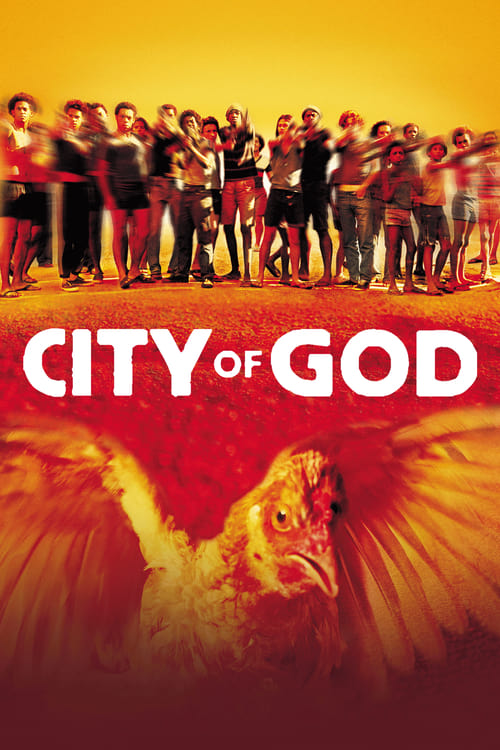
City of God
2002 · Fernando Meirelles
For when you want to be completely swept up — a gripping, adrenalized epic for a night when you have full attention to give and a stomach for hard material. One of those films people mean when they say 'you have to see it.'
What it's about
Across two decades in a Rio de Janeiro housing project that hardens into one of the city's most violent favelas, two boys take opposite paths: Rocket, who wants out and finds a possible escape through photography, and Lil' Zé, who claws his way up to become the neighborhood's most feared drug kingpin. Drawn from a novel rooted in real lives, it's a whole community's story told at full sprint.
The experience
Electric — propulsive, brutal, and impossible to look away from, with narration and energy that make two decades fly by. It's violent and heavy, but so alive that it plays like a rush rather than a chore.
Performances
The cast is almost entirely non-professional, drawn from Rio's own favelas, and the authenticity is startling — especially the kids, whose menace and charm never feel acted.
The craft
Meirelles and co-director Kátia Lund shoot with restless handheld cameras, sun-scorched color, and razor editing that turns sprawling material into pure momentum. It's a masterclass in kinetic storytelling and one of the most imitated visual styles of its decade — worth the biggest, loudest setup you have.
Why it matters
A Brazilian crossover phenomenon that became a global hit, reshaped how crime epics look and move, and launched Meirelles onto the international stage.
Snapshot
City of God (Cidade de Deus) is a Brazilian crime epic that traces roughly two decades of life in the Cidade de Deus, a public-housing project on the western fringe of Rio de Janeiro that curdled into one of the city's most violent favelas. Adapted from Paulo Lins's 1997 novel of the same name — itself a fictionalized account grounded in Lins's own years living there and in his ethnographic research — the film follows Rocket (Buscapé), a poor Black youth who escapes the cycle of violence by becoming a photographer, and the rise and fall of the psychopathic kingpin Lil' Zé (Zé Pequeno). Directed by Fernando Meirelles with co-director Kátia Lund, the film is built almost entirely from non-professional actors drawn from Rio's favelas, and it converted a local literary phenomenon into a global art-house and crossover hit. It earned four Academy Award nominations in 2004 (Director, Adapted Screenplay, Cinematography, Editing) — notably not in a year it was eligible for Best Foreign Language Film — and is now widely cited as one of the defining films of the 2000s and the most internationally visible work of the Brazilian cinematic revival.
Industry & production
City of God emerged from the resurgence of Brazilian filmmaking known as the Retomada ("rebirth"), which followed the near-total collapse of the national industry in the early 1990s after President Fernando Collor de Mello dismantled the state film body Embrafilme. The film was produced by O2 Filmes, the São Paulo production house Meirelles co-founded, which had built its capabilities and capital on commercials and television, in partnership with Andrea Barata Ribeiro and Maurício Andrade Ramos, with backing that included Globo Filmes (the cinema arm of the Globo media conglomerate) and Lumière, and international distribution muscle from Miramax and other partners in various territories. The budget was modest by international standards — commonly reported in the low millions of US dollars — and the production leaned heavily on O2's commercial infrastructure rather than a traditional studio apparatus.
The casting and rehearsal process was itself an industrial innovation. Rather than recruit known performers, the production ran an extended workshop, Nós do Cinema, led by Kátia Lund and Guti Fraga's Nós do Morro theater group from the Vidigal favela, drawing in roughly two hundred young people from poor neighborhoods. Over months, the workshop developed improvisational scenes, screen-tested participants, and ultimately cast the film, while also seeding an ongoing social and training initiative. This approach gave the film its texture of authenticity and addressed a practical problem — there was no pool of professional Afro-Brazilian favela actors to draw from — while raising the ethical and labor questions that follow any production built on the lives and labor of a marginalized community.
Technology
The film was shot on Super 16mm rather than 35mm, a choice that suited both the budget and the aesthetic: the smaller, lighter cameras allowed for handheld mobility through the favela's tight alleys and the lightweight rigs needed for the kinetic, run-and-gun coverage Meirelles wanted, and the grain of the blown-up image contributed to the raw, reportage feel. Post-production made significant use of a digital intermediate workflow — relatively novel for a film of this budget and origin in 2002 — which let the filmmakers push the heavily stylized, sun-baked color palette: saturated golds and oranges for the optimistic stretches, cooler and harsher grades as the violence intensifies. The combination of a documentary-derived shooting toolkit with aggressive digital color manipulation is central to the film's look, marrying the immediacy of cheap, mobile capture to the controlled artifice of contemporary post.
Technique
Cinematography
César Charlone, the Uruguayan cinematographer and longtime Meirelles collaborator, shot the film and is one of its principal authors. His camera is restless, handheld, and frequently embedded in the action, but it is far from the verité neutrality the handheld style might imply: the imagery is highly designed, with whip pans, snap zooms, ramped speeds, strobing, and bursts of slow motion deployed at moments of violence and revelation. Charlone and Meirelles drew on the visual grammar of advertising and music video — fast, legible, sensation-forward — and fused it with the grain and grit of documentary. The color is expressive rather than naturalistic, keyed to the emotional temperature of each era and each character. The result is a paradoxical surface that feels both spontaneous and meticulously composed, and the cinematography earned Charlone one of the film's four Oscar nominations.
Editing
Daniel Rezende's editing is perhaps the film's single most discussed formal element, and it launched his career (he too received an Academy Award nomination). The cutting is rapid, elliptical, and propulsive, organized around a fractured chronology that loops back on itself, freezes, rewinds, and branches into nested stories — most famously "The Story of the Apartment," which traces a single drug den across multiple tenants and eras. The film opens with a flash-forward — a chicken's escape and a standoff in which Rocket is caught between the gang and the police — then spirals back to reconstruct how that moment came to be, a structure that lets the editing dramatize the inescapability of the cycle. Rezende's rhythm absorbs the energies of commercials and MTV-era montage but bends them toward narrative architecture rather than mere flash, threading dozens of characters and two decades into a coherent, accelerating arc.
Mise-en-scène / staging
The favela itself is the film's dominant set, and the production staged its action in real and constructed locations that read as a labyrinth — alleys, rooftops, half-built brick structures, and dirt lots that the camera navigates as a continuous social space rather than a backdrop. Crowds of non-professional performers fill the frame, and the staging favors a sense of teeming, overlapping life in which children, dealers, workers, and bystanders share the same compressed geography. The period sweep from the 1960s through the early 1980s is conveyed through costume, hairstyle, and the shifting material culture of the streets rather than through expensive establishing spectacle. Violence is staged with a deliberate, disorienting matter-of-factness, frequently involving children as both perpetrators and victims, which is the film's most disquieting staging decision.
Sound
The score by Antônio Pinto and Ed Côrtes, supplemented by a dense soundtrack of period Brazilian popular music — samba, soul, funk, and the era-appropriate hits that mark the passage of decades — functions as both period marker and ironic counterpoint, often setting buoyant grooves against brutal events. The sound design renders the favela as a continuous acoustic environment of music, gunfire, and voices, and the music is integral to the film's tonal volatility, its ability to swing between exuberance and horror within a single sequence.
Performance
The performances are the film's ethical and aesthetic core. Working with a cast of mostly first-time actors developed through the Nós do Cinema workshop, Meirelles and Lund elicited naturalistic, improvisation-rooted playing that nonetheless serves sharply drawn characters. Alexandre Rodrigues anchors the film as the observant, self-effacing Rocket; Leandro Firmino da Hora is indelible as Lil' Zé, all sudden grins and sudden murder; Phellipe Haagensen plays the gentler Bené, and Seu Jorge — one of the few cast members with a prior public profile, as a musician — brings gravity to the doomed Knockout Ned (Mané Galinha). The absence of star personae and the cast's evident proximity to the world depicted are essential to the film's claim on authenticity.
Narrative & dramatic mode
City of God operates in an epic, polyphonic register: it is less the story of one protagonist than a braided chronicle of a place across generations. Rocket serves as narrator and moral witness — a figure of survival and observation rather than action — and his voiceover frames the film as a story being assembled, fittingly for a character who becomes a photographer. The dramatic mode is tragic and deterministic at the macro level (the cycle of violence renews itself with each generation, ending the film as it began, with younger and more ruthless children inheriting the trade) even as individual sequences pulse with comic energy, suspense, and bravura set pieces. The fractured, recursive chronology is not decoration but argument: by repeatedly circling back, the structure insists that these fates are systemic rather than incidental. The dual trajectory — Rocket's improbable escape through the camera versus Lil' Zé's ascent and destruction — gives the film its moral spine without resolving into easy uplift.
Genre & cycle
The film is a crime epic in clear dialogue with the gangster and rise-and-fall traditions, and it belongs to an international cycle of turn-of-the-millennium urban-underclass crime films that combined social realism with hyperkinetic style. It draws openly on the American gangster saga and on the chronicle-of-a-neighborhood structure, while grounding the genre in the specific political economy of Rio's drug trade. Within Brazilian cinema it sits in a lineage of favela and marginality films, and it helped consolidate a wave of internationally circulated favela narratives that would extend into television (the spin-off series City of Men, also developed by the same creative circle) and into José Padilha's later Elite Squad films. Its fusion of art-cinema ambition with the propulsion of commercial and music-video aesthetics typifies a broader 2000s tendency to dissolve the boundary between the festival film and the genre entertainment.
Authorship & method
Authorship of City of God is genuinely collaborative, and the record on the division of labor between Fernando Meirelles and co-director Kátia Lund has at times been a point of public discussion, with Lund's contribution — particularly to the casting, workshop, and direction of the young actors — sometimes argued to be underrecognized relative to Meirelles's billing. Meirelles came from a successful career in advertising and television through O2 Filmes, and that commercial fluency shapes the film's pace and surface; City of God was his breakthrough and the springboard to an international career (The Constant Gardener, Blindness, The Two Popes). The screenplay is credited to Bráulio Mantovani, who distilled Paulo Lins's sprawling, many-charactered novel into a propulsive structure — the adaptation is itself a major act of authorship, imposing the flash-forward frame and the recursive chronology. Lins's novel, rooted in his lived experience and research in the Cidade de Deus, supplies the film's documentary authority. The key technical collaborators — cinematographer César Charlone and editor Daniel Rezende — are co-authors in any meaningful sense, as the film's identity is inseparable from their kinetic image-making and cutting. Antônio Pinto's music completes the signature. The working method — long workshop-based development with non-professionals, improvisation feeding a tightly engineered final structure — is the film's defining procedure and the source of both its power and the ethical scrutiny it has attracted.
Movement / national cinema
The film is the most prominent international product of the Retomada, the revival of Brazilian cinema that gathered force in the late 1990s after the industry's collapse and the partial restoration of state and incentive-based funding. It carries forward, in transformed terms, the concerns of an older Brazilian tradition — the Cinema Novo of the 1960s (Glauber Rocha and others) was likewise preoccupied with poverty, violence, and the nation's social fractures, and the favela had long been a charged site in Brazilian film going back to Rio 40 Graus and beyond. Where Cinema Novo pursued an "aesthetics of hunger" that often rejected polished spectacle, City of God embraces a glossy, commercially fluent surface, and that shift provoked debate within Brazil: critics asked whether the film's stylistic exhilaration aestheticized misery and packaged favela violence for global consumption — the much-discussed charge of "cosmetics of hunger" leveled at the Retomada's slicker entries. That debate is itself part of the film's significance as a national-cinema landmark.
Era / period
City of God is a product of the early-2000s moment in which digital post-production, globalized art-house distribution, and a music-video-inflected visual culture converged. It reflects a period when national cinemas outside the traditional centers were finding international audiences through festivals and specialty distributors, and when the line between "world cinema" social realism and stylish genre filmmaking was blurring. Its own diegetic period — the late 1960s through the early 1980s — is rendered as a historical account of how organized drug trafficking transformed Rio's favelas, mapping a real socio-historical trajectory onto the personal stories. The film thus sits at the intersection of two periods: the historical decades it depicts and the turn-of-the-millennium production culture that made its particular form possible.
Themes
The film's governing theme is the self-perpetuating cycle of violence and poverty: a social machine that consumes each new generation of children, with escape available to almost no one. Childhood is central — the film is unnerving precisely because its killers and victims are so young — and it dramatizes how a place can manufacture criminality structurally rather than as a matter of individual moral failure. Adjacent themes include the role of representation and the gaze: Rocket's camera is the film's reflexive figure, raising the question of who gets to picture the favela and to what end, and implicating the film's own image-making in that question. Race and class are inescapable, as is the near-total absence or corruption of state institutions — the police appear as another predatory actor rather than as protection. Against this determinism the film holds a thin thread of agency: art, observation, and a measure of luck offer one boy a way out, even as the system reproduces itself behind him.
Reception, canon & influence
City of God was a critical sensation on the international circuit following its 2002 Cannes screening, widely praised for its energy, scope, and performances, and it became a substantial crossover success for a subtitled film, performing strongly in art-house and crossover release across Europe and North America (precise box-office figures vary by source and territory, so specific numbers are best treated with caution). Its four Oscar nominations across major craft and directing categories two years after its premiere were an unusual recognition for a foreign-language film, and it has since recurred near the top of critics' and public polls of the greatest films of its decade and of the twenty-first century.
Its influences run backward to the American gangster and rise-and-fall tradition and to the chronicle-of-a-neighborhood epic, to the social-realist lineage of Brazilian cinema from Cinema Novo through the Retomada, and above all to Paulo Lins's novel and the ethnographic reality it documented. Charlone and Meirelles's marriage of documentary handheld and advertising polish synthesizes those genealogies into something new.
Forward, the film's legacy is broad. It catapulted Meirelles, Charlone, and Rezende — and several cast members, notably Seu Jorge — to international careers, and it helped open the global market to subsequent Brazilian crime cinema, most directly the City of Men television series and film and José Padilha's Elite Squad pictures. Its visual and editorial style — the saturated grade, the kinetic handheld, the ramped violence, the recursive structure — became a widely imitated template for urban crime storytelling in cinema, television, and advertising worldwide. At the same time, its legacy is genuinely contested: it intensified an ongoing debate, particularly within Brazil, about the ethics and politics of stylized favela representation — whether such films testify to injustice or aestheticize and export it. That argument, rather than diminishing the film, has secured its place as a reference point in any serious discussion of how cinema pictures poverty and violence.
A Deleuzian reading
A chicken runs for its life.
The full Deleuzian reading of City of God →
Reception
It exploded out of Cannes 2002 as an instant international sensation — then, after being passed over for the Best Foreign Language Film nomination, it stunned everyone with four Oscar nominations (including Best Director) a year later. Two decades on it's no longer a discovery but a fixture: a default answer to 'best films of the 2000s'.
How City of God was received, from release to now →
Influences: the films it descends from and the films it influenced
- Goodfellas (1990) — Supplies the rise-and-fall criminal chronicle propelled by a witness's voiceover and freeze-frames that arrest the action mid-gesture — the recursive, narrated structure Mantovani's adaptation rebuilds around Rocket.
- Pixote (1981) — Established the Brazilian template of casting real favela and street children as non-professionals to document juvenile criminality with ethnographic authority — the workshop realism Lund extends.
- Rio, 40 Graus (1955) — Founding Cinema Novo act of shooting on location across the morros and weaving a polyphonic, many-charactered chronicle of a single neighborhood's poverty.
- Black God, White Devil (1964) — Codified Cinema Novo's 'aesthetic of hunger' and mythic framing of Brazilian violence — the social-realist genealogy the film inherits and glosses with advertising surface.
- Pulp Fiction (1994) — Modeled the chaptered, deliberately scrambled chronology with intertitled segments and a deferred opening that loops back at the end — the fractured architecture restated in the 'Story of the Tender Trio'/Knockout Ned blocks.
- Trainspotting (1996) — Pioneered the advertising-bred kineticism of freeze-frame character introductions with on-screen names, propulsive voiceover, and needle-drop montage that Charlone and Rezende adopt wholesale.
- La Haine (1995) — Mapped the housing-project labyrinth with restless handheld tracking of youths across a single hostile geography, fusing social-realist youth-violence with show-off camera moves.
- Salaam Bombay! (1988) — Workshopped real slum children into a cast over months of development, the long non-professional rehearsal method that disciplines improvisation into structure.
- Amores Perros (2000) — Near-contemporary Latin American breakthrough built on the same super-16 grit plus commercial-director polish, interlocking polyphonic strands across a violent city.
- Mean Streets (1973) — Meirelles and Lund's deliberate variation of film stock texture and handheld register to differentiate temporal layers — childhood rendered softer, present-tense violence more abrasive — directly extends Scorsese's 16mm/35mm format mixing; the episodic accumulation of a criminal community's history without single-protagonist causality reproduces Mean Streets' narrative logic at larger scale.
- Traffic (2000) — Meirelles and co-director Kátia Lund's handheld documentary realism — location shooting in actual Rio favelas, non-professional faces, available-light cinematography — extends Traffic's authenticating grammar into Brazilian drug-crime geography, while the episodic chapter structure mirrors Traffic's strand-based architecture as social portraiture.
- Black Orpheus (1959) — Meirelles extended Camus's practice of casting non-professional actors from actual Rio favelas — using physiognomy and community authenticity over trained performance — while replacing the elegiac lyric mode with kinetic jump-cut documentary montage, redeploying the same casting method for opposite aesthetic and political ends.
- The Constant Gardener (2005) — Meirelles and Charlone carry the identical signature forward — expressive saturated grade, jittery handheld, fractured timeline — onto a transnational thriller.
- City of Men (2007) — Direct O2 Filmes spinoff continuing the favela milieu, non-professional ensemble, and kinetic handheld house style under Meirelles's production.
- Elite Squad (2007) — Inherits the voiceover-driven favela crime epic with documentary handheld and ramped violence, then argues back against its predecessor's aestheticization of poverty.
- Slumdog Millionaire (2008) — Transposes the formula to Mumbai — slum-child chase shot on saturated kinetic handheld, structured as flash-forwards from a present-tense frame, with a non-professional child cast.
- Gomorrah (2008) — Adopts the polyphonic crime-epic structure and non-professional casting but routes it through observational handheld realism inside a concrete-project labyrinth, a deliberate counter to the glossy grade.
- Sin Nombre (2009) — Applies the saturated-handheld, non-professional gang-violence aesthetic to a Central American migration story, with the same workshop-based youth performances.
- Tsotsi (2005) — Carries the template to a Johannesburg township — a young criminal's arc told with expressive color, kinetic handheld, and locally cast non-professionals.
- Capernaum (2018) — Non-professional cast drawn from the depicted favela community, fractured chronology with retrospective narration, and kinetic handheld shooting as the grammar of Global South poverty realism; all three devices recur structurally in Capernaum.
- Estômago: A Gastronomic Story (2008) — Supplies the kinetic Brazilian editing grammar—propulsive parallel cross-cutting and interlocked timelines—that Estômago borrows even as it positions itself 'against favela realism.'
- Elite Squad: The Enemy Within (2010) — Bráulio Mantovani's screenplay model — braided, voiceover-narrated favela chronicle with handheld available-light kineticism — is the storytelling architecture Mantovani then carries directly into the Tropa scripts.
- Pudhupettai (2006) — Desaturated handheld slum realism narrated by a youth rising through a gang hierarchy across nonlinear chapters — the direct debt for Arvind Krishna's visual grammar and Kola Bhaskar's episodic cut.
- Aaranya Kaandam (2011) — Demonstrates virtuoso parallel editing weaving interlocking lower-world crime lives into a mosaic, the kinetic cross-cut technique that won Praveen K.L. and N.B. Srikanth their National Award here.
- 21 Grams (2003) — Extends the same desaturated-handheld grammar into a fully shattered, time-shuffled mosaic where the viewer reassembles causality from flash-forward fragments.
- Boogie Nights (1997) — Applies a kinetic, music-cut ensemble rise-and-fall structure to a criminal economy, sharing Boogie Nights' decade-spanning epic shape and roving virtuoso camera.
- Athena (2022) — Imports music-video cutting grammar and saturated, propulsive kineticism into a social-realist territory of urban poverty and gang war — the commercial-promo idiom applied to the underclass.
- Bus 174 (2002) — Same-year Cinema da Retomada landmark rendering Rio favela violence as a systemic, generational cycle rather than individual pathology.
- Carandiru (2003) — The parallel early-2000s Retomada impulse to dramatize urban crime with unsparing kinetic realism and a sprawling cast of the marginalized, released alongside Carandiru.
- Mango Yellow (2002) — Same-year Brazilian peripheral ensemble that, like Mango Yellow, speaks powerfully from the margins — kinetic crosscutting of interlocked lives, the other face of the Retomada's turn to the favela/periphery.
- Maria Full of Grace (2004) — Meirelles cast non-professional favela residents to depict the drug trade from its foot-soldiers up, a parallel commitment to humanizing the bottom of the chain over the kingpin.
- Once Were Warriors (1994) — A commercials-trained director transmuting slum social-realism into kinetic, sensuously color-graded spectacle — the identical 'social content in advertising-grade form' wager Tamahori made eight years earlier.
- Paid in Full (2002) — A same-year, based-on-true-events, hip-hop-inflected rise-and-fall of neighborhood drug youth told through kinetic, music-video-derived editing and ensemble character-vignette structure.
- A Dog's Will (2000) — Retomada-era feature built from TV/commercial kinetic editing and an ensemble of non-pro and stage actors including Matheus Nachtergaele, sharing the compressed televisual cutting energy.
- Brainstorm (2001) — A contemporaneous Retomada breakout built, like Brainstorm, on physically embodied performances of marginalized Brazilian youth and a kinetic, subjective handheld camera that fuses the viewer to the protagonist's body.
- Gangs of Wasseypur - Part 2 (2012) — Shares the kinetic, generation-spanning chronicle of a marginalized locale's crime ecosystem told through cycling protagonists, cast largely from non-stars for lived-in authenticity.
Similar films
- Amores Perros (2000) — influence & lineage · same viewing thread
- Salaam Bombay! (1988) — influence & lineage · same viewing thread
- Slumdog Millionaire (2008) — influence & lineage · same viewing thread
- Elite Squad (2007) — influence & lineage
- Black God, White Devil (1964) — influence & lineage
- Gomorrah (2008) — influence & lineage
- GoodFellas (1990) — influence & lineage
- The Constant Gardener (2005) — influence & lineage
All the films related to City of God →
Watch it with: curated runs of related films
- Cinema of the Dispossessed — A run of slum-and-favela dramas — Rio, Mexico City, Mumbai, the Paris banlieue — where children survive by their wits and the city itself is the antagonist.