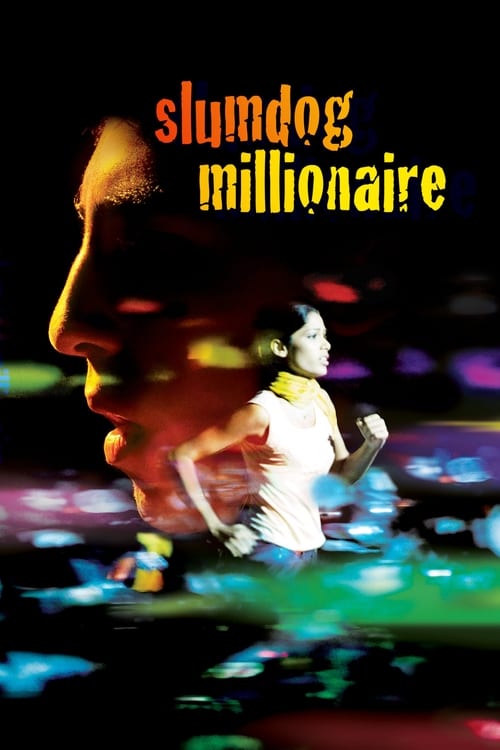
Slumdog Millionaire
2008 · Danny Boyle
For when you want a big-hearted underdog story that earns its emotion — comfort viewing with grit under its fingernails, and it leaves you lighter than it found you.
What it's about
An eighteen-year-old from the Mumbai slums is one question away from the top prize on India's version of "Who Wants to Be a Millionaire?" — and gets hauled in by police who can't believe a "slumdog" could know the answers. Under interrogation, each quiz question opens a window onto his childhood: growing up orphaned with his brother, scrambling to survive, and chasing the girl he's loved since they were kids. The game show becomes a frame for a whole life story told out of order.
The experience
It moves like a chase — fast cuts, saturated color, music pushing you forward — but keeps landing on moments of real hurt and real sweetness. You go from wincing to grinning within a scene, and the whole thing builds toward a finish that's honestly rousing.
Performances
Dev Patel, in his first film lead, carries it with an open, unguarded quality that makes the character's persistence feel like innocence rather than naivety; the child actors playing the younger versions are so alive they're arguably the film's secret weapon.
The craft
Danny Boyle shoots Mumbai at street level with restless, kinetic camerawork, and A.R. Rahman's propulsive score fuses the whole thing together — this is a film that rewards good speakers as much as a big screen. Simon Beaufoy's script is a clever piece of architecture: every trivia question keys open a chapter of the past, so structure and story are the same machine.
Why it matters
A little film nobody expected much from that swept the 2008 awards season, took Best Picture, and launched Dev Patel's career while bringing Rahman's music to a global audience. It became the reference point for a decade of conversation about how Western films portray India.
Snapshot
Slumdog Millionaire is a film built on a single, almost absurdly schematic conceit: an eighteen-year-old orphan from the Mumbai slums, one question away from winning the Indian Who Wants to Be a Millionaire?, is detained and interrogated on suspicion of cheating — because how could a "slumdog" possibly know the answers? The film's reply is its structure. Each question unlocks a flashback, and each flashback reveals that the boy's hard-won knowledge was paid for in trauma, loss, and survival. Adapted by Simon Beaufoy from Vikas Swarup's 2005 novel Q & A and directed by Danny Boyle, the film fused a Dickensian rags-to-redemption arc with the kinetic, sensory grammar Boyle had been developing since Trainspotting (1996). Released to little advance expectation — its American distributor's parent studio reportedly considered sending it straight to home video — it became one of the defining critical and awards phenomena of the decade, sweeping the 81st Academy Awards with eight wins including Best Picture and Best Director. It is also one of the most contested films of its era, celebrated as an exuberant cross-cultural fairy tale and attacked as "poverty porn" that aestheticized Indian destitution for Western consumption. Both readings are responding to the same quality: a film that treats the slum as spectacle, vitality, and engine of feeling all at once.
Industry & production
The project was a transnational hybrid from inception. Beaufoy's screenplay was developed with the British company Celador Films (notable because Celador owned the Who Wants to Be a Millionaire? format itself) and Film4. Financing and distribution ran through Fox Searchlight and Warner Bros.' Pathé arrangement in territories, with Searchlight ultimately steering the U.S. release. The widely repeated industry lore — that Warner Independent's closure left the film orphaned and nearly direct-to-DVD before Searchlight committed to a theatrical platform release — is part of the film's mythology; the broad outline is well documented, though specific internal deliberations are necessarily secondhand.
Crucially, the film was shot largely on location in Mumbai, including in and around the Dharavi district, with a substantial Indian crew and an Indian co-director, Loveleen Tandan, credited as "co-director (India)." Tandan's role — casting, working with the Hindi-speaking child actors, and handling the decision to shoot significant early portions in Hindi rather than English — was central, and the question of how fully her contribution was acknowledged became part of the film's reception discourse. The cast bridged registers of Indian stardom and unknowns: Dev Patel (then known in Britain for the TV series Skins) and the newcomer model Freida Pinto as the adult leads; the established Bollywood star Anil Kapoor as the game-show host; the internationally respected Irrfan Khan as the police inspector; and, for the children, a mix of professional young actors and non-professionals recruited locally, including children from Dharavi. The use of real slum children generated its own ethical aftermath, with the filmmakers and producers later establishing a trust to support the children's education and housing — an acknowledgment that the production's relationship to its setting carried obligations beyond the screen.
Technology
Slumdog Millionaire is a landmark in the early adoption of lightweight digital cinematography for a prestige feature. Cinematographer Anthony Dod Mantle, a veteran of the Dogme 95 movement, shot a substantial portion of the film on the Silicon Imaging SI-2K, a compact digital camera built around a tethered "mini-head" that could be carried into the crush of Mumbai streets, markets, and alleys where a full 35mm rig would have been impossible or ruinously slow. The film mixed this digital capture with 35mm film for other sequences, exploiting the contrast in texture rather than disguising it. Dod Mantle's Academy Award for Cinematography is often cited as a watershed: it was among the first Best Cinematography Oscars to honor work shot substantially on a small-sensor digital system, signaling that digital acquisition had arrived at the medium's highest tier. The technology was not incidental but constitutive — the film's claustrophobic immediacy, its ability to plunge the camera into a chase through Dharavi or the chaos of a train platform, depended on cameras small and rugged enough to go where the story lived.
Technique
Cinematography
Dod Mantle's images are saturated, mobile, and aggressively contemporary. The palette runs hot — golds, ochres, the blue of tarpaulins and the orange of communal life — and the camera is rarely still. Handheld pursuit, canted angles, smeared motion, and tight, jostling framings render Mumbai as a body in perpetual motion. Boyle and Dod Mantle deploy aerial and high-vantage shots of Dharavi's corrugated sprawl as recurring visual motifs, oscillating between the overwhelming scale of the city and the intimacy of a single face. There is a deliberate friction between the slum's squalor and the beauty of its rendering; this is the precise pressure point on which the "poverty porn" critique presses, and it is also the source of the film's affective force.
Editing
Chris Dickens's Oscar-winning editing is arguably the film's true authorial signature. The triple-strand architecture — present-tense interrogation, the live game show, and the chronological flashbacks of the brothers' childhood — is held together entirely in the cut, which must constantly cross-reference question, memory, and consequence. Dickens edits at a propulsive clip, matching action across time, snapping between the buzzer of the studio and the violence of the past, and using the rhythm of the cutting to convert what could have been a static frame-tale into something breathless. The editing also carries the film's emotional logic: a quiz answer detonates a memory, and the cut is the causal argument.
Mise-en-scène / staging
The film stages the slum as a teeming, vertical, layered environment — laundry, livestock, corrugated roofs, open sewers, call centers, and construction cranes coexisting in the frame. Boyle favors density: backgrounds are alive with incidental activity. The game-show set, by contrast, is a pool of cold studio light and engineered suspense, its blue-black void and isolating spotlight a calculated visual antithesis to the chaotic warmth of the slum. This opposition — the manufactured spectacle of television versus the lived spectacle of the street — is the film's central staging idea.
Sound
The sound design is dense and percussive, layering the ambient roar of the city with a near-constant musical pulse. A.R. Rahman's score fuses Indian classical and folk idioms with electronica, hip-hop, and global pop, and Boyle integrates needle-drops with pointed effect — most famously M.I.A.'s "Paper Planes," whose gunshot-and-cash-register hook scores the brothers' childhood hustling. The closing "Jai Ho," staged as a full Bollywood dance number over the end credits, functions as both homage and release valve, sending the audience out on euphoria.
Performance
The performances are calibrated to the film's fable register. Dev Patel plays Jamal with a watchful, wounded stillness that anchors the surrounding velocity. The child actors — three sets of performers aging the principals across the film — carry much of the emotional weight, and their unpolished naturalism is essential to the film's claim of authenticity. Anil Kapoor gives the host a glittering, faintly sinister condescension, embodying the class contempt the film interrogates, while Irrfan Khan lends the framing interrogation a gravity and eventual sympathy that legitimizes the whole structure.
Narrative & dramatic mode
The film's mode is the fairy tale told in the grammar of social realism — a deliberate, productive contradiction. Its plot machinery is frankly fabulist: destiny, coincidence, the conviction that "it is written," a love that survives every separation, a lottery of suffering that resolves into reward. Yet it delivers this fable through textures of documented misery — child blinding for beggar profit, communal riots, child trafficking, gangsterism — that belong to the register of exposé. The frame-tale architecture is its key formal device, converting a quiz show into a confessional and a life into a sequence of legible "answers." This structure has been read both as ingenious (knowledge as the residue of lived experience) and as reductive (a life flattened into trivia). The drama is fundamentally melodramatic in the classical sense: it organizes the world into moral legibility, and its emotional logic is one of accumulated suffering redeemed by poetic justice.
Genre & cycle
Slumdog Millionaire sits at the intersection of several lineages: the British social-realist tradition (it shares DNA with the kitchen-sink concern for the dispossessed, refracted through a foreign setting), the Bollywood masala film (with its embrace of coincidence, separated brothers, romantic destiny, and a closing song-and-dance), and the rags-to-riches narrative descending from Dickens, whose Oliver Twist the film consciously echoes in its orphans, its criminal underworld, and its Fagin-like exploiter of children. It belongs, too, to a late-2000s cycle of globally minded, festival-launched prestige films attentive to the Global South, and to the broader vogue for hyperlinked, time-braided storytelling that 21 Grams, Babel, and City of God had popularized — the last a frequent and apt comparison point for its slum-set energy and child protagonists.
Authorship & method
The film is most coherently understood as a Danny Boyle work, bearing the marks of his entire career: the propulsive editing and music-video sensibility of Trainspotting, the survivalist momentum of 28 Days Later (2002), the visual maximalism of Millions (2004) and Sunshine (2007). Boyle's method is omnivorous and energetic, prizing forward motion, sensory saturation, and emotional directness over restraint. But authorship here is genuinely distributed. Simon Beaufoy's screenplay performed the considerable engineering of compressing and restructuring Swarup's novel — changing the protagonist's name, foregrounding the love story, and tightening the quiz-flashback correspondence. Loveleen Tandan's co-direction made the Indian production and its child performances possible and shaped the bilingual texture of the opening act. Anthony Dod Mantle's cinematography and Chris Dickens's editing are not service crafts but co-equal authorial forces. And A.R. Rahman — already a titan of Indian film music across two decades — supplied the score and songs that arguably define the film's identity more than any image; his two Academy Awards (Original Score and, for "Jai Ho," Original Song) marked a watershed moment of global recognition for Indian film music.
Movement / national cinema
The film resists clean national classification, and that ambiguity is central to its meaning and its controversy. It is, by financing, crew leadership, and directorial authorship, a British film — yet it is set entirely in India, shot in India, performed substantially in Hindi in its early reels, and saturated with Bollywood convention and Indian musical idiom. It thus exemplifies a particular early-twenty-first-century formation: the transnational co-production that addresses a global art-house and crossover audience while drawing its raw material from a specific national culture. Within India, its reception was divided — pride in Rahman's and the film's international triumph coexisting with discomfort at a Western-authored portrait of Indian poverty that some felt traded on Orientalist spectacle. The film sits in dialogue with Indian "parallel cinema" and with realist slum portraits like Salaam Bombay! (1988), but its sensibility is finally that of an outsider's exhilarated, anxious encounter with the megacity.
Era / period
Slumdog Millionaire is a document of a specific globalizing moment — the late 2000s of call centers, satellite television, the Millionaire format circling the planet, and India's accelerating but brutally uneven economic rise. The film registers this transformation directly: the slum the brothers grew up in is being demolished for high-rise development; Jamal works at a call center serving Western customers; the game show itself is an imported spectacle of instant, televised social mobility. The film arrived, too, just as the 2008 financial crisis was breaking, and its fantasy of a poor man winning a fortune found a resonant — and to some, escapist — audience in a year of collapsing economic certainties. Technologically and industrially, it stands at the hinge where digital cinematography became prestige-legitimate.
Themes
At its core the film concerns knowledge as lived experience — the proposition that what one knows is inseparable from what one has survived, and that the powerful systematically underestimate the intelligence of the poor. Around this radiate fate and destiny ("it is written," the refrain that frames the whole), the love that organizes a life (Jamal's entire trajectory is finally about reaching Latika, not money), and the brotherhood of Jamal and Salim, a Cain-and-Abel divergence between the boy who keeps his soul and the one who sells it for survival and power. The film is preoccupied with class and the spectacle of poverty, with the city as both predator and possibility, and with modernity's collisions — communal violence, child exploitation, and globalized media all pressing on a single life. Its closing wager is unabashedly romantic: that goodness, love, and a kind of cosmic justice can prevail, "the answer," against a world organized to crush them.
Reception, canon & influence
Critical reception was, on release, overwhelmingly enthusiastic in the Anglophone world; the film accumulated a near-unprecedented run of precursor awards before its eight Academy Awards — Best Picture, Director, Adapted Screenplay, Cinematography, Editing, Original Score, Original Song, and Sound Mixing — confirmed its sweep at the 81st ceremony. It was a substantial commercial success well out of proportion to its modest budget, becoming a genuine crossover hit. Yet the acclaim was shadowed from the start by serious critique: commentators in India and the diaspora, and Western critics attentive to representation, charged the film with "poverty porn" — aestheticizing and exoticizing slum suffering for an affluent foreign gaze — and questioned the ethics of its use of child performers from Dharavi, a controversy that intensified around the children's living conditions after the film's success.
Its backward influences are legible and acknowledged: Dickens via Oliver Twist; the Bollywood masala tradition's coincidence and song; the Brazilian City of God (2002) as a model for kinetic, child-centered slum cinema; and Boyle's own Trainspotting-era style. Its forward legacy is multivalent. It catapulted Dev Patel and Freida Pinto to international careers and gave A.R. Rahman a global platform that reshaped perceptions of Indian film music abroad. It helped legitimize small-sensor digital cinematography for prestige filmmaking, accelerating an industry-wide transition. And it intensified an ongoing, unresolved conversation about who gets to represent the Global South, on whose terms, and for whose pleasure — a debate the film did not invent but crystallized with unusual force. More than fifteen years on, Slumdog Millionaire endures less as a settled classic than as a productive flashpoint: a virtuosic, deeply felt entertainment whose very effectiveness is the thing its critics most distrust.
A Deleuzian reading
A boy sits in a pool of cold blue light.
The full Deleuzian reading of Slumdog Millionaire →
Reception
A word-of-mouth sleeper that snowballed into 8 Oscars including Best Picture — then the backlash hit almost immediately, with 'poverty porn' accusations and its Oscar sweep now regularly cited in 'weakest Best Picture winners' debates.
How Slumdog Millionaire was received, from release to now →
Influences: the films it descends from and the films it influenced
- City of God (2002) — The bleach-saturated palette, whip-pan handheld pursuits through favela alleys, and a child-witness frame-tale narrating his own survival are the explicit kinetic model Boyle transposed to Dharavi.
- Pixote (1981) — Babenco cast actual São Paulo street children as non-professional leads in real locations, founding the Global-South realist template of using genuine slum kids that Slumdog inherited through its Dharavi casting.
- Salaam Bombay! (1988) — Nair's documentary-trained handheld immersion in Mumbai's railway-platform street children, performed by non-professional kids, is Slumdog's most direct Indian precedent for filming the teeming slum from a child's eye.
- Trainspotting (1996) — Boyle recycles his own toolkit wholesale — needle-drop pop scoring, freeze-frame character introductions, propulsive voiceover, and music-video cutting rhythm.
- 28 Days Later (2002) — Boyle and Dod Mantle proved a small-sensor consumer digital camera could carry a theatrical feature, the direct technical precedent for Slumdog's SI-2K digital-35mm hybrid capture.
- Festen (1998) — Anthony Dod Mantle's Dogme 95 grainy available-light handheld digital videography is the precise cinematographic method he brought to Slumdog's cramped slum interiors.
- Millions (2004) — Boyle's magical-realist, hyper-saturated child's-eye maximalism rehearses the strategy of coloring childhood poverty with wonder rather than grimness.
- Deewaar (1975) — The angry-young-man masala melodrama — invoked diegetically when young Jamal mobs Amitabh Bachchan for an autograph — supplies the coincidence, fate, and warring-brothers architecture.
- Oliver Twist (1948) — Lean's Dickens adaptation gives the orphan-in-a-criminal-underworld template — Fagin's child pickpocket gang reworked as Maman's syndicate of maimed child beggars — that Beaufoy restructured.
- Run Lola Run (1998) — Tykwer's breathless music-driven chase montage and chance-and-fate structuring of a single-goal sprint prefigure Slumdog's tempo and its destiny-rigged quiz framework.
- Bombay (1995) — A.R. Rahman's fusion-orchestral film-scoring method, layering Indian classical, qawwali, and electronica, is imported directly into Slumdog with Rahman himself composing.
- The Last King of Scotland (2006) — Dod Mantle's Oscar-winning extension of the hybrid digital aesthetic built across Festen, 28 Days Later, and LKOS: extreme color saturation in non-Western locations, handheld intimacy in chaotic crowd environments, available light deployed as a narrative signal of moral exposure and social precarity.
- 127 Hours (2010) — Boyle reunited Dod Mantle and Rahman to extend the same survival-momentum aesthetic — split-screen sensory overload, kinetic flashback inserts, score-driven climax — onto a single trapped body.
- Lion (2016) — A transnational India coproduction starring Dev Patel with a non-professional child lead (Sunny Pawar), riding Slumdog's exact Dickensian lost-child-finds-home template and slum-immersion visual grammar.
- The White Tiger (2021) — Bahrani stages a Dickensian servant-to-entrepreneur class ascent in India narrated through a retrospective confessional voiceover frame, a deliberate counter-argument to Slumdog's fairy-tale uplift.
- Gully Boy (2019) — Akhtar films a Dharavi rise-from-the-slum narrative shot in real slum density, substituting rap performance for the quiz show as the music-powered engine of escape.
- 28 Years Later (2025) — Dod Mantle's Oscar-winning mixed-format digital capture plus Boyle's propulsive cross-cut montage proved the consumer-camera-plus-kineticism method at prestige scale.
- Soorarai Pottru (2020) — A present-tense interrogation/grievance frame that unlocks a life in non-linear flashback, staged against a two-Indias class divide — the exact narrative scaffolding of Soorarai Pottru's opening.
- Beasts of No Nation (2015) — Fukunaga, operating his own handheld camera, immerses a non-professional child performer (Abraham Attah) in Global-South trauma with the same saturated, mobile, child-centered realism.
- Elite Squad (2007) — Padilha extends the City of God favela-kineticism — handheld pursuit, voiceover frame, bleach-bypass grit — sharing the Brazilian realist lineage Slumdog drew from.
- Babel (2006) — A contemporaneous transnational cross-cut multi-strand frame-tale packaging Global-South suffering for global art-house audiences, sharing Slumdog's editing-as-fate structure and coproduction model.
- 28 Years Later: The Bone Temple (2026) — Anthony Dod Mantle's lightweight digital, multi-format cameras and saturated, on-the-run kinetic montage define the trilogy's house cinematographic style of mobile immediacy.
- Forrest Gump (1994) — Deploys a frame-narrative picaresque in which a naive protagonist recounts a life that repeatedly collides with the nation's defining historical events.
- 12th Fail (2023) — Keys a slum-to-success social-mobility narrative to a single high-stakes test/quiz, using real Mumbai location texture as the engine of authenticity.
- Rush (2013) — Dod Mantle's Oscar-winning saturated, macro-detailed, percussively-cut digital cinematography — the exact sensory grammar (color, close texture, kinetic cutting) he carries into Rush.
- Lagaan: Once Upon a Time in India (2001) — Realizes the Bollywood-to-global crossover that Lagaan's Oscar-shortlist run prefigured, and does so on the back of A.R. Rahman's score breaking into the Western mainstream.
- Jersey (2019) — Deploys a framing device whose late revelation retroactively reorganizes the meaning of every prior scene — the screenwriter's structural gambit Tinnanuri builds Jersey's retrospective frame around.
- Radical (2023) — Shares the quiz/exam-as-climax architecture braided with flashback child-poverty arcs, plus a kinetic handheld treatment of slum life that maps onto Radical's test-driven suspense.
- Monsoon Wedding (2001) — Shares the saturated-color, handheld, fast-cut treatment of dense Indian urban texture married to an East-West hybrid score aimed at crossover audiences.
- The Pursuit of Happyness (2006) — Desaturated handheld poverty realism resolved into an aspirational rags-to-triumph melodrama, the same naturalism/uplift seam.
Similar films
- Gully Boy (2019) — influence & lineage · same viewing thread
- Salaam Bombay! (1988) — influence & lineage · same viewing thread
- Trainspotting (1996) — influence & lineage · often watched together
- Lion (2016) — influence & lineage
- City of God (2002) — influence & lineage · same viewing thread
- Souleymane's Story (2024) — same viewing thread
- Capernaum (2018) — same viewing thread
- Life of Pi (2012) — shared sensibility
All the films related to Slumdog Millionaire →
Watch it with: curated runs of related films
- Cinema of the Dispossessed — A run of slum-and-favela dramas — Rio, Mexico City, Mumbai, the Paris banlieue — where children survive by their wits and the city itself is the antagonist.