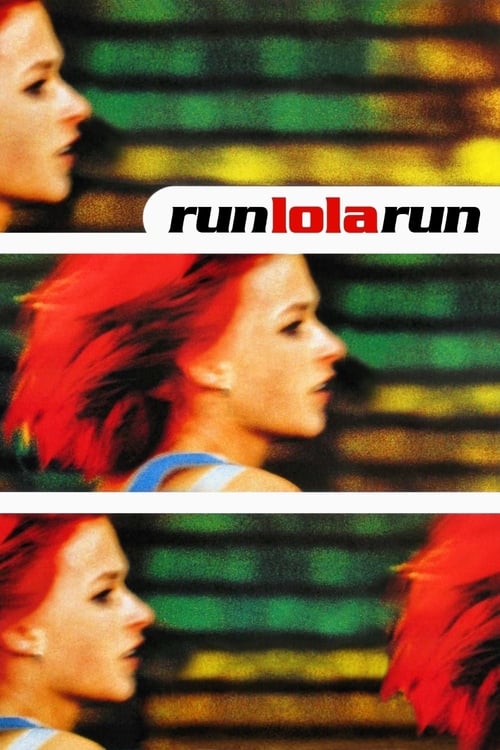
Run Lola Run
1998 · Tom Tykwer
When you want pure momentum — something short, loud, and electric for a night you can't sit still. Zero homework required, but it gives you the chance-and-fate stuff to argue about after.
What it's about
Lola's boyfriend Manni has lost 100,000 Deutschmarks belonging to a very dangerous man, and if she can't get the money to him across Berlin in twenty minutes, he'll rob a store and ruin both their lives. So she runs. The film plays her sprint three times, branching at tiny chance moments — a bumped shoulder, a missed stair — into wildly different outcomes.
The experience
An eighty-minute adrenaline shot: pounding techno, flame-red hair, streets blurring past, with a sly philosophical game about luck and fate running underneath the noise. It's exhilarating rather than stressful — you come out buzzing.
Performances
Franka Potente carries the film almost wordlessly through sheer physical commitment — her run is the performance, and it made her an international face overnight.
The craft
Tykwer throws the whole toolbox at the screen — animation, split screens, snap-fire photo montages that flash out minor characters' entire futures — all locked to a relentless techno score he co-wrote. The editing is the star: the same twenty minutes cut three ways, each variation changing the meaning of what you just saw. Loud speakers make it a different film.
Why it matters
It announced a confident new German cinema to the world, made Tom Tykwer an international name, and became the reference point for the run-it-again, forking-path thriller.
Snapshot
Run Lola Run (German title Lola rennt, literally "Lola Runs") is the film that made Tom Tykwer an international name and announced a confident, kinetic new German cinema to audiences who had largely written the country's film culture off since the waning of the New German Cinema. Built on a deceptively simple premise — a young woman has twenty minutes to find 100,000 Deutschmarks and save her boyfriend from a fatal mistake — it runs that premise three times, branching at small contingent moments into three radically different outcomes. The result is a roughly eighty-minute sprint, scored to a relentless techno pulse, that fuses the experimental conceit of the forking-path narrative with the surface energy of the music video and the logic of the video game. Franka Potente, her hair dyed a flaming red, became the decade's most recognizable image of cinematic velocity as Lola, tearing through a stylized Berlin in a single continuous propulsive motion. Beneath its breathless style the film is a serious meditation on chance, contingency, love, and the question of whether a life is determined or freely seized. Embraced at festivals and in arthouse release across the world, it remains both a pop-cultural touchstone and a frequently taught example of non-linear, "puzzle" storytelling.
Industry & production
Run Lola Run was produced by X-Filme Creative Pool, the Berlin company founded in 1994 by Tykwer together with directors Wolfgang Becker and Dani Levy and producer Stefan Arndt. X-Filme was conceived as a German answer to the auteur-driven independent model — a filmmaker-owned outfit pooling talent and risk — and Lola became its breakout success, the picture that validated the venture and helped set the terms for a commercially viable, stylistically ambitious German cinema in the years before Good Bye, Lenin! (another X-Filme production, directed by Becker) and The Lives of Others. Stefan Arndt produced; the financing, in the typical German pattern of the period, drew on public film-subsidy support and television co-production money (the public broadcasters being structurally central to German feature production).
The film was made on a modest budget — small by any international standard — and its formal inventiveness is in part a virtue made of economy: the repetition of the same compressed route, the use of animation and still-photo montage, and the propulsive cutting all extract maximum spectacle from limited means. Tykwer came to the project off two earlier features, the dark Die tödliche Maria (1993) and Winterschläfer (Wintersleep, 1997), the latter already a collaboration with cinematographer Frank Griebe and with Franka Potente. Lola consolidated this core creative team. Casting Potente as Lola and Moritz Bleibtreu as her panicked boyfriend Manni gave the film two young performers who would become leading figures of their generation of German actors; Potente in particular vaulted to international visibility, later cast in Hollywood productions including The Bourne Identity.
Technology
Run Lola Run is notable less for any single proprietary technology than for its omnivorous mixing of formats and media within one film. Live-action sequences were shot on 35mm, but Tykwer and Griebe deliberately deployed other textures to mark different orders of reality: portions of the film — broadly, the world that carries on around and apart from Lola — were rendered on video, its coarser, flatter look set against the saturated richness of the film stock that belongs to Lola's own trajectory. The film also incorporates hand-drawn animation (a cartoon Lola hurtling down the stairwell of her apartment building past a menacing dog), rapid-fire sequences of still photographs, and an aerial/overhead graphic sensibility that treats the city almost as a game board. This heterogeneity — celluloid, video, animation, photography, on-screen graphics and clocks — was part of the film's late-1990s moment, when digital intermediate workflows and non-linear editing were making such format-blending newly fluid, and it gives the picture a hybrid, restlessly self-aware visual surface. It would overstate the record to credit the film with a specific technical "first"; its achievement is one of synthesis rather than invention.
Technique
Cinematography
Frank Griebe's cinematography is organized around motion and saturated color. The dominant register is a high-key, hyper-vivid palette in which Lola's red hair, the red telephone of the opening, the red bag of money, and recurrent reds throughout function as a visual through-line and an emblem of urgency and danger. The camera is rarely still: Griebe tracks, races, and cranes with Lola, and the film alternates ground-level running shots with overhead and bird's-eye perspectives that abstract the city into pattern and route. Steadicam and tracking work sustain the impression of unbroken forward propulsion that is the film's signature sensation. Against this kinetic baseline, the film inserts pointed contrasts — the slow, intimate, red-bathed interludes in which Lola and Manni lie in bed and talk about love and death, shot in a wholly different, languid key that arrests the momentum and supplies the film's emotional ballast.
Editing
Editing, by Mathilde Bonnefoy, is the film's defining technique and the engine of its meaning. The cutting is fast, percussive, and frankly indebted to the music-video aesthetic of the 1990s, synchronized to the electronic score so that image and beat drive forward together. More structurally, the editing realizes the three-run architecture: the narrative resets twice, replaying the same twenty-minute window from the same starting gesture (Lola slamming down the phone and running) but diverging at micro-events whose consequences cascade into entirely different endings. Within each run, Bonnefoy threads the celebrated still-photograph montages — bursts of Polaroid-like snapshots that flash-forward the entire future fates of the incidental people Lola brushes past, comically and sometimes brutally altered from run to run. The editing thus does double duty: it generates visceral excitement and it articulates the film's central idea, that tiny variations in timing rewrite outcomes wholesale.
Mise-en-scène / staging
The staging treats Berlin as an abstracted, almost diagrammatic space — a course to be run rather than a documentary city. Tykwer is selective and stylized in his locations: the apartment stairwell, the bank where Lola's father works, the streets and bridges of the route, the supermarket, the casino. Recurring graphic motifs organize the mise-en-scène — spirals (the painted spiral of the stairwell, the spiral as an image of recurrence and vertigo), clocks and the relentless ticking countdown, and the color red. The compositions frequently emphasize Lola's body in full-stride motion against the urban background, and the film's design logic — the reset, the branching, the on-screen time pressure — borrows openly from the video game, casting Lola as a player-avatar attempting a level repeatedly until she "wins."
Sound
The soundtrack is inseparable from the film's identity. Tykwer co-composed the driving electronic/techno score with Johnny Klimek and Reinhold Heil, and the music is not accompaniment but motor — a continuous propulsive pulse that fuses with the editing to produce the sensation of running. Franka Potente herself contributes breathy, whispered vocals to the score (the recurring "I wish… I don't believe" refrains), folding the protagonist's interiority into the music. The sound design foregrounds the heartbeat-like rhythm, Lola's footfalls and breathing, the ringing telephone, and the ticking of clocks, all of which keep the countdown viscerally present. The score's prominence made the soundtrack a commercial property in its own right and was central to the film's reception as a piece of pop cinema.
Performance
Franka Potente's performance is largely physical and elemental: for much of the running time she is literally in motion, and she carries the film through sheer expended energy, conveying desperation, determination, and tenderness with limited dialogue. Her primal scream — Lola's literal cry that shatters glass and bends chance in her favor — is among the film's iconic gestures, a moment where performance crosses into the fantastical. Moritz Bleibtreu's Manni is the necessary counterweight: stationary, panicking, hapless, the fixed point of crisis toward which Lola hurtles. The two share the quiet bedroom interludes that give the film its surprising emotional depth, conversations about love and mortality that humanize the otherwise breathless mechanism. Supporting players, including Herbert Knaup as Lola's banker father, populate the branching world whose fates shift run to run.
Narrative & dramatic mode
The film's dramatic mode is the forking-path or multiple-draft narrative: a single situation replayed in variant versions, each diverging from a small contingent difference and resolving differently. This is the structuring principle of the whole picture. After a prologue framed by epigraphs — including lines from T. S. Eliot on exploration and arrival, and the German football aphorism "after the game is before the game" — the film presents Lola's twenty-minute race three times. In each, a marginal event (whether she trips on the stairs, how a moment of timing falls) sets a chain of consequences that determines who lives and who dies. The mode is at once suspense thriller (a literal ticking-clock race against time) and philosophical fable, using the repetition to make an argument rather than merely to entertain. Crucially, the runs are not framed as alternate universes the characters are unaware of so much as a demonstration laid before the viewer: the film foregrounds its own conditional, "what-if" logic, inviting the audience to read the differences and draw the lesson. The bedroom interludes between runs operate as lyrical caesuras, shifting register from kinetic to contemplative and supplying the love story that gives the formal game its stakes.
Genre & cycle
Run Lola Run sits at the intersection of several cycles. It is, on its surface, an action-thriller organized around a real-time countdown, but it belongs more tellingly to the late-1990s wave of "puzzle films" or non-linear narrative experiments that played games with time, causality, and repetition — a cluster that includes Sliding Doors (released the same year, with its own two-track contingency structure), and which scholars have discussed alongside the broader category of forking-path narratives. It also belongs to a German pop-cinema tendency of the period that fused arthouse ambition with the velocity and gloss of the music video and the structures of the video game. Its closest art-cinema antecedent in conceit is Krzysztof Kieślowski's Blind Chance (Przypadek, made 1981, released 1987), which likewise runs a protagonist's life down three divergent forks from a single missed-or-caught moment. Within the genre of the romance, too, Lola is a love story whose mechanism is the willingness to run, again and again, to save the beloved.
Authorship & method
The film is comprehensively a Tom Tykwer work: he wrote and directed it, and co-composed its score, making the synchronization of music and image a matter of single authorship to an unusual degree. Lola crystallizes the preoccupations that recur across Tykwer's career — chance and fate, the elasticity of time, love as a force that strains against contingency, and a fascination with formal systems and repetition (concerns he would pursue in later films including The Princess and the Warrior, again with Potente, Heaven, and his collaboration with the Wachowskis on Cloud Atlas). His method here is to subordinate every craft department to a unifying rhythmic conception: editing, score, camera, and color all serve the through-line of propulsive motion and the architecture of the three-run structure.
The key collaborators are central to the achievement. Cinematographer Frank Griebe, Tykwer's long-standing partner, supplied the saturated, motion-driven imagery; editor Mathilde Bonnefoy gave the film its percussive cutting and realized its branching form; composers Johnny Klimek and Reinhold Heil, working with Tykwer, produced the techno score that is arguably the film's co-author. Producer Stefan Arndt and the X-Filme collective provided the institutional frame that made so distinctive a film possible. Franka Potente's physical performance is the human medium through which the whole formal apparatus is felt.
Movement / national cinema
Run Lola Run is a landmark of post-reunification German cinema and the signal success of the X-Filme Creative Pool, the producer-director collective that did much to reanimate German feature production in the 1990s. Coming roughly two decades after the New German Cinema of Fassbinder, Herzog, and Wenders had faded as a coherent movement, Lola represented a different proposition: not the politically weighty, slow-burning art film of that earlier generation, but a fast, pop-inflected, internationally legible cinema confident in genre and style. It helped reposition German film as an export capable of reaching young global audiences, and it anticipated the commercial-critical successes that X-Filme and its milieu would go on to produce. As national cinema, it is also notable for its image of Berlin — a city in the throes of post-Wall transformation — rendered not as a site of historical mourning but as a vivid, abstracted playing field.
Era / period
The film is a precise artifact of the late 1990s: its electronic-dance soundtrack, its music-video editing grammar, and its video-game structural sensibility all locate it squarely in the turn-of-the-millennium pop-cultural moment, when techno culture and gaming were ascendant and digital tools were reshaping how films could be cut and composited. Its currency — the 100,000 figure is in Deutschmarks — fixes it just before the introduction of the euro, in the specific economic texture of late-1990s Germany. The Berlin it depicts is the reunified capital still in flux. The film's fascination with branching possibility and the rewriting of fate also resonates with a broader millennial mood of contingency and reinvention, and with a media culture increasingly organized around interactivity and the "replay."
Themes
The film's governing theme is chance versus determinism — whether outcomes are fixed or can be remade by will, timing, and tiny contingent differences. The three-run structure is an essay on the butterfly effect: minute variations (a fractional difference in when Lola passes a given point) cascade into wholly different lives and deaths, both for Lola and Manni and for the incidental strangers whose snapshot futures the film tracks. Bound up with this is the theme of time itself — its pressure, its compression, its potential reversibility — figured everywhere in clocks, countdowns, and the spiral. Love is the film's moral center: the bedroom dialogues ask what one would do for the beloved, and Lola's willingness to run again is the answer, making love the force that refuses to accept a determined outcome. The film also reflects on agency and persistence — the video-game logic of trying again until you succeed — and, more darkly, on the arbitrariness of fate, since the difference between catastrophe and salvation can turn on nothing more than a stumble on a staircase.
Reception, canon & influence
Run Lola Run was a critical and popular success at home and, unusually for a German film of its moment, a substantial international arthouse hit. It traveled the festival circuit to enthusiastic response — winning the Audience Award at the Sundance Film Festival in 1999, among other honors, and figuring prominently at the German film awards — and became a defining export of contemporary German cinema, widely distributed and discussed abroad. Critics responded to its energy, formal ingenuity, and the magnetism of Potente's performance; it became a regular reference point in writing on non-linear and "puzzle" narrative and a fixture of film-studies curricula.
Influences on the film run backward to several traditions: the multiple-fork conceit of Kieślowski's Blind Chance; the jump-cut energy and self-conscious play of the French New Wave (Godard above all) and the broader lineage of formally restless European art cinema; the late-twentieth-century music video, whose editing rhythms and pop-musical integration Lola absorbs wholesale; and the video game, whose reset-and-retry logic the film adopts as narrative structure. The epigraph from T. S. Eliot signals an explicit literary frame for its themes of departure and return.
Its influence forward has been broad. It became a touchstone for forking-path and alternate-timeline storytelling, frequently cited in discussions of later films and series built on replayed or branching time, from Sliding Doors' contemporaries through Source Code and a wider culture of "puzzle films." It helped legitimate music-video-derived editing and electronic scoring within feature filmmaking for a mainstream audience, and it stands as an emblem of how a small national-cinema production can achieve global pop-cultural reach through formal boldness. For its makers it was a launching point: Tom Tykwer to an international directing career, Franka Potente to Hollywood, and X-Filme to its run of subsequent successes. Within the canon, Run Lola Run endures as both a thrilling piece of pop cinema and a lucid, much-taught demonstration of narrative contingency — a film whose form is its argument.
A Deleuzian reading
You remember the stairwell first.
The full Deleuzian reading of Run Lola Run →
Reception
It exploded out of 1998 as Germany's coolest export in decades — a Sundance Audience Award winner and arthouse crossover smash — and it never really fell off: a 2024 25th-anniversary 4K rerelease confirmed its glow-up from MTV-generation sensation to certified 90s classic.
How Run Lola Run was received, from release to now →
Influences: the films it descends from and the films it influenced
- Blind Chance (1981) — The literal three-fork template: a single contingent instant (catching/missing a train) spins off three divergent runs of one life, exactly the multiple-draft architecture Tykwer replays from Lola's apartment door.
- The Double Life of Véronique (1991) — Builds narrative on doubling, chance correspondences, and recurring visual/musical motifs that rhyme across separate lives — the motif-echo grammar Lola uses across its three takes.
- Breathless (1960) — Establishes the jump cut as expressive rhythm rather than error — discontinuous, self-conscious cutting for propulsion that Bonnefoy's percussive editing inherits wholesale.
- La Jetée (1962) — Narration built almost entirely from still photographs — the direct precedent for Lola's snapshot flash-forward montages spelling out strangers' branching fates.
- Koyaanisqatsi (1982) — Cuts image directly to a driving minimalist-electronic score so that musical tempo dictates edit tempo — the score-as-editor method Tykwer pushes by co-composing the techno track himself.
- Wings of Desire (1987) — Maps Berlin as an expressive, traversable cinematic geography — the precedent for Lola's treatment of the city as a continuous game-board route to run across.
- Natural Born Killers (1994) — Extends NBK's multi-format strategy — intercutting 35mm, video and animation — with propulsive music-video editing as structural device.
- Three Colors: White (1994) — Tykwer's explicit transposition of Kieślowski's chance-architecture and object-triggered causality into kinetic form — the coin, the bag of money and the near-miss as plot engines — before he inherited the Kieślowski–Piesiewicz material outright.
- Go (1999) — Interlocking multiple-perspective replays of the same night set to a techno-club score with relentless kinetic cutting — Lola's structure and sonic palette transposed to L.A.
- Amélie (2001) — Hyper-saturated palette and accelerated montages of incidental lives and what-if contingency chains, extending Lola's whimsical cause-and-effect bookkeeping.
- The Princess and the Warrior (2000) — Tykwer's own Potente-Griebe-Klimek/Heil reunion, reworking chance, fate, and rhythmically engineered construction at a slower tempo as a deliberate companion piece.
- Source Code (2011) — Adopts the reset-and-retry video-game loop as narrative engine — re-running the same span repeatedly to learn from each attempt and alter the outcome.
- Edge of Tomorrow (2014) — Die-and-respawn game logic structured explicitly as level-grinding: each death reboots the run with accumulated knowledge, Lola's retry conceit weaponized.
- Mr. Nobody (2009) — Forking-path lives held in parallel from childhood choice-points, expanding Lola's three runs into a branching tree of mutually exclusive contingent futures.
- Cloud Atlas (2012) — Tykwer's fascination with formal systems and recurrence scaled up via match-cut editing that rhymes gesture and motif across six timelines.
- Crank (2006) — Relentless real-time kinetic camera and cutting bolted to a countdown, sustaining Lola's video-game momentum and ticking-clock propulsion across a whole feature.
- The World of Kanako (2014) — Music-video propulsion applied to narrative: relentless rhythmic cutting, on-screen graphics, and animation inserts that turn editing tempo itself into the film's argument — a percussive-cutting precursor.
- Good Bye, Lenin! (2003) — X Filme stablemate whose kinetic cross-cutting and splicing of mock-media (photo flurries, fabricated footage) into the narrative models the popular-auteurist montage Becker deploys for his fake newscasts.
- Slumdog Millionaire (2008) — Tykwer's breathless music-driven chase montage and chance-and-fate structuring of a single-goal sprint prefigure Slumdog's tempo and its destiny-rigged quiz framework.
- Survive Style 5+ (2004) — Music-video velocity, formal repetition and mixed-media inserts driving a story on pure kinetic design, a template for Survive Style's ad-tempo editing.
- Trainspotting (1996) — Pop/electronic-scored kinetic montage, freeze-frame character intros, and voiceover-driven youth energy — the same music-video-feature fusion arriving from the UK two years earlier.
- Sliding Doors (1998) — Contemporaneous branching-timeline construction spun from one missed/made connection, parallel-tracking two outcomes of a single contingent moment.
- Three Kings (1999) — Shared the era's music-video-derived formal aggression — stock-switching, freeze-frame asides, and essayistic intrusions into a genre frame.
- Lock, Stock and Two Smoking Barrels (1998) — Same-year exemplar of music-video kineticism — propulsive cross-cutting, freeze-frame stills and pop-rhythm editing driving a ticking-clock crime plot.
- Intacto (2001) — Treats probability and luck as the literal narrative engine, the turn-of-century reality-bending genre wave Intacto belongs to that makes chance a manipulable mechanic.
- The Man Who Copied (2003) — Shares the freeze-frame, animated-interpolation and propulsive-montage pop grammar, using formal play to compress a chase-for-money plot into breathless visual rhythm.
- Knockin' on Heaven's Door (1997) — The other signal work of 1990s German popular cinema engineered for export — genre energy plus a driving pop/techno soundtrack as its calling card, the same commercial formula on a different structure.
- Groundhog Day (1993) — Three passes over an identical twenty-minute route, with micro-changes in Lola's timing rippling into wholly different outcomes for background figures — the same 'butterfly bookkeeping' Ramis runs on the Punxsutawney bit players, staged as kinetic thriller rather than comedy.
Similar films
- Go (1999) — influence & lineage
- Amélie (2001) — influence & lineage · often watched together
- Breathless (1960) — influence & lineage · often watched together
- Trainspotting (1996) — influence & lineage · often watched together
- Bullet Ballet (1998) — often watched together
- Mulholland Drive (2001) — often watched together
- Victoria (2015) — shared sensibility
- Sirāt (2025) — shared sensibility
All the films related to Run Lola Run →