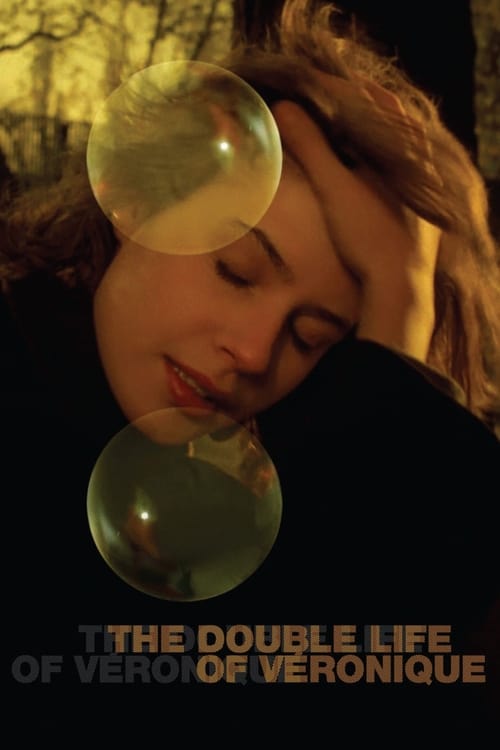
The Double Life of Véronique
1991 · Krzysztof Kieślowski
For when you want to be enchanted rather than told a story — a film for a quiet, open-hearted evening when mystery feels like a gift, not a frustration. Choose it when you want beauty you can't quite explain.
What it's about
Two young women who have never met share an identical face, the same radiant singing voice, and the same fragile heart: Weronika in Kraków, Véronique in France. Each dimly senses she is not alone in the world, and choices in one life seem to ripple, unexplained, into the other. In France, Véronique is drawn into a mysterious courtship with a puppeteer who seems to understand her secret better than she does.
The experience
Less a plot than a spell — it moves by intuition, music, and light, and it gets under your skin the way a half-remembered dream does. Melancholy and sensual at once, it asks you to feel your way through rather than figure it out.
Performances
Irène Jacob plays both women, and the miracle is how distinct they feel — the same face carrying two different souls — in a performance of extraordinary openness and warmth.
The craft
Krzysztof Kieślowski shoots the whole film through a warm amber-gold filter, so every frame glows like candlelight, and the soaring choral score is practically a lead character. Image and music carry the meaning; it's a film to watch on the best screen and speakers you have, with the lights off.
Why it matters
It introduced Kieślowski to a worldwide audience and became a touchstone for a whole strain of intuitive, music-driven art cinema — the bridge to his celebrated Three Colors films.
Snapshot
The Double Life of Véronique traces two young women — Weronika in Kraków, Véronique in Clermont-Ferrand — who share an identical face, an identical musical gift, and an inexplicable spiritual bond. When Weronika dies mid-performance from an undetected cardiac condition, Véronique feels the loss without knowing its source. The film proceeds less as conventional narrative than as a sustained meditation on intuition, duality, and the mysterious surplus of identity that escapes rational account. Shot in a saturated amber-gold palette through heavily filtered lenses, it works on sensation and mood rather than explanation, resisting any final decoding of its central mystery while sustaining an unusually intense emotional charge. A transitional work between Kieślowski's Dekalog (1988–89) and the Three Colors trilogy (1993–94), it marks his full passage from Polish national cinema into international art-cinema production and remains one of the defining films of European metaphysical cinema.
Industry & production
The Double Life of Véronique emerged from the intersection of Kieślowski's growing international reputation and a newly available route into French co-production. Following the critical success of Dekalog — which circulated internationally on the festival circuit and won prizes at Venice — French producers became interested in working with the director. The film was realized as a Franco-Polish co-production: the French side was anchored by producer Marin Karmitz and his company MK2, which had built an infrastructure for prestige European art cinema over the preceding decade; the Polish component involved Tor Film Studio in Warsaw, Kieślowski's long-standing institutional home.
The casting of Irène Jacob — a young French actress with limited screen credits at the time — in the dual lead was central to the project and carried obvious commercial risk. Jacob plays both women, a demand requiring sustained tonal distinction without recourse to obvious costume or behavioral exaggeration. The production shot on location in two blocks: Kraków for the Polish sequences, Clermont-Ferrand and Paris for the French ones. The two blocks were filmed consecutively rather than intercutting the schedule, allowing Jacob and the crew to inhabit each world separately before integration in the edit.
Kieślowski worked again with his longtime screenwriting partner Krzysztof Piesiewicz, though the script for Véronique is notably more elliptical than their shared work on Dekalog, deliberately leaving causation and metaphysics underdetermined on the page — trusting the film's visual and sonic languages to carry what dialogue and incident cannot.
Technology
The film's visual identity was created almost entirely through in-camera optical choices rather than post-production digital manipulation, which did not yet exist in accessible form. Cinematographer Sławomir Idziak, who had collaborated with Kieślowski on several Dekalog episodes and other Polish productions, developed a specific filtration approach to achieve the film's signature golden warmth: yellow and amber optical filters placed over the lens, combined with carefully managed practical and natural light sources pushed toward the warm end of their range. The resulting images carry a density and interiority that makes even exterior Kraków locations feel enclosed and jewel-like.
Idziak also employed distorting glass elements — most famously in the sequence in which Weronika views the world through a small glass marble, compressing and curving reality into a single spherical image. This is achieved practically, the camera filming through the actual marble rather than through any composite work. The tactility of this approach — the sense of genuine physical mediation between the lens and the world — contributes substantially to the film's phenomenological texture, its insistence that perception is always embodied and always partial.
Zbigniew Preisner's score was recorded with live orchestral forces, centered on a choral concerto attributed onscreen to "Van den Budenmayer," a fictional eighteenth-century Dutch composer Preisner had invented for earlier Kieślowski collaborations. The acoustic warmth of live recording, and the presence of real voices, reinforces the film's insistence on embodiment and physical sensation even in its most metaphysical passages.
Technique
Cinematography
Idziak's work on Véronique is among the most discussed cinematography of 1990s European art cinema. The amber-gold filtration operates as a metaphysical condition — suggesting that both women inhabit a world slightly removed from ordinary experience, luminous, heightened, slightly uncanny. This is not naturalist cinematography seeking transparency but an explicitly styled register in which the image's appearance is itself an argument.
Idziak works extensively with close-ups of faces and objects: eyes, hands, a piece of string, the marble, a translucent plastic bag pressed against glass. The camera repeatedly approaches surfaces as though seeking to penetrate them, mirroring the film's broader interrogation of whether one being can be sensed or touched by another across distance. Long telephoto focal lengths compress space and isolate figures from backgrounds, intensifying interiority and enclosure. Natural and practical light sources are exploited and sometimes pushed to the threshold of overexposure, particularly in the concert sequences where stage lighting and the effort of performance generate their own heat and urgency.
Editing
The film's editing — calibrated to contemplation rather than narrative momentum — extends scenes beyond the point a conventionally paced film would cut them; scenes breathe and linger at moments of ambiguous emotional content. The transition between the Polish and French halves of the film, which occurs at the moment of Weronika's death, is handled with a discretion that refuses to mark the crossing as a dramatic rupture. The film moves between its two worlds less as a break than as a modulation, sustaining the sense of continuity-beneath-difference that the premise requires.
The editing also refuses conventional shot-reverse-shot construction in many dialogue scenes, holding on Véronique's face while other characters speak, anchoring perception in her interiority rather than distributing attention evenly across the exchange. This strategy keeps the viewer anchored in phenomenological experience rather than in the exchange of information.
Mise-en-scène / staging
Kieślowski stages both women in environments that reflect their inner lives: Weronika in the dense baroque visual environment of Kraków — cobblestones, candlelight, old stone, choral rehearsal rooms — and Véronique in a slightly more open but no less hermetic domestic world in France. Neither space is rendered as realistic social milieu; both are filtered through a mood that suspends the social dimension to concentrate on the personal and the phenomenological.
The film's most celebrated staging is Weronika's death during a concert performance. She collapses mid-phrase, having given everything to the music; the audience — and the viewer — registers the physical collapse before fully understanding what has happened. The staging makes the body simultaneously the site of musical transcendence and mortal limit.
Alexandre Fabbri's puppet theater operates as a film-within-the-film: his marionettes double and mirror each other, literalizing the film's central metaphor in the register of theatrical artifice. Kieślowski uses this staging self-reflexively — the puppeteer's manipulation of controlled doubles comments obliquely on the director's own relationship to his material and his performers.
Sound
Preisner's score is not accompaniment but structural and thematic foundation. The Van den Budenmayer concerto recurs throughout, heard differently in different contexts: as aspiration in Weronika's rehearsals, as catastrophe in her fatal performance, as residue in Véronique's half-conscious musical sadness. The same material carries radically different emotional weight depending on context, embodying the film's argument that the same life can be lived and felt in more than one way.
Diegetic sound is treated with exceptional care throughout: the acoustic space of the Kraków concert hall, the close-intimacy of a bedroom at night, the rustling of materials through which clues are read. Kieślowski and his sound team create an unusually textured sonic environment that sustains the film's sensory density even in its quietest passages.
Performance
Irène Jacob's double performance is the film's greatest technical and expressive achievement. The two women share a face and a physical bearing but are differentiated through minute adjustments: Weronika more open, more nakedly feeling, more exposed to sensation; Véronique more guarded, more self-conscious as a subject experiencing her own experience. Jacob conveys this distinction without obvious behavioral marking — the difference is in degree of interiority, not in kind. Her work won the Best Actress prize at the 1991 Cannes Film Festival by consensus rather than controversy. Philippe Volter as Alexandre plays ambiguity with controlled precision: his puppeteer is manipulative and tender in equal measure, and the film allows both readings to coexist without resolution.
Narrative & dramatic mode
Véronique operates in the mode of the lyric essay rather than dramatic narrative. There is a plot — two women, one story, one death, one romance — but the film's interest is not in the mechanics of plot but in the quality of consciousness that surrounds events. The causal chain between Weronika's death and Véronique's sadness is asserted by sensation rather than explained by logic; the viewer is invited to feel the connection before, or instead of, understanding it.
The film withholds the meeting between its two protagonists. Véronique glimpses Weronika only in a blurred photograph from Kraków — a photograph she does not know depicts her double. This structural absence, the non-meeting that might have resolved everything, is the engine of the film's existential unease. Kieślowski does not allegorize or moralize the double: the film resists reducing Weronika and Véronique to an argument about fate, free will, or spiritual survival. Their relationship remains irreducibly mysterious, available to multiple interpretations — secular, metaphysical, psychoanalytic — without settling into any of them.
Genre & cycle
The film belongs to a European art-cinema cycle of metaphysical drama running from Bergman through Tarkovsky and into the 1990s: films interested in spiritual or phenomenological experience that cannot be accommodated by realism or genre convention. It also participates in a specific cycle of double and doppelgänger films that gained renewed traction in the late 1980s and 1990s, as European cinema revisited Romantic anxieties about singular identity in a period of geopolitical transformation.
Within Kieślowski's own filmography it represents the fullest articulation of a method latent in Dekalog: the use of adjacency and coincidence to probe causation the film deliberately refuses to explain. The Three Colors trilogy would extend and vary this method across different generic registers — tragedy, comedy, romance — with greater international production resources behind it.
Authorship & method
Kieślowski began his career as a documentary filmmaker in Poland, and the observational quality of his eye — the attention to gesture, face, and the texture of ordinary life — persists in his fiction. By Véronique, however, he had moved decisively away from any residual social-realist framework; the film's interest is not in documenting conditions but in pursuing states of being that elude documentation entirely.
His collaboration with Piesiewicz produced scripts structured around gaps and absences that the film's visual and sonic languages must fill without closing. This method assumes a viewer willing to engage with the work as experience rather than as puzzle to be solved.
Preisner's music is not illustrative but constitutive: Kieślowski and Preisner worked in close dialogue, with music sometimes preceding image in the creative process. The Van den Budenmayer concerto was developed in parallel with the script and the shoot rather than composed to fit already-edited scenes, making the score a co-author of the film's emotional and thematic architecture rather than an addition to it. Idziak's filtration approach was agreed with Kieślowski as the visual equivalent of the film's metaphysical proposition: to see as these women see is already to see differently.
Movement / national cinema
Véronique occupies a threshold position in both Polish and French cinema. Kieślowski belongs to the generation of Polish directors associated with the Kino moralnego niepokoju — the Cinema of Moral Anxiety — filmmakers including Agnieszka Holland and Feliks Falk who in the 1970s and 1980s used cinema to interrogate the moral conditions of life under late socialism. Kieślowski's documentary work and early features participated in this tradition, attending carefully to individual conscience under systemic pressure.
By Véronique, that specific social context has largely receded. The Polish section is set in a moment of transition — Kraków is rendered as a timeless baroque city rather than a late-socialist one — and the film's concerns are metaphysical rather than political. Véronique thus marks Kieślowski's departure from a nationally specific cinema toward a pan-European or universalist one, a transition Dekalog had begun to suggest but not yet completed.
The French section participates in the tradition of intimate French art cinema centered on bourgeois interiority, though Kieślowski imports a Polish heaviness and spiritual weight into registers French directors of the period rarely attempted. The co-production structure was itself a signal of the increasing integration of European art-cinema financing in the post-Cold War moment.
Era / period
The film was shot in 1990 and released in 1991, at the immediate aftermath of the Eastern Bloc's collapse. The political transformations that had ended Polish communism in 1989 are not directly addressed but form the invisible backdrop to a film about two women in two countries who cannot quite find each other. The new ease of movement between East and West — and the simultaneous anxiety about what would fill the vacuum left by the old certainties — hovers at the margins of the film's metaphysical preoccupations without being thematized.
European co-production was entering a period of expansion in the early 1990s, driven partly by policy frameworks including the MEDIA Programme and partly by the greater cultural fluidity of the post-Cold War landscape. Véronique was an early and unusually successful instance of this model: a film that spoke to French, Polish, and broader international art-cinema audiences without diluting the particularity of its vision into the generic middle ground that European co-productions sometimes inhabited.
Themes
The film's central preoccupation is the mystery of individual identity — whether the self is singular, bounded, and mortal, or whether it might in some sense exceed its biological container and persist in or through another. Weronika's death and Véronique's inexplicable mourning pose this question without answering it; the film's formal structure (two stories, one actress, one emotional throughline) enacts the same uncertainty at the level of cinema itself.
Intuition and pre-rational knowledge are affirmed as modes of access to reality unavailable to cognition. Véronique acts on feelings she cannot explain — pulling back from the full commitment to singing that Weronika gave and paid for — in ways the film treats as wisdom rather than failure. The body knows before the mind articulates.
Music serves as the film's privileged mode of transcendence and connection: both women are singers, both feel the Van den Budenmayer concerto as something larger than themselves, and music is the medium through which their shared existence becomes perceptible even across death. Art here is not a metaphor for experience but its densest and most dangerous form.
The manipulation of persons — by fate, by art, by love — is explored through the figure of the puppeteer. Alexandre's control of his marionettes rhymes uneasily with his management of Véronique; the film asks whether there is a meaningful difference between being the object of another's creative attention and being the instrument of their will.
Reception, canon & influence
Critical reception. The film premiered at the 1991 Cannes Film Festival, where it won the FIPRESCI Prize and the Best Actress award for Irène Jacob. Critical response was strong but not unanimous: some reviewers found the film's deliberate obscurity frustrating, its metaphysics too diffuse to sustain. Others, particularly in France and in specialist art-cinema circles, responded to it as a major work. Over the following decades the film's reputation has grown substantially — it is now widely regarded as one of the essential films of the 1990s and a cornerstone of the post-Bergman European metaphysical tradition. Digital restorations have allowed the precision of Idziak's color work to be seen with renewed clarity, widening its audience across successive generations.
Influences on the film (backward). Ingmar Bergman's attention to female psychology, interiority, and the uncanny double — most explicitly Persona (1966), in which two women's identities blur and merge — is the most consistently cited precedent. Andrei Tarkovsky's treatment of spiritual experience in material terms, his conviction that metaphysical states require sensory rather than conceptual rendering, shares Kieślowski's fundamental assumption. Robert Bresson's economy and his trust in the expressive power of the unexplained are legible in Kieślowski's restrained management of emotion. Within Polish cinema, the moral seriousness of the Kino moralnego niepokoju generation persists, rerouted through a fiction no longer anchored in social specificity.
Legacy (forward). The Three Colors trilogy (Blue, White, Red, 1993–94) extends Véronique's formal and thematic experiments at larger scale: Blue in particular, with its grieving musician protagonist and the same Preisner-scored musical architecture, reads as a direct elaboration of this film's central concerns, grief as a form of double bereavement for a life simultaneously lost and unlived. Preisner's practice of embedding fictional composer credits within his own scores became a minor point of influence in subsequent film music practice.
More broadly, the film's willingness to hold metaphysical mystery open — to refuse the explanatory closure that genre and much art cinema demands — made it a touchstone for filmmakers interested in what cinema can do that other narrative forms cannot: render, rather than argue, the felt presence of something irreducible in human experience. Tom Tykwer has cited Kieślowski as a primary influence; his interest in fate, coincidence, and the structuring of emotional experience through music carries clear lines of descent from this film. The treatment of female intuition and embodied sensation as epistemically serious modes of knowing — not as irrationality to be overcome but as legitimate access to reality — was influential in a broader shift in European art cinema toward films centered on subjective feminine experience that would mark the decade's second half.
A Deleuzian reading
A young woman on a train lifts a clear glass marble to her eye, and the gray Polish town tips over inside it — curved, gold, entire, swimming in a drop of glass she can hold in her palm but never walk into.
The full Deleuzian reading of The Double Life of Véronique →
Reception
It premiered at Cannes 1991 to real acclaim — Irène Jacob won Best Actress and it took the FIPRESCI prize — but some critics found its mysticism opaque, and rights issues kept it out of circulation in the US for years; the 2006 Criterion release turned it from hard-to-see legend into a fully canonized favorite.
How The Double Life of Véronique was received, from release to now →
Influences: the films it descends from and the films it influenced
- Persona (1966) — Bergman's sustained rhyming of two faces in extreme close-up — establishing psychological doubling through restraint rather than theatrical exaggeration — provides the performance architecture Kieślowski inherits for Irène Jacob's differentiated dual-role execution, where spiritual twinning registers in micro-expression rather than costume or gesture.
- Vertigo (1958) — Hitchcock's long telephoto lenses framing Scottie observing Madeleine across charged distances — making surveillance a subjective emotional register rather than neutral observation — directly informs Idziak's telephoto-isolation system, while the doppelganger logic of one woman substituting for another lost woman structures Véronique's entire withheld-meeting architecture.
- Mirror (1975) — Tarkovsky's non-causal lyric-essay structure — in which Artemyev's score accumulates meaning alongside image through association rather than narrative logic, trusting duration and texture over incident — is the formal precedent for Véronique's sustained refusal of causal explanation and its conviction that Preisner's choral passages can carry what dialogue and plot cannot.
- Hiroshima mon amour (1959) — Resnais and Duras's model of a film organized by a woman's interior state rather than external causation — constitutive voiceover and Georges Delerue's score creating subjective reality rather than illustrating it — establishes the lyric-essay mode Kieślowski adapts, particularly the principle that grief and involuntary memory can function as a film's structural spine without narrative justification.
- The Conformist (1970) — Vittorio Storaro's amber-and-gold cinematography — warm practical sources pushed toward the threshold of overexposure, treating color as a register of psychological and moral temperature rather than period accuracy — establishes the visual premise that Idziak systematizes into his amber optical-filtration protocol for Véronique.
- L'Eclisse (1962) — Antonioni's seven-minute closing sequence — the arranged meeting that never happens, the frame waiting as the city continues indifferently — defines the withheld meeting as a formal device capable of bearing a film's full emotional weight without resolution, a structural principle Kieślowski absorbs directly into Véronique's architecture of perpetually deferred connection.
- Dekalog (1988) — The fictional eighteenth-century Dutch composer Van den Budenmayer — invented by Preisner for earlier Dekalog episodes and deployed as a recurring leitmotif — is imported wholesale into Véronique, where the on-screen attribution of the choral concerto to this invented figure is a narrative device test-driven here; Idziak's optical filtration language was also developed across the episodes he shot for the series.
- Decalogue I (1989) — The cycle's success consolidated the Kieślowski–Piesiewicz–Preisner unit, whose golden reflective filtering, glass-mediated doubling and Preisner's choral hymnal score carry the Decalogue sensibility into international co-production.
- A Short Film About Killing (1988) — Sławomir Idziak carries forward his saturated green-gold filtration, vignetting and obstructed foreground framing as an authorial cinematographic signature born on this film.
- A Short Film About Love (1988) — Extends the doubling, chance, and metaphysical-connection motifs with Preisner's score and Piesiewicz's writing continuing the same workshop into the international period.
- Three Colors: Blue (1993) — Preisner's score for Julie's unfinished concerto functions as a narrative agent — its involuntary intrusions into the acoustic space measuring grief the protagonist refuses to acknowledge — while Juliette Binoche's anchored-interiority performance directly extends Irène Jacob's technique of channeling emotional content through micro-expression and bodily stillness rather than dramatic gesture.
- Three Colors: Red (1994) — Red deploys Véronique's withheld-meeting as its organizing formal logic — Valentine and the retired judge share the film's space across a structurally deferred connection that is never completed within the film's world — while retaining the amber-gold filtration palette, Preisner's leitmotif structure, and the contemplative pace that refuses conventional dramatic acceleration.
- Portrait of a Lady on Fire (2019) — Claire Mathon's all-practical amber-and-firelight cinematography — no artificial bounce, achieving the same jewel-like enclosure as Idziak's filtration — and Sciamma's withheld-meeting structure, culminating in a concert scene where Héloïse is glimpsed in the audience and a held gaze becomes all that remains of a shared life, directly extend Véronique's formal vocabulary of luminous interiority and deferred connection.
- Twinless (2025) — Two identical women bound across a distance, shot in a saturated-yet-muted register, originates the 'two bodies, one soul' doubling motif Twinless secularizes into twinhood and grief.
- Miroirs No. 3 (2025) — Demonstrates a doppelgänger built structurally on a piano score and pervasive mirror/glass refractions, the exact fusion of musical scaffolding and doubling imagery Petzold borrows from Ravel.
- Gattaca (1997) — Slawomir Idziak's amber-green optical filtration — glass filters placed before the lens rather than in post — is the direct technical precedent for Gattaca's warm sepia palette; Niccol hired Idziak specifically to repurpose this method for a different ideological end, coding the genetic elite's world in the register of faded photographs.
- Chungking Express (1994) — Kieślowski's bifurcated narrative—two self-contained episodes where the first generates an emotional undertow the second carries without resolving—is the formal template for Wong's two-cop structure, where the second story's warmth is tonally shaped by the first's melancholy.
- Run Lola Run (1998) — Builds narrative on doubling, chance correspondences, and recurring visual/musical motifs that rhyme across separate lives — the motif-echo grammar Lola uses across its three takes.
- Petite Maman (2021) — The uncanny doubling of a single performer across two lives, with an unexplained emotional connection passing between them treated as felt fact, not puzzle to be solved.
- Soulmate (2023) — Two women rendered as uncanny doubles linked across distance, with talismanic objects and a golden-amber palette externalizing a shared interior life.
- Love Letter (1995) — Has one actress embody two uncanny doubles who never fully meet, shot by Sławomir Idziak in filtered, golden, overexposed diffusion — the exact fusion of the-double motif with light-drunk diffused photography that defines Iwai and Shinoda's look.
- I Origins (2014) — The two-women-one-soul diptych with a hard structural break, plus Sławomir Idziak's method of shooting through refractive objects and filters so that coincidence registers optically as evidence rather than as plot contrivance — Cahill's whole premise that recurrence can be photographed descends from this.
- In the Mood for Love (2000) — Christopher Doyle and Mark Lee Ping-bin's warm amber cinematography — tungsten-balanced stock, slow-motion exposure, practical Chinese lanterns pushed to overexposure — and Shigeru Umebayashi's 'Yumeji's Theme' deployed as a constitutive leitmotif rather than atmospheric underscore both directly parallel Idziak's filtration system and Preisner's score architecture, achieving the same jewel-like enclosure of interiority.
- Mulholland Drive (2001) — Lynch extends the doppelganger-film's structural grammar — two women sharing a face across an identity that is revealed as fractured rather than doubled — while the Club Silencio sequence, in which a singer collapses mid-performance as her detached voice continues, is a precise structural rhyme to Weronika's concert death; Badalamenti's score functions constitutively throughout, as Preisner's does, generating the film's emotional climate rather than accompanying it.
- Certified Copy (2010) — Kiarostami's withheld-identity architecture — never resolving whether James and Elle are strangers or long-married, sustaining the ambiguity as the film's permanent formal condition — extends Véronique's lyric-essay principle that withholding factual resolution generates greater philosophical resonance than disclosure, applying it to the doppelganger problem of who two people actually are to each other.
- The Tree of Life (2011) — Malick applies Véronique's lyric-essay mode to mortality and spiritual continuity — whispered voiceover and Tavener/Desplat score organized by emotional association rather than causation — treating cinema as a medium for approaching metaphysical questions (what survives of a person; what connects the living and the dead) without resolving them, extending the formal precedent Kieślowski established.
- Carol (2015) — Edward Lachman shot on Super 16mm with warm Kodachrome-emulating color science and systematically composed through glass — rain-blurred car windows, restaurant panes — to achieve telephoto-style isolation of women observed from an emotionally loaded distance, a technique structurally identical to Idziak's amber optical filtration and long-lens approach, with observation-through-glass functioning as the same metaphor for impossible intimacy.
- Nostalgia (1983) — Kieślowski's amber-gold chromatic filter partitions Polish Véronique from French Véronika in a register shift directly analogous to Nostalgia's warm Russian / cool Italian chromatic-duality; Zbigniew Preisner's compositions, attributed to the fictional Van den Budenmayer, function as found-classical-score within a lyric structure that withholds causal explanation in exactly Tarkovsky's manner.
- The Belly of an Architect (1987) — Sibling in continental art cinema using doubling, the copy-and-original motif and a saturated painterly palette to dramatize permanence versus the perishable self.
- Europa Europa (1990) — Zbigniew Preisner's mournful, liturgical scoring idiom — the same composer-method lending lyrical unease and moral weight that scores Holland's film.
- Decalogue V (1989) — Idziak elaborates the same in-camera hand-filter and vignetting method into a golden-green haze, proving the Dekalog V palette a signature technique rather than a one-off, again paired with a Preisner score.
Similar films
- Three Colors: Blue (1993) — influence & lineage
- Three Colors: Red (1994) — influence & lineage
- Mirror (1975) — influence & lineage
- Portrait of a Lady on Fire (2019) — influence & lineage
- Certified Copy (2010) — influence & lineage
- Belle de Jour (1967) — shared sensibility
- Mother Joan of the Angels (1961) — shared sensibility
- Amélie (2001) — shared sensibility
All the films related to The Double Life of Véronique →