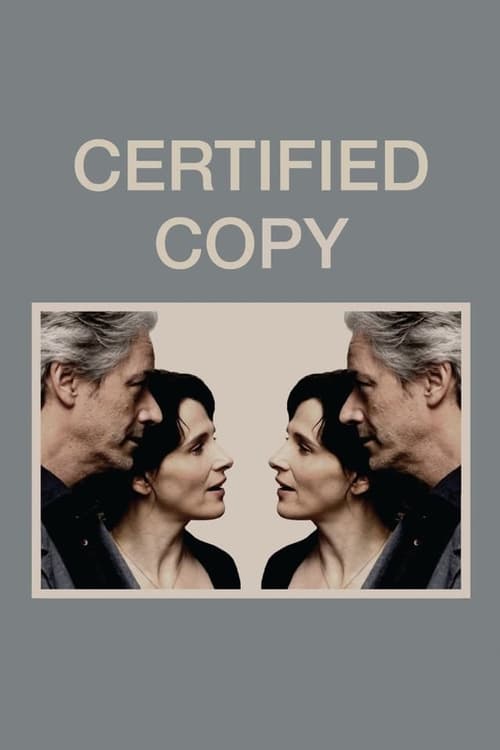
Certified Copy
2010 · Abbas Kiarostami
For when you want a film to chew on for days — ideally with someone to argue about it with afterward. It's a gentle watch on the surface, but it asks you to lean in; save it for an attentive evening, not a tired one.
What it's about
An English writer visits Tuscany to promote his book arguing that a good copy can be as valuable as an original. A French antiques dealer takes him on a drive to the hill town of Lucignano, and what starts as a polite intellectual sparring match between strangers slowly turns into something far more intimate and harder to pin down — a portrait of a marriage that may or may not exist.
The experience
It feels like eavesdropping on the most charged conversation of your life: talky, sun-drenched, and quietly destabilizing. The ground keeps shifting under you — playful one minute, wounding the next — and the ambiguity is the pleasure, not a puzzle to be solved.
Performances
Juliette Binoche is astonishing — funny, furious, and heartbroken by turns, sometimes within a single shot — in a performance that won her Best Actress at Cannes. Opera singer William Shimell, in his first film role, matches her with a reserve that keeps you guessing.
The craft
Abbas Kiarostami builds the whole film from long two-person scenes, mirrors, windows, and faces addressing the camera almost directly, so you're constantly implicated in the couple's push and pull. It's deceptively simple filmmaking of total precision — every reflection and framing choice is doing quiet work.
Why it matters
Kiarostami's first fiction feature made outside Iran proved his art traveled anywhere, and it's become a modern touchstone for films about couples talking their way toward the truth of a relationship.
Snapshot
Certified Copy (Copie conforme) is Abbas Kiarostami's first fiction feature directed outside Iran, a two-hander set across a single afternoon in Tuscany. An English writer, James Miller (William Shimell), in Italy to promote a book arguing that a good copy can be worth more than its original, meets an unnamed French antiques dealer (Juliette Binoche) who drives him to the medieval hill town of Lucignano. Roughly midway, a café owner mistakes them for a married couple; rather than correct her, the woman plays along, and from that moment the two behave as spouses of fifteen years — bickering, wounded, intimate — with no diegetic signal as to whether they are strangers improvising or a long-married pair re-enacting their estrangement. The film converts the conceit of its title into its own form: a relationship that may be a "certified copy" of a marriage, or the real thing, indistinguishable on the surface. It earned Binoche the Best Actress prize at the 2010 Cannes Film Festival and is widely regarded as one of Kiarostami's major late works and a key European art film of its decade.
Industry & production
The film was a European art-cinema production, produced by Marin Karmitz's MK2 — Kiarostami's long-standing French distributor-producer — as a France–Italy–Belgium co-production (with reported Iranian creative participation). Shooting took place on location in Tuscany, principally in and around Lucignano and Arezzo, using real streets, cafés, churches, and a hotel rather than constructed sets. Casting was central to the project's identity: Binoche, who had worked toward a collaboration with Kiarostami for years and to whom the director was personally close, anchors the film as its only professional screen star. Opposite her, Kiarostami cast the British opera baritone William Shimell — a singer Binoche had performed alongside in a staging of Mozart's Così fan tutte directed by Kiarostami — in his feature acting debut, a deliberately untrained, slightly stiff presence set against Binoche's volatility. The decision to make a polyglot film moving fluidly among English, French, and Italian reflects both the location and the international art-house market the picture was built for. It premiered in competition at Cannes in May 2010 and circulated through festival and specialty distribution rather than wide release; precise budget and box-office figures are not something I can confirm and should not be invented here.
Technology
The film is photographed in a classical, "transparent" register rather than a showy one, and presents as a 35mm production in look and texture — the warm, fine-grained image and naturalistic Tuscan light read as photochemical capture handled by a cinematographer steeped in celluloid. This marks a notable shift from the lo-fi digital experiments of Kiarostami's immediately preceding Iranian films (Ten, Shirin), which were built around small digital cameras. Here the technological choices serve a more conventional, polished European art-film surface. The most distinctive technical motif is optical rather than digital: the recurring use of glass — windshields, mirrors, shop windows — as a built-in surface for reflection and superimposition, so that the Tuscan townscape and the actors' faces layer over one another within a single take without any post-production compositing.
Technique
Cinematography
The cinematography is by the Italian Luca Bigazzi, a master of the contemporary Italian image best known for his work with Paolo Sorrentino. Bigazzi gives the film an unforced naturalism — available light, real interiors, a restrained palette of stone, ochre, and green — that grounds the increasingly metaphysical drama in tactile place. Two strategies stand out. First, the car sequence early in the film revives Kiarostami's signature automotive cinema (the talking-heads-in-transit of Taste of Cherry and Ten), with the camera fixed on the passengers while the village slides across the windshield as a moving reflection, folding landscape and conversation into one frame. Second, Bigazzi and Kiarostami repeatedly stage dialogue with characters addressing the lens nearly head-on, the camera occupying the place of the listener, so that the viewer is implicated in the exchange and made to study faces directly. A celebrated passage has Binoche's character at a mirror, applying earrings and lipstick before the imagined "anniversary," the reflective surface doubling her image precisely as the film doubles her identity.
Editing
The film was edited by Bahman Kiarostami, the director's son. The cutting is patient and long-take-oriented, trusting scenes to play out in extended duration so that the tonal hinge — the shift from strangers to spouses — can occur without an explicit cut or marker. The structure is best understood as a Möbius strip or a single continuous slide: there is no flashback, no dream device, no editorial "tell" to adjudicate which version of the relationship is true. The editing's refusal to resolve the ambiguity is itself the central authorial decision, leaving the transformation to accumulate scene by scene through performance and staging rather than montage.
Mise-en-scène / staging
Mise-en-scène carries the film's argument. The action moves through a sequence of charged Tuscan settings — a book talk, a car, a café, a piazza with a wedding party, a museum, a restaurant, a church, and finally a hotel room said to be the one where the couple spent their wedding night. Two staged artworks anchor the theme: a museum's prized "original" that the woman explains is in fact a celebrated copy, and the medieval fresco tradition of Lucignano associated with marriage and fidelity, which the film visits as newlyweds pose nearby. Kiarostami also places observers and surrogate couples throughout — the café owner, an older French couple the woman consults on the street, the bride and groom in the square — turning the town into a gallery of mirrors for the central pair. The hotel room finale, with church bells outside the open window, leaves the couple (and the viewer) suspended in the unresolved question.
Sound
The soundtrack is conspicuously spare: Certified Copy eschews a conventional non-diegetic score almost entirely, relying instead on ambient sound — footsteps on stone, café chatter, traffic, church bells, the rumble of the car — to sustain its realism. This near-absence of scoring throws the weight of the film onto the spoken word and onto silence, and it sharpens the multilingual texture of the dialogue, where the slippage between English, French, and Italian itself dramatizes how meaning is translated, mistaken, and performed. The decision to end on the toll of bells rather than a musical cue is characteristic of the film's restraint.
Performance
Performance is the film's engine, and Binoche's was honored with the Best Actress award at Cannes. Her work is a study in modulation: warmth, irritation, longing, and grief surface and recede, and crucially she must play a woman who is herself possibly performing a marriage — acting an act — without ever letting the audience settle on which layer is "real." Shimell, untrained as a screen actor, supplies a deliberately contrasting reserve; his slightly opaque, withholding James reads alternately as an aloof intellectual stranger and as an exhausted, emotionally absent husband, and the gap between the two performers' registers becomes thematically productive rather than a flaw. The film's emotional crescendos belong to Binoche.
Narrative & dramatic mode
The dramatic mode is realist conversation turned metaphysical puzzle. For its first half the film presents as a recognizable European art-cinema "walk-and-talk" — two articulate strangers debating art, originality, and authenticity. The café scene then ruptures the contract: once the woman accepts the stranger's misreading of them as a couple, the film proceeds as though they always were one, accumulating a shared past (a son, old grievances, a wedding night) that the first half explicitly contradicted. Kiarostami offers no reconciling frame. The viewer is left to choose among readings — that they are strangers improvising a marriage; that they are a real couple who began the day performing as strangers; that the question is meaningless because a convincing copy of intimacy is intimacy. This is a continuation of Kiarostami's career-long erosion of the boundary between fiction and reality, here relocated from the documentary-adjacent games of Close-Up into the interior of a relationship.
Genre & cycle
Nominally a drama and romance, the film sits within the talky two-hander relationship picture while bending the genre toward the philosophical. It belongs to a recognizable lineage of "couple adrift in Italy / Europe over one day" films and invites comparison with Richard Linklater's Before films as a real-time anatomy of a relationship through conversation — though Kiarostami's version is far more destabilizing, since the very status of the couple is in doubt. Within Kiarostami's own filmography it forms a late, outward-facing cycle with his subsequent foreign-language feature Like Someone in Love (2012), shot in Japan: two films in which the director exports his preoccupations — performance, identity, the unreliable surface of human relations — into non-Iranian settings and languages.
Authorship & method
The film is unmistakably Kiarostami's despite its new setting. His recurring methods are all present: the car as a mobile theater for dialogue; faces addressed near-frontally to the camera; the systematic blurring of the authentic and the staged; and a refusal of narrative closure that hands interpretation to the spectator. What is new is the apparatus around him — a French-Italian art-cinema infrastructure, international stars, and a polyglot script — which he absorbs without surrendering his sensibility. Key collaborators shape the result: cinematographer Luca Bigazzi lends the Tuscan light its naturalism; editor Bahman Kiarostami sustains the long-take rhythm that makes the tonal hinge possible; and on the page Kiarostami is credited as writer, building the screenplay around the conceit of his title. The casting of Juliette Binoche (muse and anchor) and the opera singer William Shimell (recruited from Kiarostami's own staging of Così fan tutte) is itself an authorial gesture, importing the theme of performance from the lyric stage into the cast list. The film carries no conventional composer, by design.
Movement / national cinema
Kiarostami was the central international figure of the Iranian New Wave, the movement (alongside Mohsen Makhmalbaf, Jafar Panahi, and others) that brought Iranian cinema to global prominence from the late 1980s onward, distinguished by location shooting, non-professional actors, child protagonists, and a self-reflexive play between documentary and fiction. Certified Copy is the moment that lineage goes transnational: it is at once an Iranian auteur's film and a European co-production made in the idiom of festival art cinema, with Italian and French craft (Bigazzi, MK2) and stars. It thus straddles two cinematic worlds — the Iranian New Wave's epistemological games and the European tradition of the intellectual relationship drama.
Era / period
Made in 2010, the film belongs to a moment of mature globalized art cinema in which established auteurs increasingly worked across borders, languages, and co-production financing. It arrived late in Kiarostami's career — he had won the Palme d'Or for Taste of Cherry in 1997 and spent the 2000s on formally radical, often digital experiments (Ten, Five, Shirin) — and represents a turn back toward a more classical, star-driven narrative cinema, executed on the international stage. It would prove one of his last completed fiction features before his death in 2016.
Themes
The governing theme is authenticity versus reproduction — the question, posed by James's book and dramatized by the couple, of whether a copy can hold the value, meaning, or truth of an original. The film extends this from art (the museum "original" that is a copy; the Lucignano frescoes) to human relationships: if two strangers can perfectly perform a marriage, and a real marriage is itself sustained by performance and habit, where does the "real" relationship reside? Bound up with this are the performativity of intimacy, the labor and disappointment of long partnership, miscommunication and translation (literalized by the three languages), memory and its unreliability, and the gap between how men and women experience the same shared life. The recurring motifs of mirrors, glass, and reflections make the theme visible: the film is full of doubled and copied images of its own characters.
Reception, canon & influence
Critical reception was strong and admiring, if marked by productive disagreement over how to "solve" the film's central ambiguity — a debate the film actively courts. Binoche's Best Actress win at Cannes 2010 was the headline honor, and the picture was broadly received as a return to major form for Kiarostami and as one of the most intellectually ambitious romances of its era; it has since featured in critical reckonings of the best films of the 2010s, though I won't attribute specific poll placements without the record in front of me.
Its influences run backward most clearly to Roberto Rossellini's Viaggio in Italia (Journey to Italy, 1954) — the foundational portrait of a couple's marriage disintegrating and obscurely reconstituting as they travel through Italy, with its own museum and ruins as mirrors — and the film is frequently read as a deliberate descendant of that work. Behind it also stand the European traditions of the marital chamber drama (the Bergman of Scenes from a Marriage) and the dialogue-driven examination of love, as well as Kiarostami's own Close-Up and Koker films, from which the fiction/reality games are inherited. Looking forward, its most direct legacy is internal: it opened the late, transnational phase that continued with Like Someone in Love (2012). More broadly it stands as a touchstone for the contemporary "philosophical relationship film," and its central device — a couple whose status the film deliberately refuses to fix — remains a reference point for filmmakers and critics interested in how cinema can stage ambiguity as content rather than withhold it as mere mystery.
A Deleuzian reading
Start with the windshield.
The full Deleuzian reading of Certified Copy →
Reception
It split Cannes in 2010 — some critics called the premise a gimmick, others a late-career masterpiece — but it has since climbed steadily into the canon, now routinely cited among the best films of the 21st century.
How Certified Copy was received, from release to now →
Influences: the films it descends from and the films it influenced
- Journey to Italy (1954) — Supplies the exact armature Kiarostami rebuilds — a couple's marriage dissolving and obscurely reknitting as they drive through Italy, using museums, ruins, and excavated relics as objective correlatives for the relationship's state.
- Last Year at Marienbad (1961) — Establishes ambiguity-as-content rather than withheld mystery: a couple whose shared past the film flatly refuses to confirm or deny, the formal precedent for Certified Copy's are-they-married Möbius.
- Close-Up (1990) — Kiarostami's own foundational fiction/reality game, where staged re-enactment and authentic event become indistinguishable — the engine later transplanted into the 'original vs. copy' marital performance.
- Scenes from a Marriage (1973) — The chamber-drama method of anatomizing a marriage through sustained two-hander dialogue scenes, the verbal-combat register Certified Copy adopts once the pair start behaving as a long-wed couple.
- Persona (1966) — Two figures whose identities and relationship destabilize and bleed into each other, foregrounding performativity over fixed character — the instability Binoche and Shimell enact across the film's hinge.
- L'Avventura (1960) — Treats Italian landscape and architecture as externalized psychic space and builds narrative around a deliberately unresolved relational void, modeling the unanswered-question structure.
- Hiroshima mon amour (1959) — Multilingual lovers reconstructing memory and identity through performed dialogue, the polyglot performed-intimacy template behind the film's French/English/Italian register-shifting.
- My Night at Maud's (1969) — The dialogue-driven philosophical examination of love, where extended talk between two people — not plot — is the cinema, a direct precedent for the two-hander's intellectual texture.
- Taste of Cherry (1997) — Pioneers the car as a mobile theater for sustained near-frontal dialogue, with dashboard framing and direct-address eyelines reused throughout Certified Copy's driving sequences.
- Three Colors: Red (1994) — Develops doppelgänger architecture through performance rather than parallel editing — two characters who slip into a prior relationship's roles — while adopting Red's threshold-blocking staging and stillness-and-close-up performance grammar in a European tourist setting.
- Wild Strawberries (1957) — Kiarostami extended Wild Strawberries' car-as-crucible format — physical travel as the pressure vessel for a couple's ambiguous interior investigation — into a film where the couple's shared past is itself uncertain, reactivating the Rossellini–Bergman road-film-as-psychological-excavation template.
- Nostalgia (1983) — Kiarostami consciously situates this Tuscan film within the post-Rossellini, post-Tarkovsky tradition of northern-European-meets-Italian space as metaphysical ordeal: Binoche and Shimell's cross-cultural casting, acoustic bilingualism across French, Italian, and English, and withholding performance that refuses to confirm the relationship's ontological status directly extend Nostalgia's craft vocabulary into a reflexive key.
- Like Someone in Love (2012) — The immediate continuation of his transnational late phase: car-bound dialogue, an abruptly unresolved ending, and characters who assume false relational roles (grandfather/client) that the film never fixes.
- Before Midnight (2013) — Turns the walk-and-talk two-hander into marital combat across real-time long takes, dramatizing intimacy as something continuously performed and stress-tested — Certified Copy's second half extended to feature length.
- 45 Years (2015) — Quietly destabilizes a marriage's foundation and closes on a single deliberately unreadable gesture, staging ambiguity as the emotional payload rather than resolving it.
- Rental Family (2025) — Stages two strangers performing a marriage that bleeds into felt truth, the performed-vs-authentic-emotion ambiguity Rental Family turns into its central device.
- Clouds of Sils Maria (2014) — Binoche in a two-hander built on the same refusal — a relationship that may be enacted or lived, held in long sustained two-shots and car interiors, with the reveal permanently withheld so that ambiguity becomes the film's structure rather than its twist.
- Ten (2002) — Pushes automotive cinema to a formal system — conversations staged entirely inside a moving car via fixed dashboard cameras — the technique Bigazzi adapts for the Tuscan drives.
- Before Sunset (2004) — The contemporary real-time walk-and-talk two-hander built from long takes, where a relationship's truth emerges only through continuous ambulatory conversation.
- The Trip (2010) — Two performers driving a scenic foodscape with their real selves and performed personae deliberately blurred, improvised dialogue as the film's entire substance — the same authenticity-vs-performance play.
- Kontinental '25 (2025) — Shares the device of sustaining a feature-length moral-philosophical argument through two-person walking-and-talking dialogue, where the conversation itself is the dramatic event.
- The Double Life of Véronique (1991) — Kiarostami's withheld-identity architecture — never resolving whether James and Elle are strangers or long-married, sustaining the ambiguity as the film's permanent formal condition — extends Véronique's lyric-essay principle that withholding factual resolution generates greater philosophical resonance than disclosure, applying it to the doppelganger problem of who two people actually are to each other.
- Toni Erdmann (2016) — Long-take conversational cinema with available light investigates whether a relationship is performed or real; performance-vs-authenticity is simultaneously the film's explicit subject and its formal method, mirroring Toni Erdmann's structural preoccupation at both levels.
- Before Sunrise (1995) — A man and woman walk and talk through a Tuscan town as their relationship mutates in real time, extending the Rohmer-Linklater conversational two-hander into shifting, ambiguous role-play.
- Winter Sleep (2014) — Carries a couple's real-time argument almost entirely on dialogue and stage-actor performance, testing how much drama sustained talk alone can hold.
- Trenque Lauquen (2023) — Kiarostami's mid-film ontological switch, where the register silently reclassifies without warning, is the same genre-molting maneuver Trenque Lauquen performs sliding from procedural to romance to near-sci-fi.
- Little French Fish (2020) — A walking, talking two-hander whose whole relationship is performed in ambiguous present tense across a neutral European town.
- Materialists (2025) — Kiarostami builds a two-hander that literalizes the question of a relationship's 'value' and authenticity through sustained conversation, the same interrogation of love as appraised object Materialists conducts.
- Through the Olive Trees (1995) — Carries the cinema-and-reality inquiry abroad — the couple's status as real or performed stays deliberately unresolved, the same reflexive ambiguity as Olive Trees' film-within-a-film.
Similar films
- Close-Up (1990) — influence & lineage · same viewing thread
- Taste of Cherry (1997) — influence & lineage · same viewing thread
- Journey to Italy (1954) — influence & lineage · often watched together
- Like Someone in Love (2012) — influence & lineage
- Last Year at Marienbad (1961) — influence & lineage
- Through the Olive Trees (1995) — same viewing thread
- The Wind Will Carry Us (1999) — same viewing thread
- Life, and Nothing More… (1992) — same viewing thread
All the films related to Certified Copy →
Watch it with: curated runs of related films
- Where Fiction Meets the Real — Watch these in sequence for the way each lets a staged fiction quietly dissolve into something documentary-real — and the real get restaged as fiction — usually while someone is on a road or a walk.