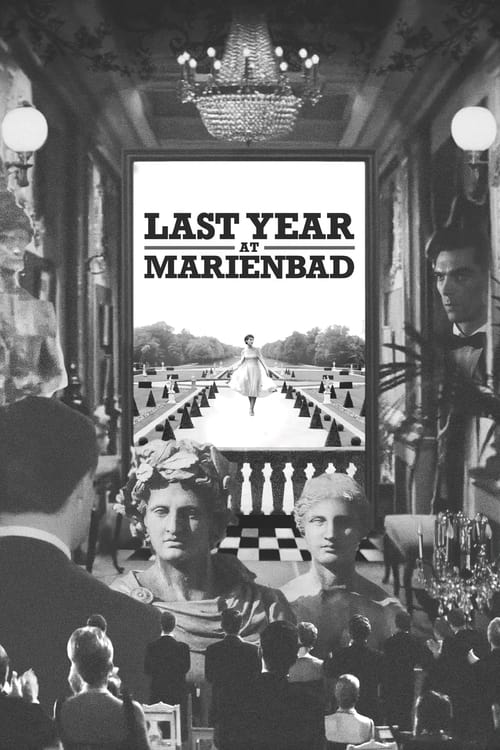
Last Year at Marienbad
1961 · Alain Resnais
For when you want a puzzle with no answer key — a late-night, lights-off film to surrender to rather than solve. Firmly on the challenge end of the scale; if you need plots to click shut, save it for a more adventurous evening.
What it's about
In the endless corridors and formal gardens of a vast baroque resort hotel, a man approaches an elegant woman with a claim: they met here last year, and she made him a promise. She remembers nothing and insists he's inventing it — yet the more he describes, the more persuasive he becomes. Around them, guests play cards and drift through mirrored salons while the film circles the one question it refuses to settle: did any of it happen?
The experience
Hypnotic and dreamlike — less a story you follow than a spell you fall into. Gliding camera moves, repeated phrases, and scrambled time create something between a ghost story and a waking dream; it's cool to the touch, gorgeous, and deliberately unresolvable.
The craft
Resnais builds the film from long, prowling tracking shots through marble hallways, an incantatory voice-over, and editing that shuffles past, present, and maybe-never with total confidence. The production design and formal gardens — figures casting shadows where statues cast none — produce some of the most famous images in French cinema. It's a film of surfaces and geometry that genuinely rewards the biggest screen you can find.
Why it matters
One of the most argued-about films ever released, it blew open what film narrative was allowed to do and became a permanent reference point for filmmakers, fashion, and music video imagery alike.
Snapshot
A man known only as X addresses a woman known only as A in the corridors, salons, and formal gardens of an enormous baroque hotel-resort. He insists they met there the previous year, that they made a promise, that something decisive passed between them. A does not remember — or refuses to. The film offers no arbitration. Through ninety-four minutes of hypnotic tracking shots, fractured time, and an insistent voice-over that narrates events the images may or may not confirm, Last Year at Marienbad dismantles the foundations of cinematic storytelling: causality, chronology, and the reliability of memory itself. It remains one of the most radically unresolved films in the canon — a puzzle constructed to refuse solution.
Industry & production
The film was produced as a Franco-Italian co-production under a consortium of companies including Argos Films, Terra Film, Précitel, Como Films, and Cineriz, with Pierre Courau and Raymond Froment among its principal producers. Argos Films, the Paris-based independent, had previously backed Resnais's Hiroshima Mon Amour (1959) and was developing a reputation as the institutional home for French cinema's most formally ambitious work.
The genesis was unusual. Alain Robbe-Grillet, by 1960 the central theorist and practitioner of the nouveau roman literary movement, wrote an original screenplay — not an adaptation of a prior work — and brought it to Resnais. Their collaboration was productive but not unified: Resnais and Robbe-Grillet reportedly held fundamentally different interpretations of the material. Robbe-Grillet emphasized the film's commitment to a purely present-tense, surface-level reality — the events of "last year" simply do not exist, since only the present moment of narration exists on screen. Resnais was more inclined toward a psychological reading, in which the images represent the subjective, shifting, internally contradictory workings of memory and desire. Both framings are defensible from the finished film, which is part of its lasting critical richness.
Principal photography took place largely at a cluster of Bavarian baroque palaces, primarily the Nymphenburg Palace complex (including the Amalienburg pavilion) and the Munich Residenz, supplemented by the Schleissheim Palace. The grand formal gardens, rigidly geometrical in the French baroque style, provided the film's most iconic exterior imagery. The choice to shoot in West Germany rather than France gave the production a slightly displaced, stateless quality consistent with the film's refusal to anchor itself in recognizable geography.
Coco Chanel, near the end of her career, designed Delphine Seyrig's costumes — a production credit that underscores both the film's aspirations to a certain haute-couture elegance and its investment in Seyrig's physical and sartorial presence as a visual system unto itself.
Technology
Last Year at Marienbad was shot in CinemaScope, the anamorphic widescreen format with an aspect ratio of approximately 2.35:1, in black and white. The choice of widescreen is formally significant: it allows Resnais and cinematographer Sacha Vierny to place figures at extreme horizontal distances within the frame, isolating them within vast architectural and landscape spaces. The elongated frame amplifies the cold grandeur of the baroque interiors, turning corridors and salons into near-abstract geometric compositions.
The film predates the widespread adoption of lightweight, hand-held cameras associated with the concurrent Nouvelle Vague (Godard and Coutard were already using Éclair cameras for their agile, improvisational shooting on Paris streets). Marienbad instead uses a fluid studio and location crane-and-dolly technique, with the camera mounted for elaborate, controlled movement. This is technically demanding filmmaking, requiring precise coordination between camera movement, actor blocking, and focal depth — the antithesis of the jump-cut spontaneity being practiced simultaneously a few kilometers away in Paris.
Technique
Cinematography
Sacha Vierny, who had worked as a camera operator on earlier Resnais projects, served as director of photography. His work here is defining: long, slow tracking shots that glide through ornate corridors without ever establishing a stable spatial anchor; deep-focus compositions that render both foreground architectural detail and distant figures with equal sharpness; and a tonal palette of extreme contrasts between black velvet drape and white plaster ornament.
The most remarked-upon visual anomaly in the film involves the geometry of shadows. In the garden sequences, the topiary and statues cast long, raking shadows consistent with a specific sun angle — but the human figures frequently cast no shadows at all, or cast shadows at angles inconsistent with the surrounding environment. This discontinuity is almost certainly deliberate, one of several strategies by which the film signals that the image cannot be taken as straightforward photographic record.
Editing
Henri Colpi, who had edited Hiroshima Mon Amour and whose own directorial debut Une aussi longue absence would win the Palme d'Or at Cannes in 1961, co-edited the film with Jasmine Chasney. The editing is the film's most disorienting formal instrument. Cuts do not respect temporal continuity: A may appear in a white gown, then a black gown, within a sequence that otherwise seems continuous. Scenes recur in variant form — the same interaction staged differently, with a different outcome, without the film marking these repetitions as flashback or correction. The "present" and "last year" are not distinguished by any conventional signal (color temperature shift, soft focus, title card). Instead, they coexist in a perpetual, unreliable present, creating what Gilles Deleuze, writing in Cinema 2: The Time-Image (1985), would identify as a defining instance of the "crystal-image," in which past and present become indiscernible.
Mise-en-scène / staging
The staging is theatrical and ceremonial in a way that reads as deliberately anti-naturalistic. Figures often freeze mid-gesture; groups in the salons stand in rigid, almost sculptural arrangements, suggesting tableau vivant rather than social gathering. The tracking shot — the signature spatial mode — functions as a form of incessant, restless inquiry: the camera moves as if searching, but the search never resolves into discovery.
The baroque architecture is not mere backdrop but structural argument. The formal garden, with its rigid geometry of gravel paths, cone-shaped topiary, and stone balustrades, provides a spatial correlative for the film's thematic territory: a world organized by rigid formal convention beneath which something ungovernable — desire, memory, the past — presses from below.
Sound
Francis Seyrig — the brother of lead actress Delphine Seyrig — composed the score, which relies heavily on baroque pipe organ. The music is often overwhelming in its emotional insistence, flooding sequences with grandiose melodic weight that stands in deliberate tension with the coolness of the images. Resnais and Seyrig also make extensive use of sound bridges — music or ambient sound continuing across image cuts that would otherwise register as hard temporal breaks, suturing together what the editing has fractured.
X's voice-over narration is omnipresent and unreliable: it describes events that the images confirm, events the images contradict, and events the images decline to render at all. The narration is written in the cadences of Robbe-Grillet's nouveau roman prose — precise, phenomenological, obsessively descriptive — yet the precision becomes a form of dizzying uncertainty.
Performance
Delphine Seyrig as A delivers one of the most formally extraordinary performances in European art cinema. The role requires stillness, passivity, and sudden flashes of terror or compliance, often with minimal psychological motivation supplied by the script. Seyrig navigates this through physical precision and a quality of sustained internal reserve that the camera finds endlessly legible. Giorgio Albertazzi as X performs with the relentless, low-affect insistence of someone narrating rather than living. Sacha Pitoëff as M (the possible husband or guardian) brings an almost caricaturally angular physical presence, and is associated throughout with a mathematical card game — a Nim-like match game — which he invariably wins, a detail that generates considerable symbolic freight.
The performances are often described as "Brechtian" in their distance from psychological naturalism, though this framing can oversimplify what is more accurately a mode of performance calibrated to an entirely different conception of screen character.
Narrative & dramatic mode
The film's narrative mode is radically associative rather than causal. There is no plot in the Aristotelian sense — no sequence of events connected by causation moving toward resolution. What the film has instead is insistence: X's verbal and physical repetition of a claim about the past, A's variable responses (denial, ambiguity, eventual apparent compliance), and the tension between them. Whether the events of "last year" occurred, whether M is A's husband, whether A ultimately leaves with X — these questions are posed and then withheld. The film's final image is of A and X departing together, but even this cannot be taken as resolution, since the temporal status of every image in the film has already been destabilized.
Robbe-Grillet's theoretical position — that cinema should attend only to what is visible in the present, refusing the psychological depths and backstory of the classical novel and classical film — finds here its most rigorous screen realization.
Genre & cycle
Marienbad belongs to no genre in the conventional sense, though it has strong structural affinities with the romantic melodrama (two figures, a disputed shared past, the possibility of reunion or departure) and the gothic (the sealed world of the grand hotel, the sinister possible-husband, the woman in apparent captivity). It is most accurately placed within the cycle of European modernist art cinema that emerged in the late 1950s and early 1960s alongside Antonioni's L'Avventura (1960) and La Notte (1961), Bergman's late-1950s trilogy, and Godard's first features. These films share an investment in radical narrative indeterminacy, the representation of psychological interiority through formal means, and the critique of classical plot as a falsification of lived experience.
Authorship & method
Alain Resnais by 1961 had established himself through his short documentary work (including Nuit et Brouillard, 1956, and Toute la Mémoire du Monde, 1956) and the feature Hiroshima Mon Amour as a filmmaker whose primary obsession was time, memory, and the impossibility of full historical recovery. His method consistently involved collaboration with distinguished literary writers — Marguerite Duras wrote Hiroshima, Robbe-Grillet wrote Marienbad, Jorge Semprún later wrote La Guerre est finie — but Resnais maintained strong auteurist control over the formal dimensions of each film.
Alain Robbe-Grillet, the film's screenwriter, was among the major French writers of the postwar period. His novels (Les Gommes, Le Voyeur, La Jalousie) had theorized and demonstrated a fiction stripped of interiority and symbolism, attending only to describable surfaces. He later became a filmmaker in his own right (Trans-Europ-Express, 1966), and his retrospective writings on Marienbad make clear that he regarded the film as a rigorous extension of nouveau roman principles.
Sacha Vierny (cinematographer) went on to become one of the essential figures in European art cinema, shooting Chris Marker's La Jetée (1962) and subsequently forming a long creative partnership with Peter Greenaway (The Draughtsman's Contract, Prospero's Books, and others).
Francis Seyrig (composer) left a relatively small body of work; the Marienbad score remains his most discussed contribution.
Henri Colpi (editor) brought to the project an exceptional understanding of the temporal possibilities of montage, developed through his work with Resnais on Hiroshima.
Movement / national cinema
Resnais is consistently placed within what has been called the Rive Gauche (Left Bank) tendency in French cinema — distinct from the Nouvelle Vague proper (Godard, Truffaut, Chabrol, Rohmer, Rivette), though roughly contemporaneous with it. Where the Nouvelle Vague was largely shaped by Cahiers du Cinéma criticism, American genre cinema, and a freewheeling improvisational energy, the Rive Gauche group — Resnais, Chris Marker, Agnès Varda — was older, more invested in literary and documentary traditions, and more given to formal austerity and political-philosophical seriousness. Marienbad is the Rive Gauche's most internationally prominent film, and arguably its defining formal statement.
Era / period
The film arrives at the precise moment when European art cinema achieved its greatest international critical prestige and institutional support. The same period produced Antonioni's trilogy (1960–62), Bergman's Through a Glass Darkly (1961) and Winter Light (1963), Buñuel's Viridiana (1961), and Godard's Vivre sa vie (1962). The international co-production model, festival circuit (Venice, Cannes, Berlin), and the global expansion of art-house cinema infrastructure made this concentrated burst of radical formal experimentation economically viable.
Themes
Time and memory are the film's inescapable territory — specifically the question of whether memory constitutes or merely represents the past, and whether desire can construct a past that was never lived. The film is also concerned with power: X's relentless narration is a form of coercion, a verbal act that attempts to determine A's reality, and A's position — beautiful, passive, possibly imprisoned within a loveless or threatening relationship with M — has been read through a feminist optic as an allegory of masculine narrative authority asserting itself over female subjectivity. The architectural environment, with its baroque rigidity and enclosure, functions as a figure for social convention that forecloses interiority. The formal garden, in particular, has been read as a figure for the film's own formal organization: exquisitely ordered on the surface, concealing something ungovernable beneath.
Reception, canon & influence
Last Year at Marienbad won the Golden Lion at the Venice Film Festival in 1961, the highest international validation available to it. Critical reception was divided from the outset: French critics associated with Cahiers du Cinéma and Positif largely celebrated it, while Anglophone critical responses were more mixed, with some influential American critics finding it pretentious or merely obscure. Pauline Kael was notably hostile; Andrew Sarris gave it more measured attention within his auteurist framework. Over time the critical consensus has shifted decisively toward the film as one of the indispensable works of postwar cinema.
Influences on the film: The shadow of Alfred Hitchcock's Vertigo (1958) — in its obsessive male protagonist, its construction of woman as desired image, and its investment in scenic architecture — is discernible, though the influence is structural rather than specific. Jean Cocteau's dreamlike baroque spaces (Beauty and the Beast, Orpheus) inform the visual logic of the film. Resnais's own prior work on memory and historical time, particularly Hiroshima Mon Amour, establishes the thematic and formal vocabulary that Marienbad radicalizes. Marcel Proust's theorization of involuntary memory and the temporal instability of the past provides an obvious literary analog, though whether this constitutes direct influence or shared intellectual milieu is hard to specify.
Legacy and forward influence: Marienbad's influence is vast and ramifying, and tracking it requires some care not to confuse general formal tendencies with specific debts. Chris Marker's La Jetée (1962), shot immediately afterward by Vierny and equally preoccupied with unstable memory and a past that may be invented, is the most immediate descendant, though it is its own independent work. Peter Greenaway's grid-like architectural compositions and his interest in narrative as a formal system rather than a vehicle for psychology are inconceivable without Marienbad. David Lynch's later work — Lost Highway (1997), Mulholland Drive (2001) — deploys a closely related structure of insistent male narration, uncertain female identity, and a past that cannot be verified. Nicolas Roeg's temporal fragmentation in Don't Look Now (1973) draws on the same modernist repertoire.
Within film theory, Deleuze's analysis of the film as a crystalline time-image in Cinema 2 (1985) gave Marienbad a central position in post-1968 theoretical discourse and secured its place as a philosophical as well as aesthetic document. It remains a standard text in graduate film studies and a touchstone for any discussion of narrative time, cinematic modernism, or the politics of representation.
A Deleuzian reading
Stand in the garden.
The full Deleuzian reading of Last Year at Marienbad →
Reception
It won the Golden Lion at Venice in 1961 while splitting critics down the middle — hailed as a masterpiece by some, dismissed as chic emptiness by others (Pauline Kael famously wasn't buying it). Today it's untouchable art-cinema canon, a fixture of greatest-films polls.
How Last Year at Marienbad was received, from release to now →
Influences: the films it descends from and the films it influenced
- Hiroshima Mon Amour (1959) — Resnais and editor Henri Colpi first develop the unreliable voiceover-image dialectic here: a woman's narrated memory is systematically undercut by images that refuse to confirm it, and Colpi's cutting between present Hiroshima and wartime Nevers without conventional flashback markers establishes the editing grammar Marienbad radicalizes into total temporal indeterminacy.
- La Belle et la Bête (1946) — Cocteau and cinematographer Henri Alekan originate the tracking shot through a corridor whose architecture is itself animate — human arms hold candelabras from the walls, velvet drapes breathe — instructing performers into slow, frozen, anti-naturalist movement that anticipates Marienbad's tableau-vivant passages where figures hold poses as the camera glides past them.
- Letter from an Unknown Woman (1948) — Ophüls and cinematographer Franz Planer develop the unhurried crane-and-dolly movement through ornate European stairwells and ballrooms as the formal expression of obsessive, unrequited memory — the specific vocabulary of fluid architectural tracking through Viennese interiors that Sacha Vierny inherits and applies to the baroque corridors of the Bavarian palaces.
- Lola Montès (1955) — Ophüls shoots in CinemaScope, using the wide frame to isolate a single woman within an elaborate theatrical spectacle as the passive object of competing narrative claims — the anti-naturalist register of performance-within-display, figure dwarfed by architectural and scenic excess, that Seyrig's posture and costuming directly extend.
- Citizen Kane (1941) — Gregg Toland's extreme deep-focus photography — small apertures, composite printing — establishes the razor-sharp fore-to-background depth of field that keeps both ornamental foreground detail and figures at the back of the frame in simultaneous focus; Vierny's compositions in Marienbad's interior salons are technically unthinkable without this precedent.
- Nuit et brouillard (1955) — Resnais tracks the camera slowly through the empty architectural spaces of Auschwitz, treating the corridor and dormitory as a trace of events the image cannot confirm — the structural method of the tracking shot as an investigation of what a space might have witnessed, which becomes the governing formal principle of Marienbad's hotel rooms and gardens.
- L'Avventura (1960) — Antonioni deploys CinemaScope to strand figures at extreme horizontal distances within architectural and island landscape — a woman disappears and her disappearance is never explained — staging radical narrative indeterminacy and anti-naturalist performance at precisely the same historical moment as Marienbad, the two films representing parallel discoveries rather than influence.
- Rashomon (1950) — Resnais adopted Rashomon's formal argument that memory constructs competing, irreconcilable versions of a shared past event and made it the visual grammar of the film itself — repeated sequences showing the same moment in contradictory versions, the editing refusing to arbitrate, extending Rashomon's epistemological uncertainty from narrative structure into moment-to-moment image.
- Wild Strawberries (1957) — Resnais pushed Wild Strawberries' Strindbergian dream-tribunal staging — protagonist confronted by witnesses to an unverifiable past in a formally austere space — to its logical extreme, collapsing the distinction between remembered and present-tense action entirely.
- The Lady from Shanghai (1947) — Resnais extends the hall-of-mirrors formal logic into a complete narrative structure: the château's mirror-lined corridors literalize an epistemology in which identity, memory, and event cannot be distinguished from their reflections, expanding Lady from Shanghai's terminal image into the film's entire method.
- Orpheus (1950) — Inherits the mirror-and-corridor dream architecture and dislocated, non-linear time as an art-cinema language of the threshold.
- Portrait of Jennie (1948) — Pushes Jennie's elliptical construction to its limit — an incantatory spoken prologue, lyric repetition of shots and lines with small variations, and depopulated formal gardens where a woman's existence is never adjudicated.
- L'Immortelle (1963) — Robbe-Grillet's directorial debut transplants the Marienbad scenario intact — a man pursues a woman through a foreign city, their possible prior encounter is structurally undecidable — and formalizes the looping temporal structure through matched-on-action cuts that land in different times without any transition signal, applying to Istanbul the method he co-invented with Resnais.
- Je t'aime, je t'aime (1968) — Resnais formalizes Marienbad's temporal loop as explicit diegetic device: the protagonist is trapped replaying a single past minute with uncontrolled variants, and the editing makes each repetition slightly different without marking which, if any, is definitive — transposing the crystal-image structure of Marienbad into a science-fiction premise where the indeterminacy has a machine cause.
- Muriel, ou le Temps d'un retour (1963) — Resnais and editor Kenout Peltier extend Marienbad's editing strategy of spatial-temporal discontinuity: cuts between shots at mismatched eyelines, without establishing shots, fragment the present Boulogne domestic space into irreconcilable shards, applying the same refusal to anchor time and place — but here to guilt over the Algerian War rather than erotic memory.
- India Song (1975) — Duras inverts Marienbad's voiceover structure: voices on the soundtrack discuss a past event while performers in the image move in slow, frozen tableau entirely unanchored to what the voices describe — radicalizing the image-sound dialectic Resnais established, so that the voiceover generates images rather than narrating them, and neither register confirms the other.
- The Mirror (1975) — Tarkovsky and cinematographer Georgy Rerberg use long, gliding tracking shots through remembered domestic spaces where past and present coexist within the same continuous take without conventional temporal marking — a formal syntax of the tracking shot as memory-terrain that is directly traceable to Resnais's method, extended here to the involuntary, multi-generational memory of the Soviet intelligentsia.
- 2001: A Space Odyssey (1968) — Kubrick stages the finale in a white Louis XVI room furnished with baroque antiques that have no narrative explanation, with a figure who ages discontinuously across cuts without any conventional temporal signal — a direct citation of Marienbad's baroque hotel-space and its temporal indeterminacy, transplanted from memory to the threshold of transcendence.
- The Shining (1980) — Kubrick deploys Garrett Brown's Steadicam as the mechanized descendant of Marienbad's dolly to pursue a small figure through the Overlook's ornate baroque corridors; Jack's photographic appearance in a 1921 ballroom photograph reproduces Marienbad's central temporal loop — the same person occurring at irreconcilable times within the same architectural space, with the hotel itself functioning as Robbe-Grillet's purely present-tense anti-memory.
- Mulholland Drive (2001) — Lynch bifurcates the narrative into two temporal registers — dreamed desire and waking failure — that cannot be reconciled and offer no key to adjudicate between them; the central female protagonist inhabits scenarios she may be remembering, imagining, or dying through, extending Marienbad's structural refusal to arbitrate between competing versions of a scenario involving a woman and her captor.
- 8½ (1963) — Resnais dissolved any stable boundary between experienced, imagined, and remembered by stripping dissolves and iris wipes entirely; Fellini absorbed this license to make fantasy and present cinematographically indistinguishable in 8½, warming the formal radicalism with autobiographical content.
- Belle de Jour (1967) — Vierny's cinematography here — uniform lighting and lens treatment across sequences of irresolvably different ontological status — gives Buñuel the technical proof-of-concept that refusing optical distinctions between memory, fantasy, and reality produces durable ambiguity rather than mere confusion.
- 2046 (2004) — Elliptical editing that returns to the same gestures and spaces without confirming their ontological status — memory, fantasy, or fact — established the formal license for 2046's accumulation structure, in which scenes approach from oblique angles and dissolve before resolution.
- Crash (1996) — The anti-cathartic editing that refuses climax-release cycles and the accretion structure of non-escalating inquiry — Crash's refusal to organize experience into conventional dramatic arc — descends from Resnais's model of time-suspended, unresolved observation in which scenes end without emotional discharge.
- Persona (1966) — Bergman and Sven Nykvist adopt anti-naturalist performance registers — one character almost entirely silent, the other speaking into a void — to stage an identity-dissolution whose governing event remains structurally undecidable; the rupture of the film's material surface mid-reel literalizes the same crisis of cinematic reality-claim that Marienbad performs through its shadow discontinuities.
- La Jetée (1962) — Same Argos/Dauman house style of frozen, statuary tableaux and a circular, self-cancelling memory architecture in which the ending re-describes the beginning.
- The Exterminating Angel (1962) — Contemporary film sharing the formal device of deliberate narrative repetition and circular time structure, both films withholding resolution and deploying repetition as an instrument that destabilizes causal logic rather than advances it.
- La Notte (1961) — Both films deploy elliptical temporal structure through architectural spaces — hotel, villa — that have absorbed emotional history; where Resnais fragments time through montage, Antonioni fragments it through the held take, but both treat the modernist built environment as a space where past and present are spatially indistinguishable.
- Othello (1951) — Resnais uses location architecture — Baroque palace rooms and formal gardens — as the spatial externalization of an epistemological contest over retrospective memory, structuring the film as mutual uncertainty about what really happened: converging on Othello's narrative/epistemological-tragedy method through similar formal means.
- Point Blank (1967) — Boorman lifts Resnais's strategy of cutting on uncertain memory — repeated, contradictory fragments and unstable temporal returns to the same image — so Walker's revenge plays as a possibly-imagined loop rather than linear chronology.
- Gertrud (1964) — Frieze-frozen tableaux, slow tracking through formal interiors, and stylized averted-gaze performance parallel Gertrud's anti-naturalistic, time-suspended staging.
- The Belly of an Architect (1987) — Direct ancestor through cinematographer Sacha Vierny, whose architectural tracking shots and frontal framing of monumental neoclassical spaces Greenaway inherits wholesale for Belly's Roman locations.
- The Saragossa Manuscript (1966) — A contemporaneous European labyrinth of unstable time and reality built from gliding widescreen tracking shots, sharing Has's refusal to anchor the viewer in a single verifiable timeline.
- The Father (2020) — Contradictory continuity and sets that silently rearrange between cuts — the deliberately unreliable editing of time and space that The Father borrows to externalize a mind that can no longer trust its own rooms.
- Céline and Julie Go Boating (1974) — Shares the device of narrative built from incantatory repetition and theatrically frozen, re-staged scenes whose status as memory, fiction, or event is deliberately undecidable.
- The Man Who Sleeps (1974) — Delivers the nouveau-roman package the film descends from: a second-person 'vous' address, repetition-as-time editing, and human figures subordinated to and frozen within architecture.
Similar films
- Persona (1966) — influence & lineage · same viewing thread · often watched together
- Hiroshima Mon Amour (1959) — influence & lineage · often watched together
- Mulholland Drive (2001) — influence & lineage · often watched together
- Muriel, or the Time of Return (1963) — influence & lineage
- L'Avventura (1960) — influence & lineage
- Blow-Up (1966) — same viewing thread
- The Swimming Pool (1969) — often watched together
- Breathless (1960) — often watched together
All the films related to Last Year at Marienbad →
Watch it with: curated runs of related films
- The Fractured Self — A run of art films where identity, memory, and sanity refuse to stay solid — watch them near each other and the faces, silences, and doublings start to rhyme.
Film essays and courses that include it
- Duration and Doubt: The Art Film from Dreyer to Kiarostami
- A School of Looking: French Cinema's Seven Decades of Formal Invention
- The Lying Eye: A Century of the Unreliable Narrator
- Out of Order: A Century of Fractured Time
- The Grammar of Dreams: Cinema's Surreal Century
- The Architecture of Forgetting
- No Vacancy: A Century of Rooms
- The Crystal and the Trap
- The Revolution That Disappeared
- The Machine That Remembers