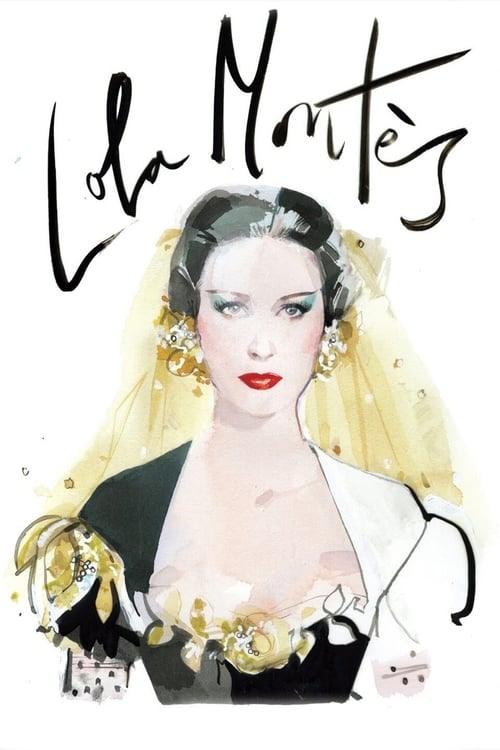
Lola Montès
1955 · Max Ophüls
For a night you want old-Hollywood-scale glamour with a bruise under it — ravishing to look at, melancholy to sit with. One for lovers of spectacle who don't mind their romance laced with cruelty.
What it's about
A woman who was once Europe's most notorious adventuress — dancer, courtesan, lover of Franz Liszt and a Bavarian king — ends up as the star attraction of a New Orleans circus, where a ringmaster auctions her scandals to the crowd night after night. Between his barked cues and the acrobatic acts, her real story unfolds in flashback: the affairs, the risks, the men, and the price. It's a life sold as a show, and the film knows exactly how cruel that is.
The experience
Dazzling and heartbreaking in the same breath — all swirling color, spectacle, and movement wrapped around a story of a woman being consumed by her own legend. It leaves you a little drunk on the images and quietly sad underneath.
Performances
Peter Ustinov is superb as the ringmaster — silky, insinuating, part showman and part jailer — his patter giving the whole film its bitter frame.
The craft
Ophüls's only film in color and widescreen, and he uses both extravagantly: the camera never stops moving, gliding through the circus ring and up into the rigging, and the flashback structure turns a biography into a hall of mirrors. It was mutilated by its producers on release and only restored decades later — the restored version is a feast that begs for the biggest screen you can find.
Why it matters
A commercial disaster that later generations recognized as one of the summits of film style — its reputation rescued and rebuilt by the restoration. It's now the touchstone for how a moving camera and a framing device can be the meaning of a film, not just decoration.
Snapshot
Lola Montès is Max Ophüls's last completed film and the only one he made in color and in widescreen — a lavish, melancholy fresco that turns the life of a notorious nineteenth-century courtesan into a circus spectacle. Within a New Orleans–style big top, a master of ceremonies (Peter Ustinov) auctions Lola's scandals to a paying crowd, and her memories — affairs with Franz Liszt, a Bavarian king, a young student — unfold in flashback between the ringmaster's barked cues and acrobatic tableaux. The film fuses Ophüls's career-long obsessions — the spectacle of a woman's life, the commodification of romance, the relentless mobility of the camera — into a single reflexive structure: a life sold as performance. Released to commercial disaster and critical bafflement, mutilated by its producers, and only fully restored decades later, it has since been elevated to the front rank of the medium's canon. It is at once a summa of Ophüls's art and a meditation on what it costs to be looked at.
Industry & production
Lola Montès was a France–West Germany co-production, mounted on a scale that made it one of the most expensive European films of its moment; precise budget figures circulate unreliably, so the safest claim is that it was an unusually costly prestige venture rather than a documented exact sum. The production was conceived to exploit the new commercial wares of mid-1950s cinema — color and the wide screen — and to showcase Martine Carol, then among France's most bankable stars, a pin-up celebrity whose box-office draw the backers expected to anchor the picture. That commercial calculus collided with Ophüls's anti-commercial sensibility, producing one of cinema's famous mismatches between a star vehicle's premise and its execution.
Like several international productions of the era, the film was shot in multiple language versions — French, German, and English — to serve different markets, a laborious practice that compounded costs. Its 1955 premiere was a debacle: audiences expecting a glamorous romance met a fractured, ironic, formally radical work, and the reception was hostile. The producers responded by re-editing the film against Ophüls's wishes — shortening it and, in some versions, reordering the flashbacks into chronological sequence to make it more "legible." Multiple truncated cuts circulated for years, and the film's reputation long rested on compromised prints. The original conception was substantially recovered only in a major restoration completed in 2008, overseen with the involvement of the director's son Marcel Ophüls and French restoration bodies, which reinstated the running time and the intended color and aspect ratio.
Technology
The film is a direct artifact of the mid-1950s technological arms race in which Hollywood and European studios deployed color and widescreen against the threat of television. It was photographed in CinemaScope (the anamorphic widescreen process introduced in 1953) and in Eastmancolor. For Ophüls these were not natural tools. He is widely reported to have been skeptical of the elongated CinemaScope frame, which resisted the vertical, enclosing compositions and the architectural framing he favored. His response was not to fill the width with landscape but to fight it — partitioning the frame with draperies, columns, banners, foreground clutter, and the apparatus of the circus, so that the wide image is constantly being subdivided, masked, and re-proportioned. The result is one of the most intelligent early uses of the format precisely because it treats the new shape as a problem to be dramatized rather than a billboard to be filled. Color is used with comparable deliberation: the circus framing scenes and the flashback episodes carry distinct chromatic registers, and the palette is modulated to mark shifts in mood, season, and emotional temperature rather than simply to dazzle.
Technique
Cinematography
Christian Matras — Ophüls's collaborator on La Ronde and Madame de…, and earlier Renoir's cinematographer on La Grande Illusion — shot the film, and it represents a culmination of the Ophülsian moving camera. The camera cranes up into the circus rigging, sweeps along the rings, tracks with Lola through ballrooms and corridors, and descends and rises to convert narrative space into a continuous choreography. In the widescreen frame these movements acquire a new lateral expansiveness. The famous final movement — a crane retreat from Lola caged, as a long line of men files past to kiss her hand for a dollar — exemplifies the method: the camera's motion completes the meaning, pulling back to reveal the human queue as an endless mechanism of consumption.
Editing
The film was edited by Madeleine Gug. Its montage is inseparable from its most contested formal feature: the flashback architecture. The present-tense circus performance is repeatedly interrupted by, and dissolves into, episodes from Lola's past, so that editing must continually negotiate between the ringmaster's stage-managed "now" and the remembered "then." This braided, non-chronological construction was exactly what producers attacked and re-cut after the failure; the chronological re-edits imposed on later prints destroyed the film's central irony — that a life is being reassembled as a show — and the restoration's recovery of the original order is what makes the film legible as Ophüls conceived it.
Mise-en-scène / staging
Mise-en-scène is the film's true subject as well as its method. The art direction by Jean d'Eaubonne, Ophüls's habitual designer, builds the circus ring as a total theatrical machine — tiered, gilded, mechanized — within which Lola is hoisted, displayed, and made to re-enact her own biography. Costumes (the work of Georges Annenkov, who dressed Ophüls's earlier French films) and decor saturate the frame. Staging consistently places Lola inside framing devices — rings, cages, doorways, stage apparatus — so that she is perpetually presented to an audience, the film's diegetic spectators standing in for us. The circus is the controlling metaphor: a life turned into an act, history turned into a sideshow.
Sound
Georges Auric, the prolific composer associated with Les Six and with a vast filmography, supplied the score, which oscillates between the brassy, ironic music of the circus and the lyrical strains of the romantic flashbacks. Sound design exploits the contrast between the ringmaster's amplified, rhythmic patter — a relentless commercial cadence — and the intimate, often hushed registers of the remembered scenes. The juxtaposition of the barker's voice with private memory is one of the film's principal ironic engines: every tender episode is bracketed by the noise of its own commodification.
Performance
Martine Carol, cast for her star wattage rather than her dramatic range, gives a performance whose very passivity Ophüls turns to thematic account. Critics have long debated her limitations, but the film arguably depends on Lola's opacity and exhaustion: she is less an agent than a surface upon which men, and audiences, project desire, and her depletion in the circus framing is the point. Around her, three of the film's male performances stand out: Peter Ustinov's ringmaster, both impresario and tormentor, who orchestrates the spectacle; Anton Walbrook (the haunted figure of Ophüls's La Ronde) as the aging Ludwig I of Bavaria, lending the affair gravity and tenderness; and Oskar Werner as the student. Will Quadflieg appears as Liszt. The casting of Walbrook in particular threads the film back into Ophüls's own body of work.
Narrative & dramatic mode
The film's dramatic mode is reflexive, ironic, and anti-linear. Rather than a chronological romance, it is a framed narrative in which the present-tense spectacle of the circus continually summons the past, and in which the act of narration is itself staged and sold. This structure converts biography into commentary: we never simply experience Lola's affairs; we watch them being marketed. The mode is fundamentally Brechtian in effect if not in doctrine — the spectator is denied easy immersion, repeatedly reminded that this is a performance with a price of admission. The drama is less about what happens to Lola than about the gap between a life as lived and a life as exhibited, and the melancholy of the film lies in that gap.
Genre & cycle
Nominally the film belongs to the historical romance and the biographical costume picture — the kind of glossy period vehicle French and European studios produced in quantity in the 1950s. But Lola Montès systematically subverts the cycle it appears to join. Where the costume romance promises sumptuous escapism and emotional uplift, Ophüls delivers irony, fragmentation, and a critique of the very spectatorship the genre depends on. It is closer to a meta-film about the biopic than a biopic, using the trappings of the prestige period drama to interrogate how celebrity and history are packaged for consumption. In this it stands somewhat apart from its cycle, which is one reason contemporary audiences, primed for a star romance, rejected it.
Authorship & method
The film is the signature statement of Max Ophüls (1902–1957), a German-born director whose itinerant career carried him through Weimar Germany, France, Italy, the Netherlands, and Hollywood before his return to France for the great late quartet of La Ronde (1950), Le Plaisir (1952), Madame de… (1953), and Lola Montès (1955). His method is defined by the mobile camera, by mirrors and decor, by circular and recursive structures, and by a persistent focus on women caught within social machinery — performers, courtesans, wives — whose desires the world converts into transactions. Lola Montès gathers these signatures into their most extreme and self-conscious form, making the apparatus of display the explicit subject.
Ophüls worked through a stable of trusted collaborators, several of whom recur here: cinematographer Christian Matras, designer Jean d'Eaubonne, and costumier Georges Annenkov, all veterans of his French films, plus composer Georges Auric and editor Madeleine Gug. The screenplay was written by Ophüls with Annette Wademant (a collaborator on Madame de…) and Franz Geiger, adapted from a novel about Lola Montès by Cécil Saint-Laurent (pen name of the writer Jacques Laurent). The collaborative continuity matters: the film is the product of a settled artistic team operating at the peak of a shared idiom.
Movement / national cinema
Lola Montès sits within French cinema of the 1950s — specifically the well-financed "tradition of quality," the polished literary-prestige mode that the emerging Cahiers du cinéma critics were beginning to attack. Yet Ophüls occupied an unusual position within that landscape. Though his films had the production gloss the young critics deplored, his authorial command of style exempted him from their scorn; he was, on the contrary, embraced as a model auteur. The film thus straddles a fault line in French film culture: institutionally a product of the studio prestige system, aesthetically a personal, radical work that the soon-to-arrive New Wave generation would claim as ancestral. Ophüls's status as a cosmopolitan émigré also makes any single "national" placement partial — his sensibility is pan-European, formed across multiple film cultures.
Era / period
The film is precisely of its moment: 1955, when CinemaScope and color were reshaping the industry, when European art cinema was gathering force, and when, in France, the critical insurgency that would become the Nouvelle Vague was forming around Cahiers. Lola Montès registers all of this — it adopts the era's new technological wares while turning them to unfashionably reflexive ends, and it became, almost immediately, a test case in the auteurist polemics of the day. Its commercial failure and the passionate critical defense it provoked make it one of the emblematic films of the mid-1950s transition between classical studio prestige and the modernist art cinema to come.
Themes
Its governing theme is spectacle and the commodification of a life — the transformation of private experience, especially a woman's, into public merchandise. Lola's loves are not narrated so much as sold; the circus is a machine for converting memory into ticketed entertainment, and by extension a figure for cinema itself and for the celebrity culture that consumes its stars. Adjacent themes follow: the performance of female identity, in which Lola is less a self than a role others script and pay to see; memory and reconstruction, since the whole film is a life reassembled out of order; decline and exhaustion, embodied in Lola's physical depletion within the ring; and the price of being looked at, crystallized in the closing image of the caged woman and the paying queue. The film is finally about the gaze as a transaction.
Reception, canon & influence
On release the film failed commercially and divided critics, and its producers' re-editing deepened the confusion by circulating compromised versions. Yet it immediately drew a fervent defense: a public letter signed by leading French film figures rallied to it, an early sign that the work's champions saw something its first audiences had missed. The auteurist critics, in France and abroad, made it a cause. Most famously, the American critic Andrew Sarris would declare Lola Montès the greatest film ever made — a judgment that became shorthand for the film's outsized reputation among cinephiles. Over the following decades its standing only rose, culminating in the acclaimed 2008 restoration, which let audiences finally see the film close to Ophüls's intentions and consolidated its canonical status.
Influences on the film (backward): It draws on the actual history of Lola Montez — born Eliza Gilbert in Ireland, the dancer and adventuress who became mistress of Ludwig I of Bavaria and a transatlantic celebrity — filtered through Cécil Saint-Laurent's novel and the broader tradition of nineteenth-century romantic biography. Formally it culminates Ophüls's own prior films, extending the framing structures and circular ironies of La Ronde and Le Plaisir and the camera idiom of Madame de…. Its reflexivity also draws on theatrical and circus traditions of the show-within-the-show.
Legacy (forward): Lola Montès became a touchstone for auteurist criticism and a foundational reference for filmmakers devoted to the expressive moving camera and to reflexive structure. Ophüls's influence on later directors is well documented in general terms — Stanley Kubrick, among others, named him an admired model for camera movement — and his legacy is frequently invoked by directors associated with elaborate tracking shots and with films about spectacle and celebrity. Beyond specific attributions, which should be made cautiously, the film's deepest legacy is conceptual: it demonstrated that the costume romance could be turned inside out to interrogate its own machinery, anticipating the self-aware, anti-illusionist art cinema that followed. As a film about the selling of a life, made by a master at the end of his own, it has acquired the added resonance of a final testament.
A Deleuzian reading
Watch the last movement first, because Ophüls built everything to arrive there.
The full Deleuzian reading of Lola Montès →
Reception
One of cinema's most famous flop-to-masterpiece stories: booed at its 1955 Paris premiere and butchered by producers into a shorter chronological cut, it was championed for decades by cinephiles before a 2008 restoration returned Ophüls's version to something like its intended glory.
How Lola Montès was received, from release to now →
Influences: the films it descends from and the films it influenced
- Sunrise (1927) — Its lyrical untethered tracking shots (the camera gliding through the marsh to the tryst) establish the expressive mobile-camera grammar that Ophüls inherited from German cinema and pushed to its limit here.
- Variety (1925) — The swooping trapeze-and-circus subjective camera presenting a performer's body as paid spectacle directly prefigures Lola's circus-arena framing of a life sold as a sideshow act.
- The Blue Angel (1930) — Its cabaret performer staged as commodified erotic spectacle within layered Expressionist decor models the gaze-as-transaction and the woman-on-display that Lola Montès makes its explicit subject.
- Citizen Kane (1941) — The fragmented, non-chronological reconstruction of a public celebrity's life from interested witnesses supplies the reflexive flashback architecture Ophüls adopts for the circus interrogation of Lola's past.
- Letter from an Unknown Woman (1948) — The unbroken staircase and amusement-park carriage tracking shots, plus a whole life narrated in retrospective flashback, form the immediate stylistic seedbed for Lola's camera and structure.
- La Ronde (1950) — Its meneur-de-jeu who steps in and out of the diegesis and its carousel-driven circular structure are the direct prototype for the circus ringmaster who narrates and stages Lola.
- Le Plaisir (1952) — The episodic show framed by an external narrator and the camera's restless exterior prowl around buildings it is barred from entering extend straight into Lola's framed, reflexive design.
- Madame de… (1953) — The gliding waltz tracking shots and the circulating object (the earrings) that converts love into a chain of transactions perfect the commodification-of-feeling that Lola universalizes into spectacle.
- The Scarlet Empress (1934) — A woman's life staged as circus pageant behind veils, drapes and framing devices — the female sovereign as both spectacle and force, rendered through layered, obstructed compositions.
- 8½ (1963) — Its closing circus-ring procession and its reflexive structure as a show about the making of its own show carry forward Ophüls's circus-as-metaphor and anti-illusionist machinery.
- Vivre sa vie (1962) — The Brechtian chaptered distanciation and the staging of a woman's body as priced transaction (prostitution presented in detached tableaux) extend Lola's commodification-of-spectacle into the New Wave.
- Barry Lyndon (1975) — Kubrick named Ophüls a model for camera movement, and his ironic third-person narration distancing a costume biography into painterly tableaux directly answers Lola's subverted costume-biopic.
- F for Fake (1973) — A reflexive essay-film about the manufacture of celebrity and the fakery of spectacle, restaging Lola's exposure of the apparatus that sells a persona.
- The Age of Innocence (1993) — Its gliding, ornamented tracking camera that maps a period society as a machine of constraint, paired with ironic voiceover narration, is an avowedly Ophülsian inheritance.
- Moulin Rouge! (2001) — The swirling theatrical spectacle, the courtesan sold as public attraction, and the explicit show-within-the-film revive Lola's gaze-as-transaction in maximalist form.
- Russian Ark (2002) — The single unbroken mobile-camera traversal of history staged as a continuous pageant is the apotheosis of Ophüls's tracking idiom, treating décor and movement as the carriers of meaning.
- The Marriage of Maria Braun (1979) — Ophüls's widescreen staging of a woman's life as spectacular commodification—theatrical-within-cinematic framing that simultaneously implicates the viewer in Lola's objectification and ironizes the male gaze—directly informs the double perspective Ballhaus and Fassbinder hold on Maria: object and agent, spectacle and critique, never resolved into identification.
- 2046 (2004) — Anamorphic widescreen isolating a woman within overloaded décor, combined with a framing-fiction device — the circus showman narrating and curating memory as spectacle — anticipates 2046's science-fiction serial as a meta-narrative structure through which a controlling author aestheticizes personal loss.
- The Leopard (1963) — Shot in CinemaScope, Ophüls developed the wide horizontal frame as a vehicle for historical-elegiac staging — figures placed within theatrical interiors to emphasize retrospective distance — providing the compositional model for Rotunno's Technirama framing of Don Fabrizio moving through his own obsolescence.
- Pierrot le Fou (1965) — Reflexive, theatrically framed widescreen color spectacle that stages performance as performance, prefiguring Pierrot's Brechtian register-switching and presentational tableaux.
- Last Year at Marienbad (1961) — Ophüls shoots in CinemaScope, using the wide frame to isolate a single woman within an elaborate theatrical spectacle as the passive object of competing narrative claims — the anti-naturalist register of performance-within-display, figure dwarfed by architectural and scenic excess, that Seyrig's posture and costuming directly extend.
- The Red Shoes (1948) — A near-contemporary treatment of the performing woman consumed by the apparatus of art, built on the show-within-the-show and the body displayed for an audience that owns it.
- Senso (1954) — Color-and-widescreen operatic spectacle staging a woman's public degradation as literal proscenium theater, the same erotic-decline-as-performance logic.
Similar films
- The Earrings of Madame de... (1953) — influence & lineage
- Le Plaisir (1952) — influence & lineage
- The Blue Angel (1930) — influence & lineage
- Letter from an Unknown Woman (1948) — influence & lineage
- La Ronde (1950) — influence & lineage
- Vivre Sa Vie (1962) — influence & lineage
- 8½ (1963) — influence & lineage
- Moulin Rouge! (2001) — influence & lineage
All the films related to Lola Montès →