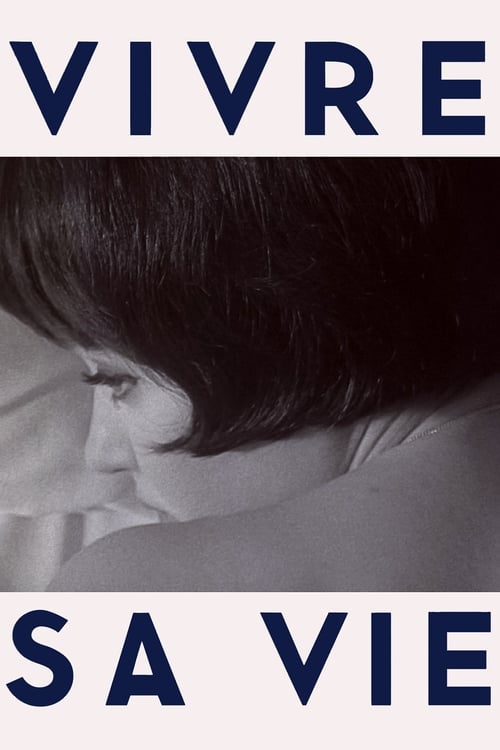
Vivre Sa Vie
1962 · Jean-Luc Godard
For when you want something stylish and thoughtful to chew on — a black-and-white Paris mood, a film that treats you like a grown-up and leaves you arguing with it afterward. More espresso than comfort food.
What it's about
Nana is a young Paris shopgirl who wants to be an actress. Told in twelve numbered episodes — each announced with a title card — the film follows her as she leaves her marriage, runs out of money, and drifts into prostitution, trying all the while to insist that her life is her own. Between the episodes she talks, dances, goes to the movies, and argues philosophy with a stranger in a café.
The experience
Cool on the surface and quietly devastating underneath. The episodic structure keeps you at arm's length, then the camera lingers on Nana's face and you're suddenly all the way in — it's a film that alternates between intellectual play and moments of piercing tenderness.
Performances
Anna Karina is the whole film — her Nana is playful, guarded, and heartbreaking, often all in one unbroken shot, and the camera is openly in love with her.
The craft
Godard breaks every rule on purpose: chapter cards, a camera that films conversations from behind people's heads, documentary-style digressions on the economics of prostitution, sudden bursts of music that cut off mid-phrase. Shot in luminous black and white, it looks like a fashion photograph and plays like an essay, and the famous scene of Nana at the cinema, tears on her face, is one of the most quoted images in French film.
Why it matters
One of the defining works of the French New Wave, it showed that a film could be a story, an essay, and a portrait at once — and it fixed Anna Karina as one of the era's iconic faces.
Snapshot
Vivre sa vie: film en douze tableaux ("My Life to Live: A Film in Twelve Scenes") is Jean-Luc Godard's fourth feature, made at white heat in early 1962 and released in France that September, barely three years into the director's astonishing run as the most theoretically restless of the Nouvelle Vague directors. Across twelve numbered episodes it follows Nana Kleinfrankenheim, a young Parisian shopgirl with vague ambitions toward acting, as she drifts out of a marriage, fails to find footing, and enters prostitution before dying abruptly in a botched transaction between pimps. The film is at once a sociological tract on prostitution, a Brechtian essay on freedom and determinism, a Dreyer-haunted Passion, and an unabashed love poem to its star, Anna Karina, then Godard's wife. Its reputation rests less on the narrative — deliberately schematic, almost a fait divers — than on its formal severity and emotional clarity: the precision of Raoul Coutard's photography, the modular chapter structure, and Karina's performance, which Godard frames with a tenderness rare in his work. Often cited as the moment Godard's cinema turned decisively essayistic, Vivre sa vie remains among the most admired and most teachable of his early films, a touchstone for theorists of the gaze, of acting, and of the relationship between documentary and fiction.
Industry & production
Vivre sa vie was produced by Pierre Braunberger through his Films de la Pléiade, one of the key patrons of the New Wave; Braunberger had backed Godard's earlier short Une histoire d'eau and was a producer comfortable with low budgets and improvisatory shooting. The film was made cheaply and quickly — shot over roughly four weeks in February 1962 on Paris locations, cafés, streets, hotel rooms, a record shop, a cinema — with a small crew built around Coutard's camera. This was the standard New Wave economy: natural light where possible, available locations, lightweight equipment, minimal sets, a production model that made artistic radicalism financially survivable.
Godard's commercial position in 1962 was ambiguous. À bout de souffle (1960) had been a genuine hit and a scandal, but his follow-ups Le petit soldat (shot 1960) — banned by French censors until 1963 over its treatment of the Algerian War and torture — and Une femme est une femme (1961) had been more divisive. Vivre sa vie was thus made under the lengthening shadow of censorship and of Godard's contested box-office viability. Its subject, prostitution, was sensitive; Godard partly insulated the film by grounding it in apparently documentary sociology, drawing on Marcel Sacotte's contemporary study of prostitution in Paris, Où en est la prostitution?, portions of which are recited almost verbatim in the film's clinical eleventh-hour catechism on the trade's economics and regulations. The film premiered at the Venice Film Festival in 1962, where it was well received and is generally credited with a special jury prize; specific award citations from this period are sometimes reported inconsistently, so the precise honor is best stated cautiously.
Technology
The film was shot on 35mm black-and-white stock in the standard Academy-adjacent ratio, using the lightweight, largely handheld-capable equipment that had become Coutard and Godard's signature. The crucial technological wager of Vivre sa vie is its sound. Godard recorded direct sound on location — an unusual and difficult choice for 1962, when most French films were post-synchronized in the studio — accepting the ambient noise, the imperfect intelligibility, and the documentary texture that live recording produced. This commitment to synchronous location sound, with its café clatter and street hum, is inseparable from the film's realism and from its self-conscious refusal of the polished studio voice. Against that live-recorded base Godard set sharply artificial interventions: Michel Legrand's recurring musical theme, deployed in fragments, and passages of silence. The film opens, notoriously, with credits over Karina's face shot in near-darkness, in profile and frontal, the technology of the close-up foregrounded as an object of attention rather than a transparent window.
Technique
Cinematography
Raoul Coutard's photography is the film's central achievement and one of the high points of New Wave black-and-white. Coutard works in long, patient takes and deliberate camera movements that feel choreographed even when they are documentary in origin. The most discussed sequences are built on refusal of conventional coverage: the opening conversation between Nana and her husband Paul is shot largely from behind, the actors' faces turned from the camera, their reflections caught dimly in a café mirror — a withholding of the face that the rest of the film will repeatedly violate and reward. Elsewhere Coutard executes slow lateral tracking shots, including a celebrated traverse along a café counter and movements through the spaces of prostitution that have the cool, observational rhythm of surveillance. The lighting favors a flat, gray, unromantic Parisian naturalism punctuated by passages of stark contrast. Coutard's camera treats Karina's face as the film's organizing landscape, and the visual argument of Vivre sa vie is in large part a debate about when, and how, we are permitted to look at it.
Editing
Cut by Agnès Guillemot — Godard's principal editor through the 1960s — the film's defining structural gesture is its division into twelve numbered tableaux, each preceded by an intertitle that summarizes or telegraphs the episode to come. This chaptering is overtly Brechtian: by announcing events in advance, the intertitles drain suspense and redirect attention from "what happens" to "how" and "why," encouraging analytic rather than empathic viewing. Within scenes Godard and Guillemot oscillate between extreme continuity — very long takes with no cutting at all — and abrupt elision, simply omitting transitions and connective tissue between episodes so that Nana's descent proceeds by jumps. The effect is paradoxical: the long takes feel like unmediated witness while the chapter structure feels like a dossier or case file, the two registers together producing the film's characteristic fusion of intimacy and clinical distance.
Mise-en-scène / staging
Godard stages Vivre sa vie as a series of framed confrontations between bodies, language, and screens. The settings are quotidian — cafés, a record shop where Nana works, hotel corridors, a billiard hall — but Godard composes within them with great rigor, frequently isolating Karina against blank walls or arranging figures in flat, frieze-like configurations. Reflective surfaces and the motif of looking recur throughout. The film is dense with embedded images and texts: a visit to the cinema, the reading aloud of Edgar Allan Poe's "The Oval Portrait," a conversation with the real-life philosopher Brice Parain on language and truth. These insertions function as mises en abyme, mirrors in which the film comments on its own procedures — most pointedly when Nana weeps at Dreyer's The Passion of Joan of Arc, her tear-streaked face cut against Falconetti's, binding Nana's coming martyrdom to one of cinema's primal images of suffering womanhood.
Sound
Sound is a deliberate field of friction. The direct location recording gives dialogue a granular, sometimes muffled immediacy, while Legrand's plangent string theme enters and cuts off mid-phrase, refusing the smoothing function of conventional scoring — a Brechtian interruption in the auditory register. Godard withholds music as often as he supplies it, and uses silence pointedly. The famous final exchange in which Nana and a young man "speak" via intertitled subtitles, their voices dropped from the soundtrack, makes the apparatus of cinematic communication audible by removing it. Throughout, the relationship between word and image is treated as a problem rather than a given, nowhere more explicitly than in the Parain dialogue, which makes the difficulty of speaking truthfully the film's stated theme.
Performance
Anna Karina's Nana is the film's heart and the reason much of its reputation endures. Karina plays Nana with a watchful stillness — grave, opaque, occasionally breaking into spontaneous delight, as in the much-loved scene where she dances alone around a billiard hall to the jukebox, the camera circling with her. Godard's direction of her is famously a study in surfaces: he frequently denies us her interiority, then suddenly grants access through the close-up, so that performance itself becomes the film's subject. The supporting playing is keyed lower and flatter, semi-documentary in tone; the non-professional and quasi-professional presences (including Parain as himself) heighten the sense that Karina is being observed within a real world. The performance won Karina lasting critical admiration and is routinely treated as definitive of her collaboration with Godard.
Narrative & dramatic mode
The film's dramatic mode is essayistic and anti-illusionist. Its twelve-tableau structure borrows from Brecht's epic theater: episodes are discrete, announced in advance, and arranged less as a causal chain than as a demonstration. The narrative question is not really "will Nana survive?" but "is Nana free?" — a question the film poses explicitly through the Parain conversation and through Sacotte's sociological data, setting individual will against economic and social determinism. Godard withholds psychological explanation; Nana's choices are presented as facts to be examined rather than motives to be understood. The abruptness of the ending — Nana shot almost arbitrarily in a sordid dispute, the film simply stopping — refuses tragic catharsis and insists on the contingency of her fate. The dossier-like apparatus of intertitles, recitation, and citation positions the viewer as analyst, even as Coutard's camera and Karina's face pull continuously toward identification. That productive tension between investigation and tenderness is the film's distinctive dramatic signature.
Genre & cycle
Nominally a drama of social fall — the prostitution narrative descends from a long literary and cinematic lineage running through Zola and the fille de joie melodrama — Vivre sa vie belongs more truly to the emergent New Wave art-essay, a hybrid that fuses fiction, documentary, and criticism. Within Godard's own early cycle it sits among the run of films built around Karina (Une femme est une femme, Bande à part, Pierrot le fou, Alphaville) and inaugurates the explicitly essayistic vein he would pursue through Une femme mariée, Masculin féminin, and Two or Three Things I Know About Her, the last revisiting prostitution as a metaphor for life under consumer capitalism. The film also participates in the period's broader documentary impulse, sharing ground with cinéma vérité in its location sound and sociological framing while remaining unmistakably authored fiction.
Authorship & method
Vivre sa vie is among the purest expressions of Godard's auteurist method in its first phase. Godard wrote, directed, and shaped the film around three convictions visible throughout his early work: that cinema should think aloud, citing and quoting other art; that the boundary between fiction and documentary should be made porous; and that the camera's relationship to the human face is the medium's central ethical question. His key collaborators are inseparable from the result. Raoul Coutard, the New Wave's defining cinematographer, supplied the long-take observational style and the luminous treatment of Karina. Agnès Guillemot, Godard's editor through the decade, realized the modular tableau structure. Michel Legrand contributed the fragmentary musical theme, used with characteristic Godardian interruption. And Anna Karina, Godard's wife and muse, is less a collaborator than a co-subject: the film is openly an act of looking at her, and its autobiographical charge — a husband filming his wife's face as it suffers — gives the formal experiment its emotional ballast. Godard also folds in voices from outside cinema, notably the philosopher Brice Parain, whose presence makes literary and philosophical citation a formal principle rather than mere allusion.
Movement / national cinema
The film is a canonical work of the French Nouvelle Vague, the critical-turned-directorial movement that emerged from the Cahiers du cinéma circle at the end of the 1950s. It exemplifies the movement's economics (cheap, fast, location-based production), its politique des auteurs (the director as the film's organizing intelligence), and its cinephilic self-consciousness (constant citation of film history — here Dreyer above all, alongside the gangster and melodrama traditions). It belongs equally to a distinctly French intellectual cinema in dialogue with literature, philosophy, and the social sciences, a national tradition in which a popular narrative form can carry Brechtian and phenomenological argument without apology.
Era / period
Vivre sa vie is a document of early-1960s Paris: the cafés, jukeboxes, cinemas, and consumer surfaces of a modernizing France, and a society in which a young woman's economic precarity could be presented as a near-statistical inevitability. It was made in the shadow of the Algerian War and the censorship apparatus that had silenced Godard's Le petit soldat, and its sociological framing reflects a moment when French cinema was newly preoccupied with the textures of contemporary urban life. The film's release in September 1962 places it at the crest of the New Wave's first great wave, before the movement's later politicization, and it captures a transitional Godard — still in love, still lyrical, already turning toward the essay.
Themes
The film's governing theme is the question of freedom: whether Nana authors her life ("vivre sa vie" — to live one's own life) or is authored by economic and social force. Around this orbit several others. The relationship between language and truth, dramatized in the Parain dialogue, where speaking and thinking are framed as a perpetual struggle toward an accuracy that betrays us. The ethics and erotics of looking — the film as a sustained inquiry into when we may gaze at a woman's face and what that gaze does to her. Martyrdom and the suffering of women, threaded through the Dreyer/Falconetti citation that makes Nana a modern Joan. The commodification of the body and, by extension, of the self under capitalism, anatomized in Sacotte's sociological recitation. And the porous border between performance and authenticity, since Nana dreams of acting while the film never lets us decide whether her face conceals or reveals her.
Reception, canon & influence
On release Vivre sa vie was received as a major and unusually controlled work from a director associated with provocation, and it has only grown in stature; it is now regularly ranked among Godard's finest films and among the essential works of the New Wave, a fixture of critical canons and university curricula. Susan Sontag's celebrated essay on the film — treating it as a work of intellectual seriousness and formal perfection — did much to secure its standing in the Anglophone world, reading it as a film about the soul and about the relation of form to feeling. (Readers should consult Sontag's text directly for her exact arguments.)
Its influences run backward to Carl Theodor Dreyer, whose Passion of Joan of Arc is cited on screen and whose ascetic close-up style underwrites the whole film; to Bertolt Brecht, whose epic theater supplies the tableau structure and the distancing apparatus; to the literary naturalism of the prostitution narrative; to Edgar Allan Poe, read aloud near the end; and to the cinéma vérité and direct-cinema currents shaping its sound and sociology. Forward, its legacy is broad. It helped establish the chaptered, essayistic feature as a durable art-cinema form, and its self-reflexive interrogation of the gaze made it a foundational reference for feminist film theory's analysis of how cinema looks at women — a body of work that takes Godard's framing of Karina as a central case, admiringly and critically alike. Filmmakers from the slow-cinema tradition and the international art film have drawn on its long takes and its fusion of document and fiction. Above all it remains the defining record of the Godard–Karina collaboration, the film most often invoked when that partnership is discussed, and a perennial model for how a modest narrative can be made to carry the weight of an entire aesthetic and philosophical program.
A Deleuzian reading
Start with the back of a head.
The full Deleuzian reading of Vivre Sa Vie →
Reception
It landed well from the start — Special Jury Prize at Venice in 1962, and Susan Sontag soon hailed it as a perfect work of art — but over the decades it's climbed from 'one of the good Godards' to many people's pick for his most emotionally direct film, and the standard answer to 'where do I start with Godard?'
How Vivre Sa Vie was received, from release to now →
Influences: the films it descends from and the films it influenced
- The Passion of Joan of Arc (1928) — Cited diegetically (Karina weeps watching it); Dreyer's frontal, ascetic close-up of a suffering woman's face is the explicit template for Coutard's filming of Karina.
- Summer with Monika (1953) — Harriet Andersson's defiant look straight into the lens is the precedent for Karina's address to the camera and the film's reflexive treatment of the gaze.
- Voyage to Italy (1954) — Observational, semi-documentary tracking of a woman through real spaces — the porous fiction/document method Godard openly revered and adapts to Paris.
- Nights of Cabiria (1957) — Builds a dignifying portrait of a streetwalker out of discrete episodic encounters rather than continuous plot, prefiguring the tableau scaffolding.
- Pickpocket (1959) — Behaviorist, affectless performance and clinical attention to a marginal worker's gestures and transactions, a model for the film's detached register.
- Letter from Siberia (1957) — Establishes the essay-film method of welding image to spoken/written commentary, which Godard imports into a fiction via intertitles and citation.
- Chronicle of a Summer (1961) — Cinéma-vérité direct-sound interviewing of real subjects, echoed almost literally in the Brice Parain café conversation on language.
- Shoot the Piano Player (1960) — Coutard's isolating framing of Nana — caught in doorways, behind glass, against bare walls — directly extends the compositional grammar he developed framing Charlie at his bar counter in Piano Player; Michel Legrand's score then functions in the same ironic-distance mode as Delerue's, refusing to sentimentalize a protagonist defined by entrapment and passivity.
- Europa '51 (1952) — Godard structures the film in discrete episodic tableaux holding the face in Dreyer-inflected duration, explicitly quoting La Passion de Jeanne d'Arc in the cinema sequence; the chapter architecture and ambient-social-register sound are the Rossellinian inheritance made structurally visible, the female protagonist as surface of social inscription.
- Lola Montès (1955) — The Brechtian chaptered distanciation and the staging of a woman's body as priced transaction (prostitution presented in detached tableaux) extend Lola's commodification-of-spectacle into the New Wave.
- Pandora's Box (1929) — Karina's cropped Louise Brooks bob, face-forward close-ups, and a twelve-episode tragedy of a woman's descent into prostitution consciously reanimate Pabst's cool, unmoralizing gaze at Lulu.
- Masculin Féminin (1966) — Explicitly divides itself into numbered tableaux interlaced with vérité interviews, extending the chaptered, Brechtian-distanced structure.
- 2 or 3 Things I Know About Her (1967) — Pushes the essayistic sociology of prostitution into consumer Paris, with whispered commentary and citation as formal principle.
- Jeanne Dielman (1975) — Durational fixed-frame observation of a housewife-prostitute that answers Godard's gaze with feminist rigor, turning the act of looking at a woman into the form.
- Stranger Than Paradise (1984) — Single-take black-and-white tableaux separated by blackouts, with deadpan Brechtian distancing replacing dramatic continuity.
- Vagabond (1985) — A fragmented document-fiction portrait of a drifting woman assembled from discrete witness testimonies and lateral tracking shots.
- Frances Ha (2012) — A black-and-white, address-titled chapter portrait of a young woman that overtly homages the Karina-era Godard look and episodic structure.
- Breaking the Waves (1996) — Godard's chapter-card architecture—twelve titled tableaux tracking a woman's progressive degradation, each introduced by intertitle—is the direct structural model for von Trier's seven-chapter organization of Bess's martyrdom, including the device of using the chapter break as simultaneous emotional distancing and narrative punctuation.
- La Chinoise (1967) — Godard's first systematic use of Brechtian chapter intertitles (twelve 'tableaux') dividing the film into self-interrupting units, combined with Karina's Falconetti-quoting frontal address to the lens, establishes the formal template—episodic structure plus testimonial close-up—that La Chinoise inherits and politicizes.
- Alphaville (1965) — Established Anna Karina's screen presence as a Godardian instrument of deadpan opacity — a face that encodes interior life the camera refuses to confirm — and pioneered the written-chapter declarative structure (twelve tableaux with headings) that Alphaville inherits wholesale as its narrative architecture.
- Poor Things (2023) — Godard's episodic chapter structure, in which a woman's trajectory is subdivided into discrete social encounters that accumulate without psychological resolution, provides the architectural model for Bella's picaresque stages of education across European milieus.
- Shame (2011) — Episodic, chaptered observation of a body for sale, the camera holding at detached clinical distance — the elliptical, segmented structure Shame echoes.
- Weekend (1967) — Its twelve numbered tableaux with intertitles, frontal framing, and Anna Karina's affectless recitation supply the Brechtian episodic-with-cards structure Weekend collages.
- Breathless (1960) — Coutard's handheld location shooting and raw direct sound establish the New Wave toolkit that Vivre sa vie disciplines into long static takes.
- Cléo from 5 to 7 (1962) — A chaptered, near-real-time portrait of a Parisian woman, structured by titled time-segments and lateral tracking through the city's streets.
- Jules and Jim (1962) — Coutard's mobile lateral tracking and the splicing of newsreel document into fiction, the shared Coutard/New Wave camera grammar.
- My Night at Maud's (1969) — Makes extended direct-sound philosophical conversation the dramatic substance of the scene, the Rohmerian counterpart to the Parain dialogue.
- Hiroshima Mon Amour (1959) — Godard's chapter-structured essay-film deploys image-voice counterpoint through intertitles and suspended sound that periodically replace rather than accompany the image, while Karina's interior-withholding performance — the camera watching a face that will not disclose — extends the Left Bank mode of performance Riva established.
- Accattone (1961) — A concurrent 'cinema of poetry' work using tableau-episodic structure (twelve chapters) and appropriated classical scoring over a fallen protagonist's fatalist arc.
- A Woman Is a Woman (1961) — Extends the Godard–Karina method — the film-as-portrait-of-the-star and the tableau/chapter structure grow directly out of framing Karina as both fiction and beloved subject.
- I Only Want You to Love Me (1976) — Godard's frontal, chaptered tableaux and clinical framing of a woman's life as a series of transactions modeled the Brechtian confessional structure Fassbinder adopts for retrospective testimony.
Similar films
- Masculin Féminin (1966) — influence & lineage · same viewing thread · often watched together
- Cléo from 5 to 7 (1962) — influence & lineage · same viewing thread
- Breathless (1960) — influence & lineage
- Vagabond (1985) — influence & lineage
- Jules and Jim (1962) — influence & lineage
- Nights of Cabiria (1957) — influence & lineage
- Pierrot le Fou (1965) — same viewing thread · often watched together
- The Mother and the Whore (1973) — same viewing thread · often watched together
All the films related to Vivre Sa Vie →
Watch it with: curated runs of related films
- Adrift in the Modern World — Watch these when you want to drift through postwar Rome and Paris alongside people who have everything and feel nothing — they rhyme on beautiful boredom, aimless days, and a search for meaning that modern comfort keeps failing to supply.
Film essays and courses that include it
- Jean-Luc Godard
- Jump Cut: The Nouvelle Vague from Birth to Dissolution
- A School of Looking: French Cinema's Seven Decades of Formal Invention
- Nobody's Darling: Sex Work, Survival, and the Cassavetes-Baker Line
- The Revolution That Disappeared
- The Director Who Took Cinema Apart
- The Cut That Was a Mistake
- The Eyes of the New Wave
- The Revolution, Reenacted