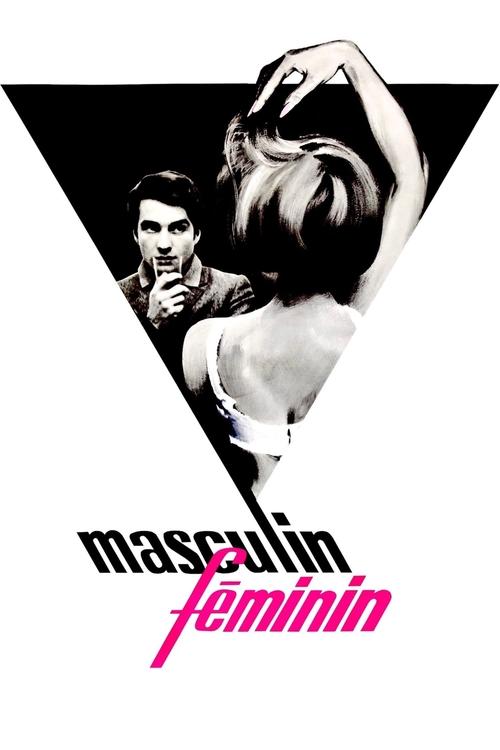
Masculin Féminin
1966 · Jean-Luc Godard
When you're in the mood for something talky, stylish, and alive — a film to argue with rather than sink into. Best when you want to hang out in 1960s Paris and don't mind a movie that keeps changing the rules on you.
What it's about
Paris, winter 1965 into 1966. Paul, just out of military service, is a broke young idealist who takes a job asking strangers survey questions for a market-research firm while he pursues Madeleine, an aspiring yé-yé pop singer with her eye on the charts. Told in fifteen loosely connected vignettes — interviews, café arguments, dates, political stunts — it's a portrait of a generation the film famously calls the children of Marx and Coca-Cola: kids torn between revolution and pop records.
The experience
Playful, prickly, and restless — it jumps between flirtation, sociology, and provocation, sometimes mid-scene, with sudden jolts of violence at the edges of the frame. It's funny and melancholy at once, and the long interview scenes have a squirmy, real-time intimacy that feels startlingly modern.
Performances
Jean-Pierre Léaud is perfect as Paul — earnest, pretentious, needy, and touching all at once — and Chantal Goya, a real pop singer of the era, brings an opaque sweetness to Madeleine that keeps the romance genuinely unreadable.
The craft
Godard shoots it like a documentary that keeps turning into fiction: crisp black-and-white, direct-to-camera interviews, intertitles, and scenes built from real questions asked of real young people. The editing is spiky and free, snapping from tenderness to news-of-the-world brutality. It's a time capsule with the seal unbroken.
Why it matters
One of the defining screen portraits of 1960s youth, catching French kids in the calm before the upheavals of 1968, and a key film in the New Wave's turn from movie-love toward politics.
Snapshot
Masculin Féminin is Jean-Luc Godard's anatomy of French youth on the cusp of 1966 — a black-and-white quasi-documentary fiction that famously proposes, in one of its intertitles, that its subjects are "the children of Marx and Coca-Cola." Built from fifteen loosely connected episodes (the original title card glosses it as 15 faits précis, fifteen precise events), the film follows Paul (Jean-Pierre Léaud), a discharged conscript, would-be intellectual, and amateur leftist, as he courts the aspiring yé-yé pop singer Madeleine (Chantal Goya) and drifts between political agitation, casual employment as a market-research interviewer, and the cafés, cinemas, and bedrooms of contemporary Paris. The film is at once a tender study of romantic and sexual miscommunication between the sexes and a sociological dossier on a generation suspended between revolutionary rhetoric and consumer desire. It marks a hinge in Godard's career — looking back to the playful improvisation of the early New Wave while pressing forward into the essayistic, politically interrogative cinema that would dominate the late 1960s. It remains one of the defining youth films of its decade and a touchstone for any account of how cinema began to absorb the textures of pop, polling, and the interview.
Industry & production
The film was produced by Anatole Dauman's Argos Films, the Paris company already central to the European art cinema of the period through its work with Resnais and Marker, in a co-production arrangement that drew in the Swedish company Sandrews along with Columbia's French and other partners — a typical mid-1960s pooling of French and Scandinavian resources to finance an auteur picture of modest budget. It was nominally adapted from two Guy de Maupassant short stories, "La Femme de Paul" and "Le Signe," a literary alibi that, as was Godard's habit, supplies little more than character names, a situational kernel, and the patina of a "source" while the finished film bears almost no narrative relation to its origins.
Shooting took place in Paris over the winter of 1965–66, largely on location in cafés, apartments, laundromats, recording studios, and on the street, with available or minimally augmented light. The production was rapid and improvisatory in Godard's manner: scenes were frequently developed close to or on the day of filming, dialogue handed to actors shortly before takes or fed to them during shooting. The film slots into an extraordinarily compressed stretch of Godard's output — arriving between Pierrot le fou (1965) and the films of 1966–67 (Made in U.S.A., Deux ou trois choses que je sais d'elle) — during which he was releasing multiple features a year and visibly accelerating toward overt political cinema.
Technology
Masculin Féminin was shot on 35mm black-and-white film at a moment when Godard and his collaborators were deliberately importing the lightweight, mobile methods of cinéma vérité into fiction. The decisive technological commitment is to direct, synchronous sound recorded on location rather than post-dubbed in the French studio tradition — a choice that carries the film's documentary charge and its characteristic acoustic clutter. Portable cameras and fast film stock made the available-light interiors and handheld street work feasible. Where many of Godard's earlier features luxuriated in color and widescreen, here the reduction to monochrome and a near-reportage apparatus is itself a statement: the film wants to look and sound like an inquiry conducted in the actual Paris of its winter, not a constructed world.
Technique
Cinematography
The cinematography is by Willy Kurant, and it is among the film's most quietly influential elements. Kurant works in a high-contrast, grainy black-and-white register that fuses the intimacy of portraiture with the contingency of documentary. Long handheld takes — most famously the extended interview in which Paul questions a young woman billed as a consumer-survey subject ("Miss Nineteen") — hold faces in close, sustained scrutiny, letting hesitation, evasion, and self-presentation register in real time. Elsewhere Kurant favors flat frontal compositions, abrupt pans that abandon one figure to find another, and a willingness to let café windows, mirrors, and passing traffic complicate the image. The camera is alternately a recording instrument and an interlocutor; its mobility and its proximity to the actors' faces give the film its distinctive feeling of eavesdropping on a generation.
Editing
The editing — by Godard's regular collaborator of the period, Agnès Guillemot — is the structural engine of the film. Rather than smoothing the fifteen episodes into continuity, the cutting foregrounds discontinuity: scenes begin and end abruptly, numbered or titled intertitles interrupt the flow, and sudden bursts of off-screen or barely-motivated violence (a gunshot, a self-immolation, a quarrel turning lethal) punctuate the romantic and conversational material without explanation. Jump cuts, blackouts, and the insertion of printed text fracture the surface continuously, so that the spectator is kept in a posture of assembly rather than absorption. The film's celebrated formal premise — discrete "precise facts" laid end to end — is realized primarily in the cutting room.
Mise-en-scène / staging
Godard stages the film in the unglamorous public and semi-public spaces of mid-1960s Paris: the café and its pinball machines, the pop recording booth, the cinema, the laundromat, the cramped apartment. Interviews and confrontations are frequently composed as two people in a confined space, the camera close enough to make the encounter feel like interrogation or audition. Print intrudes constantly into the mise-en-scène — graffiti, advertisements, headlines, the printed intertitles — so that the consumer and political signage of the city becomes part of the staging rather than mere backdrop. The famous interpolated intertitle proposing that these are "the children of Marx and Coca-Cola" exemplifies the method: text and image are juxtaposed as an argument, not a description.
Sound
Sound is arguably the film's most radical dimension. The commitment to direct recording means dialogue competes with the genuine din of cafés and streets — espresso machines, jukeboxes, traffic, fragments of overheard talk — producing a dense, sometimes deliberately difficult soundtrack that resists the clean intelligibility of studio cinema. Pop music enters diegetically through Madeleine's world of recording sessions and radio. Crucially, gunshots and other sonic ruptures arrive on the soundtrack with little or no visual cause, weaponizing sound as another instrument of discontinuity. There is essentially no conventional orchestral underscore shaping the audience's emotions; the "score" is the city and the pop record.
Performance
The performances negotiate a knife-edge between fiction and document. Jean-Pierre Léaud, already iconic as the New Wave's emblematic youth from Truffaut's The 400 Blows, gives Paul a restless, earnest, self-dramatizing intensity — talking politics, performing tenderness, never quite at ease. Chantal Goya, a genuine yé-yé pop singer cast in part for that authenticity, plays Madeleine with a guarded, slightly opaque cool that the film never fully decodes; her real-life vocation bleeds directly into the role. The supporting players, including Marlène Jobert and Catherine-Isabelle Duport, occupy the same register of semi-improvised naturalism. The interview scenes in particular blur whether we are watching acting or actual reaction, which is precisely the film's intended uncertainty.
Narrative & dramatic mode
The film abandons conventional plot for a paratactic, essayistic structure: fifteen episodes that do not so much advance a story as accumulate evidence. Romance supplies a thread — Paul's pursuit of Madeleine, their cohabitation, the surrounding constellation of friends and lovers — but causality is deliberately weak, and the film's gestures toward melodrama (including its bleak, almost throwaway ending) are undercut by the same flatness applied to everything else. The dominant mode is interrogative: the recurring device of the interview, whether Paul polling consumers for a market-research firm or the camera itself questioning the characters, turns the film into a sequence of inquiries whose answers never resolve into a thesis. Godard interrupts the fiction with title cards, statistics, and direct address, so that the dramatic register oscillates between intimate two-handed scene and sociological essay. The result is a film about young people that refuses the consolations of the youth picture.
Genre & cycle
Nominally a drama and romance, Masculin Féminin belongs most precisely to the 1960s youth film and to the art-cinema cycle of sociological portraits of a generation. It can be read alongside the international wave of mid-decade films taking the young, pop culture, and sexual modernity as subject. Within Godard's own work it forms part of a cycle of contemporary-Paris studies — films that treat the consumer city, advertising, and the commodification of desire as their true protagonist — that culminates in Deux ou trois choses que je sais d'elle. Its hybridity (fiction braided with vérité interview and political tract) places it at the boundary where genre dissolves into essay-film.
Authorship & method
This is unmistakably a Godard film of the mid-1960s, and it crystallizes his method at a transitional moment. As director and writer, Godard works by collage and improvisation: a borrowed literary pretext, dialogue composed at speed, real cultural materials (a real pop singer, real polling, real political slogans) imported into the fiction, and a finished film assembled as much by juxtaposition as by storytelling. The key collaborators are central to the achievement: cinematographer Willy Kurant, whose mobile, high-contrast black-and-white gives the film its documentary skin; editor Agnès Guillemot, whose fracturing cuts realize the "fifteen precise facts" structure; and the cast led by Jean-Pierre Léaud, whose persona Godard exploits and interrogates. Rather than a composed score, the film relies on diegetic pop — Chantal Goya's yé-yé recordings of the period — so that the "music" is itself part of the film's argument about commercial culture. (The precise attribution and provenance of individual songs heard in the film is the kind of detail that is unevenly documented; I note it rather than overstate it.) The signature Godardian gestures are all here: the intertitles, the address to the audience, the embedded interviews, the sudden violence, the refusal of psychological depth in favor of surface and slogan.
Movement / national cinema
Masculin Féminin is a canonical work of the French New Wave (Nouvelle Vague) at the point where that movement's youthful, location-shot freedom began to harden into critique. It carries forward the New Wave's signature traits — small crews, real Paris, jump cuts, cinephile and intertextual reference, the elevation of the director as author — while absorbing the influence of cinéma vérité and the ethnographic-interview practice associated with Jean Rouch. As French national cinema, it documents a specific moment: the mid-1960s Fifth Republic, a youth culture saturated with American consumer goods and homegrown pop, and a left intelligentsia whose anti-imperialist anger (over Vietnam in particular) was building toward 1968.
Era / period
The film is inseparable from its instant — the winter of 1965–66 in Paris. It is suffused with the iconography of the mid-decade: the yé-yé pop boom, market research and opinion polling as new social forces, the omnipresence of advertising and American brands, and the rising political temperature around the Vietnam War. In Godard's own trajectory it sits just before his fully militant turn, registering the pre-revolutionary mood of French youth two years ahead of May 1968. As a period document it is unusually self-aware: the film knows it is taking the temperature of a generation and builds that act of measurement into its form.
Themes
Its central preoccupation is the collision between political idealism and consumer desire — the "Marx and Coca-Cola" formulation naming a generation pulled simultaneously toward revolution and toward the marketplace. Around this run several intertwined themes: the difficulty and frequent failure of communication between men and women (the very title posits the sexes as categories to be examined); the commodification of culture and feeling, embodied in Madeleine's pop ambitions and in Paul's polling work; alienation and political impotence, with sporadic violence erupting as the unassimilated underside of everyday life; and the saturation of consciousness by media, advertising, and the interview. Sexuality, work, war, and pop are treated as facets of a single condition: young people trying to construct selves out of borrowed slogans and purchased pleasures.
Reception, canon & influence
On release in 1966 the film was recognized internationally; it featured at the Berlin International Film Festival, where it drew notice and was honored, and Léaud's performance was singled out for praise. (The exact slate of festival prizes is the sort of fact that is variously reported, so I flag it rather than assert a precise citation.) Critically it has been received as one of Godard's most accessible and humane films of the period and as a key sociological document of 1960s youth.
Its backward influences are clear: the New Wave's own founding practices; the cinéma vérité and interview ethnography of Jean Rouch and his circle; the literary armature of Maupassant (however nominal); and the broader Brechtian impulse, visible in the distancing intertitles and direct address, that runs throughout Godard's mid-1960s work.
Its forward legacy is substantial. Masculin Féminin helped legitimize the interview and the documentary register as tools of fiction filmmaking, anticipating the essay-film and the mockumentary-inflected art cinema of later decades. Its fusion of pop music, consumer imagery, and political disquiet became a template for filmmakers seeking to portray youth without sentimentality. The image of Léaud as the questioning, café-bound young intellectual reverberated through subsequent European cinema, and the film's vision of a generation caught between ideology and the commodity has been repeatedly invoked by critics and filmmakers attempting to characterize the politics of pop. Within Godard's own arc it is the indispensable bridge to the radical, openly political work of the later 1960s, and it endures as both a beloved portrait of young love and a prescient essay on the society of consumption.
A Deleuzian reading
A man and a woman sit close in a café.
The full Deleuzian reading of Masculin Féminin →
Reception
In 1966 it landed as another dispatch from a hyper-prolific Godard and split critics — some found it slapdash, others prophetic. Now it's widely seen as one of his warmest and sharpest 60s films, the definitive time capsule of pop-and-politics youth.
How Masculin Féminin was received, from release to now →
Influences: the films it descends from and the films it influenced
- Moi, un Noir (1958) — Rouch's cinéma-vérité method of having real non-actors narrate and comment on their own filmed lives supplies the embedded-interview and ethnographic-questionnaire technique Godard imports into fiction.
- Chronicle of a Summer (1961) — The on-camera sociological interview ('Are you happy?') with direct synchronous sound is the literal template for Masculin Féminin's pollster-interrogation scenes and its 'inquiry into youth' register.
- Breathless (1960) — Godard's own invention of the discontinuity jump-cut on the moving figure and handheld location shooting establishes the editing grammar Agnès Guillemot extends into the 'fifteen precise facts' fractured structure.
- The 400 Blows (1959) — Introduces the Jean-Pierre Léaud persona — the searching, autobiographically-charged adolescent — whose star-text Godard exploits and interrogates as Paul.
- Vivre sa vie (1962) — Godard's earlier twelve-tableau episodic structure with intertitled chapter headings and a documentary-interview interlude is the direct formal precursor to the numbered-episode parataxis here.
- Letter to Siberia (1957) — Marker's essayistic, paratactic montage of commentary against found imagery models the essay-film argument-by-juxtaposition that Godard fuses with fiction.
- La Chinoise (1967) — Godard pushes Masculin Féminin's embedded interviews and Brechtian direct address into fully essayistic political agit-cinema, the radical next step the bridge film anticipates.
- Le Gai Savoir (1969) — Extends the interview-and-slogan, image-and-text dialectic into a near-plotless essay on language and media, completing the dissolution of narrative begun here.
- Numéro deux (1975) — Continues the Marx-and-Coca-Cola critique of consumer society through fractured video-collage and embedded sociological speech directly descended from this film's method.
- David Holzman's Diary (1967) — Adopts the fiction-as-documentary, character-interviewing-reality device, turning Godard's embedded-interview gambit into a full mockumentary about a Léaud-like cinephile.
- Stranger Than Paradise (1984) — Inherits the deadpan episodic-vignette structure with blackout intertitles, high-contrast black-and-white and diegetic pop in place of score to portray disaffected youth.
- Slacker (1990) — Extends the essayistic-paratactic drift through café-and-street monologuing youth, using semi-improvised naturalism and overheard ideology-versus-pop talk as structure.
- Masculin Féminin's heirs — Trust (1990) — Carries forward the flattened, slogan-like deadpan dialogue and ironic gender-miscommunication duets staged against consumer-culture backdrops.
- Frances Ha (2012) — Revives the high-contrast black-and-white handheld portrait of café-bound youth adrift between ideals and commerce, explicitly homaging Godard's New Wave surface and pop-needle-drop method.
- Y Tu Mamá También (2001) — Godard's technique of embedding sociological interruptions — polling statistics, political footnotes delivered as flat intertitles — into a youth coming-of-age film to force a dialectical gap between subjective experience and historical forces is the Brechtian counter-narration Cuarón's voiceover performs when it inventories Mexico's post-PRI political texture.
- Medium Cool (1969) — Supplies the Brechtian essay structure — faux-interviews, direct address, intertitles, and fiction punctuated by documentary — that Verna Fields' associative edit translates into Wexler's argument.
- Portrait of a Young Girl at the End of the '60s in Brussels (1994) — Late-60s youth as 'children of Marx and Coca-Cola,' with politics kept offscreen while jukebox period-pop scores café conversations about love and death.
- Güeros (2014) — Chaptered, intertitled self-reflexivity married to deadpan youth caught between apathy and student politics — the template for Güeros's ironic titling and its 1999 UNAM strike backdrop.
- Lola (1961) — A New Wave contemporary using location Nantes, direct sound and pop-cultural surface to portrait youth, sharing the movement's handheld documentary skin.
- Two or Three Things I Know About Her (1967) — Companion essay-film on consumption and the commodity, using whispered direct-address voiceover and Coutard's analytic framing to interrogate Parisian youth and prostitution-as-economy.
- A Married Couple (1969) — Parallel late-60s development of the verité-into-intimacy interview ethnography of couples' gender miscommunication that Masculin Féminin fictionalizes.
- Bande à part (1964) — Adjacent Godard-Guillemot-Léaud-circle youth film sharing the digressive episodic structure, café staging and the famous distancing direct-address interruptions.
- My Night at Maud's (1969) — New Wave conversation film built on interview-like exchanges and direct location sound, a contemporary instance of dialogue-as-substance from the same Cahiers milieu.
Similar films
- Vivre Sa Vie (1962) — influence & lineage · same viewing thread · often watched together
- Band of Outsiders (1964) — influence & lineage · same viewing thread
- La Chinoise (1967) — influence & lineage
- Breathless (1960) — influence & lineage
- The 400 Blows (1959) — influence & lineage
- Chronicle of a Summer (1961) — influence & lineage
- Pierrot le Fou (1965) — same viewing thread · often watched together
- Nouvelle Vague (2025) — same viewing thread
All the films related to Masculin Féminin →
Watch it with: curated runs of related films
- Adrift in the Modern World — Watch these when you want to drift through postwar Rome and Paris alongside people who have everything and feel nothing — they rhyme on beautiful boredom, aimless days, and a search for meaning that modern comfort keeps failing to supply.