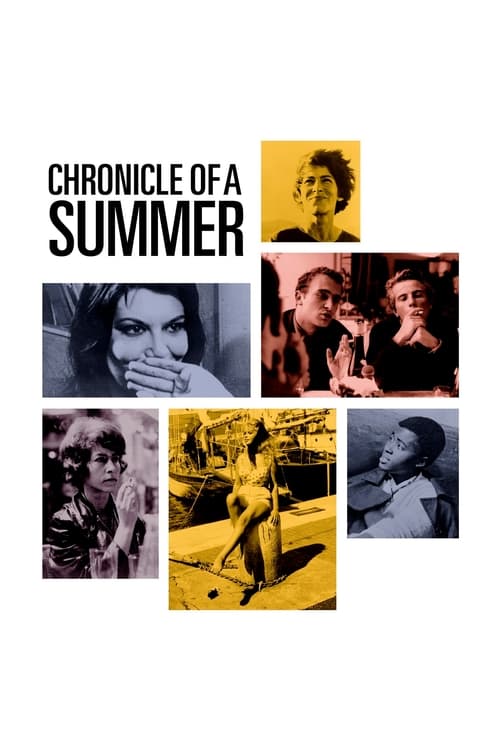
Chronicle of a Summer
1961 · Jean Rouch
For when you're curious about people — when you want faces and voices instead of plot, and a film that makes you think about truth-telling for days after. More stimulating than soothing, but warm at its core.
What it's about
In the summer of 1960, a filmmaker and a sociologist take lightweight cameras onto the streets of Paris and ask strangers a disarming question: are you happy? They follow the answers into homes and workplaces — a factory worker, students, a Holocaust survivor, an African student — as conversations about work, love, race, and war open up. Then they screen the footage back to the participants and film the argument about whether any of it was honest.
The experience
Intimate and quietly electric — you're eavesdropping on real people thinking out loud, and some moments land with startling emotional force. It feels casual and searching at once, and by the end it has you questioning what 'real' on camera even means.
The craft
This is the film that new lightweight cameras and portable sync sound made possible: handheld, walking, talking, catching life at conversational range for the first time. Its boldest stroke is turning the filmmaking itself into the subject — the directors appear, question their own methods, and let their subjects judge the results. Rough-edged by design, and thrilling for it.
Why it matters
The founding work of cinéma vérité — the term was coined for this film — and its DNA runs through virtually all modern documentary and reality-based filmmaking.
Snapshot
Chronique d'un été is the founding text of cinéma-vérité — the film for which Edgar Morin coined the term itself, borrowing it from Dziga Vertov's "Kino-Pravda." Across the summer of 1960, the ethnographer-filmmaker Jean Rouch and the sociologist Edgar Morin turned a new generation of lightweight cameras and portable synchronous sound onto the streets and apartments of Paris, asking a deceptively simple question — "Are you happy?" — and then following the people who answered into longer, more searching conversations about work, love, race, war, and survival. The result is not a survey but an experiment: a film that openly treats its own making as an intervention into the lives it records, and that ends by screening its rushes back to its participants and filming their argument about whether any of it was true. Roughly ninety minutes long, shot in black-and-white 16mm, it is at once a portrait of a French moment — Paris in the shadow of the Algerian War and African decolonization — and a self-conscious laboratory for what a camera can and cannot extract from a human face. Its influence on documentary, on the reflexive turn in ethnography, and on the porous border between fiction and nonfiction is difficult to overstate.
Industry & production
The film was produced by Anatole Dauman's Argos Films, the Paris company that would also back Resnais, Marker, and later Bresson and Wenders — a firm temperamentally aligned with the essayistic and the experimental rather than the commercial. This matters: Chronicle of a Summer was conceivable as a financed project precisely because a producer existed who treated cinema as a form of inquiry. The production was modest in budget and crew by feature standards, organized less like a shoot than like a fieldwork campaign carried out over a single Paris summer.
The animating partnership was institutional as much as personal. Rouch came out of the Musée de l'Homme and the Comité du Film Ethnographique, with a decade of West African ethnographic filmmaking behind him; Morin came from sociology and film criticism, having written Le Cinéma ou l'homme imaginaire and an influential essay on the star system. Their collaboration fused an anthropologist's method with a sociologist's questions about modern alienation. The "cast" was assembled from Morin's and Rouch's overlapping circles — friends, acquaintances, and strangers met on the street — rather than through any casting process, which is part of the film's point. Where the record of exact contractual and budgetary arrangements is thin, it is genuinely thin, and I will not invent figures; what is securely established is the producer (Argos/Dauman), the collaborative authorship, and the summer-1960 Paris timeframe.
Technology
Chronicle of a Summer is inseparable from a specific technological threshold. Its makers were working at the precise moment when 16mm filmmaking became genuinely portable and synchronous sound became genuinely mobile. The decisive instrument on the sound side was Stefan Kudelski's Nagra — a battery-powered, lightweight reel-to-reel recorder capable of running in sync with a camera without a physical cable tether, using a crystal or pilot-tone synchronization principle. For the first time a recordist could walk through a crowd, into a café, up a stairwell, and keep speech locked to image.
On the camera side, the production was bound up with the development of lightweight, quieter 16mm reflex cameras associated with André Coutant and the Éclair firm — the lineage that would shortly produce the Éclair NPR. The film is frequently cited as a testing ground for prototype lightweight equipment, and Michel Brault's arrival from Canada brought both a camera sensibility and hands-on familiarity with shoulder-borne shooting. The exact model designations used day-to-day on this particular shoot are reported inconsistently in the literature, and I will flag that rather than assert a single spec; what is not in doubt is the historical fact the film embodies — that the convergence of the Nagra and a new class of portable camera made "the camera that walks" technically real, and that Chronicle was among the first films to fully exploit it.
Technique
Cinematography
The cinematography — principally the work of Michel Brault, with Roger Morillère and Jean-Jacques Tarbès among the operators — is the film's great formal breakthrough. Brault, trained in the National Film Board of Canada's "Candid Eye" tradition, brought a handheld, walking camera that moves with its subjects rather than observing them from a tripod. The most celebrated instance is the long tracking passage following Marceline Loridan as she walks alone through the deserted Place de la Concorde and the empty halls of Les Halles, speaking aloud the memory of deportation to Auschwitz. The camera's mobility is not decorative; it produces a new relation between body, space, and speech. Rouch later credited Brault explicitly with teaching French filmmakers how to hold and move the camera, and the influence ran directly into the French New Wave's own street shooting. The image style is unpolished by design — available light, grainy stock, the frame searching and adjusting — and that roughness reads as authenticity, a visual rhetoric the film helped to invent.
Editing
The footage was shaped in the cutting room by Jean Ravel, working from a very large quantity of material down to its final form. The editing is structurally crucial because the film is not built as a continuous chronicle but as a montage of encounters and registers: the street vox-pop "Are you happy?", the intimate single-subject confessions (Marceline, Angelo the Renault worker, the student Landry, Marilou), the group scenes around a dinner table, and finally the reflexive coda. Ravel's cutting establishes rhythm and juxtaposition — placing private testimony against social ritual, individual against collective — and, decisively, it preserves the film's two-part architecture in which the documentary proper is followed by the participants watching and judging it.
Mise-en-scène / staging
"Mise-en-scène" is a paradoxical category here, because the film's premise is to minimize staging — yet Rouch and Morin are constantly present as provocateurs, and that provocation is the staging. They convene the dinners, they pose the questions, they introduce strangers to one another. The opening conversation, in which they discuss with Marceline whether one can speak truthfully before a camera, frames the entire film as an arranged situation honestly acknowledged. Rouch's notion of the camera as catalyst — that filming can provoke a truth that would not otherwise surface, a "ciné-trance" or privileged moment — means the staging is invisible only to those who haven't watched the directors step into frame. The settings are deliberately ordinary: apartments, factory gates, a café terrace, the Saint-Tropez of a summer holiday, the corridors of the Musée de l'Homme.
Sound
Synchronous location sound is the film's nervous system. Because speech could now be captured live and on the move, the film could be about talk — about what people say when asked, how they hesitate, contradict themselves, and break down. The texture of overlapping voices, ambient street noise, and unguarded confession would have been impossible with the locked, studio-bound sound apparatus of the preceding era. The film's emotional peaks — Marceline's walking monologue, the tears and discomfort in the group scenes — depend entirely on the new mobility of the microphone.
Performance
The "performers" are non-professionals playing themselves, and the film is acutely interested in the instability of that arrangement. Marceline Loridan (later Marceline Loridan-Ivens), a survivor of Auschwitz, delivers the film's most indelible passage; Angelo, a Renault factory worker, embodies the question of labor and alienation; Landry and other African students raise decolonization and race directly, in a scene where the meaning of the number tattooed on Marceline's arm is discussed across a racial and historical divide. The young Régis Debray and others appear. The film's reflexive ending hinges on whether these people were "acting" — whether the camera made them perform — and their disagreement on that point is the film's final, unresolved performance.
Narrative & dramatic mode
The film has no plot in the conventional sense; its dramatic mode is inquiry structured as accumulation and then reflection. It moves from a question (happiness) outward to a cross-section of lives, and then folds back on itself. The genuinely radical structural device is the two-stage form: first the assembled documentary, then a screening of that documentary to its own subjects, and finally a closing walk-and-talk between Rouch and Morin through the Musée de l'Homme in which they openly assess whether the experiment succeeded — whether the film captured truth or only its appearance. This reflexive coda converts the film from a record into an argument about the possibility of records.
Genre & cycle
Chronicle of a Summer sits at the headwaters of cinéma-vérité, and it is best understood in relation to its near-twin and rival, the American "Direct Cinema" of Robert Drew, Richard Leacock, D. A. Pennebaker, and the Maysles brothers, which emerged at almost exactly the same moment (Primary, 1960). The two cycles shared the new portable technology but diverged in philosophy: Direct Cinema aspired to the fly-on-the-wall, an unobtrusive observer who does not intervene; cinéma-vérité, in Rouch and Morin's conception, embraced the camera as a participant and provocateur — the "fly in the soup" rather than the fly on the wall. Chronicle is the defining statement of the interventionist, reflexive branch, and the genre debate it crystallized has structured documentary theory ever since.
Authorship & method
Authorship here is doubled and openly so. Jean Rouch contributed the ethnographic method — "shared anthropology," the idea of filming as a collaborative encounter, and the practice of "feedback," screening footage back to subjects, which he had developed in his African work and which becomes the structural climax of this film. Edgar Morin contributed the sociological frame: the questions of happiness, work, and alienation in modern France, and the analytic self-consciousness about the film's own status. The two share directing credit, and the film is the product of their dialogue, including their on-camera disagreements.
The key collaborators are the engine of the film's innovation: cinematographer Michel Brault, who imported the mobile handheld aesthetic from the NFB and is credited by Rouch with reshaping how the camera moved, working alongside operators Roger Morillère and Jean-Jacques Tarbès; editor Jean Ravel, who built the film's montage and two-part architecture from a mass of footage; and producer Anatole Dauman of Argos Films, whose backing made the experiment possible. There is no composer in any conventional sense — the film's "score" is the recorded sound of voices and the city — and there is no script in the ordinary meaning; the "writing" is the structure of questions and the editing. Where individual crew attributions are reported with minor variation across sources, I note that rather than overstate certainty.
Movement / national cinema
The film belongs to French cinema's early-1960s ferment and stands adjacent to, though distinct from, the Nouvelle Vague. Rouch's earlier ethnographic features — especially Moi, un Noir (1958) and Jaguar — were openly admired by Jean-Luc Godard, and the New Wave's appetite for location shooting, natural light, improvisation, and direct sound runs parallel to Rouch's practice; Chronicle is the documentary pole of the same technological and aesthetic revolution. It is also a landmark of French ethnographic and sociological cinema, rooted in the Musée de l'Homme tradition, and a founding work of the international documentary new wave that the portable apparatus enabled simultaneously in France, Canada (Brault, Groulx), and the United States.
Era / period
The film is saturated with its precise historical moment: the summer of 1960. The Algerian War is an unspoken and sometimes spoken pressure; the wave of African independences (the "Year of Africa," with Congo's independence) surfaces directly through the African students; the memory of the Second World War and the Holocaust lives in Marceline's body and testimony; and the anxieties of industrial labor and consumer modernity animate Angelo's story. The "Are you happy?" question is itself a period instrument — a probe into the malaise and aspiration of a Western European society between postwar reconstruction and the upheavals to come. The film captures, almost by accident, a France on the threshold.
Themes
The film's governing theme is the very possibility of truth on film — whether a camera elicits authenticity or manufactures performance, a question it refuses to resolve and instead dramatizes. Around that core cluster its social subjects: happiness and its absence; alienated labor and the rhythms of the working week; the persistence of historical trauma into ordinary life; race, colonialism, and the limits of cross-cultural understanding (the table scene where Marceline's tattoo is discussed); love, loneliness, and intimacy; and the relation between the individual confession and the collective condition. Underlying all of it is a reflexive theme of method itself — the ethics of looking, the responsibility of the filmmaker to the filmed, and the idea that observation is never neutral.
Reception, canon & influence
Within film culture, Chronicle of a Summer was received as a manifesto-work, and Morin's accompanying essay "Pour un nouveau cinéma-vérité" gave the movement its name and program. Over the following decades it ascended to the documentary canon as one of the most important nonfiction films ever made, routinely taught as the origin point of reflexive and participatory documentary.
Its influences backward are clear: Vertov's Kino-Pravda, named in the very term cinéma-vérité; the NFB's Candid Eye tradition that Brault carried into the production; and Rouch's own prior ethnographic cinema, which had already pioneered feedback screenings and the camera-as-participant in West Africa. The enabling precondition was the Nagra-plus-portable-camera technological leap shared across continents.
Its legacy forward is vast. It defined one of the two great branches of modern documentary — the interventionist, self-reflexive lineage that runs through Chris Marker, the personal and essayistic documentary, and decades of films that put the filmmaker inside the frame. Its feedback principle anticipated participatory and collaborative documentary practice and reshaped visual anthropology, where Rouch became a foundational figure. Bill Nichols's later taxonomy of documentary modes effectively canonizes the "reflexive" and "participatory" modes that Chronicle exemplifies. And by insisting that filming is an act that changes what it films — that the honest course is to show this rather than hide it — it set a standard of epistemological candor against which documentaries are still measured. Few films have done more to define what nonfiction cinema could be.
A Deleuzian reading
A woman walks alone across the Place de la Concorde.
The full Deleuzian reading of Chronicle of a Summer →
Reception
It won the Critics' Prize at Cannes in 1961 as a provocative experiment, and has since hardened into a founding text — the film that gave 'cinéma vérité' its name and its manifesto, capped by a Criterion canonization in 2013.
How Chronicle of a Summer was received, from release to now →
Influences: the films it descends from and the films it influenced
- Man with a Movie Camera (1929) — Supplies the 'kino-pravda'/film-truth program the movement renamed cinéma-vérité, including the on-screen reflexivity of showing the apparatus (camera, editor, projection) as part of the subject.
- Les Maîtres fous (1955) — Rouch's own ethnographic method here — handheld participant-camera and the practice of screening footage back to subjects (feedback) — is the technique he carries directly into Chronicle's feedback-screening climax.
- Moi, un noir (1958) — Establishes Rouch's collaboration with non-professionals voicing their own lives over location footage, the 'people as themselves' staging that structures Chronicle's interviews.
- Les Raquetteurs (1958) — The NFB Candid Eye film where cinematographer Michel Brault forged the mobile, walking handheld 16mm aesthetic he then imported into Chronicle, reshaping how Rouch's camera moved.
- Nanook of the North (1922) — Extends Flaherty's participatory ethics—collaborating with subjects and screening footage back to them—into reflexive cinéma vérité, making the on-site-feedback method explicit.
- Le Joli Mai (1963) — Takes Chronicle's Paris street-interview survey ('are you happy?') and montage-of-encounters directly, extending the questioning vox-pop method into an essayistic city portrait.
- Chronique d'un été's heir — Titicut Follies (1967) — Inherits the lightweight synchronous-sound montage-of-encounters built in the cutting room from a mass of footage, though pushing toward institutional observation rather than reflexive provocation.
- David Holzman's Diary (1967) — Directly satirizes/extends Chronicle's reflexive premise that filming changes what it films, putting the filmmaker inside the frame and interrogating the camera-as-catalyst.
- Sans soleil (1983) — Carries forward the essayistic, self-reflexive documentary branch Chronicle founded — the filmmaker's voice inside the frame meditating on the truth-status of the images.
- Shoah (1985) — Builds entirely on the camera-as-catalyst interview, where the filmmaker's on-camera provocation elicits testimony rather than recording pre-existing speech — Rouch's participatory method at feature scale.
- Sherman's March (1986) — The first-person diaristic documentary descends from Chronicle's reflexive coda and Morin's self-analysis, with the director narrating his own filming as the subject.
- Roger & Me (1989) — Puts the filmmaker physically inside the frame as provocateur-participant, the interventionist documentary mode that Chronicle's camera-as-catalyst established.
- Tongues Untied / reflexive mode (1989) — Exemplifies Nichols's 'reflexive' and 'performative' modes that taxonomize Chronicle's innovations, foregrounding the filmmaker's positioned subjectivity and the constructed nature of the document.
- Close-Up (1990) — Extends the feedback principle and non-professionals-as-themselves into a hybrid where subjects re-enact their own lives before the camera, blurring document and provocation as Rouch did.
- Grey Gardens (1975) — Uses the same portable synchronous-sound rig for intimate long takes, but the subjects' constant address to the camera reveals the camera-as-catalyst dynamic Chronicle theorized.
- The Gleaners and I (2000) — Late realization of the reflexive-participatory lineage: Varda films herself filming, foregrounding the encounter and her own hand, the digital-era heir to Rouch and Morin's on-camera self-questioning.
- Aguirre, the Wrath of God (1972) — Rouch's cinéma vérité method — embedding the camera within authentic situations and treating found behavior, real environments, and discovered events as dramatic material — is the direct methodological ancestor of Herzog's staging of the Amazon expedition in actual river conditions with non-professional participants.
- Primary (1960) — Parallel exploitation of the same Nagra-plus-lightweight-camera leap for synchronous sound on the move, but as fly-on-the-wall observation — the non-interventionist twin to Chronicle's interventionist branch.
- Pour la suite du monde (1963) — Brault again drives the handheld synchronous-sound method, and the film adopts Rouch's catalyst principle — provoking subjects to revive an event for the camera ('cinéma direct' / lived cinema).
- Le Bonheur (1965) — Shares Morin's sociological inquiry into happiness in modern France using non-professional presence and available-light location shooting in the New Wave register Chronicle helped seed.
- Breathless (1960) — Rouch and Morin used the same Cameflex lightweight camera technology on Paris streets in the same production period, but inverted Breathless's post-sync approach — developing synchronous direct sound to pursue vérité authenticity rather than studio-controlled post-dubbing — the parallel track of the same camera-technology revolution.
- The Look of Silence (2014) — Origin of the camera-as-provocation method — staging an artificial pretext (here the eye exam) that catalyzes suppressed truth rather than passively observing it.
Similar films
- Sans Soleil (1983) — influence & lineage
- Happiness (1965) — influence & lineage
- Primary (1960) — influence & lineage
- Man with a Movie Camera (1929) — influence & lineage
- The Gleaners and I (2000) — influence & lineage
- Take It All (1963) — shared sensibility
- Night and Fog (1956) — shared sensibility
- La Jetée (1962) — shared sensibility
All the films related to Chronicle of a Summer →