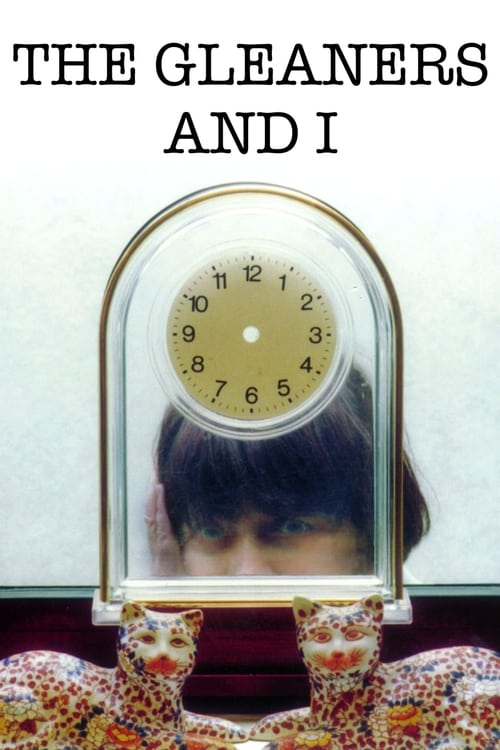
The Gleaners and I
2000 · Agnès Varda
For when you want your faith in human decency topped up — a companionable, big-hearted watch that makes you think without ever lecturing. Perfect for a reflective evening alone or with someone you like talking to afterward.
What it's about
Armed with a lightweight digital camera, Agnès Varda travels France to meet gleaners — people who gather what the harvest leaves behind. She finds them stooping in potato fields, combing Paris markets after closing, salvaging from dumpsters out of need, principle, or art, and gradually admits she's one of them: a gleaner of images, faces, and stray moments, including glimpses of her own aging hands.
The experience
Warm, curious, and quietly profound — it rambles the way a great conversation does, funny one minute and piercing the next. You come away lighter, and looking at discarded things (and people) differently.
The craft
Varda was in her seventies when she picked up one of the new handheld DV cameras, and the film crackles with the freedom it gave her — pocket-sized digressions, happy accidents left in, a dance she performs with a swinging lens cap. The essayistic structure looks casual but is precisely built, each detour circling back to waste, dignity, and time.
Why it matters
A landmark of the personal documentary that showed what consumer digital cameras could do in a master's hands, and the film that introduced Varda to a whole new generation — launching the late-career flowering that made her a beloved figure worldwide.
Snapshot
The Gleaners and I (French: Les Glaneurs et la glaneuse) is Agnès Varda's first-person digital-video documentary about gleaning — the age-old practice of gathering what a harvest leaves behind — and, by extension, about all forms of salvage: rural gleaners stooping in reaped potato and grape fields, urban scavengers combing market stalls and dumpsters after closing, artists who build from cast-off materials, and Varda herself, who "gleans" images with a lightweight camera. The French title is untranslatable in the English one: les glaneurs (the male gleaners) et la glaneuse (and the female gleaner) names Varda as one of her own subjects. What begins as an inquiry into a vanishing peasant custom widens into a meditation on waste, poverty, dignity, recycling, and the filmmaker's own aging body and mortality. Made when Varda was in her early seventies, it became both a late-career triumph and a landmark of the digital-documentary turn — one of the works most often cited when critics date the moment small consumer cameras changed what documentary could be.
Industry & production
The film was produced by Varda's own company, Ciné-Tamaris, the artisanal production house she had run since the 1950s and through which she retained authorship and control of her catalog. This is the essential industrial fact about the picture: it is a self-produced, low-budget essay film made outside the commercial feature system, financed and organized on a scale that a single filmmaker with a tiny crew could sustain. The economy of the production is inseparable from its subject — a film about making use of the discarded is itself made cheaply, with consumer and prosumer equipment, by a director who describes herself as gleaning.
The Gleaners and I premiered in 2000 (screening at Cannes that year, out of competition) and went on to unusually wide festival circulation and critical acclaim for a personal documentary, collecting numerous critics'-association and festival honors over the following year. I will not cite specific award tallies or box-office figures, as I cannot verify exact numbers; what is well established is that the film was a critical success disproportionate to its modest means and that it revived and broadened Varda's international reputation. Its reception was strong enough that Varda returned to her subjects and made a follow-up, The Gleaners and I: Two Years Later (Deux ans après, 2002), revisiting the people she had filmed and reading viewer mail — an epilogue that doubles as evidence of the original's reach.
Technology
The single most historically important fact about the film's technology is that Varda shot much of it on small handheld digital video cameras (Mini-DV–class consumer/prosumer equipment). The lightweight, inexpensive, long-recording digital camera is not merely a tool here but a theme: Varda repeatedly reflects on how the new cameras let her work alone, film her own hand with the other hand, and keep rolling cheaply enough to capture the accidental. The picture is routinely invoked in histories of documentary as an early, self-aware demonstration of what the DV revolution made possible around the turn of the millennium — an intimacy, mobility, and first-person immediacy that 16mm and video of the previous generation did not afford a septuagenarian director working essentially solo.
The technology also generates one of the film's signature passages: the "dance of the lens cap," in which Varda, forgetting to switch off the camera, lets it swing on its strap and film the cap bobbing to music. She keeps the "mistake" and scores it, turning a technical accident — the kind cheap continuous recording invites — into a small found-footage poem. The film mixes this DV material with other formats and photographic stills; it is not formally purist, but its governing sensibility is that of the handheld digital camera as a democratizing, personal instrument.
Technique
Cinematography
The visual style is deliberately unpolished and hand-held, prizing proximity and contingency over composition. Varda operated a camera herself for much of the film, and she used additional camera operators for other passages (the credited camera work is shared among several operators); I would flag that precise per-shot attributions are not something to assert firmly. The cinematography's recurring gestures are intimate and reflexive: the famous shot of Varda's own aging hand filmed in close-up against a passing landscape, "capturing" trucks between her fingers; her gray hair and spotted skin studied unsentimentally; the low, stooping angles that mirror the gleaner's bend to the ground. Interpolated throughout are images of paintings — above all Jean-François Millet's The Gleaners (Des glaneuses, 1857) and works by Jules Breton — so that the digital, contingent image is constantly held against the canonical, composed one.
Editing
Editing is where the film's essayistic intelligence lives. Varda structures it as an associative wander rather than a thesis-and-evidence argument, drifting from field to market to museum to junk-artist's studio by metaphor and rhyme rather than logic. The cutting incorporates the accidental (the lens-cap dance), the self-reflexive (Varda narrating her own process), and the digressive (a return to her subjects, objects she has kept). Varda's editing method is inseparable from her lifelong concept of cinécriture — "cine-writing" — the idea that a film is authored at every level, including the cut, as a writer composes prose. The editing is credited to Varda with a co-editor; the associative, first-person shaping is unmistakably hers.
Mise-en-scène / staging
Because it is a documentary of encounter, "staging" mostly means selection and framing of the real: Varda choosing whom to follow and how to place herself within the frame. Yet the film contains genuinely composed, quasi-authored images — the arrangement of heart-shaped potatoes she gleans and keeps; her performative "capturing" of trucks; a lawyer in judicial robes reading the penal code's gleaning statutes while standing incongruously in a cabbage field, and again in a vineyard. These staged tableaux, half-documentary and half-essayistic conceit, are the connective tissue between the observed world and Varda's authorial voice.
Sound
Sound comprises Varda's own first-person narration — intimate, curious, wry, often musing aloud — layered over location sound and a music track. The film uses original scoring (Varda's longtime musical collaboration with composer Joanna Bruzdowicz is part of her body of work, and contemporary and popular songs, including rap, also appear; I would not overstate the exact cue-by-cue attribution). The narration is the spine: it is what converts observation into essay, allowing Varda to move from a farmer's field to a reflection on her own hands within a single breath.
Performance
There are no actors; the "performances" are the self-presentations of real people, drawn out by Varda's evident warmth. The film's gallery of subjects is its great strength: rural gleaners defending an ancient right; Alain, a market-gleaner living in a shelter who holds a master's degree, eats discarded produce on principle as much as necessity, and teaches French literacy to immigrants in the evenings; a psychoanalyst-turned-winemaker (Jean Laplanche) reflecting on the vine; junk-and-assemblage artists who make work from salvage. Varda's own on-screen presence — self-deprecating, mortal, delighted — is the film's central performance, the glaneuse of the title.
Narrative & dramatic mode
The dominant mode is the first-person essay film: not a reported argument with an invisible narrator but an openly authored, digressive, subjective inquiry in which the filmmaker is a character and the act of filming is part of the subject. There is no plot; coherence comes from a governing metaphor (gleaning) elastic enough to gather potatoes, dumpster-divers, recycling, outsider art, and a filmmaker's mortality under one figure. The dramatic engine is association and discovery — the pleasure of watching a curious mind connect a Millet canvas to a bin of unsold market vegetables to its own wrinkling skin.
Genre & cycle
It is a documentary, but more precisely a personal / essay documentary in the lineage that runs through the French Left Bank and Chris Marker. Within Varda's own career it belongs to a cycle of self-implicating, self-portraiting works that would culminate in The Beaches of Agnès (Les Plages d'Agnès, 2008) and Varda by Agnès (2019); The Gleaners and I is often read as the film in which her documentary practice becomes explicitly autobiographical and reflexive. In the broader documentary field it sits at the head of the turn-of-the-millennium wave of DV-enabled, first-person nonfiction.
Authorship & method
This is an auteur documentary in the fullest sense: conceived, narrated, partly shot, and shaped by Varda through her own Ciné-Tamaris, under her governing idea of cinécriture. Varda is the writer, director, narrator, an on-screen subject, and a camera operator. The collaborators the film depends on are the camera operators who supplemented her handheld work and the co-editor with whom she cut the associative structure; her long musical association with composer Joanna Bruzdowicz belongs to the wider authorship of her filmography. I would rather understate than misattribute specific technical credits here — the verifiable point is that the division of labor is unusually collapsed into a single authorial figure, which is precisely what the new digital tools enabled and what the film is partly about.
Varda's method is worth naming directly: she treats research, encounter, digression, and even error as material to be gathered and composed, so that the film enacts its own thesis. Gleaning becomes a theory of authorship — the filmmaker as someone who stoops to collect what others pass over and finds use and beauty in it.
Movement / national cinema
Varda is historically linked to two French formations. She is often called the "grandmother of the French New Wave" for La Pointe Courte (1955), which prefigured the Nouvelle Vague, and she is properly grouped with the Left Bank (Rive Gauche) filmmakers — Chris Marker and Alain Resnais above all — whose work was more literary, documentary-inflected, essayistic, and politically engaged than that of the Cahiers du cinéma directors. The Gleaners and I is a late flowering of exactly that Left Bank sensibility: the essay form, the social conscience, the montage of image and idea. It is French national cinema of a particular, artisanal, personal kind, made outside the industrial mainstream.
Era / period
The film is a document of France at the turn of the millennium (2000), and it reads its own moment: rural depopulation and the survival of ancient customary rights; urban poverty and homelessness in an affluent society; the waste produced by industrial agriculture and supermarket retail; and an emerging ecological consciousness about recycling and reuse. Technologically it belongs to the very first years of accessible digital video, and it is often used to mark that threshold. It is also, unmistakably, a late-career film — a work made by an artist in her seventies openly contemplating time and death, which gives its period specificity a second, biographical layer.
Themes
Its central figure is gleaning as salvage and as ethics — the insistence that what society discards retains use, value, and dignity, whether the gatherer acts from necessity, thrift, protest, or art. From that root branch its major themes: waste and abundance in a consumer economy; poverty and dignity, treated without pity or exposé; recycling and ecology; art from the discarded, in the assemblage artists and, self-referentially, in Varda's own found-footage aesthetic; law and custom, dramatized by the recitation of gleaning statutes; and, most personally, aging, time, and mortality, in Varda's study of her own hands and hair. Uniting them is the reflexive claim that filmmaking is itself a form of gleaning — the glaneuse gathers images as the gleaners gather potatoes.
Reception, canon & influence
Critically, the film was received as a major work and a late-career high point, praised for its warmth, intelligence, formal freedom, and the way it turned a modest DV documentary into a first-person essay of unusual depth. It is now firmly canonical: routinely taught, frequently placed on lists of the greatest documentaries, and treated as a defining example of the essay film. (I am describing the consensus of critical and scholarly reception rather than citing specific published rankings or awards counts, which I cannot verify precisely.)
Influences on the film (backward). The most explicit are pictorial: Millet's The Gleaners and Jules Breton's paintings of gleaning women, which Varda visits in museums and uses as the film's iconographic anchor. Formally, it descends from the Left Bank essay tradition — Chris Marker's reflexive, first-person nonfiction above all — and from Varda's own prior practice, including the socially attentive fiction of Vagabond (Sans toit ni loi, 1985) and her documentary work. The camera aesthetic is enabled by, and in dialogue with, the turn-of-the-century embrace of lightweight digital video.
Legacy (forward). The Gleaners and I is one of the works most often credited with legitimizing the first-person DV documentary as a serious artistic form, helping to open the door for the personal, essayistic, digitally shot nonfiction that proliferated in the following two decades. It deepened Varda's own late turn toward self-portraiture, leading directly to The Beaches of Agnès and Varda by Agnès, and it is central to the substantial scholarly reassessment of Varda in the 2000s–2010s that recognized her as a foundational figure of European art cinema. Its immediate legacy is also literal: the 2002 follow-up, The Gleaners and I: Two Years Later, exists because the film generated enough response to warrant a return — a rare case of a documentary whose reception became part of its own continuing text.
A Deleuzian reading
Start with the hand.
The full Deleuzian reading of The Gleaners and I →
Reception
No flop-to-classic story here — it was embraced immediately, sweeping critics' non-fiction prizes after its 2000 Cannes premiere. But its stature has kept climbing: Sight & Sound's 2014 poll ranked it among the greatest documentaries ever made, and Varda's late-career beatification turned it into her signature work for a whole new generation.
How The Gleaners and I was received, from release to now →
How to watch The Gleaners and I: what to notice on a first viewing
- Watch Varda 'catch' passing trucks between her fingers on camera. She films her own aging hand in close-up, closing her fingers around trucks rushing by on the motorway as if gleaning them. The gesture tells you filming and gleaning are the same act before she ever says so.
- Notice paintings of gleaners appear between scenes of real gleaners. Varda keeps returning to Millet's and Breton's canvases, holding the composed painted image against her own loose, contingent digital footage. The contrast keeps asking what changes when the same subject moves from oil paint to handheld video.
- Listen for Varda's voice sliding from a subject to herself. Her narration moves from a farmer's field to a thought about her own hands within a single sentence, without ever announcing the turn. The narration is what turns plain observation into something closer to a personal essay.
- Watch how Alain describes his own choice to eat what's discarded. Varda lets him explain himself at length, on principle as much as necessity, rather than narrating over him or summarizing his situation. He gets to define his own dignity instead of having the film define it for him.
- Notice how the film drifts from a field to a museum. Varda's editing moves by rhyme and association rather than argument, letting one image suggest the next instead of building toward a thesis. The film thinks out loud in front of you instead of handing you a conclusion.
The whole guide to watching The Gleaners and I, with the keys for a rewatch →
Influences: the films it descends from and the films it influenced
- Sans Soleil (1983) — Marker's reflexive first-person essay-film architecture — a wandering narrator-voice threading disparate footage into associative meditation — is the direct formal template Varda adapts for her own gleaning digressions.
- Le Joli Mai (1963) — Its street-level interview method — the roving filmmaker stopping ordinary people and letting their testimony accumulate into a social portrait — is the encounter-based documentary practice Varda extends among gleaners and dumpster foragers.
- Vagabond (Sans toit ni loi) (1985) — Varda's own tracking-shot attention to a marginal drifter and to those living off society's edges seeds the ethnographic sympathy and lateral-gleaning gaze she turns documentary in 2000.
- Daguerréotypes (1976) — Her earlier neighborhood documentary establishes the cinécriture method of composing a film from close observation of humble working lives, the authorial 'writing-with-camera' she later collapses into a solo DV practice.
- Land Without Bread (Las Hurdes) (1933) — Buñuel's ironic, essayistic voice-over set against images of extreme rural poverty pioneers the reflexive commentary-over-documentary form that Varda's first-person narration inherits and warms.
- News from Home (1976) — Akerman's autobiographical voice laid over long observational takes models the first-person diary-documentary in which the filmmaker's own subjectivity becomes the organizing structure.
- F for Fake (1973) — Welles's playful, digressive editing that foregrounds the author-as-trickster shaping truth from fragments prefigures Varda's self-aware montage where error and accident are kept as material.
- Man with a Movie Camera (1929) — Varda turns the digital video camera on her own filming hands, on the battery indicator, on the apparatus's physical limitations, making the technology of image-making a co-subject alongside her documentary material — the most direct transposition of Vertov's apparatus-exposure into the digital era.
- Land of Silence and Darkness (1971) — Varda's essayistic-cumulative documentary — DV camera as intimate witness, accumulation of encounters without resolved argument, filmmaker's inquiry visible in the form — extends Herzog's essayistic mode into a peripatetic first-person register; the handheld DV camera occupies the same ethical position in Varda's grammar that the Nagra-era 16mm rig occupies in Herzog's.
- Chronicle of a Summer (1961) — Late realization of the reflexive-participatory lineage: Varda films herself filming, foregrounding the encounter and her own hand, the digital-era heir to Rouch and Morin's on-camera self-questioning.
- The Beaches of Agnès (2008) — Varda deepens the self-filmed autobiographical essay-documentary pioneered here, again using her own body, hands, and voice as the camera's subject and the film's connective tissue.
- Faces Places (2017) — It carries forward the roving-encounter DV method — the small crew wandering rural France, meeting overlooked workers, and composing a warm first-person essay from those meetings.
- Varda by Agnès (2019) — Her final lecture-film formalizes cinécriture as explicit self-commentary, extending the reflexive authorial voice that Gleaners made central to her late self-portraiture.
- Cameraperson (2016) — Johnson builds a first-person essay-documentary out of gleaned offcuts from her own career footage, treating discarded and accidental material as salvageable authorship exactly as Varda theorizes.
- Tarnation (2003) — A landmark of the cheap-DV first-person documentary Gleaners helped legitimize, assembling an autobiographical essay through associative montage of self-shot and found personal footage.
- Aftersun (2022) — Varda films herself with a consumer DV camera and makes its material qualities — compression, reach, intimacy — explicit subjects within the essay; Wells inherits this reflexive relationship between consumer technology and the limits of what can be recovered from footage, applying it to the Hi8 sequences as epistemological argument.
- Nomadland (2021) — First-person docufiction that dignifies society's discarded people and scavengers—the humanist attention to the economically overlooked that shapes Nomadland's regard for its subjects.
- No Other Land (2024) — Legitimizes the intimate prosumer-digital handheld diary — a lightweight consumer camera wielded by the author as first-person essay tool, the technological and formal predicate of the film's self-shot aesthetic.
- Minding the Gap (2018) — Uses the lightweight consumer digital camera as an extension of the author's own hand and eye, turning cheap portable gear into a first-person essayistic instrument — the ethos behind Liu's gimbal-mounted mobility.
- Black Box Diaries (2024) — Varda trains a lightweight consumer DV camera on herself, pioneering the essayistic author-in-frame with her own body and hands as material that Ito's video-diary shooting follows.
- The History of Concrete (2026) — Consumer-grade DV handled by the director alone, with the camera's accidents — lens caps, drifting hands, low-light mush — kept in the cut as evidence of the shooting body, and digressions permitted to outlast their pretext.
- The Oldest Person in the World (2026) — Turns the lightweight digital camera into a first-person prosthesis, the maker filming her own aging hand in close-up and folding the accident of the format into the essay; it licenses both Green's self-shot camera and the frank use of consumer-grade generations as evidence of elapsed time.
- My Winnipeg (2007) — Maddin's 'docu-fantasia' shares the personal-essay-documentary mode where a wry first-person narrator digresses freely, blending memory, place, and invention into associative structure.
- Los Angeles Plays Itself (2003) — An essay-film built entirely by gleaning and re-reading found images — repurposing others' discarded footage into a first-person argument — mirroring Varda's salvage-as-authorship thesis.
- The Emperor's Naked Army Marches On (1987) — Hara's method of the filmmaker actively participating in and provoking encounters, rather than observing neutrally, parallels Varda's on-screen, hands-in participatory documentary presence.
- Grizzly Man (2005) — Herzog's authorial voice-over that openly editorializes and finds personal meaning in another's discarded footage exemplifies the same first-person essayistic curation of found material.
- Nostalgia for the Light (2010) — Guzmán composes a meditative first-person essay-documentary through associative montage linking cosmic and human 'gleaning' — sifting desert remains — echoing Varda's salvage-and-mortality braid.
- Sherman's March (1986) — A solo-scaled handheld first-person road essay in which the filmmaker registers herself obliquely — hands, hair, reflections — while wandering a country, the same self-inscribing nonfiction travelogue mode.
- The Look of Silence (2014) — Sibling in foregrounding the filmmaker's own presence and complicity as an ethical frame, the reflexive authorship Oppenheimer makes central.
Similar films
- Varda by Agnès (2019) — influence & lineage
- Sans Soleil (1983) — influence & lineage
- Vagabond (1985) — shared sensibility
- Cléo from 5 to 7 (1962) — shared sensibility
- Jacquot (1991) — shared sensibility
- Jeanne Dielman, 23, quai du Commerce, 1080 Bruxelles (1976) — shared sensibility
- Happiness (1965) — shared sensibility
- Dry Leaf (2026) — shared sensibility