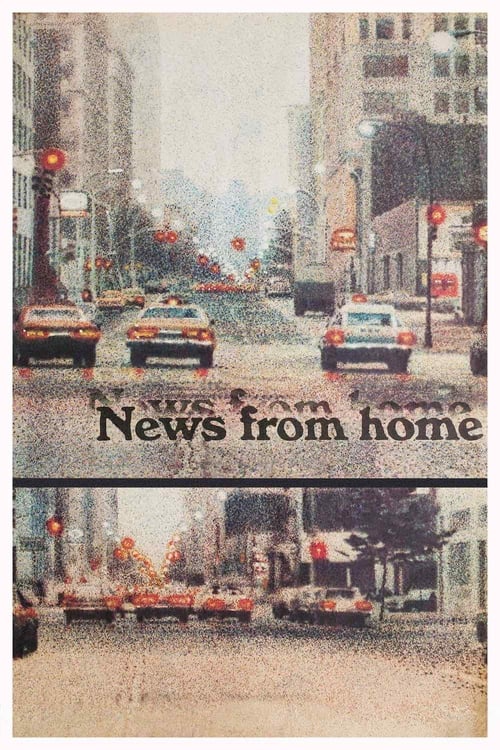
News from Home
1977 · Chantal Akerman
For when you're feeling far from home, or from someone — a late-night, lights-off film for sitting with longing rather than escaping it. Demanding if you need incident; transporting if you surrender to it.
What it's about
Long, steady shots of mid-1970s New York — subway cars, storefronts, empty morning avenues, rush-hour crowds — while on the soundtrack Chantal Akerman reads letters her mother sent from Brussels during the years Akerman lived there as a young woman. The mother asks for news, sends money worries and family gossip, wonders why her daughter doesn't write; the city, vast and indifferent, never answers.
The experience
Hypnotic and slow-burning, with an emotional charge that accumulates almost invisibly — homesickness, guilt, and love seep out of the gap between the tender voice and the impassive streets. By the final shot it has become unexpectedly overwhelming.
The craft
The design is radical in its simplicity: fixed frames and long tracking shots of the city, street noise mixed so loud it sometimes drowns the mother's letters, which Akerman reads herself in a flat, hurried voice. It's also a stunning time capsule of gritty 1970s New York — grain, neon, and graffiti-covered subways that look magnificent on a big screen.
Why it matters
A touchstone of personal, formally rigorous filmmaking that helped define the diary film and the modern city portrait — and a key work in the career that made Akerman one of the most influential directors of her generation.
Snapshot
News from Home is a feature-length documentary essay in which Chantal Akerman films the streets, subways, storefronts, and traffic of mid-1970s New York City while reading aloud, in voiceover, letters her mother sent her from Brussels during the years Akerman lived in the city at the start of the decade. Nothing is dramatized and no one is interviewed; the film's whole structure is the collision between two things that never meet on screen — the impersonal, gorgeously indifferent surface of the metropolis and the anxious, tender, faintly manipulative maternal voice that keeps asking why the daughter does not write more often. Coming two years after Jeanne Dielman, 23 quai du Commerce, 1080 Bruxelles (1975) had made her one of the most discussed young directors in European art cinema, News from Home consolidated Akerman's signature: fixed or slow-tracking long takes, durational patience, and a rigorous refusal of psychological explanation that nevertheless produces overwhelming emotion. It is at once a city symphony, an epistolary self-portrait, and a study of distance — geographic, generational, and affective.
Industry & production
The film belongs to the low-budget, artisanal wing of European auteur production that Akerman helped define. It was made through Paradise Films, the Brussels company Akerman ran with her longtime producer and collaborator Marilyn Watelet, in association with French backing — the record consistently attaches the Institut National de l'Audiovisuel (INA) and the production entity Unité Trois to the project, making it a Belgian–French co-production of the kind that sustained Akerman's work throughout her career. The scale was small: a tiny crew, no stars, no sets, and the city itself supplied free of charge. This economy was not incidental but constitutive — Akerman's aesthetic of long, unmanned-looking takes and real locations was in part a discipline learned from working with almost no money in the New York underground earlier in the decade.
The film's origins lie in autobiography. Akerman had come to New York around 1971–72 as a very young woman, supporting herself with odd jobs while absorbing the American experimental film scene. The letters read on the soundtrack date from that period; the images were shot later, on a return to the city, so that News from Home is structurally a work of return — an adult filmmaker re-photographing the site of her youth while voicing her mother's words from that same time. Precise budget and box-office figures for a film of this kind are not part of the reliable public record, and it would be misleading to assign any.
Technology
News from Home was shot on 16mm color film, the standard gauge of the independent and avant-garde cinema Akerman moved within, and later circulated in 35mm blow-up for theatrical exhibition. The technology is unshowy but decisive in two respects. First, the film relies on the capacity of the fixed tripod-mounted camera and the slow mechanical dolly or vehicle-mounted track to hold a shot far past conventional duration — the "technology" here is really the willingness to let the film run. Second, and crucially, it depends on location-recorded direct sound: the roar of traffic, the screech and rumble of the subway, sirens, and crowd noise are captured on site rather than cleaned up or subordinated in a mix. The interplay between that documentary sound and Akerman's separately recorded voiceover is the film's central technical gesture, and it works precisely because the ambient track is allowed its full, un-tamed presence.
Technique
Cinematography
The camera is the work of Babette Mangolte, the French-born cinematographer whose collaborations with Akerman — including Jeanne Dielman — are among the most important director–cinematographer partnerships in 1970s art cinema. Mangolte's images here are frontal, composed, and unhurried. Streets recede in deep perspective toward a vanishing point; storefronts and diners are framed head-on like Walker Evans photographs set very slightly in motion; the camera sits inside subway cars and on station platforms, observing passengers who occasionally notice and stare back at the lens, puncturing the film's apparent detachment. The most celebrated movements are slow lateral or forward tracks — down a street, along a subway platform — and the famous closing passage shot from a departing Staten Island Ferry, the lower-Manhattan skyline receding across the water into haze. The color is the flat, slightly grimy palette of pre-gentrification 1970s New York, and Mangolte's refusal of dramatic angle or expressive lighting is exactly what gives the city its "impersonal and beautiful" quality.
Editing
The cutting is patient and architectural: shots are held to their full duration and abutted without transitional flourish, so that the film advances as a sequence of discrete, contemplative blocks rather than a flowing continuity. Structurally the film builds from more enclosed spaces — interiors, subway cars, narrow streets — toward the great opening-out of the final ferry shot, giving the whole an emotional arc of release and departure achieved almost entirely through duration and ordering. The editorial logic is that of structural and durational cinema rather than dramatic economy; where a specific editor is credited on a film like this, viewers should consult the print's own titles, and I won't attach a name I can't verify.
Mise-en-scène / staging
There is, in the conventional sense, no staging — Akerman does not arrange her human subjects, direct passersby, or dress her locations. The "mise-en-scène" is instead a matter of where the camera is planted and how long it stays: the choice of frame, the height and frontality of the setup, the decision to let a subway car fill and empty itself of anonymous riders. Akerman's discipline is to treat the found world as if it were composed, so that the ordinary city acquires the formal rigor of a tableau. The people who wander into frame — and occasionally the ones who lock eyes with the camera — are unrepeatable documentary accidents held within an exactingly controlled formal system.
Sound
Sound is where News from Home does its deepest work. The soundtrack layers two irreconcilable registers: the direct, often deafening ambient noise of New York, and Akerman's own voice reading her mother's letters (in French) in a flat, sometimes rapid, affect-suppressed delivery. Repeatedly the city drowns the voice — a passing train or a surge of traffic swallows whole sentences of the mother's news — so that the act of listening becomes strained and partial. This is not a mixing error but the film's thesis made audible: the daughter's new world literally overpowers the maternal voice reaching across the ocean, and the spectator is placed in the position of straining to hear a mother who cannot be fully heard. The tension between attending to the words and surrendering to the noise reproduces, formally, the emotional predicament of migration and separation.
Performance
The only "performance" is vocal and it is Akerman's own. Reading her mother's letters, she adopts a deliberately unactorly monotone — hurried, undramatic, resisting sentiment — that paradoxically intensifies feeling by withholding it. The letters themselves are performances of a kind, too: the mother's characteristic mixture of love, worry, guilt-inducing reproach ("you don't write enough"), family news, and money sent, all voiced by the very daughter to whom they were addressed. That doubling — Akerman speaking her mother in her own body and breath — is the film's quiet, devastating conceit.
Narrative & dramatic mode
The film has no plot, no protagonist on screen, and no dramatic conflict in the ordinary sense. Its mode is essayistic and epistolary: a documentary of place organized around a one-directional correspondence (we hear only the mother's letters, never the daughter's replies). Meaning accrues not through event but through accumulation, repetition, and duration — the slow build of a mother's recurring anxieties against the city's endless indifference. If there is a dramatic arc, it is spatial and emotional rather than causal, moving from immersion in the city toward the valedictory distance of the closing departure. The film thus sits at the boundary of documentary and autobiographical essay, using nonfiction materials (real streets, real letters) to compose an intensely personal interior portrait.
Genre & cycle
News from Home draws on and reinvents the city symphony — the 1920s tradition of Ruttmann's Berlin: Symphony of a Great City and Vertov's Man with a Movie Camera — but strips out their montage exuberance and utopian rhythm, substituting stillness, duration, and a private voice. It also belongs to the first-person / autobiographical documentary and the structural-film lineage of the New York avant-garde. Within Akerman's own oeuvre it forms part of an informal cycle of place-and-displacement works that runs through her career — a body of films (later including D'Est and From the Other Side) built on traveling, observing, and letting landscape carry the weight of history and memory.
Authorship & method
The controlling authorship is unambiguously Akerman's: she conceived the project, selected and read the letters, and imposed the durational formal system that governs every frame. Her method here — patient fixed takes, real time, refusal of explanatory commentary, and the transformation of autobiographical material into rigorous form — is continuous with Jeanne Dielman and would define her practice for decades. The decisive collaborator is cinematographer Babette Mangolte, whose frontal, unhurried compositions give the film its particular gravity and whose partnership with Akerman was one of the defining creative relationships of the director's early career. On the production side, Marilyn Watelet and Paradise Films provided the artisanal infrastructure that made such uncompromising work possible. The film has no composer and no musical score — its "music" is the direct sound of the city — and that absence is itself an authorial decision. Where the print credits an editor or additional sound personnel, those names belong on the record; I've avoided guessing at attributions I cannot confirm.
Movement / national cinema
Akerman is a Belgian filmmaker, and News from Home is a Belgian–French production, yet the film is emblematically transnational: a Brussels-born, French-speaking director filming New York and voicing letters that cross the Atlantic. It sits at the intersection of several currents — European art cinema of the 1970s, the feminist avant-garde with which Akerman was closely associated after Jeanne Dielman, and the American structural film movement she had absorbed during her New York years (the work of Michael Snow, in particular, is frequently cited as formative for her sense of duration and the fixed frame). The film therefore belongs less to a single national cinema than to a cosmopolitan, cross-Atlantic experimental tradition, while its themes of emigration and maternal correspondence are inseparable from Akerman's specifically Belgian-Jewish family history.
Era / period
The film is a document of a very specific moment — New York City in the mid-1970s, at its most economically distressed and physically worn, the era of fiscal crisis, graffitied and failing subways, and a rougher, pre-gentrification streetscape. That period texture is now part of the film's value as an unintended archive; Mangolte's frames preserve a city that has largely vanished. In film-historical terms it belongs to the high period of the international art film and of feminist and structural experimentation, the late-1970s window in which durational, anti-illusionist cinema found genuine critical currency. The letters, meanwhile, belong to the slightly earlier moment of Akerman's own arrival, so the film holds two adjacent early-1970s temporalities in tension.
Themes
The governing theme is distance in all its forms: the ocean between Brussels and New York, the gap between mother and daughter, the space between a spoken word and its being heard. From this flow the film's other concerns — emigration and exile, and the pull between the security of home and the anonymous freedom of the new city; maternal love as both sustenance and pressure, the letters' tenderness laced with reproach and guilt; memory and return, since Akerman re-photographs the site of her own past; and, more obliquely, the burden of family history — Akerman's mother was a survivor of Auschwitz, and though the letters speak only of mundane domestic matters, that unspoken weight has been widely felt to underlie the film's charge, a reading Akerman's own later, more explicit work retrospectively supports. Finally, the film is about listening itself — the labor of attending to a voice the world keeps drowning out.
Reception, canon & influence
News from Home arrived while Akerman was, after Jeanne Dielman, a leading figure of the international art and feminist avant-garde, and it was received within that frame — as a rigorous, demanding, and deeply moving extension of her durational method, championed by critics and programmers attuned to structural and feminist filmmaking even as it remained, like all such work, a minority taste rather than a commercial success.
Its influences flowing in are legible: the city-symphony tradition; the American structural film of Michael Snow and his New York contemporaries, whose fixed frames and long durations Akerman transposed to documentary and autobiography; the still photography of the American street; and, most intimately, the epistolary raw material of her own family correspondence.
Its legacy flowing out has grown steadily. The film is now firmly canonical, routinely cited among Akerman's essential works and central to her rediscovery and canonization in the years around and after her death in 2015, when major retrospectives and restorations brought her whole body of work to new audiences. It stands as a foundational text for the contemporary first-person and essayistic documentary, for the slow-cinema sensibility that prizes duration and observation, and for filmmakers working at the seam of autobiography, place, and voiceover. Its central device — reading a parent's letters over images of a world the parent will never see — has become a widely echoed strategy in personal nonfiction. More broadly, News from Home helped establish the possibility that a film could be intensely emotional while refusing every conventional tool of emotion, a paradox that remains one of Akerman's most enduring gifts to the medium.
A Deleuzian reading
Begin with the last shot.
The full Deleuzian reading of News from Home →
Reception
Long treated as a footnote to Jeanne Dielman, it's been fully canonized in the last decade — riding the post-2015 Akerman reappraisal all the way into the Sight & Sound top 100 in 2022, where the 'minor' New York experiment turned out to be one of her most loved films.
How News from Home was received, from release to now →
How to watch News from Home: what to notice on a first viewing
- Watch storefronts and streets framed flat, straight on. Babette Mangolte shoots New York frontally and unhurried, streets receding to a hard vanishing point, like Walker Evans photographs set slightly in motion. The city looks composed rather than merely captured, held at a formal distance from you.
- Listen for a train or traffic swallowing a whole sentence. As Akerman reads her mother's letters, the city's direct sound, trains, sirens, traffic, repeatedly drowns her voice out mid sentence, never cleaned up in the mix. You end up straining to hear a mother the city keeps refusing to let you fully hear.
- Listen for Akerman's flat, hurried voice reading the letters. Akerman reads her mother's own words in a deliberately unactorly monotone, hurried and affect-suppressed, resisting the sentiment the letters themselves carry. Withholding the feeling from her voice is exactly what makes the feeling land harder.
- Notice how long each shot is held before the next one. Shots run to their full duration and are simply set beside each other with no transitional flourish, so the film advances as discrete, contemplative blocks rather than flowing continuity. You're given time to just sit in a place, not hurried past it toward a next event.
- Watch the subway riders who notice the camera and stare back. Akerman doesn't direct her human subjects, and occasionally someone in frame locks eyes with the lens, puncturing the film's apparent detachment for a second. For a moment you feel the camera get noticed back, like it's sitting there as its own body in the scene.
The whole guide to watching News from Home, with the keys for a rewatch →
Influences: the films it descends from and the films it influenced
- Manhatta (1921) — Establishes the still-photographer's frontal, static framing of New York — geometric compositions of streets, ferries, and canyon architecture held as tableaux rather than covered dramatically — the exact photographic gaze Akerman and Mangolte apply to 1970s Manhattan.
- Berlin: Symphony of a Great City (1927) — Founds the city-symphony structure of building a portrait of a metropolis from accumulated observational fragments of transit, crowds, and daily rhythm with no protagonist, which Akerman inherits as her plotless organizing armature.
- Man with a Movie Camera (1929) — Models the reflexive city film that foregrounds the apparatus recording the street — Akerman retains Vertov's frank confrontation between camera and passersby, especially the direct returned stares of subway riders who look back into the lens.
- Empire (1965) — Pioneers the fixed-camera real-time durational take as an act of pure attention, holding a single New York view far past narrative necessity — the durational endurance principle Akerman transposes to her static street corners.
- Wavelength (1967) — The structural-film template of a single sustained formal operation governing an entire film's duration; Akerman explicitly credited her exposure to Snow's New York milieu with teaching her to let a fixed shot run long enough that time itself becomes the subject.
- La Région Centrale (1971) — Extends structural film's premise that a predetermined formal system, not human drama, dictates every frame — the rigorous rule-bound impersonality Akerman adopts by letting duration and framing be governed by system rather than editorial choice.
- Letter from Siberia (1957) — Invents the essay-film method of spoken epistolary commentary set against documentary images of a place, establishing the letter-over-landscape device Akerman strips of Marker's irony and rebuilds as affectless maternal recitation.
- India Song (1975) — Voice-off reading letters laid over city images that never depict the speaker — a direct extension of India Song's principle that the soundtrack is autonomous from, and haunts, the image.
- Sans Soleil (1983) — Builds an entire feature from letters read aloud in a flat female voice over travel footage the correspondent narrates but the images resist, extending Akerman's paradox of intimate epistolary voice floating detached above indifferent documentary imagery.
- Los Angeles Plays Itself (2003) — A first-person essay-documentary portrait of a city assembled from accumulated footage and delivered in a deadpan, unemphatic narration, inheriting Akerman's model of the city as subject articulated through voice laid over image rather than plot.
- Goodbye, Dragon Inn (2003) — Slow-cinema descendant that holds static long takes of near-empty architecture in real time with only ambient direct sound and no score, prizing duration and patient observation exactly as Akerman's structural-durational sensibility taught.
- The Gleaners and I (2000) — A first-person autobiographical essay-documentary in which the filmmaker's own subjectivity organizes observed reality, extending Akerman's foundational move of turning personal material and voice into the governing structure of a nonfiction film.
- No Home Movie (2015) — Akerman's final film closes the circle by making her mother the literal on-screen subject in long static domestic takes, the endpoint of the maternal-distance epistolary project News from Home began with the mother present only as a read voice.
- Cameraperson (2016) — Constructs first-person autobiography from accumulated observational footage the filmmaker shot elsewhere, letting place, ambient sound, and duration carry emotion without dramatization — the contemporary personal-nonfiction grammar Akerman helped found.
- Wings of Desire (1987) — Akerman holds long observational shots on New York's found street surfaces while reading personal letters as voice-over, constructing city portrait as lyric text; Wings of Desire scales this grammar through Steadicam glide and Handke's overlapping whispered voices to treat all of Berlin as a collective interior.
- Code Unknown (2000) — Akerman's structural examination of a displaced subject in urban space through peripheral framing and diegetic sound without emotional guidance is the direct formal model for Code Unknown's treatment of the Romanian characters and Amadou navigating Paris as structurally constrained space.
- Aftersun (2022) — Archival city footage set against a text whose emotional content it neither illustrates nor confirms; the structural gap between what is recorded and what is known — the camera's incapacity to capture another's interiority — is the essay-film position Wells inherits for her interrogative use of video.
- Peter Hujar's Day (2025) — Recorded private correspondence read aloud over 1970s New York images treats voice as recovered archive of a vanished city — the same fusion of spoken document and downtown-NY texture.
- Dreams (2024) — Reads first-person written prose aloud over static, available-light shots, fusing autobiographical text and unembellished image exactly as Dreams stages 'experience into writing.'
- Varda by Agnès (2019) — The diaristic first-person voiceover laid over autobiographical images, pioneering the personal essay-diary register Varda's curated self-presence extends.
- Hôtel Monterey (1972) — Akerman and Mangolte's immediately prior New York film rehearses the identical grammar — frontal, unpeopled or sparsely peopled fixed frames of corridors and lobbies held in silence — making it the direct methodological precursor within her own filmography.
- Jeanne Dielman, 23 quai du Commerce, 1080 Bruxelles (1975) — The immediately preceding feature codifies Akerman's signature frontal medium-shot framing at a fixed low height and real-time durational observation of the mundane, the fully-formed system News from Home reapplies to a city instead of an apartment.
- D'Est (1993) — Akerman scales up News from Home's method with extended slow lateral tracking shots past waiting faces and winter streets, carrying forward the same voiceless observational accumulation of a place and its anonymous crowds.
- 13 Lakes (2004) — Carries structural film into the American landscape with rigorously fixed long-duration frames and pure location direct sound absent any music or commentary, sharing Akerman's inheritance from Snow while trading the city for wilderness.
- One Sings, the Other Doesn't (1977) — The epistolary voice: Akerman reads her mother's letters over city footage the same year Varda structures her film around postcards exchanged between the two friends, both turning correspondence into narrative armature.
- The Man Who Sleeps (1974) — Sibling pairing of a female voice (the mother's letters) with static shots of anonymous urban surfaces, staging the same seam between a speaking woman's words and a silent city of solitude.
Similar films
- Wavelength (1967) — influence & lineage · often watched together
- Sans Soleil (1983) — influence & lineage
- The Meetings of Anna (1978) — often watched together
- Ulysses' Gaze (1995) — often watched together
- Gertrud (1964) — often watched together
- Blue (1993) — often watched together
- Jeanne Dielman, 23, quai du Commerce, 1080 Bruxelles (1976) — shared sensibility
- Portrait of a Young Girl at the End of the '60s in Brussels (1994) — shared sensibility