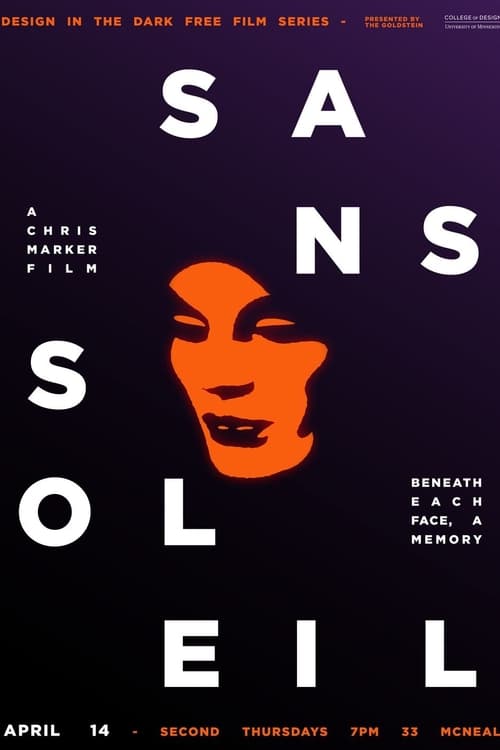
Sans Soleil
1983 · Chris Marker
For a contemplative solo evening when you want to think and drift rather than follow a story — closer to reading a great book than watching a movie. Not for when you're tired; it asks for your full, unhurried attention.
What it's about
A woman reads letters from a globe-trotting cameraman, and his images unspool alongside her voice: street festivals and sleeping commuters in Japan, independence struggles in Guinea-Bissau, volcanic Iceland, the hills of San Francisco. There's no plot — instead the film wanders the world asking how memory works, what images preserve, and what time erases.
The experience
Hypnotic and drifting, like being read to by the smartest, most curious person you know while a slideshow of the entire planet plays. It rewires how you look at ordinary footage; ideas keep surfacing days later.
The craft
Chris Marker built it from over a decade of his own travel footage, bound together by narration that turns a travelogue into a meditation — the editing makes leaps between continents feel like one continuous thought. The grainy 16mm images and murmuring voice cast a genuine spell in a quiet room.
Why it matters
It's the film that defined the essay film as a form, and generations of documentary makers, video artists, and filmmakers who blend footage with voiceover trace their lineage straight back to it.
Snapshot
Sans Soleil is the canonical essay film: a feature-length meditation assembled by Chris Marker from footage gathered across more than a decade of travel, bound together not by plot but by a voice. A woman narrates letters she has received from a fictional cameraman named Sandor Krasna, whose images and reflections move between Japan, the West African nations of Guinea-Bissau and Cape Verde, Iceland, and San Francisco. The film has no protagonist, no scenes in the dramatic sense, and no argument that can be paraphrased without loss. Instead it advances a sustained inquiry into how memory works, how images stand in for the past, and whether history can be remembered at all. Released in 1983, when Marker was in his early sixties and already a defining figure of the French documentary left, it became the work by which the essay film as a form is most often defined and taught. Its title borrows from Mussorgsky's song cycle Sunless (Sans Soleil), signaling at the outset that the film thinks of itself as a composition in movements rather than a report.
Industry & production
The film was produced through Argos Films, the Paris company run by Anatole Dauman, a producer whose catalog is nearly a syllabus of postwar European art cinema — Resnais's Hiroshima mon amour and Night and Fog, work by Bresson, Godard, and Wenders, and Marker's own earlier films. Argos was precisely the kind of producer that could sustain a project with no conventional commercial prospect: a non-fiction feature with no stars, no narrative, and footage shot piecemeal over years on Marker's own travels. Sans Soleil belongs to a mode of production specific to Marker — that of the artisan working largely alone, shooting his own material with lightweight equipment, then constructing the film at the editing table. The precise financing and budget figures are not well documented in the public record, and I will not invent them; what is clear is that the film was made cheaply by feature standards, its costs concentrated in time and post-production rather than crew and shooting infrastructure. It circulated through art houses, festivals, and cinematheques rather than commercial release, and its reputation grew through critical writing and repeated programming rather than box office. Two narration tracks were prepared — a French version read by Florence Delay and an English version read by Alexandra Stewart — reflecting an international art-cinema distribution strategy in which the spoken commentary, the film's spine, had to cross languages.
Technology
Sans Soleil is partly a film about the image technologies of its moment, and it puts them on screen as subject matter. Marker shot with small, portable cameras that allowed him to work unobtrusively in train cars, streets, ceremonies, and shops, capturing the everyday textures — sleeping commuters, department-store crowds, television flickering in the background — that the film treats as the raw material of memory. The most conspicuous technological gesture is the recurring passage through "the Zone," named for the forbidden region in Tarkovsky's Stalker, where a fictional video artist called Hayao Yamaneko feeds documentary images through an analog video synthesizer (an EMS Spectre, an early electronic image-processing device) until they dissolve into pulsing fields of solarized color. Marker's argument, voiced in the narration, is that these degraded, abstracted images are in some sense more honest than the originals — that an image already acknowledged as unreliable is preferable to one that pretends to document truth. The film thus stages, in 1983, a confrontation between photochemical cinema and the emerging electronic image, treating video manipulation not as a gimmick but as a philosophical instrument. This fascination with apparatus — and with the way each new technology reshapes what can be remembered — runs throughout and prefigures Marker's later embrace of multimedia and digital work.
Technique
Cinematography
The photography is observational and handheld, the work of a single traveler rather than a crew. Marker favors the candid and the fleeting: faces caught in passing, the eyes of commuters who do not know they are filmed, animals, rituals, advertisements, shrines. There is little of the composed, tripod-bound frame of classical documentary; instead the camera behaves like an attentive eye, drawn to detail and gesture. Crucially, the footage was almost entirely shot silent, which liberates the image from any obligation to synchronize with a recorded event and lets it float free, available to be re-contextualized by voice and music. The famous opening — three children on a road in Iceland in 1965, an image the narrator says she has never been able to link to any other and so leaves isolated on a black screen — establishes the film's whole method: the photographed instant as something both preserved and orphaned, evidence that explains nothing.
Editing
Editing is where Sans Soleil actually exists; it is a film authored in the cut. Marker juxtaposes material separated by thousands of miles and many years — a Japanese festival against a Bissau market, a San Francisco hillside against an Icelandic volcano — so that meaning arises through rhyme, contrast, and the running commentary rather than continuity. The structure is associative and recursive: motifs (cats, owls, sleep, the dead, the act of looking back) recur and accumulate resonance, and the film loops back on its own images, including the celebrated extended sequence in which Krasna retraces the locations of Hitchcock's Vertigo through San Francisco, reading that film as the only one capable of depicting "impossible memory, insane memory." The cut carries the intellectual work; the film essentially thinks by montage.
Mise-en-scène / staging
Because the footage is documentary, there is little staging in the fiction-film sense — Marker did not direct the events before his camera. The mise-en-scène lies instead in selection and arrangement, and above all in the invented framework that surrounds the images: the conceit of letters from a cameraman, the fictional video artist of the Zone, the imagined correspondent. Marker constructs a layered authorial apparatus — a director presenting a woman reading the words of a man describing the work of another man — so that the "world" of the film is built in the relationship between image and commentary rather than in front of the lens.
Sound
Sound is the film's organizing intelligence. The spoken commentary — letters from Krasna, read in the past tense ("He wrote me…") — is not illustrated by the images so much as set in counterpoint with them, often pulling against what we see. The musical score, credited to Michel Krasna (one of Marker's pseudonyms), is largely electronic, its synthesized textures binding the disparate footage into one sensibility and echoing the Zone's processed imagery. Ambient sound, music cues, and the steady grain of the narrating voice are layered so that the soundtrack becomes the connective tissue the images themselves lack. The film is, in a real sense, written for the ear.
Performance
There are no performances in the dramatic sense. The human presences are the unaware subjects of documentary footage and, decisively, the narrating voice — Alexandra Stewart in English, Florence Delay in French. That voice is the film's single sustained "performance": measured, intimate, melancholy, holding the vast geographic and temporal sprawl together through tone alone. The decision to have a woman read the words of a male cameraman introduces a further displacement, a gap between speaker and author that suits a film preoccupied with mediation and second-hand memory.
Narrative & dramatic mode
Sans Soleil refuses narrative as ordinarily understood. There is no story, no causal chain, no resolution. Its mode is the essay — a first-person inquiry that ranges freely, doubles back, contradicts itself, and follows the movement of thought rather than the logic of events. The epistolary frame supplies the only thread: a correspondence whose writer is absent and whose reader relays his words to us. This produces a peculiar temporal stance — everything is recollected, narrated after the fact, already memory by the time we encounter it. The film's drama, such as it is, is intellectual and emotional: the tension between the desire to remember and the impossibility of doing so faithfully, and the recognition that the images meant to preserve the past may instead displace it.
Genre & cycle
The film is documentary only in the loosest sense and is better described as an essay film, the form with which Marker's name is now almost synonymous. It belongs to a lineage of first-person, reflective non-fiction that runs from the travelogue and the ciné-tract through Marker's own earlier work such as Letter from Siberia (1957), with its famous demonstration of how the same footage changes meaning under different commentary. Within Marker's filmography it forms a clear pair with La Jetée (1962), his earlier short composed almost entirely of still photographs: both are meditations on time, memory, and the photographic image, and Sans Soleil explicitly nods to that precursor. It also sits within a broader 1980s expansion of personal, diaristic, and politically reflective documentary.
Authorship & method
Sans Soleil is among the purest examples of single-author cinema. Chris Marker — the chosen name of Christian-François Bouche-Villeneuve, a writer, photographer, and filmmaker famously resistant to interviews and self-display — conceived, shot, wrote, and edited it. The collaborators credited in the film are, characteristically, partly Marker himself in disguise: the cameraman Sandor Krasna and the composer Michel Krasna are fictions, and the video artist Hayao Yamaneko of the Zone is another mask. This layering of personae is not a joke but a method: Marker distributes his authorship across invented figures so that the film can interrogate its own making and refuse the authority of a single documentary "I." The genuine external collaborators are few and concentrated in the apparatus of release — the producer Anatole Dauman at Argos Films, and the two narrators, Alexandra Stewart and Florence Delay, whose voices give the written commentary its body. Beyond these, the film is essentially the product of one sensibility working in solitude, which is precisely why it can sustain so personal and idiosyncratic a voice.
Movement / national cinema
Marker is conventionally associated with the Left Bank group (the Rive Gauche), the loose cohort of French filmmakers — Alain Resnais, Agnès Varda, Henri Colpi, Armand Gatti — who were contemporaries of the Nouvelle Vague but more literary, more political, and more drawn to documentary and to the problem of memory than the Cahiers-bred directors of the New Wave proper. Where the Cahiers group came out of film criticism and cinephilia, the Left Bank came out of writing and the broader arts, and Resnais's Hiroshima mon amour and Night and Fog are its emblematic works. Sans Soleil belongs to this French tradition of intellectually ambitious, essayistic, politically engaged cinema, and to a national-cinema context in which the boundary between filmmaker and writer was unusually porous.
Era / period
The film is a product of the early 1980s but draws on footage and concerns reaching back into the 1960s and 1970s. It carries the residue of the political commitments of that earlier period — Marker had been deeply involved in militant and collective filmmaking around 1968 and after — but turns from direct activism toward reflection, registering a characteristic early-1980s mood of taking stock. Its preoccupation with the African post-independence experience, particularly the legacy of Amílcar Cabral and the trajectory of Guinea-Bissau after liberation, reflects the disenchantment of a generation reckoning with what became of revolutionary hope. At the same time its fascination with Japanese consumer modernity, electronic imagery, and television marks it as a film alert to the new media landscape then taking shape.
Themes
The governing theme is memory — not as nostalgia but as a problem. The film asks how we remember, what role images play in remembering, and whether the photographic and cinematic record preserves the past or quietly replaces it. From this flow its other concerns: time and its non-linearity; the unreliability of the image and the ethics of looking, especially across cultural distance; mortality and the presence of the dead, figured in shrines, ceremonies, and animals; and the contrast between Japan's hyper-mediated modernity and Africa's wounded post-colonial history. The Vertigo sequence crystallizes it all — Hitchcock's spiral becomes Marker's emblem for memory that loops, falsifies, and cannot be escaped. Running beneath everything is a melancholy humility: the recognition, voiced from the first image of the Icelandic children, that some moments resist all our efforts to fix their meaning.
Reception, canon & influence
Sans Soleil was received by critics as a major and difficult work, and its standing has only risen with time; it is now routinely cited among the essential documentaries and essay films, taught widely, and preserved as a touchstone of the form. (Its presence on critics' canons, including the long-running international polls, reflects this durable esteem, though I will not attribute specific rankings I cannot verify here.) Its influences run backward to Dziga Vertov's kino-eye and the Soviet montage tradition, to the literary essay in the line of Montaigne, to the Left Bank's memory cinema and especially Resnais, and to Marker's own earlier experiments with commentary and the still image. Hitchcock's Vertigo enters the film directly as both subject and lens. Forward, its legacy is enormous: it effectively codified the modern essay film and shaped the work of later filmmakers who think through montage and voice — among them figures associated with the form's expansion such as Harun Farocki, Patricio Guzmán, and a generation of gallery-based and personal-documentary artists. Its meditation on technology and the image anticipated Marker's own later multimedia and digital projects, and its influence is felt wherever non-fiction cinema treats the image as something to be questioned rather than trusted. More than forty years on, Sans Soleil remains the work to which discussions of the essay film return.
A Deleuzian reading
The film hands you an image and then refuses to let it belong anywhere.
The full Deleuzian reading of Sans Soleil →
Reception
Never a flop-to-classic story — it was admired from the start — but its stature has only compounded: what played festivals in 1983 as a strange travel-diary is now routinely called the greatest essay film ever made, ranking third in Sight & Sound's 2014 poll of the greatest documentaries of all time.
How Sans Soleil was received, from release to now →
Influences: the films it descends from and the films it influenced
- Man with a Movie Camera (1929) — Vertov's kino-eye doctrine — the camera as a roving, montage-assembled organ that observes the world's textures — is the explicit formal scaffolding Marker invokes and reworks into his global travelogue editing.
- Vertigo (1958) — Marker literally re-shoots and annotates Hitchcock's San Francisco geography of obsessive return, borrowing Vertigo's spiral logic of memory, doubling, and the image that haunts as his model for filming places as sites of recollection.
- Hiroshima mon amour (1959) — Resnais's Left Bank technique of an intimate spoken text laid in counterpoint over documentary images of place — voice that excavates memory against what the camera shows — is the epistolary-commentary method Marker inherits and radicalizes.
- Letter from Siberia (1958) — Marker's own earlier proof-of-concept where the same footage is recommented three ways establishes the ironic, image-distrusting voiceover that Sans Soleil expands into a full essayistic system.
- Night and Fog (1956) — Resnais's montage of archival and present-tense footage bound by a literary commission (Cayrol's text) models the moral interrogation of the image — what footage can and cannot witness — that Sans Soleil turns on memory itself.
- La Jetée (1962) — Its companion experiment in still-image montage and voiceover narration of time and memory shares the exact apparatus — frozen photographs, a meditative narrator, recollection as form — that Sans Soleil sets back into motion with live video.
- News from Home (1977) — Akerman reads her mother's letters over static observational footage of New York, a parallel epistolary-frame essay where read text and silent urban image generate the same voiceover-counterpoint friction Marker exploits.
- F for Fake (1973) — Welles's free-associative editing and confessional narration that openly toys with the truth-claims of documentary footage runs alongside Marker's distrust of the image and his masked, unreliable authorial 'I.'
- Sans Soleil's montage forebear: A Movie (1958) — Conner's pioneering found-footage collage — meaning produced purely through the associative juxtaposition of disparate clips and sound — prefigures the associative-montage engine Marker drives with his world imagery.
- Mirror (1975) — Marker extends Mirror's offscreen narrator device into a full epistolary structure — letters read aloud by an unnamed woman — deploying the same grammar of personal observation interlaced with documentary footage to track the erosion of memory across cultures and historical time.
- Fata Morgana (1972) — Extends the disjunctive found-music essay structure Marker had pioneered — and which Fata Morgana directly absorbed — into a tripartite global essay where cultural dissonance between image and commentary becomes the epistemic organizing principle.
- Muriel, or the Time of Return (1963) — Constructs memory as montage with amateur and found-footage inserts under a disjunctive commentary track, descending from Muriel's amateur-footage insert and split sound/image.
- Images of the World and the Inscription of War (1989) — Farocki extends Marker's interrogation of the image-as-evidence — how machines and archives produce and conceal — building essayistic montage that questions photographs rather than trusting them, the core Sans Soleil method.
- Nostalgia for the Light (2010) — Guzmán's first-person poetic narration linking astronomy, memory, and political disappearance through associative montage is a direct descendant of Marker's essay-film voice braiding personal reflection with history.
- Sunless / Level Five (1997) — Marker's own later digital essay carries forward Sans Soleil's video-synthesizer 'Zone' aesthetic and pseudonymous interlocutor, treating electronic image-processing as a way to render memory's instability.
- The Gleaners and I (2000) — Varda's handheld digital first-person wandering, digressive narration, and self-aware montage of gathered images formalize the personal essay-film Marker codified, the same roving-eye-plus-commentary structure.
- Sans Soleil's heirs: Los Angeles Plays Itself (2003) — Andersen builds an entire film as commentary laid over other people's footage to interrogate how a city is imaged — Marker's question of what the image testifies to, applied through pure montage and essayistic voiceover.
- Cameraperson (2016) — Johnson assembles fragmentary global footage into a memoir about the ethics and unreliability of what a camera records, descending directly from Marker's masked-author, image-distrusting documentary essay.
- The Beaches of Agnès (2008) — Varda's self-portrait via associative montage of personal and found images, narrated as a reckoning with memory and the photographic trace, extends Marker's theme-of-memory-and-image essayistic form.
- Our Land (2026) — Defines the investigative essay-film form: roving archival fragments bound by a meditative, interrogative narration rather than plot, the discursive shape of Our Land's voice-over inquiry.
- Twelve Monkeys (1995) — Marker's essay on memory as unreliable image and time as non-linear experience is the philosophical substrate beneath La Jetée itself; Gilliam inherits its insistence that what the camera captures cannot be trusted as witness, which is the epistemic foundation of Cole's unresolvable psychosis-ambiguity.
- Wings of Desire (1987) — Marker's essay-film treats found city footage as philosophical meditation through a narrator's letters, establishing the city as temporal palimpsest and voice-over-over-image as the essay-film's structural grammar; Wings of Desire directly inherits this form, applying it to Berlin as an accumulation of historical layers.
- My Best Fiend (1999) — Marker's technique of building documentary argument through a voice-over that comments on rather than explains heterogeneous footage is the formal model for Herzog's essayistic interweaving of archival Kinski material with present-tense Amazonian location reflection.
- For All Mankind (1989) — Marker's essay-film practice of treating found and archival footage as material for phenomenological meditation rather than historical illustration is the intellectual tradition For All Mankind inhabits, even as Reinert strips Marker's voiceover and relocates the meditation into ambient score and duration alone.
- Reminiscences of a Journey to Lithuania (1972) — Mekas's diaristic handheld footage gathered into an associative first-person travel essay, narrated as memory rather than reportage, parallels Marker's personal-documentary assembly of fragmentary world-footage.
- The Hypothesis of the Stolen Painting (1978) — An essay-film voiceover reconstructs and destabilizes the meaning of its own images, the interpretive-commentary-over-images method Ruiz runs across his frozen paintings.
- Leila and the Wolves (1986) — Contemporary essay-film that assembles memory non-linearly through layered narration and collaged image, paralleling Srour's mosaic-tableaux editing across time and place.
- Memories of Underdevelopment (1968) — Direct heir to the essay-film of a single consciousness, weaving travel footage and reflexive voiceover into a meditation on memory, image, and how private perception fails to grasp history.
- The Man Who Sleeps (1974) — Descendant essay-film built on the seed's exact sound device — a female narrator voicing a male subject's words — extending image-plus-reflective-voice into a global meditation on memory and place.
- Baraka (1992) — Shares the globe-spanning associative-montage essay form, though Marker keeps the voiceover Baraka strips away — a sibling that defines Baraka's chosen silence by contrast.
- The House Is Black (1963) — Splits authorship of the voice — a woman reads a man's letters over montage she did not shoot — inverting the seed's Farrokhzad/Golestan division of narration, and treats poetic commentary as the editing logic that assembles otherwise unrelated footage.
Similar films
- La Jetée (1962) — influence & lineage
- Hiroshima Mon Amour (1959) — influence & lineage
- Night and Fog (1956) — influence & lineage
- The Gleaners and I (2000) — influence & lineage
- News from Home (1977) — influence & lineage
- Chronicle of a Summer (1961) — shared sensibility
- Samsara (2011) — shared sensibility
- Limite (1931) — shared sensibility
All the films related to Sans Soleil →