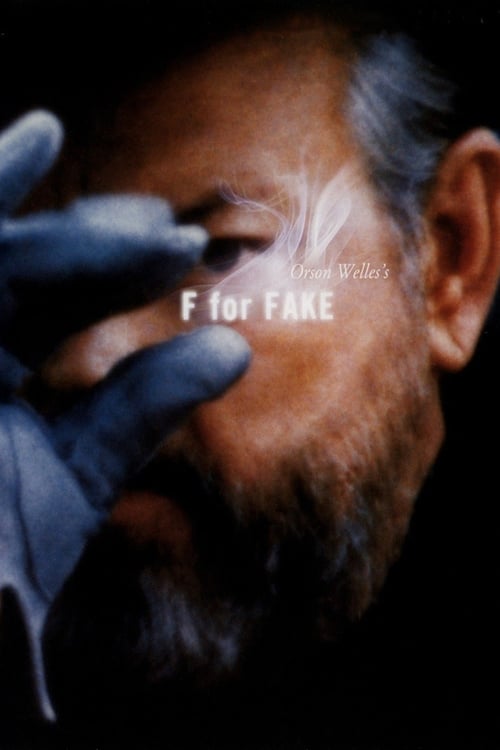
F for Fake
1973 · Orson Welles
For when you want to be dazzled and outsmarted — a playful brain-teaser of a documentary for a night when you're feeling curious rather than cozy. Great when a conventional movie feels too predictable.
What it's about
Orson Welles hosts a playful investigation into two magnificent frauds: Elmyr de Hory, the art forger whose fake Picassos and Matisses hang in real museums, and Clifford Irving, who wrote de Hory's biography before getting caught faking an autobiography of Howard Hughes. Welles — a lifelong trickster himself — keeps stepping into the frame, shuffling the evidence, and asking what separates a forger from an artist.
The experience
Fast, funny, and mischievous — it feels like a magic trick performed by someone who keeps telling you he's fooling you and fools you anyway. You come out delighted and slightly dizzy, questioning everything you just watched.
Performances
Welles is a magnetic host — part magician, part confessor — and the real-life charmers de Hory and Irving are so entertaining on camera that no screenwriter could have invented them.
The craft
The editing is the star: Welles cuts between interviews, staged scenes, and his own narration at a speed that was decades ahead of its time, building arguments through rhythm and juxtaposition. It's a masterclass in how assembly alone can create meaning — and mischief.
Why it matters
It essentially invented the modern essay film and became the touchstone for every documentary that questions its own truthfulness; it was also Welles's last completed major work, a wink of a farewell.
Snapshot
F for Fake is Orson Welles's meditation on fraud, authorship, and the ethics of illusion, assembled from footage shot primarily by French documentarian François Reichenbach and transformed—through an assault of rapid montage, direct address, and deliberate self-implication—into something unprecedented in the documentary canon. Its subjects are Elmyr de Hory, the Hungarian-born art forger who sold thousands of counterfeit Picassos, Matisses, and Renoirs to galleries and collectors across Europe and America, and Clifford Irving, the novelist who wrote a credulous book about de Hory's exploits before being exposed himself as the fabricator of a fraudulent "authorized" autobiography of Howard Hughes. At the center of both stories stands Welles himself, performing the role of host, conjurer, and ultimately the most candid faker in the room—acknowledging that cinema, magic, and the authorial persona are all species of the same confidence trick. Released in France as Vérités et mensonges ("Truths and Lies"), the film runs approximately 85 minutes and occupies a singular position at the intersection of essay film, autobiography, and playful epistemology.
Industry & production
The film's origins lie in footage shot by Reichenbach on Ibiza, where de Hory had established a comfortable semi-exile, trading on his notoriety and selling original works under his own name after the forgery schemes had largely unraveled. Irving, who also lived on Ibiza and had authored the 1969 biography Fake! about de Hory, participated in Reichenbach's documentary as both subject and guide. Welles—then deeply mired in the long, financially tortured production of The Other Side of the Wind—acquired rights to Reichenbach's material and undertook a radical reworking, adding new footage, his own performance segments, and a concluding fictional episode devised with his companion Oja Kodar. The co-production drew on French, Iranian, and West German financing. Its budget was modest by any standard, and the project gave Welles an outlet for sustained creative work at a moment when his larger projects were stalled.
The timing proved fortuitous, or perhaps uncanny: while Welles was editing, Irving's Howard Hughes hoax collapsed publicly in early 1972. Irving had submitted a forged manuscript to McGraw-Hill purporting to be Hughes's memoir, collected a substantial advance, and was exposed when Hughes himself, in an extraordinary telephone press conference, denied any involvement. The scandal was breaking news, and Welles folded it into the film's texture, allowing Irving's real-time exposure to deepen the argument that fakery begets fakery in an infinite regression. This responsiveness to current events—a documentary recut to absorb the unfolding world—gives the film some of its characteristic sense of intellectual vertigo.
Technology
F for Fake was shot primarily on 16mm film, the lightweight, mobile format that had enabled the cinéma vérité and Direct Cinema movements of the 1960s and that remained, in the early 1970s, the natural instrument of documentary observation and low-budget experimentation. Reichenbach's Ibiza footage—much of it handheld, unobtrusive, catching de Hory at work and at leisure—carries the grain and intimacy of the format. Welles's new material, including the extended opening sequence at a French train station (where he performs conjuring tricks for children) and the studio-like direct-address passages, extended the production across different stocks and conditions. The film was released theatrically in a 35mm blowup, accepting and even aestheticizing the grain that the transfer amplified. This deliberate impurity of image—no attempt to disguise the format's limitations—became part of the film's rhetorical argument: surfaces are exactly that.
Welles edited the film on a flatbed editing table using conventional film-editing methods of the period. The speed and complexity of the cut is a product of human labor at the splice, not electronic facilitation. There are no digital tools in the assembly; the montage density that defines the film was achieved by hand.
Technique
Cinematography
The cinematography is a composite identity, divided between Reichenbach's observational material—long lenses, available light, the patient surveillance of de Hory in his studio and among Ibiza's expatriate society—and footage shot for Welles's new sequences. Gary Graver, who had become Welles's primary cinematographer from the early 1970s and worked closely with him on The Other Side of the Wind, is among the credited camera operators for the new material, though the precise division of work across the production's multiple phases is not fully documented in the public record. The opening sequence of Oja Kodar walking through an unidentified urban street, attracting the appraising gazes of passing men, is shot with a quality of voyeuristic complicity—the camera as one more appraising eye—that makes it both a structurally playful introduction (beauty as a kind of forgery, the gaze as a kind of fraud) and an exercise in the objectifying male gaze that the film simultaneously critiques and enacts. The variety of cinematographic registers—newsreel roughness, controlled studio lighting for Welles's addresses, archival material, even brief clips from other films—is not inconsistency but argument: authenticity of style is as unstable as authenticity of authorship.
Editing
The editing is the film's most audacious technical achievement and the primary vehicle of its meaning. Welles supervised or executed an extraordinarily dense cut, with hundreds of shots deployed in rapid succession, sometimes within a single rhetorical flourish. This is not Eisenstein's collision montage in the classical sense—it is more associative, more playful, closer to the freely digressive editing of the personal essay than to dialectical argument. Cuts follow the logic of thought rather than continuity: a phrase of Welles's spoken narration triggers a visual rhyme, a visual rhyme triggers a counter-example, a counter-example produces an ironic juxtaposition. The effect is of a mind moving quickly and showing its tracks, reveling in the freedom to contradict itself. The editing also performs the film's central argument—that construction is inescapable, that every "document" is arranged by someone with intentions—by making the constructedness of the film maximally visible. The audience cannot forget they are watching an assembly.
Mise-en-scène / staging
Welles appears on screen from the opening moments as a performer, explicitly theatrical in his cape and hat, performing card tricks in a public space. This ostentatious self-casting as magician functions as the film's governing metaphor and ethical confession: he will deceive you, he is saying, and he wants you to know it. The staging of the Ibiza material—often using de Hory as an unreliable narrator and guide through his own story—exploits the documentary convention of the subject-led interview while undermining its claims to transparency. The concluding fictional episode, in which Kodar is said to have had an affair with Picasso who painted her portrait a hundred times and then destroyed the canvases when she refused to pose further, is staged with a smooth surface that formally mimics the rest of the film, forcing the viewer to apply the interpretive skepticism Welles has trained into them over the preceding hour.
Sound
Welles's voice—one of the most recognizable instruments in twentieth-century cinema—carries the film's narration with characteristic oratorical weight and self-mockery. The voice is itself a kind of forgery: authoritative, but performatively so, the authority and the performance inseparable. The film's music is drawn from multiple sources across its production and co-production context; the score contributes to the film's tonal variety, moving between grandeur and irony, though the specific compositional credits across the final cut are not fully established in the scholarship. Sound-image counterpoint is frequent—the narration often works against or complicates the image rather than simply glossing it.
Performance
De Hory emerges as a genuinely complex figure: vain, charming, self-exculpatory, and intermittently honest about his own extraordinary skill. His on-screen demonstrations of painting in the manner of major modernists are among the film's most striking passages—the ease and speed with which he produces a credible Matisse sketch raises genuine questions about where technical skill ends and forgery begins. Irving performs confidence and self-deprecation in alternating measures, a performance that acquired retrospective dimensions when his own fraud became public. Welles performs everything—authority, skepticism, complicity, candor—as a unified and self-aware theatrical act.
Narrative & dramatic mode
The film's most celebrated structural device is Welles's on-screen promise, delivered approximately twenty-five minutes in, that "for the next hour, every word of this film will be true." This declaration is itself a formal trap: by the time the Oja Kodar/Picasso fiction is introduced near the film's end, the promised hour has elapsed, and Welles acknowledges that he has broken his word—or rather, that the film has now entered disclosed fiction. The epistemological status of everything between the promise and the violation is thus retroactively destabilized. Did Welles begin lying before the hour ended? Was the promise itself a lie? The narrative mode is the personal essay—digressive, associative, first-person, willing to contradict itself—organized around a set of interlocking case studies that eventually folds back onto its own narrator as the final specimen of fakery under examination.
Genre & cycle
F for Fake is the landmark example—along with several of Chris Marker's contemporaneous films—of the essay film as a recognized mode within documentary. The essay film, as theorized in subsequent decades, is characterized by first-person enunciation, self-reflexive construction, the mixing of registers (documentary, fiction, archival, performed), and the foregrounding of the act of thinking rather than the presentation of an argument's conclusion. Welles did not invent the form—Marker's Letter from Siberia (1958) and La Jetée (1962) are earlier examples, and Dziga Vertov's Man with a Movie Camera (1929) is a distant ancestor—but F for Fake crystallized the form's possibilities in ways that subsequent filmmakers cite repeatedly. It also inaugurated, or substantially advanced, the self-reflexive documentary mode that would ramify into the mockumentary, the docufiction, and the openly constructed personal documentary.
Authorship & method
Welles is the film's dominant author in the deepest sense, which is also the film's central irony: a meditation on the instability of authorship produced by one of cinema's most aggressively individualist auteurs. His working method on the film was essentially that of a filmmaker working within found-footage constraints—appropriating, rearranging, re-narrating—elevated to a conceptual principle. Reichenbach's contribution as the originating documentarian is substantial; his footage provides the film's empirical backbone. Oja Kodar, who became Welles's partner in life and work during his long European exile, wrote the Picasso episode that closes the film—a significant authorial contribution to the film's most purely fictional and most thematically concentrated passage. Her authorship of the section is disclosed by Welles at the film's conclusion, in a gesture that simultaneously credits her and makes the disclosure itself another layer of the epistemological game. Welles had been struggling for years to complete The Other Side of the Wind, a film about an aging director (transparently autobiographical) whose identity as an artist is contested; F for Fake can be read as a companion piece in which those anxieties are addressed more directly and with more wit.
Movement / national cinema
The film is internationalist in production and sensibility, funded across French, Iranian, and West German sources and set largely in Ibiza, Paris, and various unspecified European locations. It belongs most naturally to the French tradition of the cinematic essay—associated with Marker, Agnès Varda, and the more digressive modes of the French New Wave—even though Welles himself was an American expatriate who had spent the previous two decades working primarily outside the Hollywood system. The film has no single national cinema; its allegiances are to an independent, pan-European art cinema tradition that in the early 1970s occupied a specific institutional position: prestigious internationally, distributed narrowly, sustained by the critical apparatus of Cahiers du Cinéma and its counterparts.
Era / period
F for Fake arrives in 1973 in the context of a broader interrogation of documentary truth that had been underway since the mid-1960s. The Direct Cinema and cinéma vérité movements had staked competing claims about the camera's capacity to capture unmediated reality; by the early 1970s, both movements had attracted skeptical criticism, and filmmakers were increasingly interested in making the camera's constructedness the subject rather than the pretense. Welles's film can be situated in this climate, alongside Marker's The Embassy (1973) and approaching Varda's later essay films. In American culture, the context is equally suggestive: the Nixon administration's elaborate fabrications, the unraveling of official narrative around Vietnam, and the Watergate revelations (ongoing as the film reached audiences) gave the theme of institutionalized fraud an urgent political dimension that Welles's film gestures toward without making explicit.
Themes
The film's central preoccupation is the unstable boundary between authentic creation and skilled imitation, which it refuses to treat as a simple moral opposition. De Hory's forgeries were accepted by experts; their rejection after exposure was not based on aesthetic re-evaluation but on provenance. If a de Hory Matisse is visually indistinguishable from a Matisse, what exactly has been forged? The film presses on the art market's investment in authenticity as a financial rather than aesthetic category. Welles extends this critique autobiographically: his own authorship had been under attack, most notably from Pauline Kael's 1971 essay "Raising Kane," which argued that Herman J. Mankiewicz deserved primary credit for Citizen Kane's screenplay and effectively challenged Welles's auteur status. The implicit self-defense running through F for Fake—Welles is a genuine artist, not merely a performer of artistic authority—is inseparable from the film's explicit argument about the legitimacy of the faker's skill. Other themes include: the commodification of art and the price that provenance (a story about origin) commands over substance; the role of experts and connoisseurs as arbiters whose authority depends on the frauds they fail to detect; the relationship between charisma and deception; and the nature of cinema itself as an art of manufactured illusions presented in darkness for audiences who consent to be deceived.
Reception, canon & influence
Backward influences: Welles cited the traditions of theatrical prestidigitation and radio drama as formative, and F for Fake draws on his own prior experiments with mixed-reality and unreliable narration—most obviously in the 1938 War of the Worlds broadcast, which is briefly referenced in the film. The structural debt to Eisenstein's montage theory is significant, refracted through a personal and ironic sensibility. Marker's essay films provided a contemporaneous example of the first-person documentary as philosophical medium. The cinéma vérité tradition, specifically the lightweight observational mode that Reichenbach's footage exemplifies, is both a source and an object of critique.
Initial reception: The film received limited theatrical distribution on its 1973 release and was not a commercial success. Critical response in the United States was thin; European reception was somewhat warmer, but the film did not break into the mainstream critical conversation immediately. Welles, already perceived as a filmmaker whose major work was behind him, was not well positioned to attract serious attention to a formally eccentric low-budget essay film.
Retrospective canonization: The film's reputation grew substantially from the 1980s onward as the essay film gained theoretical legitimacy as a genre and as documentary scholars began to revisit 1970s experiments in reflexivity. By the 1990s and into the 2000s, F for Fake had been reclaimed as one of the essential films of its decade and as Welles's most formally innovative post-Citizen Kane achievement. It is now a standard text in documentary studies curricula and in courses on the essay film.
Forward influence: The film's most direct descendant is the self-reflexive personal documentary—films in which the director appears as a character and the constructedness of the documentary frame is part of the argument. Michael Moore's work, particularly Roger & Me (1989), extends certain of the film's rhetorical strategies (the filmmaker as protagonist, the digressive associative structure, the willingness to blur documentary and performance) though without its philosophical sophistication. Errol Morris, whose early career was almost exactly contemporaneous with the film's delayed reception, has cited Welles as a touchstone. The mockumentary genre, from This Is Spinal Tap (1984) onward, owes something to the film's demonstration that documentary conventions could be deployed for comic and philosophical ends. In the essay film tradition specifically, the film's influence on subsequent filmmakers—including Varda's late-period work and the contemporary essay films of writers like Kevin B. Lee and Kogonada—is pervasive. It remains the text to which scholars and filmmakers return when trying to articulate what the essay film is for.
A Deleuzian reading
Watch the hand.
The full Deleuzian reading of F for Fake →
Reception
Critics and audiences mostly shrugged in the mid-70s — it barely got a US release and was dismissed as a minor doodle from a declining Welles. Now it's hailed as decades ahead of its time: the godfather of the essay film and, retroactively, of the entire video-essay culture that thrives on YouTube.
How F for Fake was received, from release to now →
Influences: the films it descends from and the films it influenced
- Man with a Movie Camera (1929) — Vertov's device of inserting the cameraman and editing table into the film itself—making the apparatus of production part of the film's argument—establishes the self-exposing documentary grammar that Welles inherits and ironizes.
- Battleship Potemkin (1925) — Eisenstein's theory of intellectual montage—juxtaposed shots generating ideas through collision rather than spatial continuity—directly structures Welles's rapid-fire associative sequences, especially the Oja Kodar stalker passage where cuts argue rather than narrate.
- Citizen Kane (1941) — Welles's own multi-narrator construction in which contradictory testimonies render the subject unknowable, and the embedded News on the March newsreel that deploys documentary grammar as a manipulable register, directly prefigure F for Fake's epistemological game.
- Night and Fog (1955) — Resnais's interweaving of color present-tense footage with black-and-white archival material, accompanied by narration that refuses to claim omniscience, establishes the grammar of alternating documentary registers that Welles deploys to collapse the boundary between observation and performance.
- Letter from Siberia (1958) — Marker's signature device of replaying the same footage three consecutive times with opposing narrations—proving that documentary commentary constructs rather than describes—is the direct methodological ancestor of Welles's voice-over counterpoint, where narration ironizes and destabilizes rather than confirms the image.
- Chronicle of a Summer (1961) — Rouch and Morin's cinéma vérité practice—specifically their on-camera acknowledgment that the camera's presence alters behavior—provides both the observational footage tradition Welles appropriates (via Reichenbach) and the self-reflexive methodology he subjects to philosophical critique.
- Chimes at Midnight (1965) — Welles extends the rapid-fragmentation editing he developed for Shrewsbury into essay-film form, combining the same alternation between rapid cuts and held images with an asynchronous narrator's voice now applied to questions of authorship and authenticity rather than dynastic betrayal.
- The Lady from Shanghai (1947) — Welles turns the writer-director-star collapse of authorship — first performed in Lady from Shanghai — into explicit subject matter, asking whether the artistic persona he constructed across his career is itself a forgery in the same sense as Elmyr de Hory's paintings.
- Lola Montès (1955) — A reflexive essay-film about the manufacture of celebrity and the fakery of spectacle, restaging Lola's exposure of the apparatus that sells a persona.
- Häxan (1922) — Self-consciously weaponizes the essay-film's editing of document and performance to interrogate truth and spectacle, extending Häxan's pioneering use of montage to advance an argument.
- Mr. Arkadin (1955) — Turns Arkadin's theme of the unfixable, self-fabricating life into an essay film on authorship, forgery, and the impossibility of verifying a man's truth.
- How to Steal a Million (1966) — Takes the film's throwaway premise from the van Meegeren/de Hory forgery case and makes it a formal method: Welles edits the documentary itself as a forgery, proving the joke that a copy indistinguishable from the original is functionally the original.
- Zelig (1983) — Allen's technical feat of optically inserting a fictional character into genuine archival footage—manufacturing documentary evidence for a person who never existed—directly extends Welles's demonstration that found footage can be rearranged and re-narrated to assert any truth about authorship and identity.
- This Is Spinal Tap (1984) — Reiner deploys every documentary convention—talking-head interviews, handheld vérité, tour-diary footage—as pure performance grammar for a wholly invented band; the mockumentary form's viability as a sustained rhetorical mode descends from F for Fake's proof that documentary conventions can be fully inhabited by fabricated content.
- Sans Soleil (1983) — Marker deepens Welles's narration-image counterpoint by routing the commentary through a fictional letter-writer narrating footage she did not shoot; the film pursues F for Fake's central question—whether images can ever establish truth rather than merely perform it—through the first-person essay form Welles legitimized.
- Roger & Me (1989) — Moore extends Welles's filmmaker-as-protagonist structure and digressive associative essay form; his willingness to stage and time encounters for maximum rhetorical effect while maintaining documentary framing inherits Welles's conjurer premise that the filmmaker's visible manipulation is itself part of the argument.
- The Thin Blue Line (1988) — Morris's use of stylized dramatic reconstructions intercut with contradictory witness interviews—where no reconstruction is authoritative and each retelling exposes the previous one as unreliable—operationalizes Welles's unreliable-narrator grammar in the context of factual criminal investigation.
- Exit Through the Gift Shop (2010) — Banksy constructs a documentary narrated by a filmmaker whose identity is itself an ongoing anonymous performance; the film's unreliable auteur, whose authorship of the documentary is as unstable as the art market authenticity it satirizes, extends F for Fake's author-as-conjurer device into contemporary art-world docufiction.
- Stories We Tell (2012) — Polley deploys staged Super-8 'archival' reconstructions alongside real family testimonies, then discloses the fabrications at the film's end; the central mechanism—manufactured documentary evidence revealed as performed construction—is the Welles conjurer device applied to autobiography, with the filmmaker's parentage as the unknowable subject.
- The Act of Killing (2012) — Oppenheimer invites perpetrators to re-enact their killings in the cinematic genres they love—musical numbers, gangster films, westerns—collapsing the documentary-fiction boundary through self-aware theatricality; both films use performance-within-documentary as an epistemological tool to reveal what straightforward testimony cannot access.
- My Best Fiend (1999) — Welles originated the essay-film device of the director appearing as an on-screen, partially unreliable narrator who constructs argument from assembled archival footage — the structural model for Herzog's self-inscribed narration and direct-address monologue.
- Lessons of Darkness (1992) — Foundational documentary deployment of fabrication as declared truth-method: Welles's essay openly stages its own trickery as an argument about authorship and authenticity, providing the philosophical precedent for Herzog's fabricated Pascal epigraph as an instrument of ecstatic truth rather than fraud.
- The Kid Stays in the Picture (2002) — The essay-documentary that foregrounds its narrator as a charming fabricator, deliberately collapsing the line between record and con so that unreliability itself becomes the subject.
- Synecdoche, New York (2008) — The essay-film impulse and recursive meditation on authorship, illusion, and the maker folding himself into the artwork as both subject and unreliable narrator.
- Symbiopsychotaxiplasm: Take One (1968) — Greaves structured his film as a meta-documentary that exposes its own fabrication in real time, including footage of crew members criticizing the director's competence; the layered reality-performance collapse and the director-as-conjurer figure parallel Welles's device at the identical historical moment.
- Medium Cool (1969) — Wexler's interweaving of scripted fictional drama with live documentary footage of the 1968 Chicago convention riots creates composite registers identical in principle to Welles's blending of Reichenbach's vérité footage with staged performance, raising the same ethical question about the camera's complicity in what it observes.
- La Jetée (1962) — Develops the essay-film as a primarily editorial form, where rapid associative montage and authorial voiceover, not staged action, carry the argument.
- My American Uncle (1980) — A first-person essay built from playfully juxtaposed clips that dramatizes an abstract idea (authenticity) through montage rather than plot — the same lecture-as-cinema wit.
- Roma (1972) — The contemporaneous case for editing as argument: a compiled, first-person essay film whose form is digression and cutting rhythm over post-synched narration, with no story to interrupt.
Similar films
- Citizen Kane (1941) — influence & lineage
- Zelig (1983) — influence & lineage
- Medium Cool (1969) — influence & lineage
- The Hypothesis of the Stolen Painting (1978) — shared sensibility
- Mr. Arkadin (1955) — shared sensibility
- The Stranger (1946) — shared sensibility
- L'Argent (1983) — shared sensibility
- Close-Up (1990) — shared sensibility
All the films related to F for Fake →