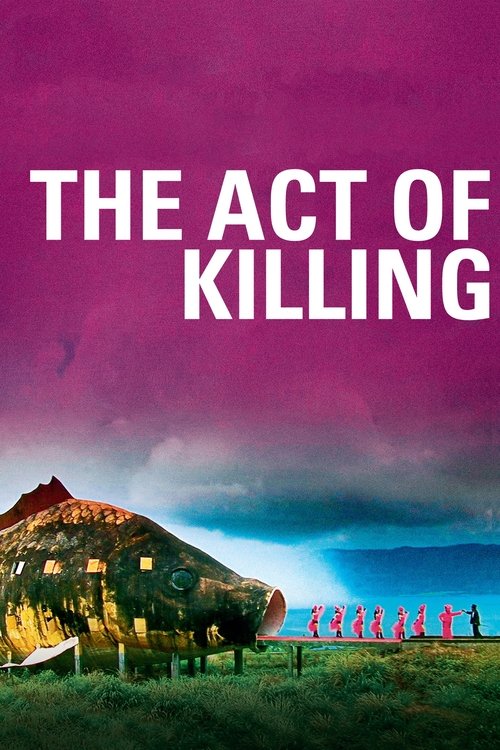
The Act of Killing
2012 · Joshua Oppenheimer
For when you want to be confronted — a documentary that will rearrange how you think about evil, guilt, and the stories people tell themselves. Demanding, essential viewing; save it for a night when you can sit with it afterward.
What it's about
In Indonesia, the men who carried out the mass killings of 1965–66 were never punished — decades later, many are still celebrated local figures. This documentary hands them the tools of moviemaking and invites them to reenact their own atrocities in the styles of the films they love: gangster pictures, musicals, Westerns. Following former death-squad leader Anwar Congo, it watches what happens when a man performs his past and the performance starts to perform back.
The experience
Genuinely unlike anything else — surreal, garish, blackly absurd, and then suddenly, quietly horrifying. It doesn't shock you with images of violence; it unsettles you with how cheerful and ordinary its perpetrators are, and the dread accumulates for days afterward.
The craft
Joshua Oppenheimer's method is the film: rather than interviewing his subjects, he lets them direct themselves, and the kitschy genre pastiches they produce — musical numbers, noir interrogations, a dreamlike waterfall tableau — become x-rays of their conscience. The clash between lurid staged fantasy and drab everyday reality is the most disturbing editing idea in modern documentary.
Why it matters
A landmark that cracked open public discussion of the Indonesian genocide, both inside and outside the country, and permanently expanded what documentary can do — proof that a film can be an instrument of moral reckoning, not just a record.
Snapshot
The Act of Killing is a documentary that asks the perpetrators of one of the twentieth century's least-acknowledged mass killings to dramatize their crimes on camera, in the genres of the Hollywood and Indonesian movies they loved. The 1965–66 anti-communist purge in Indonesia killed somewhere between half a million and more than a million people; its executioners were never tried, and many remained powerful, celebrated figures within a paramilitary and political order that still governed the country when Oppenheimer filmed. The film's central subject, Anwar Congo, was a former cinema ticket-tout turned death-squad killer in Medan, North Sumatra. Invited to stage his memories as fiction — film noir gangster scenes, lurid musical numbers, a Western, a surreal waterfall tableau — Anwar and his associates produce a self-incriminating spectacle whose artifice gradually corrodes their bravado. The result is at once a study of impunity, a meditation on cinema's complicity in self-mythology, and a slow, queasy approach to something like remorse. Released in 2012 to extraordinary critical acclaim, it became one of the defining nonfiction films of its decade and reoriented debates about documentary ethics, reenactment, and the representation of atrocity.
Industry & production
The film emerged from a long-gestating, transnational, semi-clandestine production rather than a conventional commercial pipeline. Oppenheimer had been working in Indonesia since roughly 2003, initially on a project about plantation laborers and the legacy of the anti-union, anti-communist violence that had destroyed their organizing. When survivors and human-rights contacts steered him toward the perpetrators — who, unlike the frightened survivors, spoke openly and even boastfully — the project's focus shifted. Filming stretched across roughly five years in the latter half of the 2000s. The production was structurally protected by anonymity: a substantial portion of the Indonesian crew is credited as "Anonymous," reflecting the genuine danger of associating one's name with the material in a country where the perpetrators' faction still held sway.
The film was produced through the Danish company Final Cut for Real, led by producers Signe Byrge Sørensen and Joram ten Brink, with a constellation of Danish, Norwegian, and British backers and the support of public funders and broadcasters across Northern Europe; the DOX:LAB and European documentary-financing ecosystem was central to making such an uncommercial, long-form project viable. Crucially, Werner Herzog and Errol Morris attached themselves as executive producers after seeing the work in progress. Their endorsement — two of the most influential nonfiction filmmakers alive, each long preoccupied with performance, delusion, and the unreliable self — lent the film both protective prestige and a clear lineage. The picture circulated in multiple lengths; a long director's cut runs around 159 minutes and a more widely distributed theatrical cut around 117–122 minutes. Drafthouse Films handled the high-profile U.S. release. Within Indonesia, official distribution was effectively impossible, and the film spread through free and semi-underground screenings, becoming a quietly seismic domestic event despite, or because of, its unofficial status.
Technology
The Act of Killing is a product of the digital documentary era, shot on high-definition digital video that allowed long, unobtrusive observation as well as the more controlled, lit setups required for the staged genre sequences. The technological pivot of the film is conceptual rather than gadget-driven: digital cameras made it economically and logistically feasible to keep filming over years, to let scenes run long, and to give the perpetrators their own "production" — to mount musical numbers, gangster tableaux, and burning-village reenactments at a scale that would have been prohibitive on film stock. The collaboration also relied on consumer-era playback: a recurring, devastating device is Anwar and his friends watching their own footage on monitors, the technology of review becoming the instrument of self-confrontation. The film's aesthetic doubleness — handheld vérité observation versus saturated, art-directed fantasy — is enabled by the flexibility of digital capture and post-production color, which can move between flat documentary naturalism and the heightened palette of the staged scenes.
Technique
Cinematography
The cinematography, principally by Carlos Arango de Montis with Lars Skree among the contributing camera operators, sustains two registers. The observational footage is mobile, watchful, and patient, often holding on faces a beat too long so that performance curdles into something unguarded. The staged sequences are entirely different: deliberately, garishly composed homages to genre cinema — neon-soaked noir interiors, a surreal sequence before a waterfall with dancers emerging from the mouth of a giant fish, a musical number in which a victim presents his killer with a medal and thanks him for sending him to heaven. The deliberate kitsch is the point; the camera renders the perpetrators' fantasies with enough conviction to expose their grotesquerie. Between these poles, the film frequently catches the seams — the lights, the makeup, the crew — so that the apparatus of moviemaking is never hidden but thematized.
Editing
Editing, credited to Niels Pagh Andersen with additional editors, is the film's decisive authorial act. From a reported several hundred hours of material gathered over years, the editors had to construct a through-line that was not given in advance: Anwar's drift from swaggering reenactor to haunted man. The cut interleaves observation, reenactment, behind-the-scenes preparation, and footage of the perpetrators watching themselves, building an architecture in which fiction and reality comment on each other continuously. The structure withholds easy catharsis and instead accumulates dread, culminating in a final passage that the editing has patiently earned. Andersen has spoken in interviews about searching for the emotional and dramaturgical spine rather than imposing a thesis, and the film's power owes much to that restraint.
Mise-en-scène / staging
Mise-en-scène is, uniquely, co-authored by the subjects. The perpetrators design their own sets, costumes, and scenarios, casting themselves as heroes and recruiting neighbors — including, harrowingly, survivors and their descendants — as victims. Oppenheimer's method hands the means of representation to the killers and lets their aesthetic choices indict them: the cross-dressing, the cabaret excess, the gangster cool modeled on the American movies Anwar watched across the street from his killing rooms. The staging makes visible how the perpetrators narrativized their own violence to live with it, and how cinema furnished the templates.
Sound
The sound design moves between the ambient naturalism of the documentary passages and the heightened, sometimes ironic scoring of the fantasy sequences, including diegetic music for the musical numbers. Original music is associated with Elin Øyen Vister, alongside used and source music; the recurring song "Born Free," sung in the heaven sequence, becomes one of the film's most disturbing juxtapositions. Sound also carries the testimony — the calm, conversational tone in which men describe garroting victims with wire is more chilling than any score.
Performance
"Performance" is the film's true subject, and Anwar Congo is its astonishing center. He is not an actor but a man performing himself, and the film documents the gradual failure of that performance. His associate Herman Koto — a heavyset paramilitary figure who appears in drag and runs for local office — provides grotesque comic energy that curdles into something sinister. The publisher Adi Zulkadry articulates the most unnervingly lucid defense of the killings, rejecting the premise of guilt outright. These are real men, and the ethical charge of the film derives precisely from the fact that their performances are also confessions.
Narrative & dramatic mode
The film operates as a documentary built on a fiction-within-the-film: its dramatic engine is the perpetrators' own movie-in-progress, and its arc is the psychological transformation that the act of staging forces upon Anwar. Rather than a chronological account of 1965–66, Oppenheimer constructs a present-tense study of impunity and self-deception, using reenactment not to reconstruct historical fact but to surface inner reality. The mode is closest to what might be called performative or participatory documentary, in which the filmmaker's intervention — the offer to make a movie — generates the events the camera records. The dramatic irony is total: the men believe they are making themselves heroes, while the film they are unwittingly co-authoring is an indictment. The structure builds toward Anwar's bodily reckoning in the final scenes — a retching, wordless collapse on the rooftop where he once killed — a climax that is documentary fact and dramatic catharsis at once, though the film refuses to resolve whether what we witness is genuine remorse, performance, or something irreducibly between.
Genre & cycle
The Act of Killing sits within documentary while cannibalizing fiction genres — gangster film, musical, Western, horror — as both subject and method. It belongs to a lineage of reenactment-driven nonfiction associated above all with Errol Morris (The Thin Blue Line), and to a broader cycle of twenty-first-century "perpetrator documentaries" and atrocity cinema concerned not with victims' testimony but with the psychology of those who killed. It also participates in the essayistic, self-reflexive documentary tradition. Within Oppenheimer's own work it forms a diptych with its companion film The Look of Silence (2014), which turns to the survivors' side. The film helped consolidate a 2010s cycle of formally adventurous, festival-driven nonfiction that treated documentary as a space for radical aesthetic and ethical experiment rather than mere reportage.
Authorship & method
Joshua Oppenheimer, an American-born, London-based filmmaker trained partly under the avant-garde and theoretically informed documentary milieu (his work engages performance theory and the ideas of figures like Jean Rouch and the tradition of ethnographic and reflexive filmmaking), is the film's director and guiding intelligence. His method — handing perpetrators the tools of cinematic self-representation and filming what that produces — is indebted to Rouch's notion of provoked, performed truth (the ciné-trance and cinéma vérité as a catalytic act) and to the long collaboration with his subjects over years that built the trust such revelations required. The credited co-director is the Indonesian "Anonymous," a designation that is both a safety measure and an ethical acknowledgment that the film could not have existed without local collaborators who cannot be named. Key collaborators include producer Signe Byrge Sørensen, editor Niels Pagh Andersen, cinematographers Carlos Arango de Montis and Lars Skree, and executive producers Werner Herzog and Errol Morris, whose sensibilities — Herzog's fascination with ecstatic delusion, Morris's with reenactment and the slipperiness of testimony — are visibly congenial to the project. Oppenheimer has been candid that the film is a constructed, authored work, not neutral observation: the morality of his method — implicating himself by collaborating with killers — has been central to discussion of the film and to his own statements about it.
Movement / national cinema
The film is a hybrid of international art-documentary financing (Danish-Norwegian-British) and Indonesian subject and collaboration, and it resists tidy national categorization. It is not a product of the Indonesian film industry — which could not have made or shown it — yet it is profoundly a film about Indonesia, made possible by Indonesian participants. It belongs most naturally to the transnational European-funded documentary movement that produced much of the era's boldest nonfiction, while functioning, within Indonesia, as a clandestine intervention into national memory. Its companion The Look of Silence deepens this engagement. Together the two films constitute a singular contribution to Indonesian historical reckoning made largely from outside the national cinema apparatus.
Era / period
Released in 2012, the film is a document of the post-Suharto Reformasi era's unfinished business: the New Order regime fell in 1998, but the perpetrators of 1965–66 were never held to account, and the paramilitary organization Pancasila Youth, prominent in the film, remained a force in Indonesian political life. The film captures a specific historical present in which killers could still boast on camera because they had never been challenged. It also belongs to a moment in global documentary — the early 2010s — when digital tools, festival networks, and a hunger for formally daring nonfiction converged. Its reception coincided with, and contributed to, a slow widening of international attention to the 1965 killings, a subject long suppressed within Indonesia and underexamined abroad.
Themes
The film's governing theme is impunity: what happens to a society, and to individual men, when mass murder carries no consequence and is even officially celebrated. From this flow its other concerns — the psychology of perpetrators and the stories they tell to remain human in their own eyes; the complicity of cinema and popular culture in furnishing those stories (Anwar literally modeled his killing on American gangster movies); the relationship between performance and truth, and whether reenacting an atrocity can force a confrontation with it; the corrosive persistence of fear among survivors decades later; and the fragility of national memory under an order built on a foundational massacre. The film is also, reflexively, about documentary itself — about the ethics of filming evil, the filmmaker's complicity, and the limits of empathy and judgment. Its refusal to offer redemption, or to fully deny it, is itself thematic: the film holds open the unbearable question of whether remorse is possible and what it would even mean here.
Reception, canon & influence
The Act of Killing was met with rare critical acclaim, widely named among the best films — fiction or nonfiction — of 2012 and of the decade, and it accumulated major honors including the European Film Award for documentary and the BAFTA for best documentary, along with an Academy Award nomination for Best Documentary Feature; the companion The Look of Silence would also be Oscar-nominated, a near-unprecedented double for a director working the same historical subject. Critics singled out its formal audacity and ethical seriousness, though it also drew substantive debate: some scholars and critics questioned the morality of giving perpetrators a stage, the risk of aestheticizing atrocity, and Oppenheimer's authorial control over his subjects. That debate is itself part of the film's significance.
Backward, the film's influences are clear: Errol Morris's reenactment cinema, Werner Herzog's studies of obsession and delusion, Jean Rouch's provoked and performed ethnographic truth, and the long tradition of self-reflexive documentary. Forward, its impact has been substantial. It is frequently credited with energizing a wave of formally radical, ethically probing nonfiction and with foregrounding the "perpetrator documentary" as a recognized mode. Within Indonesia, the film and its companion are widely understood to have helped break, or at least loosen, the long silence around 1965–66, contributing to public discussion and survivor advocacy in the years after release. It became a fixture of documentary curricula and ethics debates, a reference point against which subsequent reenactment-based and atrocity-facing films are measured. Few documentaries of its era have so durably reshaped both the form's aesthetic possibilities and the moral questions filmmakers ask of themselves.
A Deleuzian reading
A man stands on a rooftop in Medan, on the spot where he killed, and explains in the tone of a craftsman that he switched to strangling people with wire because beating them made too much mess.
The full Deleuzian reading of The Act of Killing →
Reception
It landed at festivals in 2012 as an instant event — Oscar-nominated, BAFTA-winning, hailed as a documentary landmark — and a decade on it hasn't cooled: it's now a fixture near the top of greatest-documentaries-ever lists and a standard answer to 'what's the most disturbing film you've seen?'
How The Act of Killing was received, from release to now →
Influences: the films it descends from and the films it influenced
- The Thin Blue Line (1988) — Establishes the stylized, multiply-staged reenactment as a tool for interrogating testimony rather than illustrating it — the repeated, contradictory restagings that expose the slipperiness of confession that Oppenheimer (whose exec producer was Morris) turns onto perpetrators.
- Chronicle of a Summer (1961) — Originates 'provoked' cinéma-vérité — the camera as catalyst that makes subjects perform a truth they would not otherwise speak — the ciné-trance method Oppenheimer cites directly as the engine of handing killers the tools of self-representation.
- Little Dieter Needs to Fly (1997) — Pioneers having a real subject physically re-walk and re-perform his own trauma on location for the camera, blurring documentary and dramatization through ecstatic re-enactment — the obsessive self-staging Herzog (exec producer) lends to the project.
- Shoah (1985) — Models the atrocity documentary built on returning perpetrators and bystanders to gesture and re-describe their acts in the present tense, refusing archival footage in favor of embodied present-day testimony as the site of horror.
- Hôtel Terminus (1988) — Builds the long-form perpetrator-interview documentary in which the filmmaker patiently draws unrepentant killers into self-incriminating performance, the ethical confrontation-through-camera Oppenheimer extends.
- The Sorrow and the Pity (1969) — Founds the method of letting complicity and self-justification indict themselves on camera through unhurried testimony, the dramatic irony of subjects condemning themselves while believing they explain themselves.
- Grizzly Man (2005) — Demonstrates assembling a documentary out of a subject's own self-authored, self-performing footage and reading delusion as cinema — the use of subject-generated mise-en-scène as primary text.
- No Home Movie / The Act of Seeing (1971) — Roots the ethical question of the camera before unbearable reality and the filmmaker's implication in looking, the self-reflexive avant-garde milieu Oppenheimer trained in that informs his candor about authored, non-neutral documentary.
- My Best Fiend (1999) — Oppenheimer extends the essay-documentary mode in which a director shapes moral argument through the strategic use of performance and re-enactment within non-fiction, directing perpetrators to stage their own histories — a formal inheritance from the Herzog tradition of author-positioned essay cinema.
- F for Fake (1973) — Oppenheimer invites perpetrators to re-enact their killings in the cinematic genres they love—musical numbers, gangster films, westerns—collapsing the documentary-fiction boundary through self-aware theatricality; both films use performance-within-documentary as an epistemological tool to reveal what straightforward testimony cannot access.
- Lessons of Darkness (1992) — Extends Herzog's doctrine that enacted, performative reconstruction reveals deeper truth than observational record: perpetrators of mass killing re-stage their atrocities in genre-film costumes, and the resulting footage is presented as the documentary's primary truth-claim — ecstatic truth applied to human perpetration rather than natural catastrophe.
- Night and Fog (1956) — Inherits Night and Fog's interrogation of complicity and the ethics of the perpetrator's own images, turning the documentary apparatus on those who staged the atrocity.
- The Look of Silence (2014) — The companion film that inverts the method — placing a survivor face-to-face with the same killers — completing Oppenheimer's diptych on Indonesia's 1965 impunity with the perpetrator-confrontation apparatus turned toward victims.
- Casting JonBenet (2017) — Extends the subject-authored reenactment by letting community members audition and perform a crime, foregrounding performance and projection over factual reconstruction in the Oppenheimer mode.
- The Wolfpack (2015) — Documents subjects who reenact their beloved genre films as a survival idiom, sharing the use of pop-cinema pastiche as the lens through which subjects narrate their own lives.
- Knife: The Attempted Murder of Salman Rushdie (2026) — Converts the perpetrator from an absence in a legal record into a performing presence who restages his own act on camera, the formal permission Knife needs to admit 'the A.' as a speaking position rather than a defendant referred to.
- Reenactments / The Missing Picture (2013) — Confronts genocide (Khmer Rouge) through constructed reenactment when the real images are absent, sharing the perpetrator-confrontation lineage — Panh's S-21 had earlier filmed Khmer Rouge guards re-performing their routines in the empty prison.
- S-21: The Khmer Rouge Killing Machine (2003) — Returns former prison guards to the site to physically re-enact their daily torture routines in real space, the closest precedent for staging perpetrators performing their own atrocities for the camera.
- The Imposter (2012) — Fuses genre-pastiche reenactment with first-person unreliable narration so the subject's self-performance becomes the film's destabilizing engine, paralleling Act of Killing's distrust of staged testimony.
- American Movie (1999) — Observes subjects staging their own genre fantasies on camera, sharing the device of treating amateur movie-making as a revealing self-portrait the documentary frames with irony.
- Mr. Death: The Rise and Fall of Fred A. Leuchter, Jr. (1999) — Gives a complicit subject the rope to perform and aggrandize himself on camera until self-justification becomes self-indictment, the dramatic-irony portrait of delusion Oppenheimer scales up to mass killers.
- Standard Operating Procedure (2008) — Marries glossy, stylized reenactment to perpetrator interviews about state atrocity (Abu Ghraib), probing how images and performance mediate guilt — the aestheticization-of-atrocity debate Act of Killing intensifies.
- Tongues Untied / Paris Is Burning (1990) — Centers subject-authored performance and self-fashioning as documentary truth, letting marginalized subjects stage their own idealized self-image for the camera as the film's primary material.
- The Voice of Hind Rajab (2025) — Uses reenactment and self-aware restaging as the only ethical route to an atrocity that resists direct depiction, foregrounding the seam between performance and the real.
- Our Land (2026) — Confronts impunity by having perpetrators reconstruct their own killings on camera, sharing Our Land's strategy of building a film around a documented act and its untried aftermath.
- The Zone of Interest (2023) — Centers the perpetrators' banal, domestic and bureaucratic self-presentation, exposing the administrative blankness of genocide from inside the killers' everyday.
- Bus 174 (2002) — Builds its argument from perpetrators' performance and involuntary theater before the camera, the same exposure of self-dramatizing violence Bus 174 reads in Sandro's hostage 'staging.'
- The Wolf House (2018) — Perpetrators re-stage and mythologize their own atrocities inside a self-produced propaganda framing — the identical false-propaganda-frame and perpetrator-mythology device Wolf House adopts by posing as a colony's promotional film.
Similar films
- The Look of Silence (2014) — influence & lineage · same viewing thread
- Our Land (2026) — influence & lineage
- Shoah (1985) — influence & lineage
- Grizzly Man (2005) — influence & lineage
- Soundtrack to a Coup d'Etat (2024) — same viewing thread
- Brazil (1985) — same viewing thread · often watched together
- Memories of Murder (2003) — often watched together
- The House That Jack Built (2018) — often watched together
All the films related to The Act of Killing →
Watch it with: curated runs of related films
- The Long Shadow of the Coup — A run of films tracing political violence from the mutiny and the massacre through martial law to the decades-long reckoning that follows — watch them near each other and the same machinery of power keeps rhyming across continents and eras.