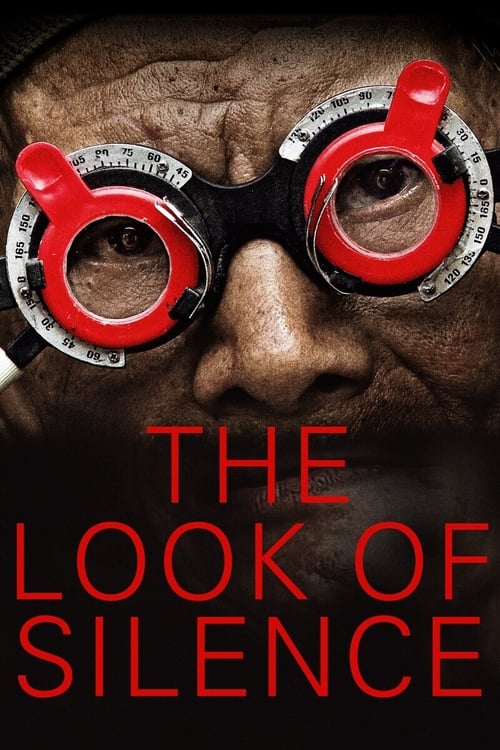
The Look of Silence
2014 · Joshua Oppenheimer
For when you want to be genuinely moved and morally challenged, not entertained — a demanding, unforgettable watch that asks your full attention and rewards it. Not a comfort film; save it for a night when you're ready to sit with something heavy.
What it's about
In North Sumatra, a middle-aged optometrist named Adi grew up in the shadow of a brother he never met — Ramli, murdered in the anti-communist purges that swept Indonesia in 1965, when at least half a million people were killed. The killers were never punished; many still hold power in the villages where the victims' families live. Using eye exams as his quiet pretext, Adi sits face to face with the aging men responsible for his brother's death and asks them, calmly and directly, to account for what they did.
The experience
Almost unbearably still and quiet — long silences, held gazes, conversations balanced on a knife's edge. It's not graphic, but the tension of watching a man politely confront his brother's killers, at real personal risk, leaves you rigid in your seat and shaken for days.
The craft
Joshua Oppenheimer builds the film around the optometry sessions — a man literally testing the vision of people who refuse to see — and the metaphor never feels forced because it's real. The framing is patient and painterly, the sound design full of insects and hush, and the confrontations are edited with extraordinary restraint: no music telling you what to feel, just faces. Watch it somewhere quiet where nothing will interrupt.
Why it matters
The companion piece to The Act of Killing, and together they forced a global reckoning with a genocide that had been officially celebrated in Indonesia for fifty years; it earned an Oscar nomination and changed public conversation inside the country itself.
Snapshot
The Look of Silence is Joshua Oppenheimer's companion piece to The Act of Killing (2012), and together the two films form the most consequential cinematic reckoning yet made with the Indonesian mass killings of 1965–66, in which anti-communist militias and army units murdered at least half a million people. Where the earlier film handed cameras and creative license to the perpetrators — inviting them to restage their crimes as gangster movies and musicals — this one reverses the optics. It follows Adi Rukun, a middle-aged optometrist in North Sumatra whose older brother Ramli was tortured and killed at the Snake River (Sungai Ular) before Adi was born. Armed with footage Oppenheimer had shot of the killers boasting, and with the pretext of an eye exam, Adi sits across from the men who murdered his brother and asks them, quietly, to account for what they did. The result is a film of near-unbearable stillness: a document of a survivor's family living inside a silence enforced by the fact that the killers still hold power. It premiered at the Venice Film Festival in 2014, where it won the Grand Jury Prize, and was nominated for the Academy Award for Best Documentary Feature.
Industry & production
The film was produced by Signe Byrge Sørensen through the Danish company Final Cut for Real, in a Danish–Finnish–Norwegian–British–led international co-production, with substantial support from Scandinavian public film funds and broadcasters — the funding architecture typical of high-end European auteur documentary. As with The Act of Killing, the American filmmakers Errol Morris and Werner Herzog lent their names as executive producers, a form of reputational sponsorship that helped both films reach festival and theatrical audiences far beyond the usual documentary circuit.
The defining production fact is danger. Because the perpetrators and their political heirs remain influential in Indonesia — many are celebrated as national heroes — a large portion of the Indonesian crew is credited as "Anonymous," including Oppenheimer's principal co-director. This is not a stylistic conceit but a security measure, and it shaped the entire shoot: filming had to be quiet, small-scale, and quickly extractable. Oppenheimer has said that he and Adi understood the confrontations could not be repeated, and that the family was moved to a different part of Indonesia before The Act of Killing was released, out of fear of reprisal. The two films were shot in overlapping periods across roughly a decade of Oppenheimer's engagement with the region; footage of the killers used inside The Look of Silence derives from that same long body of material.
Technology
Technically the film is unshowy by design. It was shot digitally on relatively compact professional cameras, a practical necessity given the need for a light footprint and rapid setups in the homes of dangerous men. That intimacy of scale is the point: the technology recedes so that faces, eyes, and pauses carry the film. A crucial piece of "technology" internal to the story is the optometric apparatus itself — the trial frames, the flip-lenses, the eye chart. Oppenheimer builds the film's central metaphor out of Adi's actual profession, using the instruments of corrected vision as a literal and figurative means of asking the killers to see. The other embedded technology is video playback: much of the film shows Adi watching a monitor of Oppenheimer's earlier interview footage, so that the film is partly made of screens within the screen.
Technique
Cinematography
The cinematography is credited to Lars Skree, and it is the film's most immediately distinguishing formal element relative to its predecessor. Skree favors patient, often static or barely-moving compositions, held long past the point of comfort. Interviews are framed frontally and close, so that the smallest tightening of a jaw or drift of the eyes becomes an event. Between confrontations, the film returns to contemplative inserts of the North Sumatran landscape and of insect life — recurring images of cocoons and metamorphosis that function as quiet visual essays on transformation, dormancy, and the fragility of a body. The palette is muted and the light naturalistic. Where The Act of Killing was baroque and hallucinatory, The Look of Silence is composed and hushed, its beauty deliberately at odds with the atrocity being described.
Editing
The editing is by Niels Pagh Andersen, the veteran Danish editor who also cut The Act of Killing, and his contribution is central to how the film thinks. Andersen structures the film around the rhythm of the confrontation scene — the setup, the disarming small talk, the turn, the recoil — and around the counterpoint between those encounters and the domestic scenes of Adi's aged parents. He is willing to hold silences, to let a killer's non-answer sit, and to cut away to the watching family or the landscape at moments of maximum tension. The intercutting of Adi viewing archival interview footage with his live confrontations builds a layered temporality in which past testimony and present accountability are placed side by side.
Mise-en-scène / staging
The staging is largely observational, but Oppenheimer's method introduces a controlled dramatic architecture. The core recurring scene — Adi conducting an eye exam on a man who helped kill his brother — is a staged premise that yields unstaged emotion. The physical arrangement is charged: the killer seated, passive, lenses flipped before his eyes, while the victim's brother stands over him in a position of quiet authority, reversing the historical power relation for the duration of the encounter. Domestic mise-en-scène is equally deliberate: the extreme old age and physical dependency of Adi's father, and the weathered endurance of his mother Rohani, are staged as the living residue of the massacre.
Sound
The sound design is spare and attentive, built around ambient rural sound — insects, wind, water — and around the human voice at conversational volume. Long stretches carry no music at all, which makes the film's silences literal as well as thematic. Where scoring appears, it is minimal and mournful rather than dramatizing; I would not want to overstate the specifics of the music credits, on which the readily established record is thinner than for the film's images. What is unambiguous is the aesthetic strategy: sound is used to intensify quiet, not to fill it.
Performance
As nonfiction, the film has no performances in the fictional sense, but Adi Rukun's presence is the film's dramatic engine, and it is a study in restraint. His calm, unaggressive persistence — the refusal to shout, the willingness to keep asking — is what makes the confrontations land as moral inquiry rather than confrontation-for-spectacle. The perpetrators "perform" in a different register: their bravado, evasions, threats, and occasional flickers of unease are the raw material, and the film's power comes from watching those masks hold or slip. The reactions of the killers' own family members — some horrified to learn the details, some defensive — supply the film's most destabilizing human moments.
Narrative & dramatic mode
The film's dramatic mode is the quest-confrontation, organized as a series of face-to-face encounters that escalate in intimacy and risk. It is at once a detective structure (Adi assembling the story of his brother's death from those who caused it) and a domestic elegy (the parents, the mourning, the inheritance of trauma by a brother born into a family already broken). The overarching arc is less about resolution than about the exposure of an impossibility: Adi seeks acknowledgment and perhaps apology, and the film's honesty lies in showing how rarely he receives either. The TMDB framing — that these meetings led "much to Adi's disappointment" — captures the deliberate refusal of catharsis. The dramatic tension is ethical and existential rather than plot-driven.
Genre & cycle
It belongs to the tradition of the personal-political documentary and to the specific cycle of atrocity-and-memory nonfiction that runs through works like Claude Lanzmann's Shoah and Rithy Panh's Cambodian films — cinema that treats genocide not as historical reconstruction but as a present-tense problem of testimony, denial, and living perpetrators. Within Oppenheimer's own oeuvre it forms the second panel of a diptych, and the two films are best understood as a single project split by point of view: The Act of Killing from the perpetrators, The Look of Silence from the survivors. It also participates in the essayistic, art-house documentary cycle of the 2010s that pushed nonfiction toward formal rigor and metaphor rather than journalistic exposition.
Authorship & method
Oppenheimer's authorship is inseparable from his method, which is the film's most debated and influential feature. Over years of fieldwork he built relationships with both perpetrators and survivors, and he developed a practice of using the camera as an instrument that reorganizes reality — a "safe" pretext (an eye exam, or, in the earlier film, a movie production) that allows suppressed truths to surface. Critics have described this as a cinema of provocation or intervention, distinct from observational purity; Oppenheimer does not merely record events but constructs the conditions under which they can occur, then films what happens. Crucially, he foregrounds his own presence and complicity, and he shares authorship with Adi, whose willingness to confront is the ethical foundation of the project.
His key collaborators recur across the diptych: producer Signe Byrge Sørensen, editor Niels Pagh Andersen, and — new to this film — cinematographer Lars Skree, whose contemplative compositions define its difference in tone. The anonymous Indonesian co-director and crew are essential and, by necessity, uncreditable authors of the work. Morris and Herzog function as tutelary presences rather than hands-on creators.
Movement / national cinema
The film sits at a crossroads of national cinemas. Institutionally it is a Danish/Nordic production, part of the strong Scandinavian documentary tradition that has produced much of the world's most ambitious feature nonfiction. Subject-wise and morally, it is an Indonesian film — its makers, its language, its landscape, and its stakes are Indonesian, even if the political situation prevented most of them from claiming it publicly. This tension between the film's production nationality and its subject nationality is itself significant: it took an international, partly clandestine coalition to make a film Indonesia's own industry could not safely produce. The film has been credited with contributing to a broader opening of public discussion in Indonesia about 1965.
Era / period
Made and released in 2014, the film belongs to a moment when documentary was gaining unusual cultural and critical prestige, and when digital tools had made intimate, small-crew shooting in dangerous conditions feasible. It depicts, and is haunted by, an earlier era — the Cold War killings of 1965–66, carried out amid the anti-communist geopolitics of the period and, as the film and its surrounding scholarship note, in a context of Western acquiescence. The film's power derives from the collapse of these two eras into one frame: elderly perpetrators who have never faced justice, and a democratic-era Indonesia in which their impunity endures.
Themes
The governing themes are silence and sight. The title fuses them: the "look" that Adi directs at the killers, the "silence" that has protected them, and the optometric conceit that asks whether men can be made to see what they did. Around this cluster the film gathers impunity and the absence of justice; the intergenerational transmission of trauma; the moral cost of forgetting and the danger of remembering; the banality and self-justification of perpetrators; and the fragile dignity of survivors. The recurring cocoon imagery threads a meditation on metamorphosis and dormancy through the whole — the possibility, never guaranteed, that something might change. Underlying all of it is a question about the limits of reconciliation: whether acknowledgment is possible where power has never shifted.
Reception, canon & influence
Critical reception was strongly positive and often placed the film among the finest documentaries of its decade; several critics judged it the more emotionally and morally coherent of the two films, precisely because it grounds the epic horror of The Act of Killing in one grieving family. It won the Grand Jury Prize at Venice in 2014 along with additional prizes there, accumulated numerous critics' honors, and earned an Academy Award nomination for Best Documentary Feature — a rare feat for a companion film following an already-acclaimed predecessor.
The influences on the film run backward to the tradition of confrontational memory cinema — above all Lanzmann's Shoah, with its insistence on present-tense testimony and its refusal of archival reenactment, and Rithy Panh's investigations of the Khmer Rouge — as well as to Errol Morris's interrogative interview technique and Werner Herzog's ecstatic, essayistic nonfiction. Most directly, it is shaped by Oppenheimer's own decade of prior fieldwork, without which its confrontations would have been impossible.
Its legacy runs forward on two tracks. Cinematically, the diptych helped legitimize a more interventionist, formally daring documentary practice and became a touchstone in debates about the ethics of filming perpetrators — how far a filmmaker may go in staging conditions for truth, and what obligations are owed to subjects on both sides. Politically, the films are widely credited with helping to break open public discussion of the 1965 killings inside Indonesia and internationally, contributing to renewed calls for acknowledgment and to scrutiny of the foreign governments complicit in the period. On the precise scope of that political impact the record invites caution rather than triumphalism — change has been partial and contested — but the film's standing as both an artwork and an act of witness is secure.
Reception
No flop-to-classic arc here — it landed acclaimed (Grand Jury Prize at Venice 2014, an Oscar nomination) and has stayed there; if anything has shifted, it's that more people now call it the equal or better of its famous companion piece, The Act of Killing.
How The Look of Silence was received, from release to now →
How to watch The Look of Silence: what to notice on a first viewing
- Watch the camera hold close and still on faces. Lars Skree frames each confrontation frontally and close, held long past comfort, so a tightening jaw or a drifting eye becomes visible. The stillness lets you read what the men will not say aloud.
- Listen for how little music plays under any of it. The film runs largely on ambient rural sound, insects, wind, water, letting long stretches carry no score at all. Silence here is not empty air; it is what the culture has enforced for fifty years.
- Watch where each man sits during his eye exam. Adi seats the killer, flips lenses before his eyes, and stands over him performing the exam, reversing who held power in 1965. The arrangement of bodies briefly undoes the historical hierarchy between killer and victim's family.
- Notice that Adi never raises his voice or shouts. His calm, unhurried questioning holds steady across every encounter, never turning into accusation, while the men across from him grow visibly unsettled. Restraint, not confrontation, is what makes the men's masks start to slip.
- Notice the shots of cocoons and insects between conversations. Between confrontations, the film keeps returning to close images of insect life and metamorphosis, a quiet visual thread apart from the human scenes. These returning images hold open the question of whether transformation is still possible here.
The whole guide to watching The Look of Silence, with the keys for a rewatch →
Influences: the films it descends from and the films it influenced
- The Act of Killing (2012) — Direct predecessor sharing the same decade of fieldwork and the camera-as-safe-pretext method, from which this film inverts the point of view to the survivor's side.
- The Emperor's Naked Army Marches On (1987) — Stages face-to-face confrontations in tight close-framing where a pursuer forces perpetrators toward reckoning, reproducing Hara's charged interrogative encounters over war guilt as an intimate optical duel.
- Knife: The Attempted Murder of Salman Rushdie (2026) — Adi's optometry frame — swapping lenses before a killer's eyes while questioning him — welds the confrontation scene to the examined eye, the same coupling of injured sight and direct address to the attacker that organizes Knife.
- Shoah (1985) — Model for present-tense testimony filmed as confrontation, refusing archival footage and instead holding the camera on faces in silence until the past resurfaces in the living body.
- Night and Fog (1955) — Establishes the spare, quiet narration laid over slow contemplation of atrocity sites revisited in the present, the register of hushed diegetic restraint Oppenheimer inherits.
- The Thin Blue Line (1988) — Source of the frontal, direct-address interview framing (Morris's Interrotron logic) used to elicit self-incriminating account by locking the subject's gaze to the lens.
- The Sorrow and the Pity (1969) — Pioneers the long-form interview that patiently corners complicity, letting evasions and boasts hang unchallenged so the viewer weighs them — the interrogative patience Adi's confrontations extend.
- Hôtel Terminus (1988) — Direct ancestor of the quest-confrontation structure: a pursuer tracking down perpetrators to their doorsteps and filming the reversal of power as they are made to answer.
- Chronicle of a Summer (1961) — Origin of the camera-as-provocation method — staging an artificial pretext (here the eye exam) that catalyzes suppressed truth rather than passively observing it.
- S-21: The Khmer Rouge Killing Machine (2003) — Returns perpetrators to the scene to reenact the physical gestures of killing before survivors, the in-situ bodily re-staging of atrocity Oppenheimer adapts.
- Lessons of Darkness (1992) — Tutelary source of the ecstatic, essayistic contemplative insert — otherworldly imagery detached from reportage — echoed in the film's insect-metamorphosis and landscape cutaways.
- Nostalgia for the Light (2010) — Sibling that binds atrocity-memory testimony to serene scientific/cosmic contemplative inserts and static, painterly framing, the same yoking of grief to non-human imagery.
- The Missing Picture (2013) — Sibling grounding national genocide in one family's private grief with formal restraint and layered temporality, the intimate scaling Oppenheimer also uses to focus the epic horror.
- Waltz with Bashir (2008) — Sibling built on the refusal of catharsis and the excavation of massacre memory through subjective reconstruction, arriving at complicity rather than resolution.
- The Gleaners and I (2000) — Sibling in foregrounding the filmmaker's own presence and complicity as an ethical frame, the reflexive authorship Oppenheimer makes central.
Similar films
- The Act of Killing (2012) — influence & lineage · same viewing thread
- Shoah (1985) — influence & lineage
- Norte, the End of History (2014) — same viewing thread
- Our Land (2026) — shared sensibility
- NAZA (2026) — shared sensibility
- The Emperor's Naked Army Marches On (1987) — shared sensibility
- Grave Torture (2024) — shared sensibility
- Silence (2016) — shared sensibility
All the films related to The Look of Silence →
Watch it with: curated runs of related films
- The Long Shadow of the Coup — A run of films tracing political violence from the mutiny and the massacre through martial law to the decades-long reckoning that follows — watch them near each other and the same machinery of power keeps rhyming across continents and eras.