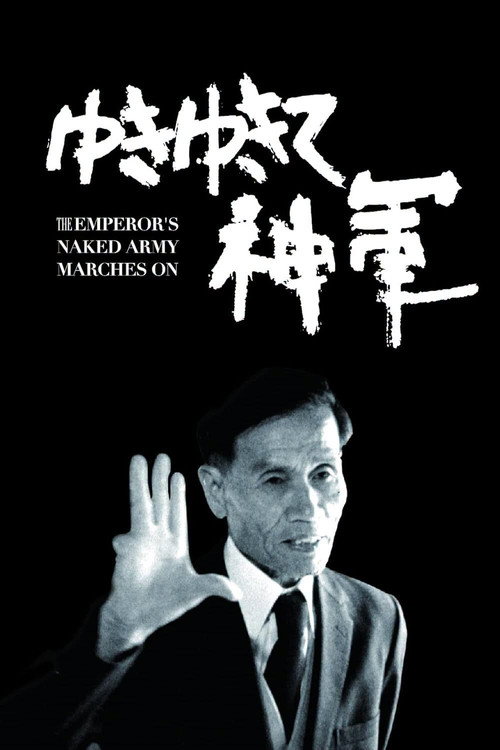
The Emperor's Naked Army Marches On
1987 · Kazuo Hara
For when you want to be shaken, not soothed — a documentary that grabs you by the collar and doesn't let go. Pure challenge: reach for it when you're ready to sit with hard questions about guilt, memory, and how far a person should go for the truth.
What it's about
Kenzo Okuzaki, a 62-year-old veteran of Japan's disastrous New Guinea campaign, spends his old age hunting down his former officers, showing up at their doors and demanding they explain how two privates in their unit came to be executed weeks after the war had already ended. He's an anarchist and an ex-convict with no patience for polite evasion, and when words fail he's willing to use his fists. What starts as one man's stubborn inquiry becomes an excavation of what really happened to the abandoned soldiers of a defeated army — and of an entire nation's refusal to account for it.
The experience
Almost unbearably tense — you watch elderly men in tidy living rooms be pushed toward confessions they've buried for forty years, never sure when Okuzaki will lunge. It's gripping, morally queasy, and darkly funny in flashes, and it leaves you arguing with yourself about whether the truth was worth his methods.
The craft
Kazuo Hara films in a raw, handheld verité style that refuses neutral distance — the camera accompanies Okuzaki into ambush interviews and keeps rolling through moments most filmmakers would flinch from. The ethical charge comes precisely from that complicity: you're aware the film is not just recording confrontations but enabling them, and that tension powers every scene.
Why it matters
A landmark of confrontational documentary and one of the most debated nonfiction films ever made, it forced a public reckoning with wartime atrocities Japan had left unspoken and made Hara's reputation as cinema's great provocateur-witness.
Snapshot
The Emperor's Naked Army Marches On (原題 Yuki Yukite Shingun, ゆきゆきて、神軍) is a Japanese documentary that trails Kenzo Okuzaki — a 62-year-old veteran of the calamitous New Guinea campaign, anarchist, and convicted felon — as he hunts down his former superior officers to force a confession about how two privates in their unit came to be executed twenty-odd days after the war had ended. What begins as a private inquiry into a bureaucratic evasion widens, in the course of Okuzaki's interrogations, into an exposure of starvation, murder, and cannibalism among the abandoned remnant of a defeated army, and into an indictment of the imperial system that dispatched them and then declined to account for them. Kazuo Hara's camera does not observe from a neutral distance; it accompanies, enables, and at moments provokes, as Okuzaki cajoles, shames, and physically assaults the aging men he confronts in their genkan doorways. The result is one of the most morally vertiginous documentaries ever made — a film routinely named among the essential nonfiction works of the postwar era, and the fullest realization of Hara's self-declared method of the "action documentary."
Industry & production
The film was produced outside Japan's studio system, through the independent partnership of Hara and producer Sachiko Kobayashi — his creative and life partner, whose production outfit (Shisso Productions) was the vehicle for Hara's entire body of work. Independence was not incidental: a subject as incendiary as Okuzaki, and a method that courted litigation and physical danger, would have been unthinkable within a mainstream commercial structure. The production was protracted, shot over a span of roughly five years in the first half of the 1980s before its 1987 release, a timeline dictated by Okuzaki's own erratic, self-directed campaign rather than by any shooting schedule.
The project's origin is one of the more discussed and partly murky points in its history. It is frequently reported that the veteran filmmaker Shohei Imamura — the great chronicler of Japan's marginal and disreputable, and himself a documentarist of wartime memory — was connected to the project's conception, having at one point contemplated Okuzaki as material. The precise nature of that involvement is not something I can state with certainty, and accounts vary; what is clear is that the finished film is unambiguously Hara's, in method and sensibility. Given the confrontational, occasionally violent nature of the footage, the film also raises unresolved questions of documentary ethics and liability that were part of its reception rather than its production paperwork.
Technology
The film was shot on 16mm, the standard gauge of committed independent and observational documentary in the period — portable, relatively inexpensive, and suited to lightweight sync-sound rigs that a very small crew could carry into a stranger's doorway. This technological base is inseparable from the film's aesthetic: the handheld mobility, the willingness to keep rolling through chaos, and the intimate proximity to faces all depend on the compact 16mm apparatus and a director who could operate it himself. There is nothing ostentatious in the technology; its significance is that it made a nimble, reactive, run-and-follow practice possible. Where the record on specific stocks, cameras, and lenses is thin, I won't invent particulars — the salient fact is the deliberate modesty of the means.
Technique
Cinematography
The camerawork is functional, reactive, and unbeautiful in the best documentary sense — its virtue is presence, not composition. Hara favors close framing on the faces of Okuzaki's interlocutors, holding on the aging former soldiers as they weigh whether to speak, deflect, or break down. The camera stays with confrontations as they turn physical, absorbing the jostle rather than retreating from it, so that the frame's instability becomes evidence of the event's reality. Interiors — cramped Japanese homes, hospital rooms, doorways — dominate, and the visual grammar is that of proximity and endurance: keep rolling, stay close, let the discomfort accumulate in real time. The film's power derives less from any single striking image than from the sustained, unflinching duration of the look.
Editing
The editing shapes a sprawling, self-generating investigation into a legible dramatic arc, sequencing Okuzaki's serial confrontations so that revelation escalates — from procedural evasion, to admissions of the postwar killings, to the buried horror of cannibalism. The cutting builds tension through the rhythm of each doorstep encounter: the approach, the resistance, the eruption, the aftermath. It also has to manage a fundamental ethical and structural problem — how much of Okuzaki to show, and how to frame his violence — and the film's decision to withhold easy judgment is as much an editorial as a directorial one. I don't want to assign the cutting to a named editor I can't verify; the shaping intelligence the film foregrounds is Hara's.
Mise-en-scène / staging
"Staging" is the crux of the film's controversy and its genius. In a conventional documentary the mise-en-scène is found; here it is, to a contested degree, precipitated. Okuzaki stages his own encounters — announcing himself, applying pressure, escalating — and Hara's presence with a camera is part of what licenses the performance. The most debated instances involve confrontations that appear catalyzed by the filmmaking situation itself, including moments where the arrival of accomplices or the turn to violence seems bound up with the fact of being filmed. The everyday Japanese settings — the modest home, the sickbed, the shop — supply an ordinariness against which Okuzaki's zeal reads as both monstrous and clarifying. The film never lets the viewer forget that the scene is being made, which is precisely its argument about how truth gets extracted.
Sound
Sync sound is the film's essential channel — the confessions, evasions, shouted accusations, and long silences of men deciding whether to incriminate themselves are the substance of the work. The soundscape is largely the raw location audio of speech and struggle, which keeps the encounters immediate and unpolished. Non-diegetic music is used sparingly if at all; the film trusts the human voice, and the texture of hesitation within it, to carry meaning. I can't confirm a composer credit with confidence and won't manufacture one — the honest description is that this is a film built on recorded speech rather than score.
Performance
The word "performance" sits uneasily on a documentary, and that unease is the point. Kenzo Okuzaki is one of the most extraordinary figures ever captured on nonfiction film: a man of ferocious conviction, gallows wit, and genuine menace, who frames his crusade in the language of divine mission (the "God's Army" of the original title) and who has already served time — including for having fired pachinko balls at Emperor Hirohito. He is at once truth-teller and bully, and he plainly performs for the camera, aware that it amplifies his campaign. The "performances" of his targets are equally riveting: the physical language of shame, the small evasions, the collapse of decades-old cover stories. The film's ethical charge comes from our inability to fully endorse or fully condemn the man whose relentlessness alone forces the buried history into the open.
Narrative & dramatic mode
Structurally the film adopts the shape of a detective story or road narrative: a driven investigator moves from witness to witness, each encounter yielding a further piece of a suppressed crime. This quest architecture gives an unruly, years-long real-life pursuit the propulsion of fiction. But the dramatic mode is deliberately destabilized by Okuzaki's methods, which convert the "interview" into interrogation and sometimes assault, so that the viewer is never allowed the comfort of a neutral fact-finding frame. The film operates in a register of escalating moral discomfort rather than resolution — it withholds catharsis, closing on the sense that the pursuit will continue beyond the frame (as, notoriously, it did in Okuzaki's later life). It is an inquiry film whose real subject is the violence, personal and historical, required to make a nation's silence speak.
Genre & cycle
The film sits within the documentary tradition but pointedly against the grain of the dominant observational school. Where American direct cinema and its inheritors prized the "fly on the wall," Hara belongs to a participatory, provocateur lineage — the filmmaker as catalyst rather than witness. It also participates in a distinctly Japanese cycle of postwar reckoning with the war's atrocities and the accountability of the imperial system, a reckoning the film argues had been culturally evaded. Its closest kinships are less with other war documentaries than with confrontational, ethically fraught nonfiction that implicates the act of filming in the events filmed.
Authorship & method
Kazuo Hara is the film's decisive author, and it is the fullest statement of the practice he termed the "action documentary" (アクション・ドキュメンタリー). Hara's premise, articulated across his career and his writing, is that the camera should not passively record but should intervene — that filming the "taboo" requires a subject willing to break social codes and a filmmaker willing to be complicit in the breaking. His earlier films establish the method: Goodbye CP (1972), about people with cerebral palsy asserting themselves in public space, and the startlingly intimate Extreme Private Eros: Love Song 1974 (1974), which turned the camera on his own former partner and his private life. The Emperor's Naked Army extends this ethic onto the terrain of national history and criminal accountability.
The other indispensable author is producer Sachiko Kobayashi, Hara's long-standing partner, without whose production framework the body of work does not exist; she is the constant collaborator across Hara's filmography. Hara himself is closely associated with the film's camerawork, consistent with his small-crew, hands-on practice. On the specific credited roles of editor and composer I will not assert names I cannot verify — the honest account is that the film is the product of a tiny, tightly held independent unit organized around Hara and Kobayashi, and its authorial signature is unmistakably singular.
Movement / national cinema
The film belongs to the current of postwar Japanese independent and political documentary that grew out of the ferment of the 1960s and '70s — a milieu shaped by figures such as Shinsuke Ogawa and Noriaki Tsuchimoto, whose committed, long-form documentary practice established nonfiction as a serious oppositional art in Japan. Hara's work is both continuous with and distinct from that tradition: it shares the political urgency and independence but replaces collective, patiently observational method with an individualist, confrontational, personality-driven approach. As Japanese national cinema, the film is a landmark of the country's uneasy, still-incomplete public reckoning with the conduct of the imperial military and the person of the Emperor — a subject that remained culturally fraught, which is part of why the film registered as transgressive at home.
Era / period
Released in 1987, near the end of the Shōwa era and shortly before Hirohito's death and the transition to Heisei, the film arrives at a charged moment in Japan's relationship to its wartime past — a period of prosperity and, many argued, of historical amnesia. Its excavation of atrocities four decades old speaks directly to the generational distance that had opened between the war and a public that had, in the film's implicit charge, agreed not to look. The film's own production era — the early-to-mid 1980s — belongs to the last flourishing of committed 16mm independent documentary before the shifts of the video and digital age, and it stands as one of the great late achievements of that analog, artisanal mode.
Themes
The film's governing themes are accountability and the machinery of forgetting: how a society disperses responsibility for atrocity across a chain of command until no individual can be held to answer, and how that diffusion is itself a form of violence against the dead. Bound up with this is the theme of the Emperor system as the moral vanishing point of Japanese war guilt — the "naked army" of the title marches under a divinity that never has to account for it. The film interrogates the ethics of truth-telling itself: whether justice can be extracted by force, and whether the pursuer who uses violence in the name of the murdered becomes something like his quarry. It is also a study of conviction bordering on monomania — the psychology of a man who has fused personal grievance, political anarchism, and religious mission into a single unstoppable campaign. And, reflexively, it is about the camera's complicity: the way witnessing shades into instigation.
Reception, canon & influence
Critically, the film has been held in exceptionally high regard since its release and has grown only more canonical with time. It garnered significant recognition on the international festival and awards circuit and became, for many Western critics and programmers, the entry point to Hara's work and to a whole strand of Japanese confrontational documentary; it is regularly cited on lists of the greatest documentaries ever made and championed by prominent nonfiction filmmakers and critics who see in it a fundamental challenge to observational orthodoxy. (I'd rather not attribute specific quotations to specific writers from memory; the safe, verifiable claim is that its critical standing is very high and durable.)
Looking backward, the influences on the film are Hara's own developing "action documentary" method across Goodbye CP and Extreme Private Eros, and the broader tradition of politically committed Japanese documentary (Ogawa, Tsuchimoto) against which Hara defined his more provocative, individual-centered approach; the possible early involvement of Shohei Imamura, noted above, belongs to this backward lineage as well, with the caveat that its extent is uncertain.
Looking forward, the film's legacy is twofold. It permanently expanded the sense of what participatory, ethically confrontational documentary could do, and it stands as a touchstone for later filmmakers exploring the collaboration between camera and subject in the extraction of buried truth — its DNA is recognizable in subsequent nonfiction that implicates the filmmaking act in atrocity and its aftermath. It also secured Hara's reputation as a defining documentarist, informing his later work (including the epic asbestos-litigation chronicle Sennan Asbestos Disaster) and the practice he has taught and written about. Its afterlife has a grim real-world coda that has become inseparable from its reception: Okuzaki's campaign of violence did not end with the film, and that continuation has long fueled debate over the film's — and the filmmaker's — responsibility, ensuring that The Emperor's Naked Army Marches On remains not a settled classic but a live ethical problem.
Reception
A prize-winner at Berlin and a surprise hit in Japan on release, it has only climbed since — now routinely ranked among the greatest documentaries ever made, a fixture of 'best docs of all time' polls.
How The Emperor's Naked Army Marches On was received, from release to now →
How to watch The Emperor's Naked Army Marches On: what to notice on a first viewing
- Watch Hara's camera stay close on faces during confrontations. Hara holds tight on the faces of the men Okuzaki confronts, watching them decide in real time whether to speak, deflect, or break down. The camera does not look away when people are deciding whether to lie, so you watch the decision happen.
- Listen for how raw and unpolished every recorded voice sounds. The soundtrack is built almost entirely from location sync sound, voices caught live in doorways and living rooms, with little or no music laid over it. Nothing smooths what you hear. The hesitation in a voice is left in, not scored over.
- Notice how Okuzaki announces himself before every doorstep encounter. Each confrontation follows a shape: Okuzaki arrives, states his purpose, and applies pressure, with Hara's camera present as part of what licenses it. You are watching a scene being made, not just found, and that is part of the film's point.
- Watch Okuzaki's tone shift between calm reason and sudden anger. Okuzaki alternates between measured explanation and abrupt eruption, a performance he plainly knows the camera is amplifying. You never get to settle on whether he is a truth teller or a bully, and the film wants that discomfort.
- Notice how ordinary and modest each home Okuzaki visits looks. The confrontations happen in plain kitchens, sickrooms, and shopfronts, everyday Japanese settings that never dramatize themselves. The ordinariness of the rooms makes Okuzaki's intensity look even more out of scale with his surroundings.
The whole guide to watching The Emperor's Naked Army Marches On, with the keys for a rewatch →
Influences: the films it descends from and the films it influenced
- A Man Vanishes (1967) — Structures the film as a detective-quest into a disappearance while openly provoking and staging its subjects, then exposing the camera's own complicity — the exact fusion of investigative armature and provoked mise-en-scène Hara escalates into Okuzaki's manhunt.
- Chronicle of a Summer (1961) — Founding cinéma-vérité model where the filmmakers act as on-screen catalysts goading subjects to break social decorum, using lightweight sync-sound rigs — the provocation-as-method Hara radicalizes into physical confrontation.
- Goodbye CP (1972) — First articulation of Hara's 'action documentary': the camera doesn't observe but forces disabled subjects into taboo-breaking public exposure, establishing the interventionist ethic later aimed at national war guilt.
- Extreme Private Eros: Love Song 1974 (1974) — Handheld, close-framed pursuit of an intimate subject who performs for and against the lens, with Hara implicating his own private life — the self-implicating proximity that carries directly into Okuzaki's tight facial framing.
- Minamata: The Victims and Their World (1971) — Committed Japanese documentary that embeds the filmmaker long-term with victims to indict institutional atrocity and forgetting — the political-accountability tradition Hara inherits even as he swaps collective testimony for a single provocateur.
- Sanrizuka: Heta Village (1973) — Collective, patient observational immersion in political struggle whose very orthodoxy Hara defined himself against, retaining its ethic of dwelling with resistance while rejecting its self-effacing camera for provoked action.
- History of Postwar Japan as Told by a Bar Hostess (1970) — Excavates imperial and postwar accountability through one loquacious, unruly individual whose testimony indicts the nation — the single-provocateur-as-lens-onto-history device Hara centers on Okuzaki.
- The Leader, His Driver and the Driver's Wife (1991) — The filmmaker becomes an on-camera provocateur who baits and destabilizes an evasive subject until the encounter itself yields the truth — inheriting Hara's method of manufacturing revelation through confrontation rather than observation.
- S-21: The Khmer Rouge Killing Machine (2003) — Compels perpetrators to physically re-perform their atrocities before the camera as an excavation of buried memory, extending Hara's provoked mise-en-scène into staged reenactment of criminal accountability.
- The Act of Killing (2012) — Implicates the filmmaking act itself in atrocity by having killers stage and dramatize their own crimes, the most direct heir to Hara's insight that the camera is complicit in the truths its provocation extracts.
- The Look of Silence (2014) — Stages face-to-face confrontations in tight close-framing where a pursuer forces perpetrators toward reckoning, reproducing Hara's charged interrogative encounters over war guilt as an intimate optical duel.
- Cameraperson (2016) — Foregrounds the ethical entanglement between operator and filmed subject as its explicit theme, making self-aware what Hara enacted — the camera's complicity in the exposure and consequences of its subjects.
- Sennan Asbestos Disaster (2017) — Hara re-applies his action-documentary method to a decade-long litigation quest, carrying the escalating pursuit-of-accountability arc and long-term embedding with an aggrieved plaintiff forward into industrial-atrocity terrain.
- Eureka (2001) — Shot by the same cinematographer, Masaki Tamura, whose combative handheld observational method — following a subject through real space with documentary patience — is the exact rigor Aoyama borrows to ground Eureka's abstractions in lived Kyushu light.
- Black Box Diaries (2024) — Hara's 'action documentary' uses the rolling camera to corner and provoke its subjects, converting filming into confrontation — the tactic Ito adopts when she records officials and her assailant to force reactions onto tape.
- Roger & Me (1989) — Builds an escalating quest structure around a filmmaker relentlessly pursuing an evasive authority figure who refuses accountability, dramatizing the chase itself — the same detective-arc engine driving Okuzaki's door-to-door confrontations.
- Sherman's March (1986) — Autobiographical handheld camera trained on the filmmaker's own intimate entanglements, turning private pursuit into structure — a Western contemporary of the confessional self-implication Hara pioneered in Extreme Private Eros.
- Grizzly Man (2005) — Centers an obsessive, camera-courting subject whose self-mythologizing performance the director shapes toward 'ecstatic truth' — a kindred practice of building the film around a monomaniacal provocateur rather than neutral observation.
- The Gleaners and I (2000) — Hara's method of the filmmaker actively participating in and provoking encounters, rather than observing neutrally, parallels Varda's on-screen, hands-in participatory documentary presence.
Similar films
- The Act of Killing (2012) — influence & lineage
- The Look of Silence (2014) — influence & lineage
- Fires on the Plain (1959) — same viewing thread
- The Human Condition II: Road to Eternity (1959) — same viewing thread
- The Human Condition III: A Soldier's Prayer (1961) — same viewing thread
- The Burmese Harp (1956) — same viewing thread
- The Human Condition I: No Greater Love (1959) — same viewing thread
- Harakiri (1962) — shared sensibility
All the films related to The Emperor's Naked Army Marches On →
Watch it with: curated runs of related films
- Japan's Long Reckoning With War — Watch these when you want Japanese cinema turning its unflinching gaze on its own war — the conscript's conscience, the retreat, the survivor who won't let the officers forget — each film picking up the moral wreckage the last one left.