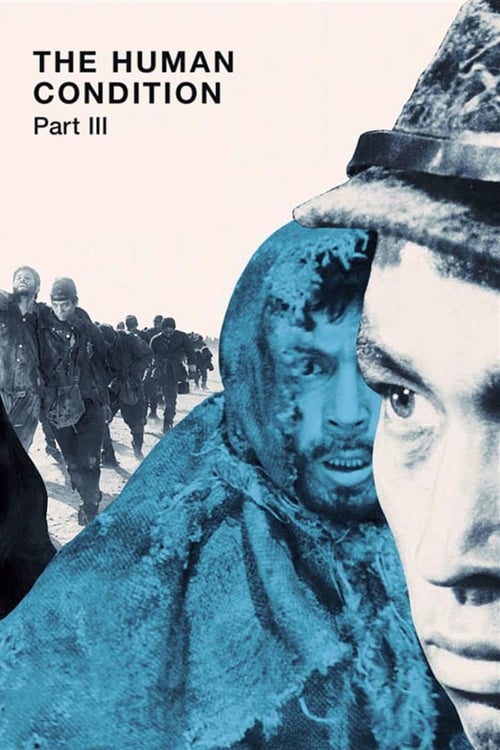
The Human Condition III: A Soldier's Prayer
1961 · Masaki Kobayashi
For when you're ready to commit to something monumental — the concluding night of a trilogy you undertake like a great novel, when you want cinema at its most serious and most humane. This is challenge viewing that earns every minute.
What it's about
The final chapter of a nearly ten-hour trilogy: after Japan's defeat in Manchuria in 1945, Kaji — a humanist who has spent the war trying to keep his conscience intact inside brutal institutions — leads a dwindling band of stragglers south on foot, toward the wife he cannot reach. Through wilderness, refugees, enemy lines, and finally Soviet captivity, the film asks what remains of a man's ideals when every system that shaped him has collapsed.
The experience
Epic in scale, crushing in feeling — a long, harrowing march punctuated by moments of aching tenderness, carried by one of the most sustained portraits of moral endurance ever filmed. It demands stamina and repays it with an ending you won't shake.
Performances
Tatsuya Nakadai's Kaji is a towering achievement — across the trilogy he ages from idealist to survivor, and here he plays exhaustion, rage, and stubborn decency with a physical intensity few actors have matched.
The craft
Kobayashi stages the retreat across vast widescreen landscapes — forests, marshes, snowfields — that dwarf his characters while the camera stays pitilessly close to their faces. The scale of the production is astonishing, and it rewards the biggest screen you can find.
Why it matters
The trilogy stands as one of Japanese cinema's supreme achievements and a definitive reckoning with the country's wartime conduct, cementing Kobayashi's stature and Nakadai's arrival as a major star.
Snapshot
A Soldier's Prayer is the concluding movement of Masaki Kobayashi's The Human Condition (Ningen no jōken), the roughly ten-hour, three-part, six-episode adaptation of Junpei Gomikawa's best-selling novel that Kobayashi released between 1959 and 1961. This final installment — comprising the novel's fifth and sixth volumes and running a little over three hours on its own — follows Kaji (Tatsuya Nakadai), a Japanese humanist and reluctant soldier, through the disintegration of the Kwantung Army after the Soviet entry into the war in August 1945. Stripped of the institutions that had both oppressed and organized his life, Kaji leads a dwindling band of stragglers south across Manchuria toward the wife he cannot reach, is taken into Soviet captivity, and discovers that the socialist state he had idealized reproduces the same cruelties he had resisted under Japanese command. The film closes the trilogy's long argument about whether individual conscience can survive systems built to extinguish it — and answers, with devastating restraint, in the negative. It is one of the monuments of postwar Japanese cinema and among the most sustained pacifist statements the medium has produced.
Industry & production
The Human Condition was produced through Shochiku, one of the major studios of Japan's studio-system heyday, with the independent production unit Ninjin Club (associated with actress Hideko Takamine and her circle) involved in the financing and packaging of the project. The trilogy's sheer scale — three theatrical features released over two years, adapting a six-volume novel — made it an unusually ambitious undertaking for a mainstream studio, and it reflected both the prestige of Gomikawa's source novel, a genuine literary phenomenon, and Kobayashi's rising standing as a director of serious, socially critical pictures. Exact budget and box-office figures are not something I can state reliably, and I will not invent them; what the record does support is that the films were commercially released and widely seen, and that the source novel's popularity gave the adaptation a built-in audience.
The production spanned demanding location work, much of it standing in for the plains and forests of Manchuria, in conditions calculated to test cast and crew — a deliberate choice consonant with the material's insistence on physical endurance. A Soldier's Prayer was released in January 1961, completing an arc begun with No Greater Love (Parts I–II, 1959) and continued in Road to Eternity (Parts III–IV, 1959).
Technology
The film was shot in black and white on Shochiku's anamorphic widescreen process (Shochiku GrandScope), the studio's equivalent of CinemaScope-style 'scope photography then standard for prestige productions. The wide, letterbox-shaped frame is essential to the film's meaning as well as its look: it lets Kobayashi and cinematographer Yoshio Miyajima set the solitary human figure against vast horizontal expanses of snow, mud, and sky, dramatizing the individual's smallness within landscape and history. Monochrome, by this date a considered choice rather than a technical default — color was available and increasingly common for A-pictures — suited the material's austerity and its documentary-adjacent gravity. Sound was monaural optical, standard for the period. The technological interest of the film lies less in novelty than in the disciplined exploitation of the 'scope frame and high-contrast black-and-white photography for expressive ends.
Technique
Cinematography
Yoshio Miyajima's photography is the film's most celebrated formal achievement. Working in wide-screen monochrome, Miyajima composes deep, balanced frames that isolate Kaji within punishing environments — the endless Manchurian snowfields of the final passages are the trilogy's signature images. Light is handled with a graphic severity: stark contrasts, silhouettes against pale skies, figures reduced to dark specks in white immensity. The camera favors a certain classical steadiness and legibility over flashy movement, so that when it does move or when a composition tightens, the shift carries weight. The recurring visual argument — one man measured against a landscape indifferent to him — is built almost entirely through framing and scale.
Editing
The trilogy's overall structure is one of accumulation: long, patiently developed sequences that let ordeals play out in something close to real experiential time, so that the audience shares Kaji's exhaustion. Within A Soldier's Prayer, the editing serves this endurance, holding on suffering and privation rather than cutting away from them. The specific editor of record is not something I can attribute with confidence, and I will not guess a name; what can be said is that the cutting rhythm is deliberately unhurried, an ethical as much as a formal decision — the film refuses the relief that faster editing would provide.
Mise-en-scène / staging
Kobayashi stages the film as a descent through successive circles of collapse: the retreat, the wilderness, the peasant villages, the Soviet camp. Space is organized to express power and its absence — the ordered geometry of camps and command versus the trackless chaos of the flight. Groups of men are arranged to register hierarchy, solidarity, and its breakdown; the crowd, throughout the trilogy, is both Kaji's responsibility and his burden. Physical detail — mud, frost, hunger, wounds — is foregrounded, giving the abstraction of "the human condition" an unrelentingly material body.
Sound
Chūji Kinoshita's score punctuates rather than saturates the film, reserving music for moments of lament and climax while leaving long stretches to wind, footfalls, and silence. The soundscape of the wilderness passages — the near-absence of human sound against natural noise — intensifies the sense of isolation. Voice, and specifically Kaji's, carries enormous dramatic freight: his arguments, refusals, and interior reckonings are the trilogy's spine, and the film treats speech as the last redoubt of a conscience under siege.
Performance
Tatsuya Nakadai's Kaji is one of the great sustained performances in Japanese cinema, carried across all three films and roughly ten hours of screen time. In A Soldier's Prayer he charts the erosion of an idealist into a spent, near-broken man without ever letting the character's moral intensity fully die — the tension between conviction and depletion is the performance's core. Nakadai works largely through physical deterioration and controlled interiority, the earlier films' articulate protest giving way here to endurance and, finally, to a solitary, wordless extinction. Michiyo Aratama returns as Michiko, Kaji's wife, whose remembered presence functions as the film's fragile north star — the "old life" the synopsis names — even as the possibility of return recedes. The trilogy was decisive in establishing Nakadai as a leading figure of his generation.
Narrative & dramatic mode
The film's mode is tragic realism structured as a via dolorosa. Its narrative engine is not plot in the conventional sense but a relentless testing: Kaji is placed in situation after situation designed to force a choice between self-preservation and principle, and the drama lies in whether he can hold his humanity intact. A Soldier's Prayer completes the pattern by removing, one by one, the supports that made moral action legible — army, nation, ideology, comrades, and finally the goal of reunion itself — until conscience must stand naked and, in the snow, alone. The dramaturgy is essayistic and dialectical, close to the source novel's discursive character: characters argue positions, and the film thinks through them. Its emotional register is elegiac and, by the end, apocalyptic in the literal sense of an unveiling — a stripping-away.
Genre & cycle
The film belongs to the postwar antiwar cycle in Japanese cinema, alongside works such as Kobayashi's own later output and the broader wave of films reckoning with the Pacific War and its aftermath. It sits at the intersection of the war film, the literary adaptation (bungei eiga), and social-problem drama. Distinctively, it is a war film almost wholly absent conventional combat spectacle; its subject is the war's moral and human wreckage — retreat, captivity, survival — rather than battle. The trilogy form itself, a serialized epic adapted from a multi-volume novel, connects it to a tradition of long-form literary cinema, and its scale set a benchmark for ambition in the national industry.
Authorship & method
The Human Condition is inseparable from Masaki Kobayashi's biography and convictions. Kobayashi was conscripted into the Imperial Japanese Army and is widely reported to have refused promotion as a gesture of pacifist principle, and he himself experienced military service and detention in the war's aftermath — experience that lends the trilogy its autobiographical charge and its unusual authority on the texture of institutional cruelty. The project reads as his central artistic statement, the fullest expression of the anti-authoritarian humanism that runs through his career.
His key collaborators here were essential. Yoshio Miyajima's cinematography (discussed above) gives the films their visual grandeur and their moral iconography of the lone figure in the landscape. Composer Chūji Kinoshita provided the restrained, lamenting score. The screenplay was adapted by Kobayashi with Zenzō Matsuyama from Gomikawa's novel, translating the book's discursive humanism into dramatic form. And Tatsuya Nakadai's Kaji is, in effect, a co-author of the trilogy's meaning, the human instrument through which its argument is felt. The source author, Junpei Gomikawa, supplied the ideological and narrative architecture; the film is faithful to the novel's essayistic seriousness while giving it overwhelming visual and performative body.
Movement / national cinema
The film stands within the flourishing of serious Japanese cinema around the late 1950s and early 1960s, a period in which the studios still commanded formidable craft resources and directors such as Kobayashi, Kon Ichikawa, and Masaki Kobayashi's contemporaries produced ambitious, internationally legible work. Kobayashi is often grouped with the humanist, socially critical strain of postwar Japanese filmmaking rather than with the emergent Japanese New Wave, though his willingness to indict national institutions aligned him with the era's questioning temper. The trilogy is a landmark of Shochiku's prestige production and of Japanese cinema's postwar reckoning with militarism and empire — a reckoning conducted, pointedly, from the standpoint of a Japanese protagonist implicated in and victimized by his own nation's system.
Era / period
Made in 1959–1961, the trilogy belongs to the roughly decade-and-a-half after Japan's defeat, when the war remained a raw and contested subject and the country was negotiating its postwar identity. Its depiction of Japanese conduct in Manchuria — the forced-labor system, the brutality of the army, the collapse of empire — engaged directly with recent, painful history. That it extends its critique to the Soviet captivity in the final film is historically pointed: Japanese prisoners were held in Soviet camps after the war, and the trilogy's refusal to let socialism off the hook complicated any simple Cold War reading, insisting instead on a critique of coercive systems as such. The film is thus both a period reconstruction of 1945 and a document of its own late-1950s moment of reckoning.
Themes
The trilogy's governing theme, announced in its title, is the human condition itself — specifically, the survival of individual conscience within systems designed to destroy it. Kaji is the recurring test case: a man who insists on treating others humanely and on preserving his own integrity, and who is broken, by degrees, for the attempt. Interlocking themes cluster around this center: the corruption of institutions (army, state, ideology) and their demand for complicity; the betrayal of ideals, as the socialism Kaji believes in proves, in Soviet hands, as brutal as what he fled; the tension between principle and survival; and the crushing of the individual by history and landscape alike. A Soldier's Prayer sharpens these into a final metaphysical question — whether goodness has any purchase in a world structured by force — and delivers its answer as tragedy: Kaji's solitary death in the snow, moving toward a home he will never reach, is the trilogy's terminal image of hope extinguished but not, quite, recanted.
Reception, canon & influence
The Human Condition is securely canonical, widely regarded as Kobayashi's masterpiece and one of the towering achievements of Japanese and world cinema; its critical standing has if anything grown with time, aided by restoration and home-video circulation that made the full ten-hour work accessible to later generations of viewers and critics. Specific contemporary reviews, prizes, and figures I will not fabricate; I can note that the trilogy has been championed by major critics and is regularly cited among the great humanist epics of the medium, and that its first installment is understood to have brought Kobayashi significant recognition. Where the granular reception record is thin in my knowledge, I flag it rather than invent.
Looking backward, the influences on the film are legible: Gomikawa's novel above all, which supplied its structure, its protagonist, and its discursive humanism; the traditions of literary adaptation and social-realist drama in Japanese cinema; and, arguably, the epic humanism of directors and literary traditions that treated the individual against the sweep of history. Kobayashi's own wartime experience is the decisive "source" behind the source.
Looking forward, the trilogy consolidated Kobayashi's authority and cleared the way for the run of masterworks that followed — the jidaigeki indictments of feudal authority, Harakiri (1962) and Samurai Rebellion (1967), and the anthology Kwaidan (1964) — extending into period settings the same anti-authoritarian conscience worked out here in modern-war terms. It made Tatsuya Nakadai a star and gave him the role against which his subsequent career was measured. More broadly, The Human Condition became a reference point for the long-form, morally serious antiwar epic, an example later filmmakers and critics invoke when arguing for cinema's capacity to sustain sustained ethical and historical inquiry at scale. Its final image of a man dying in the snow, faithful to a humanity the world has no use for, remains one of the enduring emblems of postwar film.
A Deleuzian reading
Snow, and one dark shape in it.
The full Deleuzian reading of The Human Condition III: A Soldier's Prayer →
Reception
A huge event in Japan on release and a prize-winner on the festival circuit, the trilogy then drifted into 'legendary but rarely seen' status in the West for decades — until Criterion's 2009 box set turned it into a bucket-list pilgrimage, with this final part now often rated the summit of the whole nine-and-a-half hours.
How The Human Condition III: A Soldier's Prayer was received, from release to now →
How to watch The Human Condition III: A Soldier's Prayer: what to notice on a first viewing
- Watch how small a single man looks against the snow. Miyajima's widescreen frames repeatedly reduce Kaji to a dark speck in a vast white field, using scale rather than close-up to measure him against the landscape. A frame this empty stops being a backdrop and becomes a field where nothing can be done.
- Watch Nakadai's body for signs of wear, not just his face. Nakadai plays Kaji's decline through posture, gait, and physical depletion, mud, frost, and hunger accumulating on his body as much as in anything he says. Once argument stops being enough, the body becomes the only place left for the film to show endurance.
- Notice how long the film stays with hunger and cold. The editing holds on privation instead of cutting past it, letting ordeals play out close to their real duration so you share the exhaustion rather than just witness it. Refusing to speed past suffering is an ethical choice, not just a slow pace.
- Listen for wind and footsteps instead of music. Kinoshita's score stays out of most of the wilderness passages, leaving long stretches to wind, footfalls, and silence, saving music for a handful of moments. Silence this sustained makes isolation something you hear, not just something the plot tells you about.
- Watch how the men are grouped as a column moves. Kobayashi arranges the stragglers to register hierarchy and solidarity and its breakdown, so the shape of the group tells you as much as any single man's face. Kaji's men are both what he protects and what weighs on him, and the staging shows both at once.
Influences: the films it descends from and the films it influenced
- Fires on the Plain (1959) — Establishes the antiwar grammar Kobayashi extends — high-contrast monochrome reducing the lone soldier to a black figure crawling across a scorched Philippine landscape, conveying war's horror through the starving body's degradation rather than through battle spectacle.
- The Burmese Harp (1956) — Model for the postwar bungei-eiga soldier-as-conscience: a literary-adaptation humanism in which a wandering ex-soldier becomes a moral witness, filmed as a solitary silhouette against terrain, indicting war without glorifying combat.
- Grand Illusion (1937) — The foundational 'antiwar without combat' structure — war critiqued entirely through prison camps, dialogue, and men negotiating hierarchy and humanity, the dialectical humanist template Kobayashi transposes to Manchuria.
- Paths of Glory (1957) — Shares the indictment of military hierarchy crushing the individual conscience, staged through cold institutional geometry and the tracking of a lone principled man through the machinery of army authority.
- Battleship Potemkin (1925) — Source of the essayistic-dialectical method — editing that stages collective cruelty and the awakening of conscience as an argument, the montage-as-thesis logic underpinning Kobayashi's discursive structure.
- Ugetsu (1953) — Precedent for the long-take, unhurried staging that dwarfs the human figure within landscape and weather, giving literary-adaptation moral seriousness a fluid, contemplative camera.
- Seven Samurai (1954) — Model for endurance-length humanist epic and the telephoto figure-in-landscape — actors etched against mud, rain, and wind across a long-form runtime that treats duration itself as moral weight.
- Harakiri (1962) — Reunites Yoshio Miyajima's rigorous anamorphic monochrome and Tatsuya Nakadai to replay the conscience-vs-system dialectic in jidaigeki form, its formal precision and anti-authoritarian argument developed directly out of Kaji's trial.
- Samurai Rebellion (1967) — Transposes the same essayistic anti-authoritarian structure into a feudal setting with Nakadai and geometrically severe widescreen staging, a single man's principled refusal escalating against institutional power.
- Kwaidan (1964) — Continues Kobayashi's authorship of painterly, deliberately composed widescreen tableaux and sparse, unnerving sound design, applying the trilogy's compositional control to stylized anthology form.
- Ran (1985) — Casts Nakadai in the lead of a tragic antiwar epic built on figures dwarfed in landscape and the collapse of a moral order, extending the humanist-epic scale and lone-figure iconography into color.
- Come and See (1985) — Carries forward the endurance-length antiwar method — war's horror registered through one innocent's bodily and psychic degradation moving across a devastated landscape, duration weaponized as moral experience.
- The Thin Red Line (1998) — Inherits the essayistic-dialectical antiwar mode — competing voiceover consciences meditating on war's machine against figures placed within indifferent nature, refusing heroics for philosophical inquiry.
- Andrei Rublev (1966) — Shares the long-take endurance monochrome epic across historical sweep, the conscience-vs-system of an ethical man against a brutal order, and the recurring composition of the solitary figure held within vast landscape.
- The Sword of Doom (1966) — Kobayashi's epic extracted from Nakadai a sustained performance vocabulary for a man hollowed by systematic violence — the physical grammar of stillness-as-danger, the unblinking affect that registers as void rather than calm — which Okamoto then concentrates and purifies into Ryunosuke's absolute vacancy, stripping away the residual humanity Kobayashi kept legible in Kaji.
- The Naked Island (1960) — Parallel experiment in near-wordless material-detail realism — sparse monaural sound and monochrome compositions of laboring bodies moving through an unforgiving landscape, endurance conveyed through repetitive physical texture.
- Woman in the Dunes (1964) — Extends the same high-contrast monochrome and obsessive material-detail texture (sand, skin, grain) into an existential dialectic of the individual trapped by an impersonal system.
Similar films
- The Burmese Harp (1956) — influence & lineage · same viewing thread
- Fires on the Plain (1959) — influence & lineage · same viewing thread
- Harakiri (1962) — influence & lineage · often watched together
- Ran (1985) — influence & lineage · often watched together
- Seven Samurai (1954) — influence & lineage · often watched together
- The Human Condition II: Road to Eternity (1959) — same viewing thread · often watched together
- The Human Condition I: No Greater Love (1959) — same viewing thread · often watched together
- Samurai Rebellion (1967) — influence & lineage
All the films related to The Human Condition III: A Soldier's Prayer →
Watch it with: curated runs of related films
- Japan's Long Reckoning With War — Watch these when you want Japanese cinema turning its unflinching gaze on its own war — the conscript's conscience, the retreat, the survivor who won't let the officers forget — each film picking up the moral wreckage the last one left.