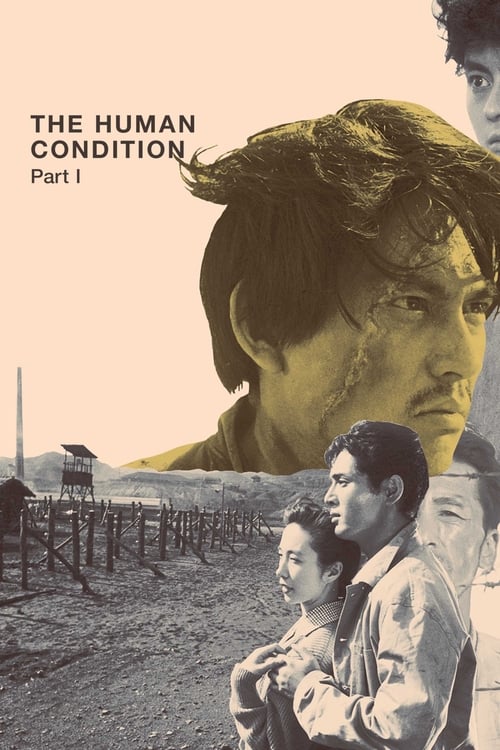
The Human Condition I: No Greater Love
1959 · Masaki Kobayashi
For when you want cinema at its most serious — a film to commit an evening to and carry with you for weeks. Pure challenge, and worth it: the start of one of the great long-haul viewing projects.
What it's about
Kaji, a young Japanese idealist, takes a job supervising labor at a vast iron-ore mine in occupied Manchuria during World War II — partly to escape the draft, partly to prove that workers, including Chinese prisoners of war, can be treated humanely. He arrives with his new wife and his principles, and finds both under siege from brutal foremen, scheming officials, and the machinery of empire itself. It's the first movement of a nearly ten-hour trilogy about what conscience costs inside an inhuman system.
The experience
Somber, gripping, and morally relentless — three and a half hours that move with the weight of a great novel. It's demanding viewing, but the tension between one man's decency and the cruelty around him keeps tightening until it's hard to breathe.
Performances
Tatsuya Nakadai, in the role that made him one of Japan's greatest actors, plays Kaji's idealism as something physical — you watch conviction, doubt, and fury fight across his face for the entire running time.
The craft
Masaki Kobayashi shoots the mine and the Manchurian plains in stark, monumental black-and-white widescreen, staging huge crowds and intimate marital scenes with equal control. The scale of the production — a bestselling novel adapted at full length, refusing all shortcuts — is itself the statement.
Why it matters
The opening of one of the most ambitious projects in film history, a searing self-indictment of Japan's wartime conduct made barely a decade after the war, and the film that launched Tatsuya Nakadai's legendary career.
Snapshot
No Greater Love is the opening movement of Masaki Kobayashi's The Human Condition (Ningen no jōken), a six-part, nearly ten-hour trilogy adapted from Junpei Gomikawa's best-selling novel and released by Shochiku in three installments between 1959 and 1961. This first film, comprising the first two parts of the cycle and running roughly three and a half hours, transplants its idealistic protagonist Kaji (Tatsuya Nakadai) and his new wife Michiko (Michiyo Aratama) to a vast iron-ore mining operation in Japanese-occupied Manchuria during the final years of the Pacific War. Kaji accepts the post of labor supervisor partly because it carries a draft exemption, and partly because he believes he can prove that humane treatment of the Chinese forced labourers—including prisoners of war delivered to the mine as "special workers"—will also be more productive. The film charts the slow, grinding defeat of that conviction against company greed, sadistic foremen, and the Kempeitai (military police). It is at once an intimate marital drama and a panoramic indictment of the colonial-militarist system, and it established the central terms of one of postwar Japanese cinema's most ambitious moral epics.
Industry & production
The Human Condition was a Shochiku production, and its scale was unusual for a studio better known in this period for domestic dramas and the gentle humanism of directors like Yasujirō Ozu and Keisuke Kinoshita. Kobayashi, a Shochiku contract director since the late 1940s who had apprenticed under Kinoshita, had spent the 1950s building toward socially critical work, and the source material gave him a vehicle of exceptional reach. Gomikawa's novel was a publishing phenomenon in mid-1950s Japan—a sprawling, partly autobiographical account of a conscientious man crushed by the war machine that resonated powerfully with a nation still processing defeat and occupation. Its popularity made a screen adaptation commercially plausible despite the formidable length and politically charged subject.
The production was mounted as a multi-film undertaking, with the first installment shot and released in 1959 and the subsequent parts following over the next two years. Manchurian exteriors were largely re-created in Hokkaido, whose cold, open landscapes stood in for the continental setting—an arrangement dictated both by postwar geopolitics, which placed the historical locations in the People's Republic of China, and by logistics. The harsh conditions of the shoot became part of the film's lore, consonant with its punishing physical content. Precise budget and box-office figures are not something the English-language record reliably documents, and I won't invent them; what is clear is that the trilogy represented a major, sustained commitment of studio resources and that its critical standing helped cement Kobayashi's reputation internationally.
Technology
The film was shot in black-and-white anamorphic widescreen using Shochiku's GrandScope process, the studio's CinemaScope-compatible format, yielding an aspect ratio of roughly 2.35:1. The choice is fundamental to the film's effect: the wide frame allows Kobayashi and cinematographer Yoshio Miyajima to set the small, embattled figure of Kaji against enormous horizontal expanses—the mine, the barracks compound, the flat Manchurian plain—so that the format itself dramatizes the individual's smallness within an oppressive system. Monochrome, by this date a deliberate aesthetic and economic choice rather than a default (color was well established in Japanese features), suits the film's austere moral seriousness and its documentary-leaning treatment of labor and landscape. Sound was monaural optical, standard for the period. There is nothing technologically experimental here in the manner of contemporaneous avant-garde work; the film's ambition lies instead in the rigorous, large-scale deployment of mature studio tools.
Technique
Cinematography
Yoshio Miyajima's photography is the film's most celebrated craft element, and it would anchor his long association with Kobayashi (he later shot Harakiri and Kwaidan). Miyajima exploits the GrandScope frame for compositions of stark geometric clarity: rows of labourers, fence lines, and the receding architecture of the camp organize the wide image into grids of confinement. Deep, hard contrast renders the Manchurian winter as a bleached, unforgiving field, while interiors are carved with directional light that isolates faces in moral close-up. The camera alternates between this monumental, almost sculptural distance and sudden intimacy, a rhythm that keeps the personal stakes legible inside the epic scale. Crowd compositions—the assembled "special workers," the watching guards—are staged in depth so that systems of power and their human cost occupy a single frame.
Editing
Across nearly three and a half hours, the cutting is patient and accumulative rather than propulsive; the film builds its case through duration, letting scenes of negotiation, humiliation, and labor play at length so that the slow erosion of Kaji's idealism registers as lived time. Sequences are organized into clear dramatic blocks—Kaji's arrival and ambitions, the management's resistance, the arrival and treatment of the POW labourers—escalating toward confrontation. I cannot reliably attribute the editing to a specific cutter from memory, and rather than guess I'll note that the trilogy's editorial signature is its willingness to sustain discomfort, refusing the relief of brisk pacing.
Mise-en-scène / staging
Kobayashi's staging is rigorously moral in its geometry. The mining compound is presented as a machine for dehumanization—watchtowers, fences, parade grounds—and characters are blocked within it to express hierarchy and entrapment. Kaji is repeatedly placed between groups: management above him, labourers below, the military police at the margins, so that the frame literalizes his role as a doomed mediator. Crowd scenes of forced labor are arranged with documentary density, and acts of cruelty are staged frontally and without sensational embellishment, demanding that the viewer witness rather than be thrilled. The marital scenes with Michiko establish a counter-space of tenderness whose fragility deepens as the institutional world closes in.
Sound
Chūji Kinoshita's score—he was the brother of Kobayashi's mentor Keisuke Kinoshita—supports the film's gravity without overwhelming it, deployed in restrained passages that underscore the emotional crises rather than continuously scoring the action. Much of the film's power comes from environmental sound: wind across the plain, the machinery and din of the mine, the bark of orders. Silence and ambient noise are used to heighten the documentary weight of the labor sequences, and the relative sparseness of music keeps the focus on the harsh materiality of the setting.
Performance
The film is a showcase for Tatsuya Nakadai in his first major leading role, a part that launched one of the great careers of postwar Japanese cinema and his enduring collaboration with Kobayashi. Nakadai plays Kaji as a man of fierce inner conviction whose decency is tested past endurance; the performance modulates from earnest idealism to anguished compromise to barely contained rage, carrying the moral argument of the entire trilogy. Michiyo Aratama gives Michiko warmth and steel, grounding the political drama in a marriage worth defending. The supporting ensemble of officials, foremen, and military police is drawn in sharp, often grimly recognizable types, embodying the gradations of complicity within the system.
Narrative & dramatic mode
The film operates as moral-realist tragedy structured around a single, sustained ethical experiment. Kaji is given the chance to test his humanist principles inside an inhumane institution, and the narrative is essentially the methodical demonstration of how that institution defeats, co-opts, or corrupts every reform he attempts. The dramatic engine is not suspense in the conventional sense but the dread of inevitability: we sense early that Kaji's decency cannot survive the system, and the film's length makes us live through each compromise. The marriage plot runs in counterpoint, offering both the stakes of Kaji's survival and a measure of what the war costs in private life. It is melodrama in the serious, classical sense—a drama of moral clarity and feeling—wedded to a near-documentary social canvas.
Genre & cycle
No Greater Love belongs to the postwar Japanese anti-war film and to the broader international cycle of humanist war epics, but it is unusual in foregrounding the home-front colonial labor system rather than combat (combat enters later in the trilogy). It can be read alongside Japan's tradition of socially critical "tendency" filmmaking and the era's reckoning-with-defeat dramas, while its sheer scale aligns it with the international vogue for the prestige epic. Within Kobayashi's own output it inaugurates the cycle of institutional-critique films—works in which a principled individual is ground down by a rigid system—that runs through Harakiri (1962) and Samurai Rebellion (1967), making The Human Condition the contemporary-set cornerstone of that thematic project.
Authorship & method
The Human Condition is the most directly personal of Kobayashi's films, and understanding it requires understanding his biography. Born in 1916, Kobayashi was a pacifist who was conscripted into the Imperial Japanese Army and served in Manchuria; by his own account he refused promotion as a silent protest against the militarist system, and he was later held as a prisoner of war. The figure of Kaji—a man who will not become an officer in a machine he despises, yet cannot extricate himself from it—is thus a near-autobiographical projection, and the film's moral intensity flows from lived conviction rather than abstract politics.
His key collaborators form a recognizable Kobayashi workshop. The screenplay was written by Zenzō Matsuyama, a frequent Kobayashi collaborator, with the director's own involvement, condensing Gomikawa's massive novel into dramatic shape. Cinematographer Yoshio Miyajima became Kobayashi's essential visual partner across this period. Composer Chūji Kinoshita provided the restrained score, extending the Kinoshita-Kobayashi lineage that began with Kobayashi's apprenticeship to Keisuke Kinoshita. And Tatsuya Nakadai's casting initiated a director-actor partnership that would define both men's most ambitious work. The method throughout is one of moral rigor realized through controlled, large-scale classical technique rather than stylistic flamboyance.
Movement / national cinema
The film sits at a hinge point in Japanese cinema. It was produced at the threshold of the Japanese New Wave (Nūberu bāgu), the late-1950s/early-1960s wave of younger, politically combative filmmakers—Nagisa Ōshima among them—who emerged partly from within Shochiku. Kobayashi is not usually counted among the New Wave proper; his sensibility is closer to the older studio humanism, and his technique remains classical. Yet The Human Condition shares the New Wave's anti-authoritarian anger and its willingness to confront Japan's wartime conduct head-on, including the colonial exploitation of Chinese labor. It thus functions as a bridge between the humanist tradition of his mentor Kinoshita and the more radical reckoning of the younger generation, a major-studio epic carrying a dissident charge.
Era / period
Released in January 1959, the film belongs to a Japan a decade and a half past defeat, prosperous enough to underwrite a monumental production yet still actively working through the moral legacy of the war and occupation. The late 1950s were a high point of Japanese studio output and of widescreen prestige filmmaking, and also a period of pointed political tension that would culminate in the 1960 Anpo protests against the U.S.–Japan Security Treaty. The film's unflinching depiction of Japanese atrocities against the Chinese—forced labor, summary execution, institutional sadism—was a pointed intervention in a national conversation about responsibility, addressed to audiences who had often been encouraged to remember themselves primarily as victims of the war.
Themes
The film's governing theme is the survival of individual conscience inside a coercive system, and the question—posed by the title's invocation of the "human condition"—of whether decency is possible under such conditions at all. Subordinate to this are the corruptions of colonialism and the exploitation of the Chinese as expendable labor; the complicity that institutions extract from even well-meaning participants, as Kaji discovers that to reform the system from within is still to serve it; and the tension between idealism and compromise, principle and survival. The marriage carries the theme of love as both a sustaining value and a hostage to history. Kobayashi refuses easy consolation: Kaji's humanism is genuinely admirable and almost wholly ineffectual, and the film's tragic force comes from holding both truths at once.
Reception, canon & influence
The Human Condition was received as a serious and important work on release and has grown in stature to become a recognized landmark of Japanese cinema and of world anti-war filmmaking; it is frequently cited among the most ambitious achievements of the medium for its scale and moral seriousness. The trilogy earned festival recognition and is today widely available in restored form, sustaining its reputation among critics and cinephiles—though I would flag that specific contemporary box-office and award particulars for this first installment are not something I can cite with confidence, and I won't fabricate them.
Looking backward, the film's deepest influence is Gomikawa's source novel and Kobayashi's own wartime experience; more broadly it draws on the postwar humanist tradition of his mentor Keisuke Kinoshita and on the international model of the long-form realist epic. Looking forward, its most important legacy is internal to Kobayashi's career: it crystallized the individual-versus-institution drama he would perfect in the period films Harakiri and Samurai Rebellion, and it launched Tatsuya Nakadai as a leading man. Beyond that, it stands as a foundational reference point for serious cinematic treatments of complicity and conscience in wartime, and its commitment to confronting Japanese culpability toward China gave it a lasting moral and historical significance that extends well past its considerable artistic achievement. It is, finally, the necessary first chapter of an unfolding tragedy—its defeats here are the ground from which the trilogy's longer descent proceeds.
A Deleuzian reading
A man stands in the middle of an enormous frame.
The full Deleuzian reading of The Human Condition I: No Greater Love →
Reception
A landmark event in Japan on release — the opening act of a hugely ambitious adaptation of Junpei Gomikawa's bestselling novel — it drifted into 'legendary but little-seen' territory in the West for decades, until Criterion's 2009 box set and Letterboxd turned the full trilogy into one of the most revered epics in the canon.
How The Human Condition I: No Greater Love was received, from release to now →
Influences: the films it descends from and the films it influenced
- Twenty-Four Eyes (1954) — Kobayashi's mentor model: restrained humanist pacifism carried by performance and a sparse Chūji Kinoshita score rather than rhetoric, the exact emotional register Kobayashi inherited through his Kinoshita apprenticeship.
- Sansho the Bailiff (1954) — Long-take, deep-staged realization of moral-realist tragedy in which a conscientious individual is slowly ground down by an exploitative institution he cannot escape.
- The Best Years of Our Lives (1946) — Gregg Toland's deep-focus staging deployed across a long-form postwar reckoning, layering foreground and background action so social pressure is composed into the frame rather than cut to.
- Ikiru (1952) — The conscience-versus-bureaucratic-system drama—one man asserting moral agency against an indifferent institutional machine—that Kobayashi recast in military form.
- Black River (1957) — Kobayashi's own immediate precursor: his first pairing with Tatsuya Nakadai and the Yoshio Miyajima camera, working out the corruption-of-institution material in high-contrast monochrome.
- The Burmese Harp (1956) — Postwar Japanese anti-war film built on a soldier's awakening conscience toward the war dead, using on-location environmental realism over heroics.
- Paths of Glory (1957) — Anti-war indictment structured around the individual who refuses complicity with a murderous military hierarchy, staging the chain of command as a geometry of confinement.
- Harakiri (1962) — Perfects the individual-versus-institution drama with Miyajima's anamorphic high-contrast compositions and rigorous geometry of confinement, Nakadai now the lead.
- Samurai Rebellion (1967) — Transposes the conscience-versus-system structure to feudal authority via severe symmetrical staging and a slow accrual of inevitability, again anchored by Nakadai.
- Kwaidan (1964) — Extends the Miyajima partnership's anamorphic compositional control and sparse, environmentally attentive sound design toward stylized formal precision.
- The Battle of Algiers (1966) — Moral-realist treatment of colonial exploitation built on documentary-grade environmental realism, refusing to let either oppressor or resister off the ethical hook.
- Andrei Rublev (1966) — Long-take, long-form moral epic tracking an artist's conscience under historical brutality, sustaining the same dread-of-inevitability tempo across episodic chapters.
- Come and See (1985) — Immersive, durational anti-war epic that sustains relentless dread of the inevitable as a single witness is stripped of innocence by the war machine.
- Schindler's List (1993) — High-contrast monochrome epic of complicity and conscience inside wartime atrocity, using documentary-styled realism to confront a nation's culpability.
- Ran (1985) — Nakadai's late tragic lead in anamorphic widescreen, the figure crushed by the very system of power he upheld—the breakout actor's arc completing the lineage Kobayashi began.
- Merry Christmas, Mr. Lawrence (1983) — Choreographs Japanese army discipline as ritual — ranks lined in depth, the slapping-line, collective punishment for one man's offense — and centers the humane intermediary who speaks the prisoners' language and is destroyed by his position, which is precisely Lawrence's job in the film.
- Fires on the Plain (1959) — Same-moment anti-war epic rendering a soldier's moral and physical degradation in stark high-contrast monochrome, sharing Kobayashi's refusal to console the viewer.
Similar films
- The Burmese Harp (1956) — influence & lineage · same viewing thread
- Fires on the Plain (1959) — influence & lineage · same viewing thread
- Harakiri (1962) — influence & lineage · often watched together
- Ran (1985) — influence & lineage · often watched together
- The Human Condition III: A Soldier's Prayer (1961) — same viewing thread · often watched together
- The Human Condition II: Road to Eternity (1959) — same viewing thread · often watched together
- Ikiru (1952) — influence & lineage
- Sansho the Bailiff (1954) — influence & lineage
All the films related to The Human Condition I: No Greater Love →
Watch it with: curated runs of related films
- Japan's Long Reckoning With War — Watch these when you want Japanese cinema turning its unflinching gaze on its own war — the conscript's conscience, the retreat, the survivor who won't let the officers forget — each film picking up the moral wreckage the last one left.