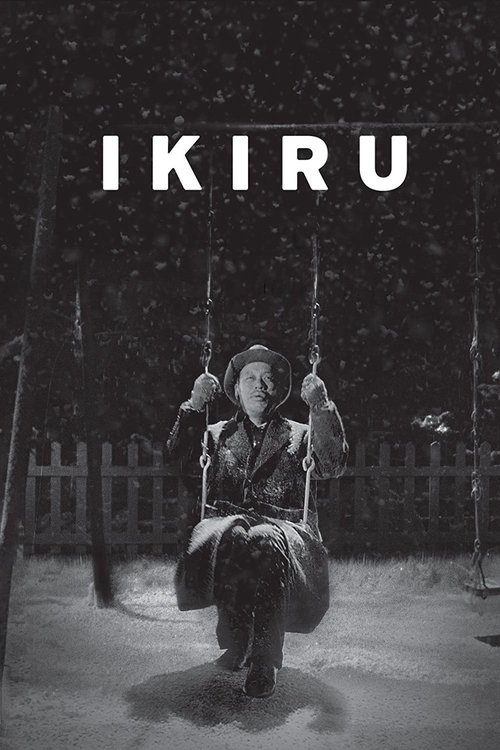
Ikiru
1952 · Akira Kurosawa
For when you need a good cry that leaves you better than it found you — the film to reach for when you're taking stock of your own life. Demanding of your attention, but one of cinema's great consolations.
What it's about
Watanabe has spent thirty years behind the same desk in a Tokyo city office, stamping papers that go nowhere. A cancer diagnosis gives him months to live and forces the question he's deferred his whole life: what has any of it been for? He tries night life, tries company, and finally fixes on one small, stubborn goal — to make his job mean something before the end.
The experience
Quietly devastating and then, unexpectedly, uplifting — it moves at the pace of a man learning to feel again, and it earns every tear honestly. You finish it wanting to call someone you love and quit wasting your evenings.
Performances
Takashi Shimura gives one of the most moving performances ever filmed — hunched, hoarse, his enormous eyes doing the work of pages of dialogue. A whole life of regret and late-blooming resolve lives in his face.
The craft
Kurosawa builds the film with daring structure rather than sentiment, withholding and reframing its story so the meaning of one man's life becomes something you piece together yourself. The black-and-white compositions — an office buried in paper, a lone figure on a swing in the snow — are among the most indelible images in cinema.
Why it matters
It's the cornerstone of Kurosawa's humanist reputation, endlessly cited, taught, and remade — the film people mean when they say cinema can change how you live.
Snapshot
Ikiru — the title translates simply as "To Live" — is among the most concentrated meditations on mortality in world cinema, and among the most formally audacious films to emerge from postwar Japan. Watanabe Kanji, a senior section chief in a Tokyo municipal bureaucracy, learns he has months to live and must, for the first time in thirty years, ask himself what his life has been for. What Kurosawa fashions from this premise is not a conventional redemption narrative but a structural argument about how meaning is perceived, deferred, and ultimately obscured by the social institutions that surround a human being. The film's decisive formal gambit — cutting away from its protagonist before his death and reconstructing his final act through the retrospective testimony of colleagues who mostly failed to understand him — transforms a humanist drama into something closer to an epistemological inquiry. Ikiru is simultaneously the most accessible and the most philosophically rigorous of Kurosawa's non-samurai films.
Industry & production
Ikiru was produced by Toho Co., Ltd., the major studio that anchored Kurosawa's career throughout the 1940s and 1950s. By 1952, Kurosawa held an unusually strong position within the studio system: Rashomon's shock triumph at the Venice Film Festival in 1951 — it won the Golden Lion — had made him internationally legible in a way no Japanese director had previously been, and Toho extended him commensurate latitude. The production budget and shooting schedule reflect a mid-range prestige picture rather than an epic; Ikiru was shot entirely on studio sets and a handful of Tokyo locations, and its modesty of physical scale sharpens the film's moral intensity rather than diminishing it.
The script was developed through Kurosawa's characteristic collaborative process with two writers who would become his core dramaturgical partners: Shinobu Hashimoto, who had co-written Rashomon and would go on to co-write Seven Samurai, Ikimono no Kiroku, and The Hidden Fortress; and Hideo Oguni, beginning a collaboration with Kurosawa that would extend through Dersu Uzala. The three writers worked through Tolstoy's novella The Death of Ivan Ilyich as an acknowledged structural and spiritual source — Tolstoy's account of a judge who discovers terminal illness and finds that his entire adult life has been a social performance rather than a lived reality directly informs Watanabe's situation and the film's critique of Japanese bureaucratic culture. Kurosawa was open about the debt, which was a matter of thematic inheritance rather than adaptation; the screenplay transposes Tolstoy's moral cartography onto postwar Tokyo's civic bureaucracy.
Technology
Ikiru was shot in black and white on standard 35mm, in the Academy ratio (approximately 1.37:1) that remained standard for Japanese theatrical release in 1952. There was no deployment of unusual photographic process: the film's power derives from the manipulation of existing tools rather than novelty of apparatus. Toho's studio infrastructure in this period was technically sophisticated by regional standards, having rebuilt substantially after wartime damage and American requisitioning. Sound was recorded and mixed using the optical monaural track standard for the era. The film predates both widescreen conversion and magnetic stereo sound in Japanese theatrical exhibition.
Technique
Cinematography
Asakazu Nakai served as cinematographer — he and Kurosawa had already worked together on earlier films and would continue through Seven Samurai and beyond. Nakai's work here is precise and deliberately unglamorous, matching the gray institutional world the narrative inhabits. The deep-focus compositions in the bureaucratic sequences — stacks of papers, identical desks, the shuffling of petition folders — create a visual rhetoric of entrapping space: Watanabe is always enclosed, framed by the machinery of his institution. The transition into Watanabe's night-world — the bars, the cabaret, the novelist's company — introduces shallower focus and more fluid camera placement, a visual loosening that parallels the character's temporarily liberated state. The film's most celebrated image, Watanabe alone on a park swing in falling snow, singing softly to himself as he dies, is held in a fixed medium shot at slight distance: Nakai and Kurosawa resist the close-up that would sentimentalize the moment, trusting instead the composition and Shimura's stillness.
Editing
Koichi Iwashita edited Ikiru under Kurosawa's close supervision. The film's most radical editorial decision is structural rather than rhythmic: the pivot that occurs roughly two-thirds through, when the narrative leaps past Watanabe's death to a wake scene and proceeds, entirely through retrospective dialogue and flashback, to reconstruct what Watanabe actually did with his final months. This structure — learned forward, explained backward — creates an epistemological gap that is the film's argument in formal terms: the people best positioned to observe Watanabe's transformation are the people least equipped to understand it. The editing of the flashback sequences within the wake is notably discontinuous and associative, cutting against conventional scene grammar to suggest the fragmentary, self-interested nature of collective memory.
Mise-en-scène / staging
Kurosawa's staging throughout the bureaucratic scenes is geometrically oppressive. The famous opening shot of Watanabe at his desk, dissolving into the narration about a mummy who has been at his post for thirty years, establishes the regime of spatial repetition that governs the institutional world. Kurosawa uses depth and lateral movement to differentiate the two halves of Watanabe's experience: early, he is planted, static, surrounded by subordinates and files; later, even when moving through identical Tokyo streets, there is a quality of provisional freedom in the staging. The playground sequence at the end, where the completed slide and swing-set represent Watanabe's legacy, is staged with the children's noise and movement providing a structural counterpoint to the bureaucrats' deliberate immobility at the preceding wake.
Sound
Fumio Hayasaka, who had scored Rashomon and would score Seven Samurai before his death in 1955, composed the music for Ikiru. The score is used sparingly, with deliberate emotional restraint in the moments where conventional filmmaking would swell the strings. The diegetic use of music is more pointed: Watanabe's performance in the bar of the old song "Life Is Brief" (Gondola no Uta), a sentimental melody from a 1915 Takarazuka production, is one of Japanese cinema's memorable musical moments not because it is technically extraordinary but because its placement and Shimura's delivery invest a piece of period schmaltz with genuine grief. The moment works because it is surrounded by silence and the discomfort of onlookers, not because the production inflates it.
Performance
Takashi Shimura's portrayal of Watanabe Kanji is among the defining screen performances of 1950s world cinema. Shimura — a Kurosawa regular who had appeared in Drunken Angel, Stray Dog, and Rashomon — deploys an extreme economy of physical means. The famous transformation in the film's second half is accomplished without any conventional dramatic climax on screen; we infer it retroactively. In the earlier portions, Shimura plays Watanabe's shock and dissolution through stillness and a quality of internal collapse visible primarily in the eyes. The supporting cast, particularly the actress playing Toyo — the young woman whose vitality Watanabe briefly pursues as a model of living — is deployed with precision; her discomfort with Watanabe's attention is played without caricature, which keeps the ethical ambiguity intact.
Narrative & dramatic mode
Ikiru's narrative architecture is its most significant formal contribution. The film operates in two movements separated by a radical ellipsis: the first follows Watanabe in dramatic present-tense as he receives his diagnosis, circles through grief and dissipation, and gradually arrives at a resolution to build a playground for a working-class neighborhood whose petition had been shuffled through his desk for years. The second movement begins with his death already accomplished, and the film's remainder — roughly the final third — takes place entirely at and after his wake, structured around retrospective accounts from colleagues. This retrospective structure was unusual in Japanese cinema of the period and remains unusual globally: it refuses the cathartic identification that a conventional deathbed narrative would deliver, replacing it with an inquiry into whether meaning can survive the social structures that processed the person who made it.
The mode is humanist realism indebted not only to Tolstoy but to the tradition of Japanese shōshimin-eiga (films about ordinary citizens), inflected by the existentialist preoccupations circulating in postwar intellectual culture.
Genre & cycle
Ikiru belongs to a cycle of postwar Japanese social dramas concerned with the spiritual costs of organizational life — a genre that has no precise Western equivalent but which would later be taxonomized as salaryman films (sarariiman-eiga). The bureaucrat as protagonist had precedents in prewar Japanese film, but the postwar versions carry an additional weight: the administrative class who had served the imperial apparatus were now serving American-supervised democratic reconstruction, with similar moral anesthesia. Kurosawa is unusually explicit in connecting institutional inertia to individual moral failure; where other filmmakers in the cycle tended toward pathos, Ikiru maintains a diagnostic edge. The film also overlaps with the broader post-Occupation cycle of films reckoning with Japanese social structure — it appeared in the same years as Naruse's late melodramas and Ozu's Tokyo Story (1953), which shares its concern with generational estrangement and the concealed anguish of middle-aged lives.
Authorship & method
Kurosawa's directorial method in this period was defined by intensive pre-production script development, autocratic control on set, and close partnership with a small stable of collaborators. The three-writer script process with Hashimoto and Oguni was not merely a division of labor but a genuine dialectic: Kurosawa described their working method as involving days of silent individual writing followed by collective comparison and revision. The screenplay for Ikiru is unusually tight by Kurosawa standards, showing the marks of this rigorous drafting process.
Nakai's cinematography gives the film its visual discipline. Hayasaka's score, deployed with consistent restraint, represents a creative alignment on emotional economy that distinguishes this film from Hollywood contemporaries treating similar material. The editorial structure — with its bold retrospective pivot — is attributed in Kurosawa's production records to close collaboration between director and editor during the cut, though the precise genesis of the structural decision is not documented in any public primary source.
Movement / national cinema
The film arrives at a specific conjuncture in Japanese national cinema: the American Occupation formally ended in April 1952, and Ikiru was released in October of the same year. Japanese filmmakers were navigating the end of censorship restrictions (which had prohibited, among other things, criticism of feudal social structures — the very structures that postwar bureaucracy partly reproduced) while also processing the experience of defeat, reconstruction, and cultural occupation. The film's critique of institutional inertia has a political valence specific to this moment without being programmatically political.
Internationally, Ikiru contributed to the emerging Western understanding of Japanese cinema as a serious national tradition with philosophical ambitions comparable to European art cinema. It was screened and discussed abroad in the wake of Rashomon's Venice triumph, and was among the handful of films that convinced European critics in the 1950s that Japanese cinema warranted the same attention they were giving to Bergman, Fellini, and the French New Wave's heroes of classical Hollywood.
Era / period
The early 1950s in Japan are a period of rapid institutional rebuilding following defeat and occupation. The Tokyo of Ikiru is not the bomb-leveled cityscape of films from the late 1940s but it is not yet the high-growth economic miracle city of the 1960s — it is a city of reconstruction, where new civic amenities (a children's playground, the object of Watanabe's final effort) represent genuine if modest achievements. The bureaucratic world Kurosawa depicts — defined by petition shuffling, inter-departmental buck-passing, and the absorption of individual agency into procedure — is both a critique of that specific postwar administrative culture and an argument about institutional life as such.
Themes
The film's organizing theme is the relationship between the awareness of death and the possibility of authentic action. Watanabe's thirty years of bureaucratic non-life and his few months of purposeful engagement are held in deliberate contrast, and the film refuses the consoling implication that one transformed act redeems the waste. The retrospective structure enacts the film's second major theme: that meaning is socially produced and socially obscured, that the institutions which absorb individual effort are also the institutions that prevent survivors from correctly perceiving what the individual actually did. The final scene — where the colleagues who had briefly resolved to behave differently at Watanabe's example return to their desks unchanged — is not cynical but diagnostic. A subsidiary theme is the generational estrangement between Watanabe and his son, which parallels the Tolstoyan argument that social respectability and emotional inaccessibility are produced together.
Reception, canon & influence
On release in Japan, Ikiru was received as a major work, though its structural unconventionality produced some critical debate about the tonal shift in the second half. Kurosawa won the Kinema Junpo prize for best director. Internationally, the film built its reputation more slowly than Rashomon, partly because its social setting was more specifically Japanese and less susceptible to the universalist mythologizing that greeted the earlier film. By the 1960s, as the international art cinema circuit developed, Ikiru had secured its canonical position.
Influences on the film (backward): Tolstoy's The Death of Ivan Ilyich is the acknowledged primary source for the moral and structural argument. The film draws on the shōshimin-eiga tradition of Shimizu Hiroshi and others. Kurosawa's own engagement with American cinema — particularly the social realism of John Ford and the moral geometry of Frank Capra — is legible in the film's investment in the ordinary man as dramatic subject, though the Japanese film is far less sentimental in resolution than its American parallels.
Legacy (forward): Ikiru has exerted consistent influence on filmmakers working with mortality, bureaucracy, and the question of whether individual action can matter within institutional structures. The film's retrospective narrative structure anticipates techniques later codified in art cinema. Yasujiro Ozu's Tokyo Story, released the following year, shares the film's formal interest in ellipsis and retrospective grief, though the two directors arrived at their concerns independently. In Western cinema, comparisons are frequently drawn to Ingmar Bergman's Wild Strawberries (1957), which similarly deploys an aged protagonist's retrospective self-examination, though there is no documented direct influence in either direction. The film was explicitly remade by Oliver Hermanus as Living (2022), with a screenplay by Kazuo Ishiguro, transposing the action to 1950s London — a production that received serious critical attention and demonstrated the continued vitality of Kurosawa's structural conception. The image of Watanabe on the swing in the snow has entered the permanent iconography of world cinema and is among the images most frequently invoked in critical writing about cinematic representations of death and meaning.
A Deleuzian reading
Start with the swing.
The full Deleuzian reading of Ikiru →
Reception
A hit with Japanese critics on release — it topped Kinema Junpo's 1952 poll — but abroad it was long overshadowed by Kurosawa's samurai epics; today it's routinely called his most profound film, the humanist heart of his filmography.
How Ikiru was received, from release to now →
Influences: the films it descends from and the films it influenced
- Rashomon (1950) — Hashimoto Shinobu co-wrote both films; the epistemological apparatus of assembling truth from competing, self-interested retrospective testimonies is directly transposed into Ikiru's wake-scene structure, where the colleagues narrating Watanabe's final months are as unreliable — and as self-serving — as Rashomon's witnesses.
- Citizen Kane (1941) — Welles's structural template — post-death epistemological investigation through witness interviews that fail to yield a definitive truth — is the formal blueprint Kurosawa inverts: where Kane's witnesses partially illuminate their subject, Ikiru's wake witnesses actively obscure theirs, turning epistemological failure into the film's moral thesis.
- Late Spring (1949) — Ozu's deep-focus geometric compositions of domestic and institutional space as visual entrapment — rooms and corridors framed as arguments about social obligation — and his extreme restraint of non-diegetic score establish the Japanese humanist visual grammar that Nakai and Kurosawa inherit and intensify for the bureaucratic world of Ikiru.
- Bicycle Thieves (1948) — De Sica's neorealist discipline — unglamorous fixed-medium-shot framing of an ordinary man against bureaucratic urban indifference, and the deliberate withholding of non-diegetic score at moments of emotional climax — provides the formal model for how Nakai renders Ikiru's institutional world without aesthetic embellishment.
- The Best Years of Our Lives (1946) — Toland and Wyler's systematic deployment of deep-focus photography to embed characters within institutional space — background relationships carrying equal visual weight to foreground action — directly informs Nakai's compositions burying Watanabe in the geometry of files, desks, and subordinates.
- Drunken Angel (1948) — Restates the clinical curve as a whole film's architecture — terminal diagnosis as structure — and makes the waltz-over-a-dying-man device the spine, with 'Gondola no Uta' sung diegetically by the patient himself over a nightclub piano.
- Wild Strawberries (1957) — Bergman's retrospective life-review structure for a dying academic — the realization that institutional success has crowded out authentic experience — directly extends Ikiru's formal architecture, while Sjöström's restrained physical performance (stillness as the measure of emotional depth) descends explicitly from Shimura's economy of gesture.
- Cleo from 5 to 7 (1962) — Varda transposes Ikiru's radical two-movement structure into real time: a woman awaiting a cancer diagnosis shifts abruptly from social performance to authentic experience, while her identity as a professional singer whose diegetic performance defines her extends the formal logic of 'Gondola no Uta' as self-revelation through song.
- The Remains of the Day (1993) — Ishiguro's screenplay and Ivory's direction extend Ikiru's institutional-self-erasure argument: Stevens, a butler whose entire identity is the professional role he performs, is revealed retrospectively through fragmentary memory, with Hopkins's physical economy of repressed expression directly descending from Shimura's method of containment as emotional argument.
- The Sweet Hereafter (1997) — Egoyan's non-linear epistemological reconstruction of a community trauma through retrospective, unreliable, self-interested witness testimony — where truth emerges only in fragments from those with reasons to distort it — extends the formal logic of Ikiru's wake scene into a full structural principle rather than a single-act device.
- The Death of Mr. Lazarescu (2005) — Puiu's real-time tracking of a dying man through the institutional machinery of Romanian healthcare — deep-focus corridors, no non-diegetic score, unglamorous restraint — extends Ikiru's argument about bureaucratic indifference to dying individuals into documentary-adjacent formal territory while sharpening its critique of collective institutional failure.
- Still Walking (2008) — Kore-eda's fixed geometric compositions staging family reunion as institutional entrapment, and his use of a diegetic song hummed throughout as unhealed wound and crystallized memory, directly inherit Ikiru's formal vocabulary — the most continuous living descendant of the humanist visual grammar Ozu and Kurosawa developed in parallel.
- Amour (2012) — Haneke's static medium-shots of an apartment as geometric entrapment — compositions that refuse camera movement even at moments of extreme suffering — and his strict refusal of the close-up at the moment of dying directly extend Nakai and Kurosawa's decision to hold the park-swing death scene at restrained distance rather than move in.
- Still Life (2013) — The most structurally direct Ikiru descendant: a local government bureaucrat who spends his working life honoring unclaimed dead is himself revealed, backward through the traces he left, to have died at an empty funeral attended only by those he helped — a direct transposition of Ikiru's two-movement radical-ellipsis and retrospective reconstruction into British social-realist cinema.
- Tokyo Sonata (2008) — The sequences of Ryuhei navigating unemployment queues and government offices — a middle-aged man facing bureaucratic anonymity after workplace erasure — directly extend the salaryman-in-crisis template Akira Kurosawa established in Ikiru, including the deadpan satire of institutional process and the pathos of a man whose social function has been voided before his body has.
- Harakiri (1962) — Hashimoto's screenwriting method of reconstructing a figure's suppressed moral truth through retrospective testimonies — first deployed in Ikiru's flashback-structured funeral sequence — provides Harakiri's central narrative mechanism: an institution's self-serving memory confronted with evidence it has buried.
- Ivan's Childhood (1962) — Tarkovsky cites Ikiru alongside Rashomon for its elliptical flashback structure — the protagonist's interiority rendered through time-shifts that arrive without optical announcement, refusing to mark memory as separate from present-tense experience.
- The Human Condition I: No Greater Love (1959) — The conscience-versus-bureaucratic-system drama—one man asserting moral agency against an indifferent institutional machine—that Kobayashi recast in military form.
- Umberto D. (1952) — An exact contemporary parallel: a retired state employee whose decades of institutional service have left him socially invisible and facing death, filmed with the same fixed-medium-shot discipline, minimal non-diegetic score, and unglamorous institutional framing — the Italian neorealist version of the same formal project Kurosawa pursues.
- Tokyo Story (1953) — Ozu's geometric staging of family as institutional entrapment — pillow shots of rooftops and corridors as moral punctuation — and his fixed low-angle camera held at restrained medium distance on scenes of death and grief work the identical formal problem as Ikiru from within the same postwar Japanese humanist tradition.
- La Strada (1954) — Fellini uses a recurring diegetic melody — Gelsomina's theme played on her own trumpet — as the film's primary emotional architecture, its reappearances marking spiritual transformation; this matches Ikiru's structural use of 'Gondola no Uta' as the diegetic song that crystallizes, in a single fixed composition, Watanabe's achieved self-knowledge.
- Biutiful (2010) — Prototype of the linear death-watch: a terminal diagnosis reorganizes the protagonist's remaining time into a race to set his affairs and children in order, mortality treated as process rather than event.
Similar films
- Tokyo Story (1953) — influence & lineage · often watched together
- Rashomon (1950) — influence & lineage
- Wild Strawberries (1957) — influence & lineage · often watched together
- Amour (2012) — influence & lineage · often watched together
- After Life (1999) — often watched together
- Ran (1985) — often watched together
- High and Low (1963) — often watched together
- Drive My Car (2021) — often watched together
All the films related to Ikiru →