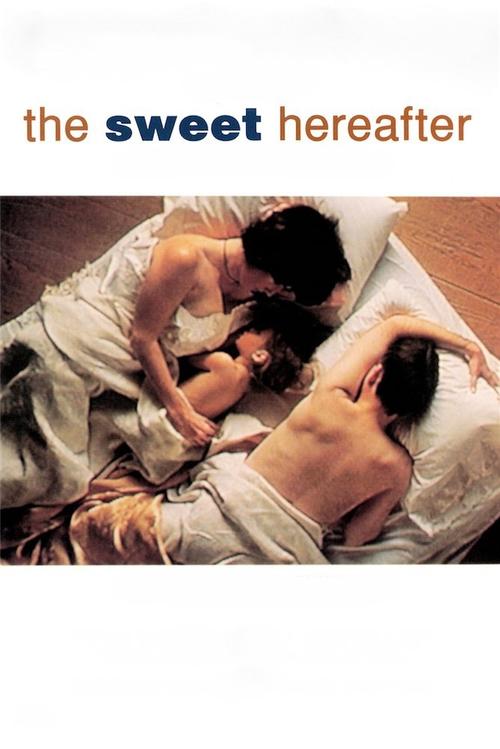
The Sweet Hereafter
1997 · Atom Egoyan
For when you want a serious, beautiful film about loss and are prepared to sit with it — the opposite of comfort viewing, but deeply rewarding if you're ready to feel something and think about it for days.
What it's about
A school bus skids off an icy road in a small mountain town in British Columbia, and more than a dozen children die. A big-city lawyer arrives to assemble a class-action suit among the grieving families, but his efforts pull the community further apart, while a teenage survivor left paralyzed by the crash carries her own private reckoning. The film moves between time frames — before, during, and after — circling the catastrophe rather than replaying it.
The experience
Hushed, wintry, and devastating in slow motion. It refuses easy catharsis — no courtroom fireworks, no consoling arc — and instead lets grief accumulate like snow, which makes it one of the most quietly overwhelming films of its decade.
Performances
Ian Holm is extraordinary as the lawyer, a man whose professional mission is tangled up with his own private anguish over a lost child, and a young Sarah Polley gives the film its still, unreadable center as the surviving teenager.
The craft
Atom Egoyan braids several timelines into a mosaic that reveals the town's wounds gradually, trusting the viewer to assemble the picture. The frozen landscapes are shot with an austere beauty, and Mychael Danna's spare, folk-inflected score threads the whole thing together like a dark fairy tale.
Why it matters
It won the Grand Prix at Cannes and earned Egoyan Oscar nominations for directing and writing, carrying him from cult art-house figure to canonical filmmaker and setting a benchmark for how cinema can handle communal grief.
Snapshot
The Sweet Hereafter is the film with which Atom Egoyan, already a fixture of the international festival circuit, crossed from cult art-house figure to canonical author. Adapted from Russell Banks's 1991 novel, it takes a catastrophe — a school bus skids off an icy road and sinks through a frozen lake, killing fourteen children in the fictional mountain town of Sam Dent, British Columbia — and refuses almost every convention by which cinema metabolizes grief. There is no accident-and-aftermath chronology, no courtroom climax, no consoling catharsis. Instead Egoyan braids several time frames around Mitchell Stephens (Ian Holm), a big-city lawyer who arrives to assemble a class-action suit, and Nicole Burnell (Sarah Polley), a teenage survivor left paralyzed. The film's quiet detonation is a lie Nicole tells in a deposition — an act that dissolves the lawsuit and, with it, the town's fantasy that blame can be converted into repair. Widely regarded as Egoyan's masterpiece, it won the Grand Prix at Cannes and earned him Academy Award nominations for direction and adapted screenplay, an unusual honor for a Canadian art film working this far outside commercial storytelling.
Industry & production
The film was a Canadian production, financed and produced through Egoyan's own company Ego Film Arts with the participation of Canadian public-culture funding bodies (Telefilm Canada and related agencies) and broadcast partners — the ecosystem that had sustained Egoyan's career since the mid-1980s. This is a mid-budget art film by any measure: modest financing, a compressed shoot in British Columbia's interior (the Merritt/Spences Bridge region stands in for Sam Dent), and a cast that mixes a distinguished British lead with Egoyan's regular Canadian ensemble. Precise budget and box-office figures are not something I can state reliably, and I won't invent them; the film's commercial footprint was small relative to its outsized critical and career impact.
The production's decisive move was securing Banks's novel and Egoyan's insistence on restructuring rather than illustrating it. Banks reportedly admired the adaptation, and the collaboration became a model of how a strong literary source can be honored precisely by being formally reinvented. The casting of Ian Holm — then between his long stage-and-screen career and his later Lord of the Rings fame — gave the film a gravitational center that helped it travel internationally, while the young Sarah Polley, already a Canadian screen presence, delivered the performance that would define the film's moral core.
Technology
Technically the film is of its moment: shot photochemically on 35mm, in the last years before digital intermediate grading and digital capture reshaped independent production. There is no showy technology on display — no visual-effects set piece even for the central catastrophe, which Egoyan stages with extreme restraint (the bus seen at a great distance, a slow slide, a hole in the ice) rather than with spectacle. The film's power comes from analog craft — anamorphic-scale landscape photography, optical and editorial control of time — rather than from any tool that dates it. Its "technology," in the meaningful sense, is compositional and structural.
Technique
Cinematography
Paul Sarossy, Egoyan's long-standing director of photography, shot the film in a widescreen format that opens the mountain valley into something vast, indifferent, and beautiful — snow, rock, and low winter light dwarfing the human figures. The palette runs cold: bleached whites, grays, muted blues, the warmth reserved for interiors and memory. Sarossy favors patient, often static or slowly gliding framings; the camera watches rather than chases. Aerial and high-angle views of the valley and the frozen lake recur, giving the landscape an almost mythic scale that ironizes the human effort to litigate meaning out of chance. The most famous image — the bus as a small dark shape on the white expanse, then its slow disappearance — derives its horror from distance and stillness, an aesthetic of withholding that runs through the whole film.
Editing
Editing is where The Sweet Hereafter does its deepest work, and Susan Shipton's cutting is inseparable from Egoyan's authorship. The film moves fluidly among at least three temporal registers: the town before the accident, the aftermath as Mitchell gathers his plaintiffs, and a frame set roughly two years later in which Mitchell, on an airplane, recounts everything to Allison, an old friend of his estranged daughter. Rather than flagging these shifts with captions or dissolves, the film glides between them on associative logic — a face, a sound, a line of dialogue — so that past and future press on the present continuously. The result is not confusion but a structure of grief: time as something that no longer runs forward, in which cause and consequence are experienced simultaneously. The editing withholds the accident itself for much of the running time, letting dread accrete around an event we already know has happened.
Mise-en-scène / staging
Egoyan and production designer Phillip Barker compose interiors that quietly encode relationship and repression — the Burnell house where Nicole's father Sam nurses ambitions for her singing career, the domestic spaces where litigation is negotiated over kitchen tables. Barns, motels, and hospital rooms are staged with a stillness that makes small gestures resonate. The recurring image of Nicole reading Robert Browning's "The Pied Piper of Hamelin" to the Ansell children by lamplight is staged almost as a tableau, a pocket of warmth the film will later revisit with devastating irony. Egoyan stages confrontation obliquely; the incestuous relationship between Nicole and her father is conveyed through arrangement, glance, and a barn-loft scene bathed in artificial colored light, never through exposition.
Sound
Sound design is used to bridge and blur the film's time frames as much as the editing does, with voices and the Browning text carrying across cuts. The film's aural signature, though, is Mychael Danna's score and the diegetic music. Egoyan integrates song into the fabric of meaning: Nicole is a singer, and her performances — including a rendition associated with Jane Siberry's "One More Colour" — become expressive threads that outlive her body's injury. The Pied Piper poem, spoken aloud, functions almost as a second score, a recurring incantation whose meaning shifts as we grasp its parallel to the town's lost children and to Nicole herself.
Performance
Ian Holm gives one of his finest screen performances as Mitchell — outwardly a controlled, professional advocate, inwardly a father in freefall over a daughter lost to addiction, whose phone calls to her (and his monologue to Allison) reveal that his crusade against the town's "accident" is also a displaced grief for a child he cannot save. Sarah Polley's Nicole is the film's still center: watchful, wounded, and finally the only figure to seize moral agency, her deposition lie an act of refusal aimed at both her father and the machinery of blame. The ensemble — Bruce Greenwood, Gabrielle Rose, Arsinée Khanjian, Maury Chaykin, and others — plays a community fracturing along lines of guilt, money, and old intimacies, each grief privately incompatible with the others.
Narrative & dramatic mode
The film's dramatic mode is elegiac and interrogative rather than causal. Banks's novel rotates among first-person narrators; Egoyan translates that polyphony into cinematic time-braiding, so that the "story" is less a sequence of events than a field of overlapping recollections and premonitions. The organizing conceit is Browning's Pied Piper: a town that loses its children, and a single lame child left behind who could not follow the others into the mountain. Nicole, in her wheelchair, is that surviving child, and her false testimony — claiming the bus was speeding, thereby killing the suit — is the film's climactic action precisely because it is an anti-action, a deliberate closing of the legal wound rather than its exploitation. The film thus inverts the courtroom-drama template: its dramatic satisfaction lies in the refusal of resolution and the choice of a private moral truth over public compensation.
Genre & cycle
Nominally a drama, The Sweet Hereafter sits at the intersection of the literary adaptation, the ensemble "community in crisis" film, and Egoyan's own cycle of chamber dramas about trauma, mediation, and fractured families. It arrived amid a broader 1990s art-cinema interest in fragmented, non-linear storytelling and in grief as subject — but it belongs less to any commercial cycle than to Egoyan's personal filmography, extending concerns from Exotica (1994), his previous critical breakthrough, into a bleaker and more classical register. If it has genre kin, they are other films that treat catastrophe as an epistemological rather than spectacular problem.
Authorship & method
The Sweet Hereafter is a near-perfect instance of an auteur working with a settled repertory company. Egoyan wrote the screenplay, directed, and shaped the film's temporal architecture in the edit, but his authorship is collaborative in practice. Paul Sarossy (cinematography), Susan Shipton (editing), Mychael Danna (music), and production designer Phillip Barker were long-term partners whose sensibilities are woven into Egoyan's; his wife and frequent lead Arsinée Khanjian appears in the ensemble. Egoyan's method here marks a maturation: where earlier films sometimes foregrounded video, surveillance, and technological mediation of memory, this one internalizes those obsessions into pure narrative structure. The mediating "screen" becomes time itself. Banks's authorship matters too — the source supplies the multiple-narrator architecture and the Pied Piper frame that Egoyan claimed was already latent in the novel — making this a case study in adaptation as structural translation rather than transcription.
Movement / national cinema
The film is a landmark of English-Canadian cinema and of the loosely grouped "Toronto New Wave" with which Egoyan is associated. As an Armenian-Canadian director, Egoyan had long explored diaspora, memory, and dislocation; here he turned those preoccupations onto a Canadian landscape and community, producing what many consider one of the defining Canadian art films of the century. It exemplifies the small, publicly-supported, auteur-driven national cinema that Telefilm-era Canada made possible — a model in which festival prestige rather than box office defined success. The film's international triumph became a point of national cultural pride and helped legitimize Canadian art cinema abroad.
Era / period
Made and released in 1997, the film belongs to the high-water mark of 1990s independent and international art cinema, when festival auteurs commanded serious critical attention and specialty distribution was robust. It is a late-analog film in craft and a formally ambitious one in a decade increasingly drawn to non-linear narrative. Its period setting is contemporary-to-its-making, but its temporal dislocations and wintry timelessness give it a quality outside any dateable present — a story that could be a fable.
Themes
Grief and its economies sit at the center: the film asks what a community does with sorrow, and how the impulse to assign blame — and to convert loss into money — corrodes the very bonds it claims to defend. Mitchell's lawsuit is portrayed not as villainy but as a form of misdirected mourning, "anger management" for the bereaved, as the film almost literally frames it. Against this runs the theme of the lost child and the survivor's burden, carried through the Pied Piper allegory. The incest subplot introduces damage of a "different kind" — the loss of innocence the synopsis gestures toward — and makes Nicole's final lie legible as an act of reclaimed will against a father who has both violated and instrumentalized her. Underneath everything lies Egoyan's perennial subject: memory as the medium in which trauma is endlessly relived, and the impossibility of a clean accounting of the past.
Reception, canon & influence
Critically, the film was a major event. It shared in Cannes 1997 by winning the Grand Prix (the festival's runner-up prize) along with the international critics' FIPRESCI recognition, and it went on to earn Egoyan Academy Award nominations for Best Director and Best Adapted Screenplay — a rare double nomination for a Canadian art film and a signal of how far it had crossed over. It was widely honored at the Canadian Genie Awards and topped numerous critics' year-end lists; it durably reset Egoyan's reputation, and Sarah Polley's performance became a foundation of her subsequent career as both actor and, later, filmmaker.
Its influences run backward through several channels: Russell Banks's novel most directly; the poetic-fatalist tradition of literary adaptation; and Egoyan's own prior filmography, whose experiments with mediated memory the film distills. Robert Browning's poem supplies both structural frame and thematic key.
Looking forward, the film's legacy is more atmospheric than school-founding. It stands as a reference point for how cinema can render grief through fractured temporality rather than melodrama, and it is frequently cited in discussions of the non-linear, elegiac art film. It remains the touchstone by which Egoyan's later, more uneven work is measured, and a cornerstone of the English-Canadian canon. Beyond specific films it can be said to have shaped, its influence lives in a sensibility — the conviction that the deepest way to dramatize catastrophe is to refuse spectacle and let time, not plot, do the mourning.
A Deleuzian reading
A teenage girl reads aloud by lamplight.
The full Deleuzian reading of The Sweet Hereafter →
Reception
A sensation on arrival — it took the Grand Prix (plus two more prizes) at Cannes '97 and landed Egoyan two Oscar nominations — and its stature has only hardened since: it's now the consensus answer to 'greatest Canadian film,' and the peak against which everything else Egoyan made gets measured.
How The Sweet Hereafter was received, from release to now →
How to watch The Sweet Hereafter: what to notice on a first viewing
- Notice how small the people look against the snow. Sarossy shoots the valley in wide format, letting snow, rock, and low winter light dwarf the human figures standing in it. The camera often holds still and watches rather than following the action. The landscape is given more visual weight than the people, so it always feels bigger than anyone's grief.
- Notice cuts that jump time with no caption or fade. Egoyan moves between the town before the crash, its aftermath, and a later frame on an airplane, gliding between them on a face, a sound, or a line of dialogue rather than a marked transition. Past and present press on each other continuously, which is what grief actually feels like rather than a timeline.
- Listen for the Pied Piper poem returning throughout. Nicole reads Robert Browning's poem to children by lamplight early on, and its words and voice keep resurfacing across cuts, almost like a second score running under the film. The poem is doing narrative work: it is quietly telling you what kind of story this is before you know it.
- Notice the bus appearing as a small shape in the distance. The film's most famous image places the school bus as a small dark mark on a huge white landscape, then lets it slowly vanish, using distance instead of close spectacle. Withholding a close view of the accident makes its horror a matter of scale and stillness, not gore.
- Watch how often Mitchell talks to someone on the phone. Ian Holm plays Mitchell as a composed, professional lawyer, but his private phone calls keep interrupting his work. His public manner and his private calls sit side by side in the same scenes.
The whole guide to watching The Sweet Hereafter, with the keys for a rewatch →
Influences: the films it descends from and the films it influenced
- Exotica (1994) — Egoyan's own prior film with the same repertory crew (Sarossy/Shipton/Danna/Khanjian) built the nonlinear withholding structure that circles a dead child and defers its grief until late — the exact architecture Sweet Hereafter refines.
- The Adjuster (1991) — Earlier Egoyan ensemble study of loss and mediation that established the cool Sarossy observational distance and Danna's melancholic scoring that Sweet Hereafter internalizes from technological subject into pure temporal form.
- Don't Look Now (1973) — Associative cross-temporal editing splinters chronology so grief for a drowned child bleeds across past, present, and premonition — the template for temporal braiding as an act of mourning.
- Hiroshima mon amour (1959) — Interleaves present intimacy with traumatic flashback so that memory itself becomes the film's montage logic, prefiguring Shipton's editing of time as the mediating 'screen.'
- Rashomon (1950) — The multiple-narrator architecture, rendering one event through irreconcilable testimonies, is the structural DNA of Banks's and Egoyan's polyphonic adaptation.
- Ikiru (1952) — Egoyan's non-linear epistemological reconstruction of a community trauma through retrospective, unreliable, self-interested witness testimony — where truth emerges only in fragments from those with reasons to distort it — extends the formal logic of Ikiru's wake scene into a full structural principle rather than a single-act device.
- In the Bedroom (2001) — Extends the anti-melodramatic mourning of a lost child through restrained ensemble observation and a pointed refusal of catharsis and courtroom spectacle.
- 21 Grams (2003) — Shatters chronology into a braided mosaic so that a fatal accident and its aftermath are experienced as fragmented, non-consecutive time.
- Away from Her (2006) — Sweet Hereafter's own Nicole turns director, carrying its Canadian elegiac restraint and memory-loss theme into her own withholding, literary-adaptation debut.
- We Need to Talk About Kevin (2011) — Non-chronological editing sifts a mother's shattered memory around a community atrocity involving children, extending grief-through-fractured-temporality.
- Manchester by the Sea (2016) — Gradual flashback braiding discloses a family catastrophe of dead children, rendering grief through numb restraint rather than spectacle — the sensibility Egoyan modeled.
- Certain Women (2016) — Anamorphic withholding-distance landscape cinematography and a polyphonic small-community structure of separate lives held at observational remove.
- Wind River (2017) — Anamorphic snow-landscape framing of a community-in-crisis mystery centered on a dead child, marrying widescreen wilderness to communal grief.
- Joint Security Area (2000) — A community trauma investigated by an outside professional who collects fractured testimony across non-linear time, where the retrospective reconstruction is exposed as incomplete and the investigator's own position is structurally compromised — JSA's Swiss officer Sophie Jean occupies an identical structural role.
- Drive My Car (2021) — Literary adaptation (Russell Banks novel) structured around fractured temporality; an embedded poem — the Pied Piper, read aloud as counterpoint — functions structurally as Drive My Car's Uncle Vanya does: a borrowed text that reframes a community's unacknowledged grief as moral allegory.
- House of Sand and Fog (2003) — Dual-perspective literary adaptation of a community tragedy with no villain, where parallel narrative strands converge fatally — the seed's competing-rights architecture in embryo.
- Hope (2013) — Pioneers the community-in-mourning-after-harm-to-children structure, refusing to depict the catastrophe directly and dwelling instead on collective repair.
- Aasha (2026) — Road death as an inciting incident that reorganises a community into factions of grievance and compensation, with the truth of the crash withheld and finally disclosed as a moral rather than forensic fact — the disclosure changes nothing legally and everything emotionally.
- Three Colors: Blue (1993) — Music-cued elliptical editing dramatizes a mother's grief for a dead child through fracture and withholding rather than melodrama, the 1990s art-cinema mode Egoyan shares.
- Affliction (1997) — Contemporaneous Russell Banks adaptation sharing the wintry small-town fatalism and the flawed-patriarch, community-in-crisis frame translated from the same authorial source.
- Safe (1995) — Cinematography of withholding distance strands its protagonist in wide, depopulated frames and refuses the reassurance of psychological close-up.
- The Ice Storm (1997) — Shares composer Mychael Danna's elegiac score and the frozen-landscape ensemble structure in which a community's catastrophe crystallizes around its children.
- H-8... (1958) — A single road accident kills a community's children and the film anatomizes the town it claims through interwoven strands — the fated-community-by-vehicle structure descended intact.
- Maudie (2016) — Atlantic/rural-Canadian elliptical chronicle: cold coastal restraint and fractured time governing emotional accumulation, the regional-realist register and editing mode Maudie shares.
Similar films
- The Ice Storm (1997) — influence & lineage
- 21 Grams (2003) — influence & lineage
- Blue Heron (2026) — shared sensibility
- Eureka (2001) — shared sensibility
- Taste of Cherry (1997) — shared sensibility
- Once Upon a Time in Anatolia (2011) — shared sensibility
- Melancholia (2011) — shared sensibility
- Humanist Vampire Seeking Consenting Suicidal Person (2023) — shared sensibility