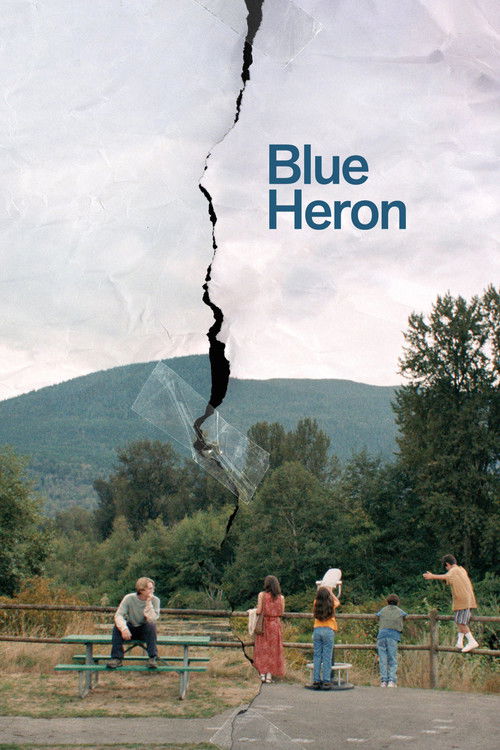
Blue Heron
2026 · Sophy Romvari
For when you want a film that sits with you gently and hurts anyway — something honest about family, mental illness, and the things kids absorb without being told. A challenge, but a soft-spoken one; bring patience, not popcorn.
What it's about
In the late 1990s, a family of six starts over in a new house on Vancouver Island, and the youngest child, Sasha, watches the household from ground level — half understanding, half sensing what the adults won't say out loud. The fresh start frays as Jeremy, the eldest brother, spirals into behavior that grows harder to explain and harder to contain. It's a portrait of a family trying to hold itself together while one of its own becomes a source of fear and grief at once.
The experience
Quiet, somber, and deeply compassionate — it moves at the pace of memory, letting small domestic moments carry enormous weight. The child's-eye view keeps things ambiguous in a way that gets under your skin: you feel the danger before you can name it, and the tenderness never leaves the room.
The craft
Sophy Romvari built her reputation on intimate, autobiographical short films, and this debut feature carries that same handmade precision: restrained direction, an eye for the textures of a 1990s childhood, and an experimental streak that trusts silence and suggestion over exposition. It's independent filmmaking at its most personal, where every framing choice feels like an act of remembering.
Why it matters
One of the most anticipated Canadian debuts of its moment, it marks Romvari's step from quietly beloved festival shorts to feature filmmaking — the culmination of a decade-long autobiographical project about her own family's losses.
Snapshot
Blue Heron is the debut narrative feature of Sophy Romvari, the Hungarian-Canadian filmmaker who spent the 2010s building one of the most quietly admired bodies of short work to emerge from the North American festival circuit. Set in the late 1990s on Vancouver Island, the film follows a family of six through the perceptual frame of its youngest member, Sasha, as a domestic "fresh start" curdles under the escalating, dangerous behavior of the eldest child, Jeremy. For anyone who has followed Romvari's career, the material is unmistakable: it is the fiction-feature culmination of the autobiographical reckoning she began in her shorts, above all the widely circulated Still Processing (2020), which confronted the deaths of her two older brothers through a box of rediscovered family photographs and home video. Blue Heron converts that essayistic, grief-driven inquiry into a sustained dramatic narrative — a coming-of-age film organized around a child's incomplete understanding of an unfolding family crisis. The specifics of the film's production and release credits are, at the time of writing, only thinly documented in reliable sources, and several claims below are therefore framed as reasoned inference from Romvari's established practice rather than verified fact.
Industry & production
Blue Heron belongs to the world of low-budget, festival-financed Canadian art cinema rather than the commercial or studio sphere. Romvari came up through Toronto's film-school and cinephile ecosystem — she studied film production at York University — and her shorts were sustained by the apparatus of public and institutional support that defines independent filmmaking in Canada: arts-council grants, festival labs, and small production collectives. A first feature in this idiom is typically assembled from some combination of Telefilm Canada and provincial funding, festival development programs, and modest private equity, then routed to audiences through the international festival ladder rather than wide theatrical release. I do not have verified figures for Blue Heron's budget, financing partners, or distribution deal, and will not invent them; readers should treat the film's economic scale as that of a regionally rooted independent production made for a fraction of a conventional drama's budget.
What can be stated with confidence is the production's autobiographical and geographic specificity. Setting the film on Vancouver Island in the late 1990s ties it directly to Romvari's own childhood and family history, and the choice of a period setting — pre-smartphone, on the cusp of the consumer-digital era — is itself a production decision with aesthetic consequences, demanding period-correct interiors, costuming, and a deliberately analog texture of family life. The use of a six-person family unit and a child protagonist also signals a production built around an ensemble of relatively unknown and possibly young or first-time performers, a casting strategy consistent with the naturalism Romvari has pursued throughout her work.
Technology
Romvari's shorts have been notable for treating image-capture technology as subject matter, not merely as a means: Still Processing is in large part a film about photographic and videographic media as vessels of memory, foregrounding the grain of old prints and the dropout and tracking artifacts of consumer videotape. It would be consistent with that sensibility for Blue Heron to think carefully about its capture format — whether shooting digitally with an eye to a soft, period-evocative palette, or incorporating analog or analog-emulating textures to register the 1990s. I do not have confirmed technical specifications (camera system, capture format, aspect ratio, or finishing pipeline) for the feature, so I flag this as an area where the record is genuinely thin. What is safe to say is that Romvari's authorship has always been media-conscious: the apparatus of recording a family — the camcorder, the snapshot, the archive — is a recurring thematic and formal concern, and a period family drama is a natural place to extend it.
Technique
Cinematography
On the evidence of her shorts, Romvari favors a restrained, observational camera: patient framings, an attention to domestic space and natural light, and a refusal of the over-emphatic. Her images tend to grant rooms and objects their own duration, letting meaning accrete through what is held in frame rather than through cutting or camera movement. For a film told through a child's perception, this approach has obvious dividends — a low, watchful eye-line; thresholds, doorways, and partial views that mimic a child's incomplete access to adult events; and a tendency to keep the most frightening behavior (Jeremy's) at the edges of the frame or just out of view, registered through reaction and aftermath. I do not have a verified credit for the film's director of photography and will not attribute the work to a specific cinematographer.
Editing
Romvari's editing instincts run toward the elliptical and the contemplative. Still Processing built its emotional architecture through juxtaposition — the cut as an act of memory-work, placing past against present. In a narrative feature organized around a child's partial comprehension, editing becomes the primary instrument of point of view: scenes likely begin late and end early, withholding the connective tissue an adult would supply, so that the audience shares Sasha's experience of sensing that something is wrong before being able to name it. The dramatic "reveal" of family dynamics promised by the synopsis is, in this mode, less a plot mechanism than a function of accumulation and ellipsis.
Mise-en-scène / staging
The film's period setting places enormous weight on production design and staging. A late-1990s family home — its furniture, its clutter, the specific objects of a six-person household — must carry the burden of authenticity, and Romvari's naturalism depends on getting such textures exactly right. Staging in her work tends to be unforced, with performers occupying real domestic geography rather than blocked for the camera's convenience; conflict is staged obliquely, often through the spatial dynamics of who is present, who is absent, and who is being protected from knowledge. The "blue heron" of the title invites a reading of the natural landscape of coastal British Columbia as a counterweight to domestic tension — a recurring image of stillness or watchfulness against which the family's instability is measured — though without the finished film in front of me I offer this as interpretation rather than established fact.
Sound
Sound in observational family cinema of this kind typically privileges the ambient and the diegetic: household noise, overlapping voices, the acoustic signature of specific rooms. Given Romvari's media-consciousness, it would be unsurprising for the film to make expressive use of off-screen sound — the danger heard through walls — as a means of keeping violence at the perceptual margin where a child would encounter it. I have no verified information about the film's sound design team or its score, and decline to attribute either.
Performance
The dramatic engine of Blue Heron is performance, and specifically the contrast between a child's transparency and the opacity of the adults and the troubled eldest sibling around her. Romvari's casting and direction have consistently aimed at lived-in naturalism rather than performed intensity; a film resting on a young protagonist's gaze requires a child performance of unusual unselfconsciousness, and the surrounding ensemble must convey the strain of a family managing a crisis it cannot fully control or acknowledge. Specific cast credits are not reliably available to me, and I will not name performers I cannot verify.
Narrative & dramatic mode
The film operates in the mode of restricted, child's-eye realism — a lineage that runs from Victor Erice's The Spirit of the Beehive and René Clément's Forbidden Games through Charlotte Wells's Aftersun and the domestic miniatures of the contemporary festival circuit. Its dramatic mode is one of revelation-through-perception rather than plot: the synopsis's phrase "internal dynamics are slowly revealed" describes a structure in which the audience reconstructs the family's reality from fragments a child can perceive but not interpret. The threat posed by Jeremy is the narrative's gravitational center, but the film's interest lies less in incident than in the texture of living adjacent to danger — the way a household absorbs, normalizes, and conceals a crisis. This is a dramaturgy of accumulation and dread rather than of crisis-and-resolution, and it aligns with the broader contemporary art-film preference for the elliptical over the explanatory.
Genre & cycle
Nominally a drama, Blue Heron sits at the intersection of several current cycles: the autobiographical first feature, the 1990s-set memory film, and the family-trauma chamber drama. The late-2010s and 2020s saw a marked wave of personal, memory-driven features — Aftersun (2022) is the touchstone, but the cycle includes a broader turn toward filmmakers excavating their own childhoods through the textures of late-analog media. Romvari's film extends the specifically Canadian strain of intimate, regionally grounded realism while participating in this transnational cycle of memory cinema. Its emphasis on a dangerous sibling also connects it to a quieter tradition of films about the unspoken pathology within ostensibly ordinary families.
Authorship & method
Sophy Romvari is the clear authorial center of Blue Heron, and the film should be read as the consolidation of a method developed across a decade of shorts. That method is autobiographical without being confessional in any glib sense: it treats personal loss as a problem of representation, asking how images, objects, and memory can or cannot hold the people who are gone. Still Processing — in which Romvari literally sorts through the photographic record of her brothers' lives — is the essential precursor text, and Blue Heron reads as its fictional transposition, restaging the family from the inside and in the present tense of childhood rather than the retrospective tense of the archive. Romvari is also a product of online cinephile culture; her sensibility was formed in dialogue with film history and film criticism, and her work carries a deliberate, allusive relationship to the canon of observational and autobiographical cinema.
On her key collaborators — cinematographer, editor, composer, and any co-writer — I do not have verified credits and will not fabricate attributions. It is worth noting only that Romvari has across her career operated within a small, repeat-collaboration milieu typical of Canadian independent production, where a feature debut is usually built with trusted partners carried over from short-film work.
Movement / national cinema
Blue Heron belongs to Canadian independent cinema, and more specifically to its West Coast / British Columbia register — a regional cinema distinct from both the Québécois tradition and the Toronto-centered English-Canadian mainstream. It can also be located within a broader, internationally legible movement of low-budget, festival-oriented art cinema marked by observational realism, autobiographical impulse, and a self-aware relationship to film history — a sensibility shared by a generation of filmmakers who came to the medium through cinephile communities and criticism as much as through industry pathways. The film's Vancouver Island setting roots it firmly in place, and its landscape is not incidental but constitutive of its identity as a regional Canadian work.
Era / period
The film is doubly era-bound: made in the mid-2020s, set in the late 1990s. That gap is the point. The late-1990s setting locates the family at the threshold of the digital age, in the last fully analog moment of domestic memory-keeping — the era of camcorders and snapshots that Romvari's archival sensibility is drawn to. As a 2026 production, the film arrives within the mature phase of the memory-film cycle, after Aftersun and its many successors have established a recognizable grammar for excavating childhood through period texture; Blue Heron both inherits and is measured against that recent lineage.
Themes
The film's central themes follow directly from Romvari's preoccupations: the family as a site of both shelter and concealed danger; childhood as a condition of partial knowledge; and memory as something reconstructed rather than retrieved. The synopsis foregrounds a "fresh start" undone by a sibling's escalating behavior — a structure that thematizes the impossibility of escaping family pathology by changing address, and the particular burden borne by a youngest child who witnesses what she cannot understand or prevent. Grief and its anticipation hang over the material, given what Romvari's earlier work tells us about the autobiographical wellspring. The heron of the title gestures toward themes of watchfulness, stillness, and the indifferent persistence of the natural world alongside human crisis — an interpretation I offer as a reading consistent with the film's apparent design rather than as documented authorial statement.
Reception, canon & influence
As a 2026 release, Blue Heron's critical reception and festival trajectory are still emerging, and I do not have reliable documentation of its premiere venue, reviews, or any awards; I will not invent them. What can be said is that Romvari arrived at her feature debut with substantial critical goodwill earned through her shorts, Still Processing in particular, which was warmly received on the festival circuit and established her as a filmmaker to watch.
The influences on the film (backward) are legible from her practice and the material itself: the child's-eye art cinema of Erice and Clément; the observational, duration-conscious realism associated with contemporary slow cinema; the recent wave of autobiographical memory features crystallized by Aftersun; and, most directly, Romvari's own Still Processing, which functions as the film's essayistic prototype. Its legacy (forward) cannot yet be assessed — it is too new, and its influence will depend on a reception history not yet written. The most honest forward-looking claim is a structural one: as the first feature by a filmmaker whose shorts had already marked her as a distinctive voice in Canadian autobiographical cinema, Blue Heron stands to be read as the work in which that voice scaled to feature length, and its significance will be measured by what Romvari builds upon it next.
A Deleuzian reading
A door left half-open.
The full Deleuzian reading of Blue Heron →
Reception
Premiered as a tiny Canadian debut at Locarno 2025 and snowballed almost overnight — by its 2026 release it was sitting at 98% on Rotten Tomatoes and a 92 Metascore, with trades calling it the most acclaimed film of the year so far.
How Blue Heron was received, from release to now →
How to watch Blue Heron: what to notice on a first viewing
- Watch how low the camera sits, near a child's own eye level. Romvari keeps the camera at Sasha's height throughout, watching the family from where a small child would actually be standing. You experience the house the way the youngest person in it would, not from an adult's vantage.
- Notice how often a doorway or a half-open door frames a scene. Thresholds and partial views recur throughout, keeping the most difficult moments at the edge of what Sasha, and you, can actually see. The film shows you exactly as much as a child in that house would have been able to see.
- Listen for tension that arrives as sound from another room. The film keeps its most frightening behavior off-screen, registered through a voice or a noise carried through a wall rather than shown directly. The dread has no clear location; it fills the whole house instead of one visible moment.
- Notice how abruptly scenes seem to start and end. Scenes begin after something has already started and stop before it resolves, withholding the connective explanation an adult narrator would normally give. You are made to sense something is wrong before you can say exactly what it is.
- Watch for a heron standing still in shallow water. A heron recurs, motionless and watchful, set against a household that cannot hold still in the same way. The bird becomes a still point the film measures the family's instability against.
The whole guide to watching Blue Heron, with the keys for a rewatch →
Influences: the films it descends from and the films it influenced
- Forbidden Games (1952) — Establishes the template of staging adult death and grief entirely through a small child's uncomprehending ritual play, the restricted-POV strategy Romvari uses to keep loss off-screen and refracted.
- The 400 Blows (1959) — Founds autobiographical child realism built from location shooting and an observational camera that simply watches a boy navigate domestic neglect, the documentary-of-childhood method Romvari inherits.
- The Spirit of the Beehive (1973) — Cited directly in the dossier — its honeyed natural light, held durations, and a child's face as the sole register of unspoken family trauma are the exact perceptual grammar of Blue Heron.
- Cría cuervos (1976) — Filters a mother's death and a grieving household through the watchful, semi-fantastical perception of a young girl, modeling the child's-eye treatment of mourning and analog keepsakes (photos, a record) as memory triggers.
- Fanny and Alexander (1982) — Period family drama rendered at child's-eye height, where production design and a boy's vantage convert a household into a remembered world — the scaled-up domestic-memory architecture behind Romvari's feature.
- The Long Day Closes (1992) — Autobiographical memory built through elliptical editing and off-screen diegetic sound (overheard voices, ambient domestic noise) standing in for narrative, the associative-recall editing logic Blue Heron adopts.
- Ponette (1996) — Sustains an entire grief narrative on an unforced, improvisatory child-naturalist performance shot in close observation, the directing-of-children technique Romvari's performance facet depends on.
- Ratcatcher (1999) — Observational, sensory naturalism in which a child processes a death he half-caused through textures and natural light rather than plot — the restricted, elliptical child-POV realism closest to Romvari's register.
- Still Processing (2020) — Romvari's own essayistic short, named in the dossier as the prototype: its literal sorting of a dead brother's photographic archive is the documentary source that Blue Heron transposes into present-tense fiction.
- Stories We Tell (2012) — Canadian autobiographical reconstruction of family loss that fabricates and foregrounds analog media (staged Super 8) as the material of memory, the same interrogation of whether images can hold the dead.
- The Florida Project (2017) — Keeps adult catastrophe at the blurred edge of a child's sunlit play through strict restricted POV and naturalistic, non-professional child performance — the same withholding of trauma from the young protagonist's frame.
- Roma (2018) — Autobiographical childhood reconstructed through meticulous period production design, observational long takes, and dense diegetic-ambient sound, the memory-as-environment approach Romvari shares at smaller scale.
- Anne at 13,000 ft (2019) — Contemporary Canadian-independent observational realism — handheld, restricted to one subject's perceptual field, built within a small repeat-collaborator milieu — the exact production grammar Romvari's feature emerges from.
- Petite Maman (2021) — Distills grief into a child's-eye chamber piece with natural light, elliptical economy, and unforced child performance, sharing Romvari's stripped naturalism applied to mourning a family member.
- The Cathedral (2021) — Autobiographical family history told through elliptical, object-centered montage and period analog ephemera, with sound and inserts carrying the narrative — a near-exact formal cousin to Blue Heron's memory method.
- Aftersun (2022) — Named in the dossier as the crystallizing autobiographical memory feature: it reconstructs a lost parent through analog camcorder footage and elliptical, restricted child recollection, the immediate model for Romvari's scaling-up.
Similar films
- Aftersun (2022) — influence & lineage
- Petite Maman (2021) — influence & lineage
- Ghostlight (2024) — same viewing thread
- Tótem (2023) — shared sensibility
- Bring Her Back (2025) — shared sensibility
- Riceboy Sleeps (2023) — shared sensibility
- The Beloved (2026) — shared sensibility
- Hereditary (2018) — shared sensibility
All the films related to Blue Heron →
Watch it with: curated runs of related films
- Funny Because It Aches — A run of tender, deadpan dramedies where love, grief, and the panic of becoming yourself all get metabolized through jokes — watch these when you want to laugh and cry in the same scene.