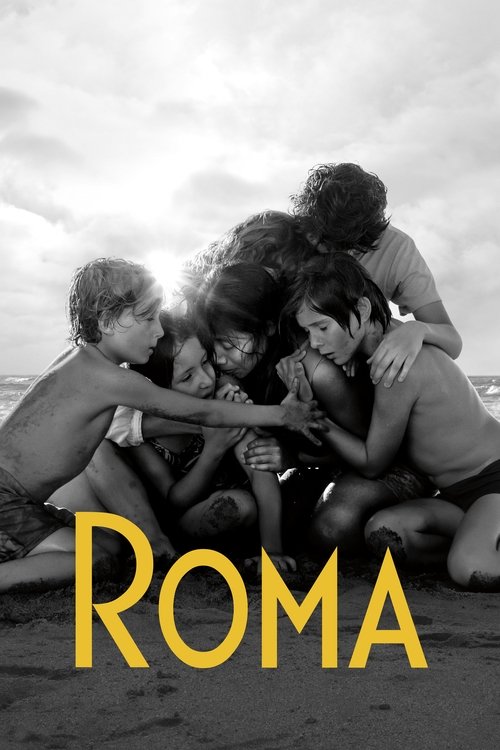
Roma
2018 · Alfonso Cuarón
For when you want to sink into a film slowly and come out moved — a patient, contemplative evening that repays your full attention and may leave you in tears without quite knowing when it happened.
What it's about
Mexico City, 1970. Cleo, a young indigenous woman, works as a live-in domestic for a middle-class family — cooking, cleaning, putting the four children to bed — while the household quietly comes apart around an absent husband. Drawn from Cuarón's own childhood and dedicated to the woman who raised him, it follows a year in which Cleo's private life and the family's crisis, and the country's unrest, all converge.
The experience
Unhurried and immersive — the camera glides through daily routines until you live inside this house, and then the film delivers moments of overwhelming emotional force precisely because it never begs for them. Tender, sad, and quietly monumental.
Performances
Yalitza Aparicio, a first-time actress, gives a performance of remarkable stillness and openness as Cleo — the film rests on her presence, and she earned an Oscar nomination for it.
The craft
Cuarón shot it himself on large-format digital in luminous black and white, favoring wide, slowly panning compositions where whole worlds play out in a single frame. The sound design is extraordinary — street vendors, dogs, planes overhead — building the city around you. This is a film that genuinely transforms on a big screen with good sound.
Why it matters
Winner of the Venice Golden Lion and three Oscars including Best Director, it was the film that made Netflix a serious force in prestige cinema and brought domestic workers' lives to the center of a global conversation.
Snapshot
A black-and-white memory film set in Mexico City's middle-class Colonia Roma district during 1970–71, Roma follows Cleo (Yalitza Aparicio), an indigenous domestic worker employed by a bourgeois family in crisis. Shot by its own director on large-format digital equipment and distributed globally by Netflix, the film won the Venice Golden Lion and three Academy Awards — Best Director, Best Cinematography, and Best International Feature Film — at the 91st ceremony. Semi-autobiographical, it is dedicated to Cuarón's childhood nanny Liboria "Libo" Rodríguez, whose perspective the film inhabits and honors while simultaneously acknowledging the economic and racial distances that structured their relationship.
Industry & production
Roma occupies an anomalous position in production history: a $15-million personal film financed by a technology company and released simultaneously on a global streaming platform and in a limited theatrical run. Netflix's involvement gave Cuarón unusual autonomy — no studio notes, no theatrical-first mandate demanded by traditional distributors — but it also generated the most consequential industry controversy of the decade: whether a streaming-first title should be eligible for the Palme d'Or, the Golden Lion, or the Academy Awards. The Cannes Film Festival in 2018 barred Netflix titles from competition; Venice did not, and awarded Roma its top prize. The Academy permitted its eligibility under then-existing rules requiring a minimum theatrical run, which Roma satisfied with a brief run before its Netflix premiere.
The film was a deeply personal project for Cuarón, written over years from childhood memory, and shot on locations in and around the original family home on Calle Tepeji in Colonia Roma. The production employed meticulous period reconstruction of early-1970s Mexico City — street signs, vehicles, storefronts, and clothing — and cast largely from open calls, prioritizing faces and bodies over trained industry experience. The Mexican director Carlos Reygadas served as a producer. The shoot extended over several months in 2017, with Cuarón shooting without a conventional script on set — he had detailed storyboards and scene notes but worked improvisationally with the actors in the moment.
Technology
Cuarón photographed the film himself on the Arri Alexa 65, a large-format digital cinema camera with a sensor roughly equivalent in area to 65mm film. Shooting in a native monochrome workflow (rather than desaturating color footage in post), the production captured images in 6.5K resolution, preserving exceptional tonal range and fine detail. The choice of black and white was aesthetic and memorial: Cuarón has spoken of memory as inherently monochromatic, stripped of the chromatic noise of the present. The large sensor's shallow depth-of-field characteristics and tonal latitude allowed deep-focus compositions reminiscent of classical Hollywood and Mexican Golden Age cinematography while retaining a distinctly contemporary crispness.
For IMAX theatrical exhibition, the film was presented in the 1.78:1 aspect ratio native to the Alexa 65's sensor, filling the full IMAX frame — a deliberate expansion of the domestic, intimate material into an overwhelming scale. This tension between domestic subject and monumental presentation was thematically intentional.
The production used no traditional musical score. Sound was captured on location and augmented through a meticulous post-production sound design by Cuarón and his team, treating ambient audio — airplane noise, street sounds, televisions, rain — as structural rather than incidental.
Technique
Cinematography
The film's visual grammar is built on slow, lateral tracking shots executed on a motion-control dolly and long takes that refuse to cut to emphasize a single character's interiority. The camera moves at its own tempo, often indifferent to the positions of the actors, panning away from a character mid-action or arriving late to a moment of crisis. This autonomy of the camera is a philosophical position: the world is not organized around any single consciousness. The famous opening shot — water flowing across tiled floor, reflecting an airplane crossing the sky — establishes the film's method in miniature: patient accumulation of sensory detail, the mundane and the cosmic held in the same frame.
Cuarón photographs interiors with characteristic depth, placing characters in layered planes — a door, a courtyard, a street beyond — that render the class stratifications of the household spatial as well as social. The household's rooms are consistently populated with background activity; laundry, children, animals. The camera frequently holds on Cleo's face in moments of stillness, using the Alexa 65's resolution to find expression in minute physiognomic detail.
The film's most technically ambitious sequences — the forest fire hunt, the New Year beach rescue, the hospital delivery — are executed in single unbroken takes or near-unbroken sequences, their duration transforming physical event into sustained phenomenological experience. The beach sequence, in which Cleo wades into the ocean to rescue drowning children despite not knowing how to swim, was shot in extremely difficult surf conditions; the danger visible on screen is reported to have been partially real.
Editing
Cuarón co-edited the film with Adam Gough. The editing is conspicuously slow by contemporary standards, with a mean shot length considerably above the mainstream average. Cuts are often delayed beyond the moment the action completes, holding on faces or spaces after the narrative event has concluded. This rhythm refuses the conventional hierarchy that privileges drama over duration. Some of the film's most emotionally significant moments — the stillbirth in the hospital, the revelation in the furniture store — are staged without the conventional cut to reaction shot; the camera observes rather than edits the viewer's response.
Mise-en-scène / staging
Staging is rooted in the ensemble choreography of the household — the family's four children, the grandmother Theresa, the two domestic workers Cleo and Adela, and the recurring intrusions of the absent father and the arriving guests. Cuarón's blocking is horizontal and deep rather than hierarchical; no character is consistently staged at frame center or compositional dominance. Cleo's smallness within grand architectural spaces — the courtyard, the cinema lobby, the hospital corridor — is registered through sustained wide-frame placement rather than low-angle or close-up assertion.
The furniture store sequence during the Halconazo (June 10, 1971 — the paramilitary "Halcones" massacre of student demonstrators) juxtaposes domestic anxiety with political violence in the same sustained frame. Cleo recognizes her former lover Fermín among the paramilitaries in the street; labor pains begin simultaneously. The film does not cut away from either event. This collapse of personal crisis and historical violence into a single spatial and temporal plane is the film's central formal argument.
Sound
The absence of a conventional underscore makes the film's sound design do the work of emotional orientation normally assigned to music. Aircraft (heard repeatedly as an aerial intrusion into the domestic) establish a sonic motif of the exterior world pressing into enclosed space. The noise of Mexico City — vendors, traffic, dogs, television sets tuned to martial arts films — fills the household without being aestheticized into background texture. Rain, when it falls, fills the entire soundscape. The New Year fireworks that accompany the beach sequence function as a grotesque counterpoint, festive sound sutured to near-tragedy. The film's sole moment of conventionally "musical" sound is a briefly heard Mexican popular song that grounds the period without comment.
Performance
Yalitza Aparicio, a schoolteacher from Oaxaca with no prior acting experience, was cast as Cleo after an open call that reportedly extended across Mexico and sought specifically for an indigenous woman of Mixtec-Triqui heritage to match the profile of Cuarón's actual nanny. Her performance — largely interior, physically precise, communicating through posture and controlled expression rather than dialogue — attracted immediate critical attention as a discovery. Marina de Tavira (Sofía) is a trained stage and screen actress whose work provides a contrasting register: more volatile, more conventionally "performed." The children — largely non-professional — were guided through complex emotional situations by Cuarón in an extended rehearsal period conducted before cameras rolled. The directorial method emphasized lived situation over scripted line readings.
Narrative & dramatic mode
Roma belongs to what might be called the "durational memory film" — a mode that organizes narrative not around plot resolution but around the gradual accumulation and release of emotional knowledge. The film has two parallel throughlines: Cleo's pregnancy and abandonment by Fermín; Sofía's martial estrangement and slow confrontation with her husband's departure. These are not interwoven through conventional crosscutting but coexist in the shared space of the household, surfacing and receding as daily routine allows. The film's climax — the beach rescue, followed by Cleo's tearful acknowledgement that she did not want her baby — is not presented as revelation so much as the making-conscious of what the film's slow formal attention has already allowed the viewer to suspect.
The narrative mode owes something to the Italian neorealist tradition of incident-as-story rather than plot-as-engine, and more directly to the Japanese shomin-geki (films of ordinary life) in its interest in the textures of domestic routine as dramatic substrate.
Genre & cycle
The film sits at the intersection of several generic traditions: the Latin American social-realist film (with its tradition of examining class and ethnicity through domestic labor); the European art cinema memory film (from Amarcord through The Mirror); and the emerging prestige streaming feature of the 2010s. It is also a document of Mexico City's urban history — part of a cycle of films engaging the political violence of the early 1970s under Luis Echeverría, though it approaches that violence tangentially, through Cleo's body rather than through political argumentation.
Authorship & method
Cuarón is the dominant authorial intelligence of Roma to an unusual degree: writer, director, cinematographer, and co-editor. His willingness to perform his own cinematography — rare among directors of his stature — reflects both the film's intimacy (he did not want an intermediary optical intelligence between himself and the material) and his formal ambitions after Children of Men and Gravity, both of which were defined by extended single-take sequences he had developed in close collaboration with his longtime cinematographer Emmanuel Lubezki. With Lubezki not photographing this film (the reason has not been publicly explained in detail), Cuarón's assumption of the camera role was a deliberate extension of his directorial sovereignty.
The production had no conventional musical composer. Sound design was handled through collaboration with Cuarón's post-production team. The film's editing, co-executed with Adam Gough, reflects a sensibility established in Cuarón's earlier work: the refusal to cut on emotional peaks, the insistence on duration as a form of respect toward the observed.
Movement / national cinema
Roma belongs to the extraordinary generation of Mexican directors — including Alejandro González Iñárritu and Guillermo del Toro — who emerged in the 1990s and came to dominate global prestige cinema in the 2000s and 2010s. Unlike the explicitly genre-inflected and internationally co-produced work of Iñárritu and del Toro, Roma represents Cuarón's turn toward a distinctly national and autobiographical mode: shot in Mexico City, in Spanish and Mixtec, with an indigenous non-professional protagonist, engaging Mexican political history. It participates in the longer tradition of Mexican Golden Age cinema — the black-and-white work of Gabriel Figueroa (cinematographer for John Ford and Luis Buñuel, among others) is a clear aesthetic ancestor — while refracting that tradition through a contemporary art-cinema sensibility.
The film also belongs to a broader global trend of semi-autobiographical art films by major directors — Pawel Pawlikowski's Ida and Cold War, Jafar Panahi's personal films, Paolo Sorrentino's The Hand of God — that emerged in the 2010s, in which formal austerity and personal memory are explicitly linked.
Era / period
Roma arrives at a specific moment in the restructuring of global film distribution: 2018, when streaming platforms had gained the financial scale to fund major auteur projects but had not yet resolved their relationship with theatrical exhibition and festival culture. The film is, in this sense, a pivot document: proof that the Netflix model could produce and distribute films of genuine formal ambition and critical weight, and that such films could compete for and win the most prestigious institutional recognitions in cinema. The industrial argument the film made — by winning the Golden Lion, multiple BAFTA and Oscar awards, and critical consensus — changed the landscape for streaming-financed cinema, for better and worse.
Themes
The film's central preoccupation is with the invisible labor of domestic workers — specifically indigenous women — who sustain bourgeois family life while their own emotional and reproductive lives are structurally denied. Cleo's pregnancy, her abandonment by Fermín, her stillbirth, and her subsequent rescue of the children who are simultaneously her charges and her employers are held in sustained, non-sentimental focus. The film does not resolve the class structure it depicts; its final image of Cleo ascending to the rooftop laundry — returning to work — is ambiguous in precisely the way the film's political critics have noted. Whether this is an honest acknowledgement of structural limits or a romanticization of endurance is a genuine interpretive question the film leaves open.
Memory and the unreliability of filial perspective are a secondary thematic register. Cuarón has acknowledged that his childhood memory of Libo was filtered through the perspective of a privileged child unable to fully comprehend her interiority; the film is partly an act of imaginative reparation, an attempt to reconstruct a subjectivity he could not access as a child. The black-and-white photography, the period reconstruction, the memorial dedication — these frame the film as a retrospective act of attention.
Political violence and its impingement on private life — the Halconazo as the exterior breaking into the domestic — is the third major thematic strand, connecting the personal narrative to Mexico's broader history of state repression.
Reception, canon & influence
Critical reception was exceptional: the film achieved a rare unanimity of critical praise across European and American film culture, with particular attention to Aparicio's performance, Cuarón's cinematographic work, and the film's formal rigor. It regularly appeared in year-end top-ten lists for 2018 and has been included in multiple critical surveys of the decade's most significant films. The Sight & Sound 2022 poll listed it among the most significant films of the previous decade. Dissenting voices — primarily from Latin American critics and domestic workers' rights advocates — questioned whether the film's aesthetic beauty aestheticized rather than interrogated the conditions of its protagonist.
Influences on the film are multiple and acknowledged. The Italian neorealist tradition — particularly Vittorio De Sica's Umberto D. and the films' use of non-professional actors in location shooting — is a clear formal ancestor. Andrei Tarkovsky's The Mirror (1975), another semi-autobiographical memory film using a fragmented, non-linear treatment of childhood, is frequently cited as a structural influence. Federico Fellini's Amarcord (1973) shares the project of reconstructing a specific time and place through an adult's retrospective imagination. The slow cinema tradition — Béla Tarr, Hou Hsiao-hsien, Nuri Bilge Ceylan — informs the film's relationship to duration. Gabriel Figueroa's Mexican black-and-white cinematography, particularly his work for Buñuel on Los Olvidados (1950), established an aesthetic lineage Cuarón knowingly invokes.
Legacy and forward influence is still forming at the time of this writing, but several trajectories are visible. The film demonstrably changed Netflix's investment in prestige auteur cinema and altered the terms of the streaming-versus-theatrical debate in ways that continued to reverberate through subsequent years' festival negotiations. It opened sustained discussion about indigenous representation and the casting of non-professional actors in Mexican and Latin American cinema, directly raising the profile of Aparicio and foregrounding questions of ethnicity and class in discussions of Mexican cultural production. The film's treatment of domestic labor as serious dramatic subject — and its visual method of slow observation without sentimentality — can be traced in subsequent films engaging similar material across global art cinema. Cuarón's assumption of his own cinematographic role has been noted as one of the most prominent examples of director-as-cinematographer in recent major cinema, a practice with few direct predecessors at this scale.
A Deleuzian reading
Soapy water slides across a tiled courtyard, back and forth, back and forth.
The full Deleuzian reading of Roma →
Reception
Arrived as an instant event — Venice Golden Lion, near-universal acclaim, three Oscars — and its stature has only settled upward, routinely landing near the top of best-of-the-2010s lists. The main thing that's changed is that its Best Picture loss to Green Book now reads as one of the Academy's most infamous recent calls.
How Roma was received, from release to now →
Influences: the films it descends from and the films it influenced
- Umberto D. (1952) — Cuarón directly inherits De Sica's method of casting non-professional actors from marginalized social classes and holding on their labor and daily routine through an unhurried, non-interventionist camera that refuses dramatic acceleration — the precise observational posture Roma adopts toward Cleo's domestic work.
- The Mirror (1975) — Roma's fragmented, non-causal memory structure — in which the child's present-tense experience is overlaid by an adult's retrospective understanding — replicates Tarkovsky's formal device of treating autobiographical time as spatial superimposition rather than linear narration, where past and present coexist in the same image.
- Amarcord (1973) — Cuarón borrows Fellini's project of reconstructing a vanished social world through accumulated period texture — costume, street noise, political backdrop, seasonal ritual — where collective milieu becomes as dramatically active as individual psychology, memory operating as ethnography rather than confession.
- Los Olvidados (1950) — Gabriel Figueroa's deep-focus, high-contrast black-and-white cinematography for Buñuel — strong lateral shadow, wide compositions anchored in Mexico City urban poverty — establishes the aesthetic grammar Cuarón consciously invokes as the founding visual tradition of Mexican cinema his own monochrome photography enters into dialogue with.
- Jeanne Dielman, 23 quai du Commerce, 1080 Bruxelles (1975) — Akerman's refusal to editorialize domestic labor — holding on Dielman's repetitive household tasks in real time without psychological close-up or musical commentary — is the formal precedent for Roma's slow-cut rhythm of observation, which treats Cleo's cooking, cleaning, and childcare as dignified subject rather than narrative ellipsis.
- A City of Sadness (1989) — Hou's compositional method — wide-frame deep-focus staging with figures positioned at middle distance, slow lateral pans tracking action across crowded domestic interiors, historical upheaval registered as pressure on private life — provides the architectural model for Cuarón's simultaneous personal/political staging and his preference for distance over close-up intimacy.
- Sátántangó (1994) — Tarr's substitution of ambient environmental sound — wind, rain, footsteps on mud — for conventional musical score, and his insistence on extended real-time duration as the primary bearer of moral meaning rather than editing rhythm, is the slow-cinema precedent Cuarón most directly engages in Roma's soundscape design and unhurried editorial tempo.
- Children of Men (2006) — Cuarón's development with Emmanuel Lubezki of extended autonomous long-take sequences — in which a single unbroken camera move carries the full burden of narrative event — is the direct formal precursor to Roma's autonomous camera method, here transferred from handheld crisis-mode to tripod-steady observational duration with the same principle of refusing the cut as an interpretive act.
- Y Tu Mamá También (2001) — Cuarón returns to Mexico using the same ethical-camera principle — the long take held on the domestic worker whom the bourgeois family around her doesn't truly see — extending the Oaxacan roadside witness strategy inward to the class architecture of a single household, now shooting in 65mm himself in Lubezki's stead.
- Fanny and Alexander (1982) — Cuarón's own extended lateral tracking shots through the household and its adjacent rooms—surveying simultaneous overlapping domestic activities without privileging a single point of focus—directly inherit the grammar of Bergman's Christmas party lateral tracks through the Ekdahl apartment as a space of social abundance.
- Ida (2013) — A personal memory film whose black-and-white, formally composed, anti-spectacular image was licensed by the art-cinema appetite Ida's success helped revive.
- The Man Who Wasn't There (2001) — Large-format digital black-and-white deployed as a deliberate formal statement with contemplative long takes — the modern continuation of monochrome-as-authorial-choice that Deakins's work here anticipated.
- Minari (2020) — Chung's semi-autobiographical immigrant family drama extends Roma's template of the memory film as cultural excavation, deploying a similar blend of non-professional and professional performance to reconstruct a specific ethnic-class milieu through a child's partial comprehension — the child's epistemological limit as the film's structural and emotional horizon.
- Aftersun (2022) — Wells inherits Roma's formal commitment to the delayed-reaction cut — scenes conclude before emotional resolution, the camera holding on aftermath rather than peak — constructing a memory film around the same principle that retrospective adult understanding arrives structurally late, the edit enacting the gap between witnessed event and its eventual comprehension.
- Past Lives (2023) — Song extends Roma's method of embedding immigrant personal memory within wide-frame compositions that hold multiple figures in sustained observational takes, treating duration as the primary medium of emotional accumulation — long static two-shots where the distance between figures carries the weight of elapsed time and cultural displacement.
- Pillion (2025) — Cinematographer Nick Morris cites Cuarón's restraint directly: available-light naturalism and a static, observational camera (no Steadicam) favored over busy coverage.
- Cold War (2018) — Pawlikowski's decision to shoot in 1.37:1 Academy-ratio black-and-white — using the format itself as a period-authenticity marker, framing figures within tight compositions that carry historical constraint in the image geometry — is a parallel formal choice to Roma's native monochrome, both films in the same festival year treating aspect ratio as mnemonic register.
- Capernaum (2018) — Labaki's casting of an actual undocumented child laborer (Zain Al Rafeea) as non-professional lead, integrated into location texture through a handheld observational camera that treats performance and environment as continuous — rather than staged against each other — is the contemporaneous parallel to Roma's non-professional casting methodology in a different national context.
- Loveless (2017) — Zvyagintsev shares Roma's compositional grammar of lateral tracking shots and wide-frame staging in which human figures are diminished by architectural and landscape space, using this geometric coldness to encode the structural indifference of social systems toward individual lives — wide-frame smallness as political argument.
- Burning (2018) — Lee's film shares Roma's slow-cut rhythm and its compositional patience — scenes extend beyond conventional dramatic resolution, the camera observing without steering — and deploys ambient environmental sound (wind, insects, distant traffic) as the dominant acoustic texture in lieu of score, treating sonic environment as psychological atmosphere.
- The Love That Remains (2025) — Parallel case of total directorial authorship as self-photography — the director acting as his own DP to mine personal/family memory, with composed static and laterally-tracking long takes treating the household as landscape.
- My Father's Shadow (2025) — A memory film in which domestic intimacy is punctured by an off-screen national crisis arriving through news and broadcast, holding a restrained, observational register against historical violence.
- Blue Heron (2026) — Autobiographical childhood reconstructed through meticulous period production design, observational long takes, and dense diegetic-ambient sound, the memory-as-environment approach Romvari shares at smaller scale.
- Society of the Snow (2023) — Cuarón's Netflix-financed Spanish-language prestige film — natural-light priority, non-celebrity-feeling ensemble performance, Ibero-American subject pitched at international award recognition — validates and models the streaming-platform prestige strategy Society of the Snow extends.
- Manhattan (1979) — Shares the project of using high-contrast, large-format black-and-white as an expressive, memorializing lens on a personally beloved city rather than a stylistic affectation.
- Mudbound (2017) — A Netflix-financed, black-and-white-toned period drama of domestic labor built on available-light naturalism and stillness, sharing Mudbound's streaming-prestige and formal patience.
- House of Hummingbird (2019) — Recreates a personal 1970s domestic past with national upheaval kept to the background, staged in patient, observational wide compositions.
- Mars One (2022) — Latin American domestic-and-labor family portrait that pushes political unrest to the literal edges of the frame while foregrounding household intimacy.
Similar films
- Romería (2025) — shared sensibility
- The Great Beauty (2013) — shared sensibility
- Minari (2021) — shared sensibility
- Roma (1972) — shared sensibility
- If Beale Street Could Talk (2018) — shared sensibility
- Invisible Life (2019) — shared sensibility
- Like Water for Chocolate (1992) — shared sensibility
- Moonlight (2016) — shared sensibility
All the films related to Roma →