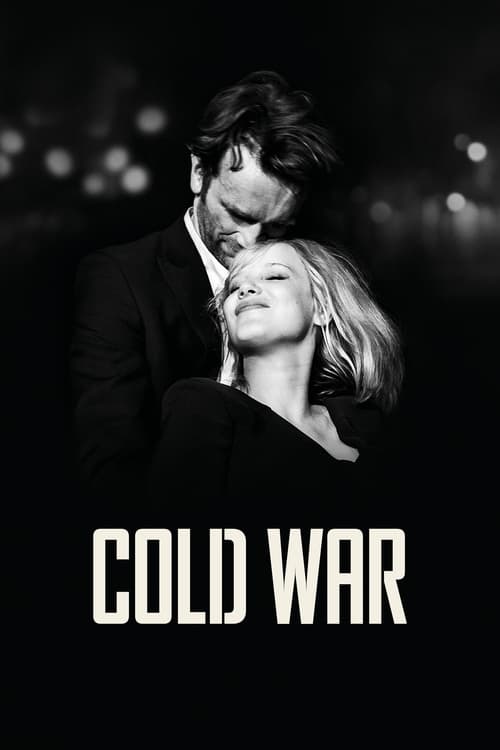
Cold War
2018 · Paweł Pawlikowski
For when you want a grand, doomed romance that aches in the best way — beautiful enough to lose yourself in, short enough for a weeknight, and guaranteed to leave you a little wrecked.
What it's about
In the rubble of post-war Poland, a refined musician auditioning singers for a state folk ensemble meets a sharp, magnetic young woman from the provinces, and the two fall into a love affair that will stretch across fifteen years and half of divided Europe. From Warsaw to East Berlin to the jazz clubs of Paris, they keep finding each other and losing each other — mismatched in temperament, separated by borders and politics, unable to stay together or apart.
The experience
Swooning and heartbreaking at once — it moves fast, leaping years between cuts, so every reunion lands with a jolt and every parting stings. At under ninety minutes it's an epic that feels like a held breath, carried along on folk songs and smoky jazz.
Performances
Joanna Kulig is the film's live wire — volatile, funny, and devastating as Zula, especially when she sings — while Tomasz Kot gives Wiktor a wounded, watchful elegance; the chemistry between them is the whole movie.
The craft
Shot in luminous black-and-white in a boxy old-fashioned frame, nearly every composition could hang on a wall, and Pawlikowski's ruthless editing trusts you to fill the years between scenes. Music does the emotional storytelling — one folk melody keeps returning, transformed from village song to Stalinist anthem to Paris jazz. It's ravishing on a big screen with the sound up.
Why it matters
It won Pawlikowski Best Director at Cannes and earned three Oscar nominations, confirming him — after Ida — as a master of the compressed, pictorially perfect European art film.
Snapshot
Cold War is an epic compressed into miniature: a fifteen-year love affair, spanning the Stalinist 1950s and the early 1960s, told in roughly eighty-eight minutes of luminous black-and-white. Paweł Pawlikowski's follow-up to his Oscar-winning Ida (2013) traces Wiktor (Tomasz Kot), a refined musician and arranger, and Zula (Joanna Kulig), a sharp-tongued provincial singer, as they meet inside a state folk-music ensemble in ruined post-war Poland and then circle one another across Warsaw, East Berlin, Yugoslavia, and Paris. They are, as the TMDB synopsis frames it, "fatally mismatched and yet drawn to each other" — but the film makes the geopolitical metaphor literal: their union is repeatedly severed by borders, ideologies, defections, and the gravitational pull of home. Dedicated to the director's own parents, whose volatile relationship loosely seeds the story, Cold War is at once a personal elegy and a formal tour de force, structured as a series of elisions — scenes that begin after the decisive moment and end before resolution, leaving the audience to feel the years fall away in the cuts. It won Pawlikowski Best Director at Cannes and earned three Academy Award nominations.
Industry & production
Cold War was produced principally by Opus Film (Łódź), the Polish company behind Ida, with Ewa Puszczyńska and Tanya Seghatchian as lead producers, alongside Apocalypso Pictures and France's MK Productions, with sales handled by Protagonist Pictures. It is a Polish–British–French co-production, a structure typical of mid-budget European art cinema that pools national funding bodies (the Polish Film Institute among them), broadcaster money, and international distribution advances to reach screens beyond the home territory. The film arrived carrying unusual expectations: Pawlikowski's Ida had won the 2015 Academy Award for Best Foreign Language Film, making him one of the most internationally visible Polish directors of his generation, and Cold War was positioned as a deliberate companion piece — another monochrome, Academy-ratio chamber work mining mid-century Polish history.
Domestically, the film landed in a charged political climate; Poland's then-governing Law and Justice party had made cultural memory a battleground, and a film foregrounding the cruelties and absurdities of the Stalinist cultural apparatus carried implicit weight, though Pawlikowski's treatment is more melancholic than polemical. Internationally, Amazon Studios handled the U.S. release. The picture's festival trajectory — Cannes competition, then a long awards campaign — exemplifies how a compact European art film is built into a global event through the prestige circuit rather than wide commercial release. Specific budget and box-office figures are not something I can cite reliably here, and I won't invent them.
Technology
Cold War belongs to a strand of contemporary cinema that uses current digital tools to reconstruct an analog past. The film was, like Ida, captured digitally and rendered in high-contrast black-and-white rather than shot on monochrome stock; the look is engineered in capture and grade, not inherited from period film emulsion. This matters because the image's silvery sheen and deep blacks — the texture one associates with 1950s photography — are a designed effect, achieved with modern sensors and post-production control over contrast and tonality. (I'm confident the production was digital in origin; I won't specify an exact camera package, as I can't verify the model.)
The other decisive technical choice is the aspect ratio: the boxy 1.37:1 Academy frame, the standard of cinema's classical era. Restoring that ratio is itself a technological-aesthetic decision, requiring the whole production design and framing to be conceived for a near-square window. Combined with the monochrome palette, it situates the film inside the visual grammar of the period it depicts, while digital projection delivers that vintage frame to contemporary multiplexes with a clarity the original era never had.
Technique
Cinematography
Łukasz Żal, returning from Ida, is the film's co-author in the deepest sense. His black-and-white compositions are built on stillness, negative space, and the expressive placement of figures low in a tall frame beneath looming skies, walls, and ceilings — a strategy that dwarfs the characters within their ideological architecture. Where Ida was almost ascetic in its fixity, Cold War permits more movement and warmth, particularly in the Parisian jazz-club and recording sequences, where the camera loosens and the light grows smoky and seductive. Żal modulates register by place: the early Polish folk-collecting scenes have a documentary plainness; the state-ensemble stage numbers are frontal and theatrical; Paris is glamorous, shadowed, and intimate. The Academy ratio forces verticality, and Żal repeatedly uses it to isolate a single face or to stack a couple against an oppressive expanse, making composition itself carry the theme of confinement and longing. The cinematography earned an Academy Award nomination.
Editing
Jarosław Kamiński's editing is arguably the film's most radical element. Cold War advances by ellipsis: the narrative leaps months or years across hard cuts and fades to black, dropping us into a new city and a new phase of the affair with minimal exposition. We are never shown the mechanics of a defection, a reunion, or a marriage — only the before and after, with the rupture lodged in the cut. This compression is what lets a fifteen-year saga run under ninety minutes without feeling rushed; the omissions become the film's emotional engine, asking the viewer to supply the offscreen anguish. The technique recalls the elliptical romance of older European cinema while feeling startlingly modern in its austerity. Kamiński's work was recognized at the European Film Awards.
Mise-en-scène / staging
The film is a study in controlled environments. Marcin Masecki and the music team aside, the physical world — ruined churches, drab rehearsal halls, Party banquet rooms with Stalin's portrait unfurling behind a choir, the bohemian clutter of a Left Bank flat — is rendered with precise period specificity that always doubles as psychology. Staging often places performance at the center: the folk ensemble on its proscenium, Zula singing at a microphone, the recording booth in Paris. These framed performances become the recurring stage on which the couple's power shifts play out. The recurring motif of the ruined chapel — site of the opening and the devastating close — gives the film an architecture of return.
Sound
Music is the film's circulatory system, and Cold War is unusually rigorous in using a single melody as a structural through-line. The Polish folk song "Dwa serduszka, cztery oczy" ("Two Hearts, Four Eyes") is first heard as raw field-recorded folk material, then arranged into a swelling patriotic showpiece for the state ensemble, and finally transformed into a melancholy French-language jazz ballad in Paris — the same tune carrying the lovers' changing circumstances and the corruption of the folk-authentic by the state and then by the market. The ensemble itself is modeled on the real Polish state folk troupe Mazowsze, whose post-war rise from peasant song to Cold War cultural ambassador the film fictionalizes. Notably, Cold War largely forgoes a conventional non-diegetic score; its music is overwhelmingly source music — folk, Party anthem, jazz, even a jukebox blast of rock-and-roll marking the encroaching West. (Marcin Masecki is associated with the jazz arrangements; I'd flag that the precise division of musical credits is worth verifying rather than asserting in detail.)
Performance
Joanna Kulig's Zula is the film's volcanic center — by turns guarded, seductive, drunken, defiant, and wounded — a working-class survivor whose talent and self-protective cunning make her both irresistible and unknowable. Kulig delivers her musical numbers herself, and the performance scenes (a slurred, reckless dance to "Rock Around the Clock" in a Paris bar especially) externalize the character's despair with physical bravado; she won Best Actress at the European Film Awards. Tomasz Kot's Wiktor is her deliberate opposite: contained, watchful, intellectually superior and emotionally recessive, a man whose love is real but whose composure reads as coldness. The film depends on this temperamental mismatch — refinement versus rawness, West versus home — and both actors play across long silences and ellipses, having to register years of accrued damage in a glance after each cut.
Narrative & dramatic mode
The film operates as a fragmented melodrama — high romantic feeling delivered through anti-melodramatic restraint. Its dramatic mode is elliptical and episodic: each chapter is a discrete encounter separated by a fade, and the cumulative form resembles a song cycle or a set of variations more than a conventional three-act arc. Causation is withheld; we infer the forces (the state, exile, jealousy, the impossibility of belonging in the West for Zula and of returning for Wiktor) from their effects. The result is a tragic structure in which the lovers are repeatedly reunited and re-severed, each cycle costing more, building toward an ending of stark finality. The mode privileges feeling and image over explanation, trusting montage and music to do narrative work that dialogue conventionally performs.
Genre & cycle
Cold War sits at the intersection of the doomed-romance tradition and the historical-political art film. As romance it belongs to the lineage of impossible-love sagas where private passion is crushed by public history. As a Cold War narrative it joins films about artists negotiating life under and after Stalinism, and about the seductions and disappointments of Western exile. It also functions as a musical of a particular kind — not the integrated Hollywood musical but a film about music-making, the folk-revival ensemble and the jazz club as parallel institutions. Within Pawlikowski's own work it forms a diptych with Ida: both are short, monochrome, Academy-ratio reckonings with twentieth-century Polish trauma, suggesting a deliberate authorial cycle of compressed historical chamber pieces.
Authorship & method
Pawlikowski's method on Cold War is autobiographical at the root: the protagonists are named Wiktor and Zula after his own parents, and the film is dedicated to them; he has described drawing on their long, stormy, repeatedly broken-and-renewed relationship while fictionalizing freely. His working approach favors radical compression and intuition over exhaustive plotting — building the film around vivid scenes and trusting elision to bridge them, a practice consistent with the screenplay he developed with co-writer Janusz Głowacki (with additional writing collaboration). The authorship is genuinely collaborative in its craft pillars: Łukasz Żal's cinematography and Jarosław Kamiński's editing are inseparable from the film's identity, as is the musical conception built around the migrating folk melody. Pawlikowski, who spent much of his career in Britain making documentaries and English-language features before returning to Poland, brings an outsider-insider's double vision — intimate with the material yet formally disciplined in a way that resists nostalgia.
Movement / national cinema
The film is a flagship of the post-2010 resurgence of Polish art cinema on the world stage, anchored by Pawlikowski and the Opus Film production base. It engages directly with Polish national memory — the Stalinist cultural machine, the folk-revival ensembles weaponized as state propaganda, the exile experience — while addressing an international audience through the universal language of monochrome romance. It also converses with the heritage of earlier Polish and Eastern European cinema's preoccupation with art-making under totalitarianism, though Pawlikowski's sensibility, shaped by decades in the West, is more pared-down and lyrical than overtly satirical. As a co-production, it embodies the contemporary reality that "national cinema" of this prestige tier is financed and circulated transnationally.
Era / period
Cold War depicts roughly 1949 to 1964, moving from the immediate post-war ruins through high Stalinism and into the relative thaw of the early 1960s. The period detail is exacting and thematically loaded: the folk ensemble's transformation into a vehicle for Party iconography, the surveillance and border control that govern every reunion, the contrast between austere socialist Poland and a Paris that is glamorous but, for Zula, alienating and commercially compromising. The film captures the specific tragedy of the divided continent — that the same borders separating systems also sever individual lives — and uses the encroaching sounds of Western pop to mark the era's cultural shifts. As a film made in 2018, it views this period through a lens of mournful retrospection rather than period reconstruction for its own sake.
Themes
Central is the impossibility of belonging: Wiktor cannot live in Poland and Zula cannot fully live outside it, so the love that requires them both in one place is structurally doomed. Closely bound to this is the corruption of authenticity — the folk song's journey from peasant field recording to state anthem to commodified jazz ballad dramatizes how both totalitarian politics and Western markets hollow out the genuine article. The film meditates on exile and home, on art as both refuge and trap, and on love as a destructive compulsion that the lovers choose repeatedly against their own interest. The recurring ruined chapel frames a final theme of transcendence-through-renunciation: the idea, voiced near the close, that the only union available to them lies on "the other side."
Reception, canon & influence
Critically, Cold War was among the most acclaimed films of its year. It premiered in competition at the 2018 Cannes Film Festival, where Pawlikowski won the award for Best Director, and went on to a dominant showing at the European Film Awards (taking top honors including Film, Director, Actress, Screenwriter, and Editing). At the Academy Awards it earned three nominations — Best Director, Best Cinematography, and Best Foreign Language Film — a remarkable haul for a subtitled film and a marker of Pawlikowski's standing after Ida. Reviewers singled out its formal economy, Żal's images, Kulig's performance, and the audacity of compressing an epic into under ninety minutes.
Looking backward, the film's influences are legible: the monochrome Academy-ratio austerity and the lineage of European romances in which history crushes love; the documentary-rooted attention to the folk-revival apparatus modeled on Mazowsze; and Pawlikowski's own Ida as immediate formal template. Looking forward, Cold War consolidated a contemporary mode — the short, ravishing, black-and-white historical art film — and reinforced the international viability of Polish prestige cinema, cementing Pawlikowski as a defining figure of the form and Żal as one of the era's most sought-after cinematographers. Its broader legacy lies in demonstrating that radical narrative compression and source-music structure can carry the full emotional weight of an epic, an example likely to be studied for its editing and its single-melody architecture as much as for its romance.
A Deleuzian reading
A scene ends.
The full Deleuzian reading of Cold War →
Reception
It arrived already garlanded — Best Director at Cannes 2018 and a genuinely surprising Best Director Oscar nomination for a black-and-white Polish film — and rather than being reappraised, it simply settled in as the modern doomed-romance touchstone people measure other love stories against.
How Cold War was received, from release to now →
Influences: the films it descends from and the films it influenced
- Ida (2013) — Direct formal template: the 1.37 Academy frame and silvery monochrome with figures shoved to the bottom edge under cathedral-scale negative space — Łukasz Żal's identical static-composition grammar, which Cold War simply extends.
- The Umbrellas of Cherbourg (1964) — Doomed romance whose entire architecture rests on a single melody re-orchestrated across the film and on lovers severed by the pressures of war/history — the source-music structural engine Cold War inherits and literalizes through its migrating folk tune.
- Jules et Jim (1962) — Decade-spanning love triangle told in episodic leaps, bridging years through brisk narration and elliptical compression rather than continuous plotting — the fragmented-melodrama scaffolding Cold War compresses to 88 minutes.
- Hiroshima mon amour (1959) — Editing that intercuts intimate love against the weight of historical catastrophe, building a romance out of memory fragments and elision instead of scene-to-scene continuity.
- Ashes and Diamonds (1958) — Polish deep-focus monochrome staging of doomed individuals trapped inside the new Stalinist political machinery — the national art-cinema lineage and the Stalinist-Poland mise-en-scène Cold War works within.
- Man of Marble (1977) — Anatomizes the socialist-realist propaganda-spectacle apparatus and the staging of worker/folk performance for the state — precisely the Mazowsze ensemble's transformation from folk troupe to Party showpiece that Cold War dramatizes.
- The Cranes Are Flying (1957) — Soviet-bloc wartime romance in which bravura expressive monochrome camerawork registers history physically crushing the lovers — the Eastern European 'history-destroys-love' template.
- In the Mood for Love (2000) — Builds a doomed romance from repeated near-misses and a recurring musical leitmotif, letting ellipsis and motif-repetition carry feeling that plot deliberately withholds — Cold War's same logic of compression-by-recurrence.
- The Passion of Joan of Arc (1928) — Austere Academy-ratio purity in which faces float against flattened negative space — the framed-performance close-up grammar Żal echoes in Kulig's recital and audition shots.
- Casablanca (1942) — A single diegetic source song ('As Time Goes By') deployed as the romance's leitmotif within a love story sundered by political history — the song-as-emotional-anchor device Cold War rebuilds around its folk melody.
- The Unbearable Lightness of Being (1988) — An Eastern European romance scored to national folk-classical music used as both emotional engine and identity anchor — the Janáček strategy of nationalist sound carrying the love story's yearning.
- Interrogation (1989) — Uses diegetic folk and cabaret performance as ironic counterpoint to Stalinist repression, echoing Interrogation's diegetic cabaret songs set against the prison's coercion.
- Passing (2021) — Adopts the boxed 1.37 Academy frame, high-key silvery monochrome and pointed negative space directly downstream of the Ida/Cold War compositional template.
- Belfast (2021) — Autobiographical political-historical childhood rendered as compressed black-and-white vignettes — a memory-film made squarely in the commercial wake Cold War and Roma opened for monochrome period prestige.
- The Lighthouse (2019) — Near-square boxed Academy-ratio black-and-white revival whose festival/awards viability rode the prestige Cold War helped re-establish for the constricted monochrome format.
- Hamnet (2025) — Żal's available-light photography fused to an elliptical, withholding narrative structure that elides time across emotional ruptures, prefiguring Hamnet's suppression of key events.
- Phoenix (2014) — Postwar doomed romance turning on a cabaret leitmotif ('Speak Low') and on framed musical performance as the mechanism of recognition and betrayal — the same fusion of staged song and historical wound.
- Roma (2018) — Same-year ravishing black-and-white autobiographical-historical memory film; together with Cold War it consolidated the contemporary mode of the monochrome prestige art film built from elided personal recollection.
- First Reformed (2017) — Uses the near-square 1.37 frame and austere negative space as an expressive constraint that pins isolated figures within emptiness — the same transcendental-style compositional discipline.
- Two Prosecutors (2025) — Academy-ratio, high-contrast formal asceticism narrating private lives crushed in the gears of the Soviet state apparatus — the same disciplined visual rule-set.
- The Painted Bird (2019) — Łukasz Żal's anamorphic 35mm monochrome, static long takes, and available-light compositions share the formal vocabulary of The Painted Bird, with both films positioning photochemical anamorphic monochrome as an ethical argument about Eastern European mid-century experience rather than a nostalgic or merely aesthetic choice.
- Dear Comrades! (2020) — Pawlikowski's follow-up continues the Academy ratio monochrome grammar for post-war Communist-bloc intimate historical mode, with Łukasz Żal's deep-focus depth staging directly cognate to Andrei Naidenov's cinematography in Dear Comrades!.
- Carol (2015) — Pursues the same austere, desaturated (monochrome) treatment of a doomed mediated romance, compressing years into elliptical fragments and trusting held looks over dialogue.
- There's Still Tomorrow (2023) — Parallel use of near-Academy-ratio black-and-white in which love and cruelty between a couple are expressed through choreographed music-and-movement set pieces, kin to Cortellesi's dance-staged intimacy.
- Corpus Christi (2019) — Extends the desaturated, formally controlled Polish-prestige aesthetic and foregrounds diegetic song/liturgical music as emotional structure, sharing Corpus Christi's Oscar-circuit positioning.
- The Son of a Thousand Men (2025) — A masterclass in ellipsis-rhythm editing, leaping across years in hard cuts so the gaps themselves carry the emotion — the same elliptical grammar central to Rezende's craft.
Similar films
- Ida (2013) — influence & lineage
- Ashes and Diamonds (1958) — influence & lineage
- The Cranes Are Flying (1957) — influence & lineage
- Phoenix (2014) — influence & lineage
- In the Mood for Love (2000) — influence & lineage · same viewing thread
- A Short Film About Love (1988) — shared sensibility
- Possession (1981) — shared sensibility
- Interrogation (1989) — shared sensibility
All the films related to Cold War →
Watch it with: curated runs of related films
- Love Against the Grain — A run of films where desire refuses the shape its world demands — opera stages, drought-struck Taipei, an honor-bound Lahore household, drenched Buenos Aires — and burns brighter, and more dangerously, for the refusal.