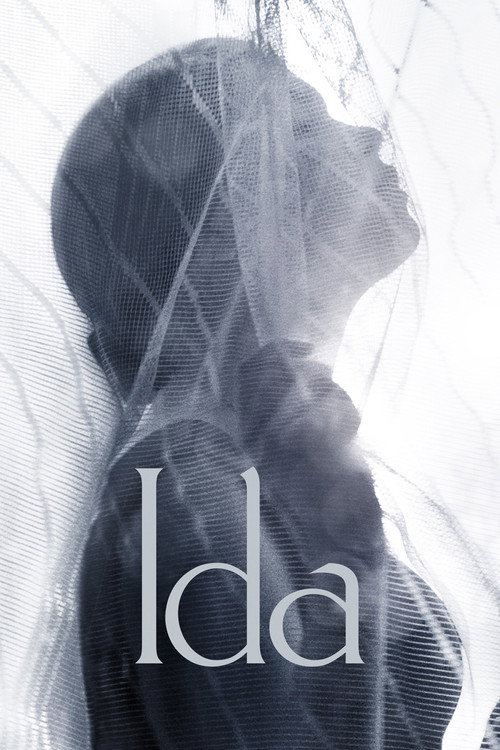
Ida
2013 · Paweł Pawlikowski
For a contemplative night when you want something beautiful, brief, and profound rather than busy — a film to sit with in silence afterward. Challenge more than comfort, but a gentle, absorbing kind of challenge.
What it's about
Poland, 1962. Anna, a young novice raised in a convent, is days from taking her vows when she's sent to meet her only living relative — a hard-drinking, sharp-tongued aunt who was once a state prosecutor. The aunt tells her who she really is: her name is Ida, she was born Jewish, and her parents vanished during the German occupation. Together the mismatched pair drive into the countryside to find out what happened to the family.
The experience
Hushed, spare, and mesmerizing — eighty minutes of long silences, wintry light, and two women circling an enormous grief. It's quiet on the surface and seismic underneath, the kind of film that settles into you slowly and stays.
Performances
Agata Kulesza is extraordinary as the aunt — brittle, caustic, and quietly breaking — while newcomer Agata Trzebuchowska carries the film on stillness alone, a face the camera can't stop searching.
The craft
Shot in luminous black and white in a boxy, old-fashioned frame, with a nearly motionless camera and figures placed low in vast empty compositions — every shot could hang on a wall. The austerity isn't a pose; it concentrates the emotion, and it's stunning on a big screen.
Why it matters
It became the first Polish film to win the Academy Award for Best Foreign Language Film and reopened a raw national conversation about Poland's wartime and postwar past.
Snapshot
Ida is a black-and-white chamber drama set in Poland in 1962, in which a young novice on the threshold of her vows is sent to meet her only surviving relative and discovers that she was born Jewish, that her name is Ida Lebenstein, and that her parents were murdered during the German occupation. Shot in the boxy Academy ratio (1.37:1) with an almost entirely static camera and figures pressed to the bottom of vast, empty frames, the film compresses an enormous historical weight — the Holocaust, Stalinism, the unhealed seam between them — into eighty tightly controlled minutes and two women. Directed by Paweł Pawlikowski on his return to Poland after a long career in British documentary and fiction, it became the first Polish film to win the Academy Award for Best Foreign Language Film (at the February 2015 ceremony, honoring 2014) and, unusually for a monochrome Academy-ratio picture, also earned an Oscar nomination for cinematography. It is at once a road movie, a detective story of buried bones, and a study in faith withheld and tested.
Industry & production
Ida is a Polish-Danish co-production, produced principally through Poland's Opus Film with Danish partners (Phoenix Film among the co-producers), supported by the Polish Film Institute and Eurimaches-style European funding mechanisms typical of mid-budget art cinema of the period. It was modestly budgeted by any international standard — a deliberately small, contained production whose economy is legible on screen in its handful of locations, tiny cast, and absence of spectacle. I do not have a reliably documented exact budget figure and will not invent one; the safe characterization is "low, in the range typical of European auteur drama."
The film's commercial trajectory was the inverse of its scale: a slow-building festival and arthouse success. After premiering at Telluride and Toronto in the autumn of 2013 and circulating through the festival circuit, it accumulated critical momentum across 2014 and became one of the highest-grossing subtitled releases of its season in several markets, an outsized return on a deliberately spare film. Its Oscar win consolidated Pawlikowski's international standing and effectively relaunched a Polish-language phase of his career.
Technology
Ida was captured digitally and finished as high-contrast monochrome rather than originated on black-and-white film stock — a now-common workflow in which the absence of color is a creative decision executed in capture and grade rather than a property of the negative. (The specific camera and sensor I won't assert with false precision; the relevant fact is digital origination graded to a deep, silvery monochrome.) The choice matters because it let the filmmakers pursue an extreme, painterly tonal range — luminous skies, crushed shadows, skin that reads almost like the grain of old photographs — while retaining the flexibility digital postproduction affords. The decision to present the film in the 1.37:1 Academy ratio rather than a contemporary widescreen format is the single most consequential "technological" choice: it is a frame inherited from the cinema of the 1930s–50s, and it governs the film's entire visual grammar.
Technique
Cinematography
The cinematography — credited to Ryszard Lenczewski and Łukasz Żal, with Żal completing the shoot after Lenczewski had to step away during production, both ultimately sharing the Oscar nomination — is the film's most discussed formal element. Nearly every shot is static, locked on a tripod; the camera observes rather than pursues. The defining gesture is composition against the top of the frame: characters are routinely placed low, in the bottom third or even the bottom edge, with great expanses of wall, ceiling, or white winter sky above them. This negative space has been read variously as the pressure of God, the indifference of history, the void left by the dead, and simply the smallness of two people inside forces larger than themselves. Faces are isolated, often in stark frontal or profile arrangements that recall devotional portraiture and identity photographs alike. The deep-focus monochrome, the hard north light, the snow and bare trees, all build an austerity that is the opposite of nostalgia — a 1960s rendered as moral winter. The film's rare camera movements, including a handheld passage near the close, register precisely because the preceding stillness has made motion feel like rupture.
Editing
Cut by Jarosław Kamiński, the film is edited with the same withholding discipline that governs its images. Scenes are short and elliptical; the film trusts the viewer to supply connective tissue and resists the explanatory beat. Crucial revelations — who killed the family, where the bodies lie — arrive obliquely, and emotional turns are frequently placed off-screen or in the cut, so that consequence registers before cause is fully stated. The editing's restraint is essential to the film's brevity; at roughly eighty minutes it is almost a novella, and the cutting keeps it from ever feeling either rushed or padded.
Mise-en-scène / staging
The staging is rigorously frontal and frieze-like. Interiors — the convent refectory, Wanda's cramped apartment, rural cottages, a provincial hotel — are dressed with a documentary plainness that avoids period fetishism; the 1960s here is shabby, depopulated, and gray rather than stylish. Pawlikowski composes in tableaux, holding the frame and letting actors enter and exit a fixed field rather than reframing to follow them. Symmetry, doorways, and windows partition the image; religious iconography (crucifixes, the novice's habit) and secular Communist drabness coexist in the same depopulated rooms, the two competing faiths of postwar Poland made visible as décor.
Sound
The sound design, with Kristian Eidnes Andersen credited on the sound and music side, is sparse and largely diegetic, which makes the film's musical choices ring out. There is little or no conventional underscore in the Hollywood sense; instead, Ida uses source music as a thematic device. Bach and Mozart represent the ordered, sacred world Ida is preparing to enter, while the intrusion of jazz — a young saxophonist Ida and Wanda encounter on the road, and a passage of John Coltrane's "Naima" — embodies the worldly, sensual, modern life that briefly opens to her. The contrast of sacred European music against American jazz is the soundtrack's central argument, the soundscape of a vocation and the soundscape of a possible other life.
Performance
The film rests on two performances in deliberate opposition. Agata Trzebuchowska, a non-professional reportedly discovered outside the industry, plays Ida/Anna with an almost expressionless containment — a stillness of face that forces the viewer to read the smallest flickers, in the Bressonian and Dreyer-esque tradition of the withheld countenance. Against her, Agata Kulesza plays the aunt, Wanda Gruz — once a feared Stalinist state prosecutor nicknamed "Red Wanda," now a hard-drinking, chain-smoking, sexually frank woman corroded by what she has done and lost. Kulesza's performance is the film's furnace of feeling, all worldly appetite and self-disgust, and the dialectic between the two women — the believer who has known nothing and the cynic who has known too much — is the film's true subject.
Narrative & dramatic mode
Ida operates in a stripped, elliptical realist mode crossed with the structure of a quest. The engine is a journey: aunt and niece set out to learn how and where Ida's parents died, a road movie whose destination is a literal exhumation. But the dominant register is interior and theological rather than procedural. The film refuses melodrama at almost every turn, declining to score its revelations or to give the characters cathartic speeches; the most devastating disclosures are delivered flatly, in kitchens and forests. Its dramatic mode is one of moral testing — Ida is offered, in sequence, the knowledge of her origins, the spectacle of her aunt's despair, the temptation of ordinary life and love, and a loss that throws her back on the question of what she actually believes. The ending withholds resolution, leaving the protagonist mid-stride between two lives.
Genre & cycle
The film sits at the intersection of several traditions: the European art-house drama of conscience; the Holocaust-aftermath film, distinct from the wartime-set Holocaust film in that it concerns memory, complicity, and unburied history rather than the event itself; the convent or vocation film concerned with faith and renunciation; and the road movie. Within the cycle of twenty-first-century films reckoning with Eastern European complicity in the Shoah, Ida belongs to a wave of works confronting the uncomfortable fact that some Jews who survived the Germans were killed by their Polish neighbors — a reckoning that, in the years around the film, was a live and bitter public argument in Poland.
Authorship & method
Ida is a profoundly authored film, and Pawlikowski has described it as a return to the Poland of his childhood after decades abroad. Born in Warsaw in 1957, he left as a teenager and built his career in Britain, first in BBC documentary and then in fiction with Last Resort (2000) and My Summer of Love (2004). Ida was his first Polish-language feature and a conscious turn toward a personal, memory-grounded image of his native country. He co-wrote the screenplay with the British playwright Rebecca Lenkiewicz, whose contribution helped shape the spare, withholding dialogue. The cinematography by Ryszard Lenczewski and Łukasz Żal (Żal completing the film) realized Pawlikowski's static, top-weighted compositional system; the editing by Jarosław Kamiński enforced its ellipticism; and the sound and music work credited to Kristian Eidnes Andersen built the sacred-versus-jazz dialectic. The collaboration with Żal proved foundational: the cinematographer became Pawlikowski's key visual partner, returning for Cold War (2018), which shares Ida's monochrome Academy-ratio language.
Movement / national cinema
Ida is a Polish film in deep dialogue with Polish cinema history, even as its maker spent his formative professional years outside it. It stands downstream of the Polish Film School of the late 1950s — the Wajda-and-Munk generation that confronted war and national trauma — and of the moral-anxiety cinema and the metaphysical chamber dramas associated with Krzysztof Kieślowski. At the same time, its austerity connects it to a broader European transcendental tradition rather than to any contemporary Polish commercial mainstream. Its international success made it, for a global audience, one of the most visible Polish films of its era, and it became a flashpoint precisely because it intervened in a national argument about how Polish cinema should represent the country's wartime past.
Era / period
The film is set in 1962, in a Poland fully consolidated under Communist rule, where the Stalinist terror of the late 1940s and early 1950s has receded into the recent, shameful past — embodied by Wanda, a former regime prosecutor now demoted to a lesser judgeship and drinking herself toward ruin. The period setting is doubled: the 1960s present is haunted by the German occupation of two decades earlier, and the film's drama lies in the collision of those two eras of Polish trauma, the Nazi genocide and the Communist terror, in two women who each carry one of them. The early-1960s texture — provincial hotels, jazz bands, the thaw-era loosening — is rendered without glamour, as a gray interregnum.
Themes
The central themes are identity and inheritance: Ida must decide what to do with a self she never knew she had — Jewish, orphaned, named for the dead. Faith is tested against knowledge, the cloistered certainty of the novice set against the unbearable facts of history. The film interrogates guilt and complicity at two levels — the murder of Jews by their Polish neighbors during the occupation, and the murders committed by the Stalinist state in which Wanda was an instrument — refusing to let either off the hook. It meditates on memory and the buried dead, literally in its exhumation plot. And it weighs renunciation against worldly life: the saxophonist, the dance, the offer of an ordinary future against the silence of the convent. Crucially, the film declines to tell the viewer which choice is right.
Reception, canon & influence
Critically, Ida was among the most acclaimed films of its years of release, praised for its compositional rigor, its moral seriousness, and the Kulesza–Trzebuchowska pairing. It won the European Film Award for Best Film and swept major European honors before culminating in the Academy Award for Best Foreign Language Film — the first such win for Poland — and the Best Cinematography nomination that drew particular attention given its monochrome, near-square frame. Its reception in Poland was sharply divided: while many celebrated the international recognition, the film drew criticism from nationalist quarters for foregrounding Polish complicity in the murder of Jews, and there were public campaigns demanding explanatory disclaimers be attached to broadcasts to "contextualize" the history. That controversy is itself part of the film's significance — it landed inside a raw national debate about historical memory.
Its influences run backward to the austere spiritual cinema codified in Paul Schrader's notion of the "transcendental style": the iconic faces and ascetic framing of Carl Theodor Dreyer (The Passion of Joan of Arc) and the withholding, grace-haunted minimalism of Robert Bresson (Diary of a Country Priest), alongside the Polish traditions of Wajda and Kieślowski. Forward, its most direct legacy is in Pawlikowski's own Cold War (2018), which extends the same monochrome Academy-ratio idiom into a postwar romance and won him Best Director at Cannes. More broadly, Ida's international success helped license a renewed art-cinema appetite for black-and-white, boxy-ratio, formally severe filmmaking, and it stands as a reference point both for the post-Holocaust memory film and for the late-period revival of the static, composed, anti-spectacular image.
A Deleuzian reading
Start with the frame.
The full Deleuzian reading of Ida →
Reception
Acclaimed abroad from the start — it became the first Polish film ever to win the Best Foreign Language Film Oscar (2015) — but at home it triggered a nationalist backlash, including a petition demanding disclaimers about its portrayal of wartime Polish-Jewish history. A decade on, the controversy has faded and it sits comfortably as a modern classic, landing on BBC Culture's 2016 critics' poll of the 21st century's greatest films.
How Ida was received, from release to now →
Influences: the films it descends from and the films it influenced
- The Passion of Joan of Arc (1928) — Trzebuchowska's withheld, near-blank countenance held against voids of white wall descends directly from Dreyer's isolation of Falconetti's face in empty negative space.
- Diary of a Country Priest (1951) — The grace-haunted minimalism and elliptical withholding of dramatic event — letting offscreen action and silence carry the spiritual weight — is the Bressonian method Pawlikowski adopts wholesale.
- Au Hasard Balthazar (1966) — Bresson's use of non-professional 'models' emptied of expression underwrites the casting of first-timer Trzebuchowska as a face that registers grace rather than performs emotion.
- Ordet (1955) — The static, frontal tableau staging of figures in austere whitewashed interiors, where stillness itself becomes the register of the sacred, is a Dreyer compositional inheritance.
- Winter Light (1963) — The sparse, faith-versus-doubt chamber drama set in bare interiors with a clergy figure interrogating belief supplies Ida's spiritual-crisis architecture.
- Mother Joan of the Angels (1961) — This Polish convent drama's stark high-contrast monochrome and nuns pinned small and low against vast empty white walls is the most direct precedent for Ida's top-weighted, negative-space framing.
- Ashes and Diamonds (1958) — The Polish Film School idiom of deep-focus black-and-white compositions reckoning with wartime guilt and national memory is the native tradition Pawlikowski returns to.
- A Short Film About Killing (1988) — Kieślowski's ascetic moral seriousness and filtered, desaturated Polish image — withholding judgment while staging questions of complicity and conscience — is the immediate domestic forebear.
- Andrei Rublev (1966) — The monochrome contemplation of faith, silence, and a vow-bound figure moving through a violent national past models the transcendental gravity Ida pursues.
- The White Ribbon (2009) — Severe high-contrast monochrome, static composed tableaux, and a withheld resolution that implicates a community in buried collective guilt — the same anti-spectacular moral image.
- Schindler's List (1993) — Pawlikowski and Łukasz Żal's Academy-ratio black-and-white photography with static long-takes and deep compositional austerity constitutes a formal counter-argument to Kamiński's kinetic handheld approach for Polish Holocaust subject matter — both films agree that black-and-white is the ethically obligatory register for this history, but Ida's immobility explicitly refuses Schindler's documentary-movement grammar.
- The Lives of Others (2006) — Łukasz Żal and Ryszard Lenczewski stage figures in the lower third of the wide anamorphic frame against flat Polish sky and institutional ceilings — a bureaucratic spatial grammar for Communist Poland that inherits from Bogdanski's GDR work — and Agata Trzebuchowska's suppressed-interiority performance follows the same Bressonian model Mühe employs: accumulated silence and minimal gesture carrying the weight of a transformation the face refuses to display.
- Cold War (2018) — Reunites cinematographer Łukasz Żal to extend the exact monochrome Academy-ratio idiom, top-weighted framing, and elliptical jump-across-time editing into a postwar romance.
- First Reformed (2017) — Schrader directly applies his own 'transcendental style' theory — Academy-ratio framing, ascetic stillness, a clergyman's faith crisis withheld behind an impassive face — the same codified tradition Ida draws on.
- Roma (2018) — A personal memory film whose black-and-white, formally composed, anti-spectacular image was licensed by the art-cinema appetite Ida's success helped revive.
- Corpus Christi (2019) — Extends the Polish faith-and-identity drama — an impostor wearing the cassock, confronting buried communal guilt — in the same severe contemporary Polish register Ida re-established internationally.
- Hamnet (2025) — Łukasz Żal's static, painterly compositions built on rigorous horizontal-vertical balance — the classical compositional discipline he brings to Hamnet's candle-scaled interiors.
- Beanpole (2019) — Academy 1.33 ratio deployed as a deliberate historical photographic register for WWII-legacy drama, with bodies placed in the lower frame quadrant and space withheld above — the immediate formal model for Beanpole's aspect ratio choice and compositional logic.
- Conclave (2024) — Photochemical acquisition, severely restricted gray-ochre palette, figures isolated in the lower quadrant of a deep-focus frame, and interior stillness performance within religious institutional architecture — the formal template Fontaine and Berger's visual approach most directly echoes in the convent and conclave spaces.
- Son of Saul (2015) — Shares the post-Holocaust memory film's formal severity and withholding — a rigid framing system that refuses spectacle and pins history to a single withheld face.
- Aftermath (2012) — Confronts the identical raw subject — Polish complicity in the murder of Jewish neighbors and the unearthing of suppressed local history — that fueled Ida's national controversy.
- Two Prosecutors (2025) — Shares the boxed Academy ratio, desaturated austerity, and static frontal compositions deployed to render Eastern-bloc moral airlessness as a formal condition.
- Sound of Falling (2025) — Boxy Academy-ratio compositions with available-light chiaroscuro used to excavate buried, place-bound historical trauma through stillness.
- The Painted Bird (2019) — Łukasz Żal and Ryszard Lenczewski's 35mm monochrome with severe available-light discipline in a Polish post-war landscape, combined with static long takes and deliberate use of empty frame space as moral weight, places Ida within the same 2010s European photochemical revival that The Painted Bird extends — both arguing that 35mm monochrome is the ethical material for representing mid-century Eastern European violence.
- Dear Comrades! (2020) — Pawlikowski established the template of Academy ratio monochrome plus Bressonian pacing for conducting an intimate protagonist through suppressed national history; Dear Comrades! deploys the same formal package for Soviet rather than Polish state crime.
- The Girl with the Needle (2024) — The closest formal sibling: academy ratio as visual constriction in a Polish historical setting, monochrome with textured depth-of-field composition, a female protagonist navigating suppressed institutional evil — Pawlikowski established the contemporary template for this exact formal vocabulary that the film fully inhabits, including the use of negative space within the narrowed frame.
- The Ascent (1977) — Shares the high-contrast monochrome of religious conscience — a novice's ascetic face framed against empty space and snow, the frame's silence carrying a spiritual reckoning.
- Happening (2021) — Uses the revived Academy ratio to box a young woman inside the frame, turning aspect ratio itself into an instrument of confinement and period austerity.
- Tatami (2024) — Revived the boxy Academy 1.37:1 frame with rigorous static B&W compositions, the near-square format Tatami borrows to box its athlete inside mounting pressure.
- Leviathan (2014) — Severe, static compositions that frame religious institutions against a nation's buried guilt, using stillness and empty space as the vehicle of a historical-political reckoning.
- Godland (2022) — Academy-ratio framing that pins figures to the bottom or edge of the image beneath a heavy void of sky, staging religious vocation as compositional smallness.
Similar films
- Cold War (2018) — influence & lineage
- Sound of Falling (2025) — influence & lineage
- Corpus Christi (2019) — influence & lineage
- The White Ribbon (2009) — influence & lineage
- Mother Joan of the Angels (1961) — influence & lineage
- Son of Saul (2015) — influence & lineage
- The Piano (1993) — same viewing thread
- The Girl with the Needle (2024) — same viewing thread
All the films related to Ida →
Watch it with: curated runs of related films
- The World Against Her — A run of women worn down or driven to extremity by a merciless community, marriage, or economy — watch them near each other and the sacrifice, the drift, and the violence start to rhyme.