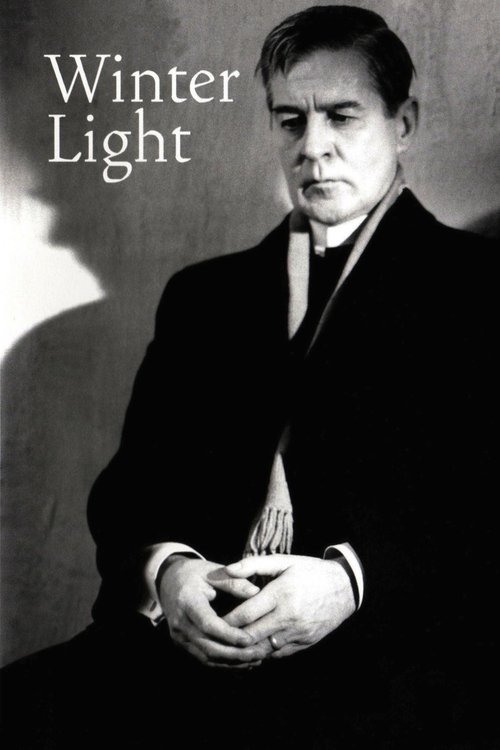
Winter Light
1963 · Ingmar Bergman
When you want the hard stuff: a film to wrestle with about faith, doubt, and what we owe each other, best on a quiet night with time to sit afterward. Pure challenge — save it for when you're ready.
What it's about
Over the course of one gray Sunday, a rural Swedish pastor conducts services for a dwindling congregation while his own faith runs dry. A fisherman paralyzed by dread of nuclear war comes to him for counsel he can't give; a schoolteacher who loves him offers a devotion he can't accept. In just eighty-one minutes, the film watches a man of God confront the silence on the other end of his prayers.
The experience
Stark, wintry, and unsparing — slow-burning chamber drama played out in long close-ups where every flicker of doubt registers. It's a heavy sit that pays off in a kind of cleansing severity; you leave feeling scoured rather than comforted.
Performances
Gunnar Björnstrand plays the pastor's exhaustion and self-disgust with frightening precision, and Ingrid Thulin delivers a long, unbroken letter-reading straight to camera that is one of the most naked pieces of acting ever filmed. Max von Sydow makes the despairing fisherman unforgettable in only a few minutes of screen time.
The craft
Shot in flat gray natural light by Sven Nykvist, who reportedly studied how winter light moved through a real country church for the film's look. Bergman strips everything away — no score, few camera moves, faces held in merciless close-up — until the silence itself becomes the antagonist.
Why it matters
The severe center of Bergman's faith trilogy and a permanent reference point for filmmakers tackling religious doubt; its story of a clergyman in crisis has been openly echoed by major directors ever since.
Snapshot
A country pastor in rural Sweden conducts a Sunday morning communion, then watches helplessly as the parishioner he has failed walks out and shoots himself by a frozen river. In eighty-one minutes shot largely in static close-up and gray natural light, Bergman dismantles institutional faith from the inside: not through dramatic apostasy but through exhaustion, self-deception, and the terrible weight of God's silence. Winter Light (Nattvardsgästerna, literally "The Communicants") is the central panel of the trilogy Bergman grouped with Through a Glass Darkly (1961) and The Silence (1963) — three variations on what he called the reduction of God to human scale. It remains one of the most severe and formally exacting works in the canon of European art cinema, and one of the most directly influential on subsequent generations of filmmakers grappling with transcendence and its absence.
Industry & production
Winter Light was produced by Svensk Filmindustri (SF), the state-adjacent Swedish studio that had been Bergman's institutional home since the late 1940s. By 1963 Bergman occupied an unusual position within the Swedish film industry: commercially unreliable but artistically undeniable, shielded by international prestige won with Smiles of a Summer Night (1955), The Seventh Seal (1957), and Wild Strawberries (1957). Producer Allan Ekelund had collaborated with Bergman across most of this run and gave him the short-schedule, low-budget conditions that suited his working method. The film was shot in approximately five weeks, largely at Filmstaden (the SF studio complex in Råsunda outside Stockholm) and at actual Lutheran churches in the Swedish countryside — principally Dalby Church and Torsång Church in Dalarna, regions whose flat winter light and timber-and-stone interiors Bergman and his cinematographer Sven Nykvist had been studying carefully. The modest budget imposed no particular constraint on a script that required no spectacle; what it did produce was the slightly pinched, stripped quality that Bergman had begun to regard not as a limitation but as a method.
Technology
The film was shot in black-and-white on 35mm, in the near-square Academy ratio (1.37:1) — a deliberate retention of the older format at a moment when widescreen had become the commercial norm. Bergman and Nykvist considered the squarer frame more suited to faces and to the kind of direct, confrontational portraiture the film demanded. No original musical score was composed or recorded; the only music in the film is diegetic — the congregation singing Lutheran hymns within the church services that bookend and punctuate the narrative. This was not an oversight or budget decision but a programmatic choice: the absence of non-diegetic scoring removes the conventional emotional underwriting that scores supply, leaving the viewer without the usual cues for how to feel about what they are watching.
Technique
Cinematography
Sven Nykvist, who had begun his sustained collaboration with Bergman on Through a Glass Darkly (1961) and who would remain his principal cinematographer until Fanny and Alexander (1982), developed on Winter Light what would become one of the most recognizable visual signatures in international art cinema: the use of diffused, flat, near-natural light that refuses glamour entirely. Swedish winter light — overcast, directionless, draining color even from black-and-white images — becomes the film's dominant visual register. Nykvist supplemented available church light with carefully placed fill to eliminate harsh shadows without creating warmth or drama. The result is a gray luminosity that photographs faces as though stripping away performance, exposing the tissue beneath. The film's most discussed sequence is the letter scene: Marta (Ingrid Thulin) reads aloud a letter she has written to the pastor, and Nykvist holds her face in extended close-up for roughly seven minutes — one of the longest such sustained shots in Bergman's work — without cutting away to reaction or relief. The camera does not move. The effect is less observational than prosecutorial.
Editing
Ulla Ryghe edited the film. The cutting is extremely restrained — there are passages, particularly in the dialogue confrontations, where the film holds a single shot for durations that exceed theatrical convention by a significant margin. Bergman had been moving toward this kind of durational editing since the late 1950s, but the practice reaches an extreme here. The editing in the church service sequences is almost liturgical in its regularity, cutting on the rhythms of the service rather than on psychological beats. Notably, the intercutting between Tomas and his congregation during the opening communion is not expressive or emphatic but simply attentive, as if the camera were another parishioner. This flatness of tempo is itself an argument about repetition and the mechanical continuation of ritual.
Mise-en-scène / staging
Bergman stages the film's central conversations as confrontations of two faces in shallow space — there is almost no deep staging, no significant movement through environment, none of the compositional elaboration visible in his earlier work. The churches are cold and largely empty; the vestry is cramped; the parsonage kitchen where Tomas meets Marta after her letter is just a kitchen. Production designer P. A. Lundgren kept every interior functional and unliterary. The one significant piece of staging that has attracted scholarly commentary is the repeated use of the threshold — doorways and passageways that characters cross or fail to cross, particularly Jonas Persson (Max von Sydow), who leaves the pastor's study to his death. The final image of the film — Tomas ascending to the altar to begin the second service for a congregation of two — is staged as simply as everything that precedes it, which is what makes it so difficult to resolve.
Sound
The film's sound design is notable for the presence of environmental silence. The churches produce the peculiar acoustic of stone and cold air: footsteps are audible, the rustling of coats, the sound of the organ as it grinds into action. This near-silence is not peaceful but pressurized. The absence of a score means that transitions between scenes must be carried entirely by diegetic sound or by cut — Bergman uses both, and the abruptness of some cuts (particularly the cut from Jonas in the vestry to his body by the river) produces the shock effect that music would normally manage and soften.
Performance
Gunnar Björnstrand plays Tomas as a man in the middle of a slow collapse who has not yet fully understood what is happening to him. Björnstrand had worked with Bergman across the 1950s and was capable of the kind of internal performance — minimal gesture, a face doing almost nothing while the subtext does everything — that the film required. Ingrid Thulin's performance as Marta is among the most demanding in the film, particularly in the letter scene, where she must sustain a monologue of extraordinary emotional complexity without the support of editing or reaction. Max von Sydow has relatively little screen time as Jonas, but the scene in which Tomas delivers not pastoral comfort but his own anguished crisis of faith onto the suicidal man — essentially using Jonas as a confessor rather than consoling him — is staged with enough stillness to register its full moral horror. Allan Edwall as the sexton Algot Frövik, physically deformed and deeply attentive, provides the film's crucial pivot in his late monologue on the suffering of Christ.
Narrative & dramatic mode
The film observes something close to the classical unities: it spans roughly ninety minutes to two hours of diegetic time, moves through a small number of locations, and concentrates on a single action — Tomas's encounter with Jonas Persson and its aftermath. The structure is chiasmic: the film begins and ends with a church service, the liturgy completed in one case and refused in another, then completed again. Within this frame, the narrative strips away each of Tomas's defenses in sequence. His faith is already gone at the opening; the film is about what remains and whether it is enough. The Algot Frövik monologue near the end functions not as resolution but as reframing — offering Tomas, and the viewer, a reading of Christ's passion in which the silence of God is the central event, not the crucifixion. Whether Tomas accepts this reframing, and what it would mean for him to do so, the film refuses to determine.
Genre & cycle
Winter Light belongs to the cycle of European art-cinema films engaging with religious crisis that stretches from Robert Bresson's Diary of a Country Priest (1951) through Carl Theodor Dreyer's Ordet (1955) and into the work of later filmmakers. In generic terms, it is a chamber drama in the tradition of Strindberg — intensely psychological, spatially confined, concerned with the damage that two people do to one another in proximity. It has no genre precedent in Swedish popular cinema; it is a work of theological inquiry in dramatic form. Its connection to the "Silence of God" trilogy is thematic rather than formally cohesive — the three films do not share characters or settings — but the trilogy framing has shaped how critics and programmers have contextualized Winter Light since its release.
Authorship & method
The screenplay is Bergman's own, drawing explicitly on his upbringing as the son of Henrik Bergman, a Lutheran pastor who served the Swedish royal court. The film has a strongly autobiographical current — Bergman has discussed the way his father's clerical household shaped his understanding of faith as duty, performance, and private doubt — though the extent to which specific scenes or characters map onto biographical events is not fully established in the scholarly record. Bergman's working method at this period was highly controlled: he rehearsed actors extensively before shooting, wrote detailed instructions in his scripts, and ran closed sets. His relationship with Nykvist had by 1963 become one of genuine creative co-authorship; Nykvist's decisions about light are inseparable from the film's meaning. There is no score because Bergman and Nykvist agreed that music would falsify what the images were trying to do. Ulla Ryghe's editing served Bergman's tendency toward duration, and the two continued to work together through the 1960s.
Movement / national cinema
Winter Light is a Swedish film made within the specific cultural context of Swedish Lutheranism — a state church that had, by the early 1960s, become largely a cultural institution rather than a site of live devotion for much of the Swedish population. Bergman was working at the intersection of this secularizing culture and a set of existentialist and theological questions — Kierkegaard is a persistent philosophical intertext across his work of this period — that gave his films an international resonance beyond specifically Swedish concerns. Swedish cinema of the early 1960s was not a nationally unified movement in the way that the French New Wave was, but it had international visibility primarily through Bergman, and Winter Light consolidated his reputation among critics interested in cinema as a medium capable of sustained philosophical inquiry.
Era / period
The film was made in the early Cold War period, and it is one of the few films of the era to engage directly with nuclear anxiety not as thriller material but as a condition of ordinary consciousness. Jonas Persson's suicidal despair is triggered specifically by fear of the Chinese nuclear program — fear that civilization will be annihilated before his unborn child can grow up. Tomas, unable to offer any consolation, instead uses Jonas's crisis to voice his own theological collapse. The Cold War setting is not incidental; the film understands nuclear terror as a specific historical form of the old theological question about whether suffering and death can be made meaningful, and it answers in the negative.
Themes
The central theme is the vacancy behind institutional faith — the possibility that the forms of religion can persist after their content has evacuated. Tomas continues to administer communion, preach, and perform rites while experiencing what he describes as complete spiritual emptiness. The film asks what such performance means: is it hypocrisy, or endurance, or something else for which there is no clean word? Alongside this runs the theme of emotional solipsism — Tomas's inability to receive Marta's love, his substitution of theological crisis for human presence, his use of Jonas as a receptacle for his own pain. Marta herself is one of the film's most uncomfortable presences: she loves Tomas with a directness that the film offers as the closest thing to grace it contains, and she is consistently refused. The sexton's meditation on Christ's suffering — his argument that the agony in Gethsemane and the desolation of "My God, my God, why hast thou forsaken me?" constituted the true passion, not the physical torment — reframes the film's central question: perhaps abandonment by God is not a modern pathology but the original condition, and the question is only what one does with it.
Reception, canon & influence
Winter Light received respectful but not uniformly enthusiastic reviews upon its Swedish release in February 1963. Some critics found it too austere and withholding for sustained engagement. Its international critical reputation grew through the 1960s, aligned with the expansion of serious film criticism in Europe and North America and with the emergence of the auteur as the central critical category. Bergman himself is reported to have held the film in particular esteem among his own work — describing it in various interviews as among his most personal and formally resolved — though the scholarly record of exact quotations from Bergman's statements should be consulted in reliable sources, as this claim circulates in several versions.
Looking backward, the film's most legible influences are Carl Theodor Dreyer — specifically the extended facial close-up as an instrument of spiritual inquiry, developed in The Passion of Joan of Arc (1928) and Ordet (1955) — and Robert Bresson, whose Diary of a Country Priest (1951) established the template of the spiritually suffering cleric as the protagonist of transcendental cinema. Strindberg's chamber drama tradition shaped the formal confinement and the relentlessness of the psychological confrontations. Kierkegaard's theology — particularly the concepts of the three stages of existence and the necessity of the "leap" — provides the philosophical subtext of Tomas's crisis.
Looking forward, Winter Light became one of the primary reference points for what Paul Schrader theorized in Transcendental Style in Film (1972) as a cinema of the holy through aesthetic reduction. The film's influence on subsequent filmmakers is substantial and traceable. Andrei Tarkovsky, who wrote extensively about Bergman, absorbed the chamber-drama approach and the use of duration and silence as spiritual registers across his own work. The most direct late descendant is Paul Schrader's First Reformed (2017), in which a Protestant minister loses faith in the face of environmental catastrophe — the Cold War nuclear anxiety replaced by climate despair — and in which the influence of Winter Light on framing, structure, and dramatic mode is explicit; Schrader has discussed the connection in numerous interviews. Lars von Trier's engagements with faith and suffering in Breaking the Waves (1996) and Dancer in the Dark (2000) owe something to the Bergman tradition that Winter Light crystallized. More broadly, the film established that cinema could take institutional religion seriously as a site of contemporary crisis — neither satirizing nor sentimentalizing faith — and that this required a formal severity to match.
A Deleuzian reading
Begin with a face that refuses to release you.
The full Deleuzian reading of Winter Light →
Reception
Audiences in 1963 found it punishingly austere even by Bergman standards — the grim middle child of his 'Silence of God' trilogy — but its stock has only risen, and Bergman himself named it a personal favorite, the film where he felt he'd gotten everything right.
How Winter Light was received, from release to now →
Influences: the films it descends from and the films it influenced
- The Passion of Joan of Arc (1928) — Dreyer's sustained close-up on Falconetti's face as the primary instrument of spiritual interrogation establishes the template Bergman and Nykvist refine: the human face held in frame long enough to become a theological text rather than an expressive performance.
- Diary of a Country Priest (1951) — Bresson's template of the spiritually exhausted cleric rendered through behavioral surface rather than emotional expressivity — including the refusal of a non-diegetic score — directly precedes Tomas's ordeal and Bergman's equation of formal severity with theological honesty.
- Ordet (1955) — Dreyer's structuring of the narrative around liturgical acts — the deathwatch, the funeral — and his use of the long take to make the viewer inhabit the duration of grief establish the pacing model Winter Light extends to the entire texture of a single film day.
- The Virgin Spring (1960) — The Bergman-Nykvist collaboration's direct extension of Virgin Spring's theological near-silence: the film strips away all ambient sound to make the absence of God's answer a formal property of the image, compressing the earlier film's method into a single sustained register.
- Persona (1966) — Extends Winter Light's shallow-space confrontational two-shot staging into compositions where the gap between two faces becomes the primary dramatic arena; Ulla Ryghe's editing rhythm — the cut timed to thought rather than action — carries directly over from her work on Winter Light.
- Andrei Rublev (1966) — Tarkovsky absorbs the Bergmanian chamber-drama approach — confined episodes, extended duration, silence as spiritual register — and scales it to medieval Russia; his theoretical writings directly cite Bergman's sculpting of time as the precedent for duration's role as a plastic, not merely temporal, material.
- Nostalghia (1983) — The candle-crossing sequence structures the long take as an act of spiritual endurance the viewer must complete in real time alongside the protagonist, directly extending Winter Light's method of making duration the medium through which spiritual cost — not merely spiritual content — is registered.
- The Sacrifice (1986) — Tarkovsky hired Sven Nykvist as cinematographer, explicitly importing Winter Light's flat northern light and compositional grammar into a film structured around one man's covenant with God during nuclear crisis — Bergman's Cold War anxiety formally and literally reconvened.
- Breaking the Waves (1996) — Von Trier's chapter structure as liturgical organization — each section prefaced by a title card and landscape painting — transplants Winter Light's division of a single day into discrete spiritual stations onto a longer arc, treating institutional Calvinist faith as a site of suffering rather than comfort.
- Of Gods and Men (2010) — Structures the entire narrative rhythm around the Cistercian daily office — lauds, vespers, compline — using diegetic Gregorian chant as the only recurring sonic element, making liturgical time the formal armature in direct extension of Winter Light's equation of durational form with religious practice.
- Ida (2013) — Pawlikowski and cinematographer Łukasz Żal adopt the Academy ratio, place figures in the lower third to give weight to empty ceilings and architecture, and build compositions from flat gray overcast winter light — a direct citation of Nykvist's formal system for staging a figure's confrontation with silence and absence.
- Silence (2016) — The structuring theological question — whether God's silence during suffering constitutes abandonment or presence — is rendered through a cleric-protagonist's first-person crisis without consolatory resolution; the refusal to score the suffering sequences and the architectural severity of the ordeal echo Winter Light's formal and theological intransigence.
- First Reformed (2017) — Schrader adopts the Academy ratio, minimal camera movement, the suppression of a score, and the journal-as-structural-device to follow a Protestant pastor's collapse of faith in the face of environmental catastrophe; Schrader has publicly cited Winter Light as his primary architectural model, replacing Cold War nuclear anxiety with climate despair.
- The Celebration (1998) — Deliberately eliminates non-diegetic music from the emotional architecture of an intimate drama, using ambient silence and diegetic sound as the only acoustic register; the austerity that Dogme's Vow of Chastity prohibition on scoring directly inherits and radicalizes into a rule.
- Stalker (1979) — Bergman's structure of a journey toward a site of potential grace that delivers only the silence of God rather than transcendence supplies the exact theological armature Tarkovsky literalizes in the Zone's unanswered Room — a threshold that cannot be crossed without self-annihilation.
- The White Ribbon (2009) — Bergman's use of harsh natural light in underdressed Protestant interiors to strip emotional comfort — bare stone surfaces, no score in the church sequences — equates formal austerity with spiritual and moral interrogation in a way Haneke inherits directly.
- Through a Glass Darkly (1961) — The first panel of the God's Silence trilogy, co-authored with Nykvist using the same system of flat overcast natural light and chamber-drama confinement — the technical and formal contract that Winter Light inherits and intensifies into its most stripped form.
- The Silence (1963) — The third panel of the trilogy completing the same formal program: no non-diegetic score, Nykvist's undramatized available light, and systematic use of architectural silence — corridors, hotel interiors — as theological statement rather than mood device.
- Au Hasard Balthazar (1966) — Shares the Bressonian inheritance that Winter Light also claimed — non-expressive performance achieved through exhaustive takes until habit replaces acting, elevated diegetic sound as primary dramatic carrier, no underscoring — demonstrating how the same formal system generates a distinct theological argument.
- Day of Wrath (1943) — A chamber drama of faith, guilt and God's silence shot in long quiet takes and gray diffused light, extending Dreyer's study of conscience and the close-studied face.
- Small Things Like These (2024) — The moral-chamber drama built from long, quiet two-handers and stretches of pregnant silence treated as an instrument — the spiritual crisis staged through stillness and faces rather than plot is the template for Small Things' reticent conscience.
- Mother Joan of the Angels (1961) — Contemporaneous distillation of faith-and-doubt into a spare, cold, near-empty ecclesiastical space where God's silence is the drama — the same theme of confinement inside belief.
- The Fire Within (1963) — Contemporaneously builds a whole film on the held close-up of a face in spiritual crisis, using a spare, unadorned monochrome aesthetic that refuses consolation — the same gravity applied to the same subject in the same year.
- Nazarín (1959) — Uses sparse diegetic sound and stripped, unadorned staging to dramatize a clergyman's collapsing faith, part of the same severe post-Nazarín art cinema that makes belief a crisis rather than a solace.
- The Trial of Joan of Arc (1963) — Contemporaneous chamber austerity that strips a crisis of grace to bare interiors and unadorned faces, refusing musical or dramatic underlining in the same early-1960s ascetic register.
Similar films
- Through a Glass Darkly (1961) — influence & lineage
- The Silence (1963) — influence & lineage
- The Sacrifice (1986) — influence & lineage
- Ordet (1955) — influence & lineage
- Persona (1966) — influence & lineage
- Andrei Rublev (1966) — influence & lineage
- Diary of a Country Priest (1951) — influence & lineage
- Breaking the Waves (1996) — influence & lineage · often watched together
All the films related to Winter Light →
Film essays and courses that include it
- Ingmar Bergman
- The Habit and the Void: Faith, Institution, and Doubt in World Cinema
- The Art of Duration: Slow Cinema from Dreyer to Tarr
- No Comfort: Cinema's Grammar of Despair
- God Is Silent, Death Is Certain: Existentialism in World Cinema
- The Silence of God: Cinema's Argument with the Divine
- Last Acts: Cinema's Confrontations with Self-Destruction
- The Face on Trial
- You Can Only Film the Doubt
- The Pursuit of the True Light