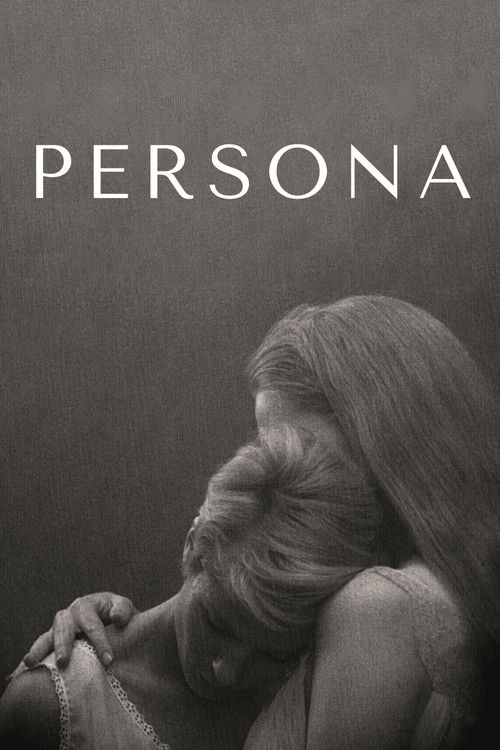
Persona
1966 · Ingmar Bergman
For when you want a film to chew on for days — a challenge, not a comfort, best watched alone and undistracted when you're up for cinema at its most intense and mysterious.
What it's about
A celebrated stage actress stops speaking mid-performance and won't start again, though doctors can find nothing wrong. She's sent to recover at a remote seaside cottage in the care of a young nurse, Alma, who fills the silence with talk — small talk, then secrets, then confessions she's never made to anyone — until the line between the two women starts to blur.
The experience
Hypnotic and unnerving — intimate as a whispered confession one minute, formally jolting the next, with images that seem to reach out of the screen at you. It's short, but it gets under your skin and stays there; you'll want to talk about it immediately.
Performances
Bibi Andersson does nearly all the talking and makes a monologue-heavy role feel dangerously alive, including one confession scene that's justly famous; Liv Ullmann, almost entirely silent, gives a face-only performance so expressive it launched her career.
The craft
Sven Nykvist's black-and-white photography is some of the most striking ever shot — faces held in enormous close-up, split and overlapped until you can't tell whose is whose, all in stark island light. Bergman frames the story with startling experimental passages that remind you you're watching a film, and the sound design does as much unsettling work as the images.
Why it matters
It became one of the most analyzed films ever made and a fixed point of world art cinema — the reference for any film about identity dissolving between two people, and the peak of Bergman's influence.
Snapshot
Persona is a two-hander in which a stage actress, Elisabeth Vogler, chooses silence as a form of self-protection—or self-erasure—and the young nurse assigned to her care, Alma, fills that silence so completely that the boundary between the two women dissolves. The film is simultaneously a psychological study, a theoretical essay on cinema, and a destabilizing formal experiment. Shot in black and white on Sweden's island of Fårö by cinematographer Sven Nykvist, it runs approximately eighty-three minutes and contains almost no plot in any conventional sense. It is among the most analyzed films in the medium's history and a fixed point in the canon of world art cinema.
Industry & production
By 1966 Ingmar Bergman was the dominant figure at Svensk Filmindustri (SF), the Stockholm-based studio that had backed his work since the late 1940s. He enjoyed unusual autonomy: final cut, control over casting, and minimal interference from producers. This latitude was not unconditional goodwill—The Silence (1963) had been an international sensation and a domestic scandal, its commercial performance giving Bergman cover for continued risk-taking.
The immediate conditions of Persona's creation were shaped by illness. Late in 1965 Bergman was hospitalized, variously reported as an inner-ear infection and severe pneumonia compounded by vertigo. Confined to bed, he began writing what became the film's script—initially described in interviews as fragmentary, more a series of images and questions than a conventional screenplay. He later called the working notes that became Persona an act of convalescing, something written without the usual pressure of a clear narrative destination. The film went into production in spring 1966, shooting primarily at SF's Filmstaden studios in Råsunda and on Fårö, the spare Baltic island that Bergman had begun using as a second home and that appears here for the first of many times in his work.
The cast was small and deliberately asymmetrical. Bibi Andersson, a veteran of several Bergman films, took the role of Alma. Liv Ullmann, a Norwegian actress who had not previously worked with Bergman, was cast as Elisabeth Vogler—a role requiring enormous physical and psychological presence while speaking almost no dialogue. The collaboration between Bergman and Ullmann that began here would extend across twelve films and become one of the defining creative partnerships in cinema history.
Technology
Persona was shot on 35mm black-and-white stock, in the Academy ratio. Nykvist, who had refined his collaboration with Bergman through Winter Light (1963) and The Silence, pursued extreme reductions in artificial light on this production, pushing the camera close to faces and working with available or near-available light sources. The technical results—dense blacks, luminous faces emerging from shadow, the textures of skin rendered with documentary directness—were not incidental to meaning. Bergman and Nykvist treated the close-up of the human face as a philosophical object, not merely a dramatic device.
The film's opening sequence exploits the material apparatus of cinema deliberately: a projector warming up, a fragment of silent-era animation, the image of a film burning in the gate. These images are not found footage in any archival sense; they were composed and photographed for the film. The self-referential use of celluloid's physical substrate—treating a frame as an object that can burn—was technically straightforward but conceptually radical, foregrounding the medium at a moment when mainstream cinema was only beginning to assimilate such gestures from the European avant-garde.
Technique
Cinematography
Nykvist's approach in Persona marks a decisive turn in his aesthetic. Where earlier films in the Bergman–Nykvist collaboration still employed more conventionally expressionist lighting schemes, Persona moves toward a severe naturalism of luminance. Extreme close-ups of Andersson's and Ullmann's faces—sometimes filling the entire frame—became the film's characteristic register. The most discussed image is a composite shot in which the two faces are optically merged into one, the left hemisphere of Alma's face joined to the right hemisphere of Elisabeth's; the resulting figure is disturbing, neither woman and both, a visual argument about identity fusion that the film's narrative has been building toward without stating.
Depth is frequently suppressed. The film often refuses the conventional grammar of shot/reverse-shot dialogue exchange, instead placing both women in the same frame in ways that force the viewer to read their spatial relationship as psychological. The beach and rocky coastline of Fårö provide an austere exterior that extends the interior's emotional climate rather than offering relief from it.
Editing
Ulla Ryghe edited the film in close collaboration with Bergman. The editing is in certain respects the film's most theoretically charged element. The opening prologue is structured as a kind of countdown—fragmentary images accumulating without diegetic logic—and the film's close returns to some of these materials, framing the central narrative as something projected, recalled, or constructed rather than straightforwardly witnessed. Within the main story, cuts are sometimes withheld (long takes, extended silences) and sometimes jarring—most famously when the film appears to break, the frame burning and the image dissolving, an interruption that occurs at a moment of emotional crisis.
A key scene—Alma's confessional monologue describing a sexual encounter on a beach—is presented in an unusual way that some critics describe as doubled, the camera holding on Ullmann's listening face in a manner that draws attention to time passing, to the act of attending. The precise formal structure of this sequence has been a subject of scholarly debate.
Mise-en-scène / staging
The spatial logic of Persona is resolutely confined: a hospital ward, a coastal cottage, the beach. Bergman strips the environment of decoration and incident, directing attention unrelentingly to the bodies and faces of his two actors. The staging frequently places Andersson in motion—talking, moving through the cottage, preparing food—while Ullmann's Elisabeth is still, watchful, and positioned like a mirror. The physical asymmetry (one who speaks, one who watches) is also a power asymmetry that the film slowly inverts.
The framing of faces against light sources—windows, open sky, blank walls—gives many compositions an almost icon-like flatness, faces presented as objects of contemplation rather than subjects in action.
Sound
Persona makes deliberate, aggressive use of silence. Elisabeth's refusal to speak is not the film's only sonic gesture; the cottage scenes are often stripped of ambient sound in ways that would feel artificial in a naturalistic register but here signal interior states. Music appears sparingly. Lars Johan Werle, who provided original music for several Bergman films of the period, contributed to the score, though Persona is not a heavily scored film—sound design and the texture of silence carry at least as much weight as any melodic material.
The monologues Bergman gives Andersson—dense, intimate, often delivered directly or semi-directly at the camera—are given full sonic presence, the voice close-miked, nothing ambient to soften or contextualize. The voice itself becomes the primary object of attention.
Performance
Bibi Andersson's performance in Persona is built almost entirely from language and its modulation: the speed of speech, the breaking of the voice, the moments of sudden quiet. Alma talks to fill a void, and Andersson traces the stages of that filling—from professional cheerfulness to confession to something approaching hysteria—with remarkable internal clarity. Her famous beach monologue, a lengthy and sexually explicit account delivered with almost documentary plainness, is one of the most demanding sustained performances in Bergman's body of work.
Ullmann's Elisabeth is defined by negation. The performance consists of listening, watching, small bodily responses—a half-smile, a hand placed on a shoulder—and it is extraordinarily controlled. Ullmann has said in interviews that Bergman gave her almost no traditional direction for the role, instead describing images and states; the performance she delivers communicates volumes through restraint. That this was her first collaboration with Bergman makes its accomplishment the more remarkable.
Narrative & dramatic mode
Persona belongs to the tradition of the two-person chamber drama, a form with deep roots in Swedish theatrical culture, particularly in Strindberg. The structure is that of a relationship that undoes itself through proximity: the more Alma gives Elisabeth, the more destabilized her own sense of self becomes. What begins as a clinical pastoral—nurse caring for mute patient—gradually loses its asymmetry until neither woman is clearly who she was.
The film is not a psychological thriller in any genre sense; it withholds the comforts of explanation. The causes of Elisabeth's silence, the precise nature of the identity transfer, whether events toward the film's end occur in reality or imagination—none of these are resolved. Bergman is working in a mode that might be called phenomenological: the film conveys what it is like to be inside a dissolution rather than observing one from outside.
Genre & cycle
Persona fits no genre cleanly. It participates in the international art film as a market and critical category—a category crystallizing in the 1960s through the global circulation of films by Antonioni, Godard, Resnais, and Bergman himself—while also drawing on the psychological horror of the doppelgänger tradition and the intimate realism of the chamber play. Its closest Swedish relative is Strindberg's The Stronger (1889), a one-act in which one woman speaks and another does not; the power question Strindberg raises—who, in the end, is stronger—Bergman reopens without answering.
Authorship & method
Bergman's method in the mid-1960s was intensely collaborative within a hierarchically organized creative unit. Sven Nykvist's contribution to Persona is inseparable from the film's meaning: the visual philosophy of the extreme close-up, of light stripped to essentials, belongs to both men. Nykvist has described their working process during this period as one in which lighting decisions were made together on set, sometimes departing from any prior plan in response to what a face was doing on a given day. The result is a cinematography that feels responsive rather than composed—intimate in the sense of being genuinely close to its subjects.
Bergman wrote his own scripts throughout his career and regarded the screenplay as the first stage of a process rather than a blueprint. The script for Persona is notoriously sparse on psychological explanation, more a structure of provocations than a causal chain. The editing relationship with Ulla Ryghe extended across several films; her contribution to the film's fragmentary structure and its deployment of the apparatus-revealing prologue and epilogue is significant.
Movement / national cinema
Persona emerges from Swedish cinema's long engagement with theatrical interiority—the influence of the stage on Swedish film runs from Victor Sjöström through Bergman—but by 1966 it also belongs to a transnational moment. European art cinema of the early 1960s had made formal experimentation and the foregrounding of medium-specificity internationally legible as prestige gestures. Bergman was, alongside Fellini and Antonioni, one of the figures through whom this mode was defined for international audiences. Persona is simultaneously deeply rooted in Swedish cultural preoccupations (the body under examination, the ethics of speech and silence, the Strindbergian couple-as-battleground) and a document of a pan-European modernist cinema at its most adventurous.
Era / period
The mid-1960s saw cinema in a state of expansive formal self-questioning. The French New Wave had spent five years dismantling classical continuity editing; Italian neorealism's legacy was being absorbed and transformed; underground cinema in the United States was exploring duration, real time, and the body. Persona does not belong to any of these movements directly, but it participates in the same cultural atmosphere—the assumption that what cinema could do formally was still an open question, that the medium's conventions were available for disassembly.
Bergman's own position in this moment was singular: internationally canonical before the New Wave directors had solidified their reputations, yet himself radicalized by the new climate into a formal experimentation that his earlier work, however strong, had not attempted.
Themes
Persona's thematic obsessions are primarily: the instability of personal identity and whether a coherent self can survive sustained intimacy; the ethics and violence of speech, particularly speech directed at someone who cannot or will not reply; the relationship between theatrical performance and authentic selfhood; the ambiguity of care—whether nursing, parenting, or artistic attention is ultimately an act of power; and motherhood as a site of guilt and denial (Elisabeth's abandonment of her son is treated as foundational to her breakdown, though the film resists moralizing about it).
Psychoanalytic readings—the film was produced in a cultural moment of high Freudian and Lacanian influence—have dominated its critical reception, treating the merging of the two women as a dramatization of ego dissolution or the breakdown of the mirror stage. These readings are supported by the film's imagery but not exhausted by it; the film also sustains readings focused on gender and power, on the ethics of representation, and on cinema itself as a machine for projection and identification.
Reception, canon & influence
Persona received serious critical attention on its initial release in Sweden in 1966 and internationally through 1967, though reactions were not uniformly laudatory; the film's deliberate difficulty divided critics accustomed to Bergman's more conventionally narrative features. Susan Sontag, in a substantial 1967 essay, offered one of the first extended theoretical accounts of the film and remains a touchstone for Persona scholarship. Over the following decades the film rose steadily in critical estimation until it became one of a small number of works considered definitionally canonical in world cinema; it appears consistently in major critics' polls and on university syllabuses in film studies programs globally.
Working backward through influence: Bergman acknowledged Strindberg's chamber dramas as foundational; the doppelgänger literature of Poe, Hoffmann, and Dostoevsky is relevant background. Carl Theodor Dreyer's cinema—particularly the extreme close-up portraiture of The Passion of Joan of Arc (1928) and the uncanny doubling of Vampyr (1932)—is a significant formal antecedent. Robert Bresson's refinement of performance to essential gesture informs the film's use of Ullmann. Bergman was also a serious reader of theater; his engagement with the existentialist drama of Strindberg and (by this period) Beckett is visible in Persona's stripped structure and its preoccupation with speech as inadequacy.
Looking forward: Persona's influence is pervasive enough to constitute a genealogy of its own. Robert Altman identified it as a direct precursor to 3 Women (1977), his most Bergmanesque film. David Lynch's Mulholland Drive (2001) reworks the identity-merging structure with Hollywood mythology as its field of dissolution. The film is visible in the psychological and body horror strands of 1970s European cinema and in the slow cinema movement of the 1990s and 2000s—Béla Tarr, Michael Haneke, and others whose cinema insists on duration, the face, and the refusal of reassuring narrative closure. At the level of acting pedagogy, the film's exploration of what an actor can do without language has made it a text in conservatory training. The composite face shot has been reproduced, cited, and parodied often enough to constitute an iconographic signature—one of the handful of images that stands for the idea of cinema as philosophical art rather than story delivery system.
A Deleuzian reading
Start with the face.
The full Deleuzian reading of Persona →
Reception
It baffled plenty of first-run critics in 1966 — even admirers admitted they weren't sure what they'd watched — but it climbed steadily into the pantheon and now sits comfortably in Sight & Sound's all-time upper ranks as Bergman's most acclaimed film.
How Persona was received, from release to now →
Influences: the films it descends from and the films it influenced
- The Passion of Joan of Arc (1928) — Dreyer's systematic construction of Falconetti's face as the film's sole landscape — extreme close-ups held past expression into raw physiognomy — establishes the close-up as a philosophical rather than dramatic device, the direct formal model Bergman and Nykvist develop into Persona's face-as-cinema-object approach.
- Man with a Movie Camera (1929) — Vertov's opening sequence showing the projectionist, the empty theater, and the cameraman loading his equipment establishes the apparatus-revealing prologue as a formal possibility that Persona's opening sequence of sprocket holes, silent-era animation fragments, and burning celluloid directly quotes and extends.
- Hiroshima mon amour (1959) — Resnais holds the camera on Riva's face during Okada's near-silent presence for extended durations while she delivers an interior monologue at close range — establishing the close-miked confession delivered to a half-present listener as a formal unit that Bergman adopts precisely for Alma's beach-orgy monologue to the silent Elisabeth.
- Pickpocket (1959) — Bresson's method of directing through subtraction — models forbidden from psychological signaling, reduced to flat vocal delivery and isolated gesture — establishes negation-based acting as a viable cinematic mode that Bergman adapts for Ullmann's sustained presence-through-silence, making performed absence the film's central dramatic instrument.
- L'Avventura (1960) — Antonioni trains the viewer to read behavioral non-response — a character's failure to react conventionally, an interlocutor staring past the person addressing them — as the film's primary dramatic event rather than its absence; Persona inherits this perceptual contract entirely, making Elisabeth's refusal-to-speak the active force in the narrative.
- The Silence (1963) — In Bergman and Nykvist's first systematic deployment of near-available-light close-ups within a two-woman chamber structure — two sisters in mutual silence — the visual and sonic grammar of Persona is substantially assembled three years before the fact; the Fårö-island spatial austerity and suppression of fill light are tested here.
- Gertrud (1964) — Dreyer's final film deploys extended spatially static monologues in which a character speaks at length to a partially unresponsive interlocutor, rejecting conventional cross-cutting to treat the act of sustained speech as a phenomenological event — the direct model for how Bergman stages Alma's confessional sequences.
- 8½ (1963) — Bergman pushed 8½'s metafilmic self-reflexivity to rupture: the mid-film frame-melt, the projected grain, the splice — Bergman extends Fellini's gesture of a film examining its own conditions of existence into outright formal violence on the filmstrip itself, making the apparatus visible as 8½ had made the director visible.
- Wild Strawberries (1957) — Bergman extended Wild Strawberries' confinement-as-crucible staging — two figures in a bounded space forcing mutual psychological exposure — and the observer-ghost structure, while destabilizing the film's own material substrate in ways Wild Strawberries' naturalistic surface held in reserve.
- Through a Glass Darkly (1961) — Nykvist pushes the extreme close-up of Through a Glass Darkly to its formal limit, shooting two faces in superimposition as identities dissolve—the shallow DoF that isolated Karin's features now becomes a device for identity erasure, extending the psychological-dissolution grammar into outright rupture of the film's own surface.
- Winter Light (1963) — Extends Winter Light's shallow-space confrontational two-shot staging into compositions where the gap between two faces becomes the primary dramatic arena; Ulla Ryghe's editing rhythm — the cut timed to thought rather than action — carries directly over from her work on Winter Light.
- The Magician (1958) — The logical culmination of The Magician's disguise-within-disguise and enforced silence: Elisabet's vow of silence and the subsequent identity dissolution between two women extend Aman/Grima's gender masquerade to its limit, while the film-apparatus self-consciousness — the reel burning, the splice — makes explicit what The Magician's magician-as-filmmaker allegory had left as subtext.
- The Hour of the Wolf (1968) — Shot by Nykvist the following year, with Ullmann's performance of psychological dissolution continuing Persona's negation-based acting vocabulary, the film deploys the same extreme close-up architecture while inverting the dynamic — a woman watching a man fragment — extending Persona's formal apparatus into explicit horror register.
- Cries and Whispers (1972) — Nykvist's most extreme deployment of the face-filling close-up — faces shot at distances that render skin as landscape — extends the formal logic of Persona's composite-face sequence into color cinematography, while the four-woman chamber structure amplifies the identity-fusion concern of the earlier film across a larger ensemble.
- Scenes from a Marriage (1973) — Bergman and Nykvist transpose Persona's close-miked two-person monologue architecture into extended TV-film grammar — two faces in available-light domestic interiors, sustained speeches to a partially unresponsive listener — distilling the chamber drama's formal logic into its purest sustained expression across six episodes.
- The Double Life of Véronique (1991) — Kieślowski translates Persona's optical composite-face shot — two women sharing a single identity merged into one image — into narrative architecture: where Bergman performs the merger in a single frame, Kieślowski separates the two women across geography and lets the editing system enact the fusion.
- Mulholland Drive (2001) — Lynch constructs the progressive identity fusion of two women — Watts and Harring collapsing into one another through recasting and narrative inversion — as a genre exercise extending Persona's identity-merger thesis; the Club Silencio apparatus-revealing set-piece, where the live performance is revealed as pre-recorded, restates Persona's prologue argument that cinema is a medium of absence performing presence.
- The Ice Tower (2025) — The cinema of two women merging: reflective doubling, superimposed faces, and a performer's opacity that refuses psychological explanation.
- Twinless (2025) — Originates the long take held on faces until two identities visibly bleed into one another, the formal device Sweeney and DP Greg Cotten use to stage merging selves.
- The Currents (2025) — Builds reflective doubling and withheld speech — a cinema of the unsaid — in a seaside/water setting that renders psychic dissolution formally rather than verbally.
- Die My Love (2025) — The foundational use of facial close-up and elliptical, rupturing montage to dramatize the fragmentation and merging of a woman's identity.
- Sentimental Value (2025) — The reflexive interrogation of the actress's craft and the instability of performed identity, foregrounding film's own apparatus — ancestor to the film-within-a-film's questioning of who is performing whom.
- Miroirs No. 3 (2025) — The foundational two-women chamber piece in which identities mirror, bleed, and exchange in near-isolation — the formal kernel of substitution-as-staging.
- Three Colors: Red (1994) — Sven Nykvist's use of reflective glass surfaces and extreme close-up to explore identity merger between two people whose lives double each other directly informs Sobociński's layered-window compositions as a visual correlative for mediated selfhood.
- Au hasard Balthazar (1966) — In the same year, Bresson's most complete realization of negation-based performance — Wiazemsky and the donkey both enacting presence through withholding — establishes with Persona the twin poles of European art cinema's formal repertoire of performed absence, the two films together defining what non-expressive screen acting can accomplish.
- Blow-Up (1966) — Carlo di Palma's available-light location cinematography and Antonioni's phenomenological structure — a photographer who cannot stabilize reality through looking — runs parallel to Persona's own epistemological mode; both films in 1966 push European modernist close-up practice toward a formal argument that the camera cannot finally know its subject.
- 2 ou 3 choses que je sais d'elle (1967) — Godard extends the apparatus-revealing address that Persona's prologue initiates by sustaining it as a narrative strategy: Raoul Coutard's extreme close-ups on faces and objects, with Godard's whispered voiceover monologue delivered at close-mike directly to the viewer, running Persona's self-referential formal logic through an entire feature.
- Vertigo (1958) — Bergman shares Vertigo's formal project of staging identity-dissolution between a dominant figure and a woman-as-constructed-image: Nykvist's extreme close-up grammar of face-to-face selfhood-unraveling, and the narrative of one self absorbed into another's projection, are cognate with Scottie's reconstruction of Judy as Madeleine.
- Solaris (1972) — Bergman's use of the extreme close-up face as the film's primary dramatic surface — where psychological doubling is read entirely through registered light on skin and micro-expressional suppression — is the performance-mode sibling to Tarkovsky's approach with Bondarchuk, whose internalized affect converts the face into the film's sole emotional screen.
- Belle de Jour (1967) — Bergman independently arrives at the same anti-psychologizing performance direction — actors performing psychological states through controlled surface behavior without legible emotional expression — that Buñuel deploys with Deneuve, producing in Ullmann and Andersson an equivalent managed opacity.
- Andrei Rublev (1966) — Also 1966, Bergman makes a character's refusal to speak the structural and narrative center of the film — silence generating meaning through surrounding pressure to fill it — which is precisely the formal move Tarkovsky makes with Rublev's years-long vow: withholding speech as the more powerful artistic act than explaining it.
- Last Year at Marienbad (1961) — Bergman and Sven Nykvist adopt anti-naturalist performance registers — one character almost entirely silent, the other speaking into a void — to stage an identity-dissolution whose governing event remains structurally undecidable; the rupture of the film's material surface mid-reel literalizes the same crisis of cinematic reality-claim that Marienbad performs through its shadow discontinuities.
- Repulsion (1965) — Bergman's near-simultaneous deployment of extreme close-up on the female face as the primary unit of psychological investigation—in black-and-white, in confined space—runs as a parallel formal project to Repulsion's epidermally intimate visual grammar.
- Woman in the Dunes (1964) — Bergman's minimalist two-hander in which two women's identities progressively merge — staged in stripped settings, shot in high-contrast chiaroscuro by Nykvist, scored in near-silence — is the contemporaneous European parallel to Teshigahara's two-hander structure of identity erosion through enforced proximity.
- Juliet of the Spirits (1965) — Sven Nykvist's diffused soft-focus portraiture and the treatment of female psychological dissolution through total mise-en-scène integration — décor, costume, and staging carrying psychological meaning without exposition — runs parallel to Juliet's visual method.
- L'Eclisse (1962) — Bergman's parallel European modernist invention: two women failing to fully inhabit the same psychological space, staged through object-attention and physical proximity that substitutes for intimacy, with elliptical dialogue and radically de-dramatized narrative that mirrors L'Eclisse's anti-romantic choreography — both films end by dissolving the distinction between character and vacancy.
Similar films
- The Silence (1963) — influence & lineage · same viewing thread
- Cries and Whispers (1972) — influence & lineage · same viewing thread
- Mulholland Drive (2001) — influence & lineage · often watched together
- L'Avventura (1960) — influence & lineage · often watched together
- The Double Life of Véronique (1991) — influence & lineage
- Last Year at Marienbad (1961) — same viewing thread · often watched together
- Face to Face (1976) — same viewing thread
- Blow-Up (1966) — influence & lineage · same viewing thread
All the films related to Persona →
Watch it with: curated runs of related films
- The Fractured Self — A run of art films where identity, memory, and sanity refuse to stay solid — watch them near each other and the faces, silences, and doublings start to rhyme.
Film essays and courses that include it
- The Constructed Self: A Century of Gender and Identity on Screen
- Duration and Doubt: The Art Film from Dreyer to Kiarostami
- Ingmar Bergman
- Radical Attention: A Century of Art Cinema
- The Grammar of Shadow: Black & White Cinema from Caligari to Raging Bull
- The Grammar of Dreams: Cinema's Surreal Century
- The Disappearing Self: A Cinema of Estrangement
- The Other Self: A Century of Doubling
- The Interior Eye: Cinema's Search for Lives Felt From Within
- The Face That Cannot Act
- The Face on Trial
- The Self That Splits in Two
- The Self That Will Not Hold
- The Pursuit of the True Light
- Consumed by the Image
- The Horror of the Family