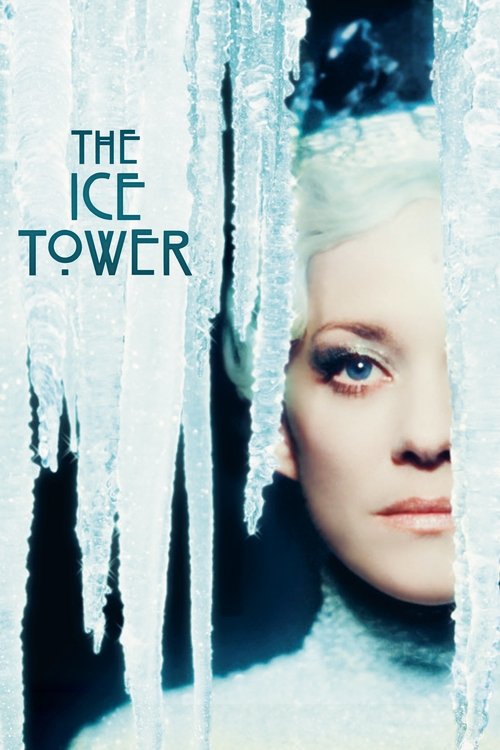
The Ice Tower
2025 · Lucile Hadžihalilović
For when you want something genuinely strange and beautiful — a film that unsettles as much as it enchants. Best reached when you're willing to surrender to a mood rather than follow a story.
What it's about
Jeanne, a fifteen-year-old runaway orphan in the 1970s, drifts onto the soundstage where an adaptation of Hans Christian Andersen's The Snow Queen is being filmed. She becomes transfixed by Cristina, the production's glacial, magnetic star — an actress whose offscreen presence seems as mysterious and untouchable as the queen she plays. Hadžihalilović uses this fascination to build a sensuous fable in which the boundary between the fairy tale being filmed and the world outside it quietly dissolves.
The experience
Slow, hypnotic, and delicately strange — a film that works through sensation and atmosphere rather than plot, accumulating quiet dread alongside its beauty. It has the texture of a dream that stays with you without quite explaining itself.
Performances
Marion Cotillard as Cristina is a presence more than a character — remote, luminous, calibrated to a film that treats her as living myth. Clara Pacini carries the film as Jeanne with wide-eyed, contained intensity.
The craft
Hadžihalilović renders the 1970s film set as a world unto itself — soft light, period textures, an air of staged unreality held in gorgeous stasis. The film-within-a-film conceit is handled with formal rigor that keeps the viewer subtly off-balance about which layer of reality they're occupying. It won the Silver Bear for Outstanding Artistic Contribution at the 75th Berlin Film Festival — effectively a citation for its visual and aural design.
Why it matters
Confirms Hadžihalilović as one of contemporary cinema's most singular voices, and stands among the strongest entries in a lineage of dreamlike, female-centered European art cinema that has no close equivalent.
Snapshot
The Ice Tower (French: La Tour de glace) is the fourth feature by Lucile Hadžihalilović, a French-German-Italian co-production that premiered in competition at the 75th Berlin International Film Festival on 16 February 2025 and won the Silver Bear for Outstanding Artistic Contribution. Running 118 minutes and set in the 1970s, it follows Jeanne (Clara Pacini), a fifteen-year-old runaway orphan who drifts onto the soundstage where a film of Hans Christian Andersen's The Snow Queen is being shot, and becomes transfixed by its star, Cristina (Marion Cotillard), the glamorous, glacial actress incarnating the Queen. Around that mutual fascination Hadžihalilović builds a characteristically oblique, sensuous fable in which the boundary between the film-within-the-film and the world outside it slowly dissolves. It is the director's first feature to center a star of Cotillard's stature, and her most explicit meditation on cinema itself — on the cold magnetism of the screen image and the danger of being captured by it. The film extends rather than departs from the body of work that made Hadžihalilović a cult figure: Innocence (2004), Evolution (2015), and Earwig (2021). Critical reception was strong (roughly 79/100 on Metacritic, an 81% Rotten Tomatoes rating) and Sight and Sound placed it at No. 18 on its list of the fifty best films of 2025.
Industry & production
The Ice Tower is a classic instance of the contemporary European art-house co-production model, assembled across three national funding systems to finance a director whose work is prestigious but commercially niche. The reported budget was roughly €4.9 million. Lead production came from the French company 3B Productions, with the producers credited as Muriel Merlin and Ingmar Trost; the financing partners included Arte France Cinéma — the cinema arm of the Franco-German public broadcaster that has long underwritten auteur cinema — alongside the German house Sutor Kolonko, the Italian company Albolina Film, and Davis Films. The tri-national structure (France, Germany, Italy) is reflected in the casting of the German actor August Diehl in a key supporting role. Distribution was spread across territories: Metropolitan Filmexport in France, Grandfilm in Germany, BFI Distribution in the United Kingdom, and Yellow Veil Pictures in North America, with Goodfellas handling international sales. The presence of Gaspar Noé — Hadžihalilović's longtime partner and collaborator — in a supporting acting role (as "Dino") reflects the close-knit production milieu around the couple's joint company history. After Berlin, the film traveled the festival circuit through 2025, including San Sebastián (where it took the Zabaltegi-Tabakalera award) and Neuchâtel, before staged theatrical releases — a rollout typical for slow, atmosphere-driven arthouse rather than wide commercial play.
Technology
The film was shot digitally by Jonathan Ricquebourg but conceived to evoke the textures of analog cinema, in keeping with its 1970s setting and its subject — the making of an old-fashioned, hand-built fairy-tale movie. Rather than chasing photographic transparency, the production foregrounds the artisanal apparatus of pre-digital filmmaking: painted backdrops, in-camera atmospheric effects, smoke, mirrors, and the glass-and-light trickery by which classical cinema manufactured the marvelous. The "ice tower" and Snow Queen sets belong to a studio world of constructed illusion, and the technology of the film is in large part a loving reconstruction of older technologies of enchantment. The precise capture format is not exhaustively documented in available sources, but the controlled, painterly image — deep shadow, selective pools of light, a restrained palette tilting toward blues, whites, and amber — points to a digital workflow heavily shaped in the grade to imitate film-era density. This is consistent with Hadžihalilović's method across her career: she treats the camera less as a recording instrument than as a means of producing a hypnotic, slightly unreal surface.
Technique
Cinematography
The cinematography by Jonathan Ricquebourg is the film's most celebrated element and the likely basis of its Silver Bear for Outstanding Artistic Contribution. Ricquebourg — whose credits include Albert Serra's The Death of Louis XIV, Tran Anh Hung's The Pot-au-Feu / The Taste of Things, and Hadžihalilović's own Earwig — works here in a register of chiaroscuro and cold luminosity. He favours measured, often static or slowly gliding framings, faces emerging from darkness, and a careful orchestration of artificial light sources that make the studio world glow like a snow-globe. The image continually rhymes the warm, grimy "real" spaces Jeanne inhabits against the blue-white sterility of the Snow Queen set, so that the visual scheme itself dramatizes the pull between life and the frozen perfection of the screen.
Editing
Edited by Nassim Gordji Tehrani, the film proceeds at the deliberate, dilated pace that defines Hadžihalilović's cinema. Cuts are withheld; shots are allowed to breathe past the point of conventional narrative economy, producing a trance-like temporality in which the viewer, like Jeanne, becomes absorbed. The editing strategically confuses diegetic levels — footage from the film-within-the-film, rehearsals, and Jeanne's own perceptions are intercut so that the spectator cannot always be sure which order of reality is on screen. This montage of ambiguity is the principal engine of the film's uncanny effect.
Mise-en-scène / staging
Staging is where Hadžihalilović's authorship is most legible. The production design by Julia Irribarria and costumes by Laurence Benoit build two contrasting worlds: the worn, brownish textures of 1970s working life and the crystalline artifice of the Snow Queen production. Hadžihalilović composes in symmetrical, frieze-like arrangements, placing the small figure of Jeanne against vast sets, mirrors, and the eponymous tower so that scale itself communicates her vulnerability and entrancement. Reflective surfaces — glass, ice, screens, the actress's own face — recur as motifs of doubling. The mise-en-scène consistently subordinates psychological realism to a dream-logic of thresholds, corridors, and enclosures.
Sound
Sound is fundamental to Hadžihalilović's immersive method, and The Ice Tower leans heavily on a designed soundscape — ambient hum, breath, the mechanical noise of the studio, wind and cold — rather than on conventional underscoring. The available record on a credited composer is thin; reviewers noted that the film largely eschews a traditional dramatic score, using music sparingly and pointedly. This restraint is consistent with the director's practice of building emotion through texture and silence rather than melodic cueing, leaving the viewer suspended in an atmosphere that feels more felt than narrated.
Performance
The performances are pitched, deliberately, between the naturalistic and the somnambulant. Marion Cotillard plays Cristina with a controlled, masklike glamour — an actress playing an actress playing the Snow Queen, three layers of artifice she modulates through stillness, voice, and the management of her own iconic image. Clara Pacini, in a breakthrough leading role, carries the film as Jeanne: watchful, mostly silent, her fascination registered through gaze and posture rather than dialogue. August Diehl and Gaspar Noé fill out the studio world. Hadžihalilović characteristically directs her performers toward opacity, withholding the interior cues that would let us "read" them, which keeps Jeanne and Cristina mysterious to us as they are to each other.
Narrative & dramatic mode
The dramatic mode is elliptical and associative rather than causal. Hadžihalilović offers the skeleton of a recognizable story — orphan flees, finds refuge in a film studio, fixates on a star, is drawn into the production — but declines to fill it with the psychological exposition and plot mechanics of conventional drama. Information is rationed; motivations are left implicit; the film advances by mood, repetition, and accreting image. The central device is the porous membrane between the Snow Queen fiction and the frame story, so that the fairy tale's logic (a child lured by an icy, beautiful Queen) begins to govern the "real" events. This is fable structure rather than three-act drama: the narrative works by enchantment and dread, and resolution comes as transformation and threshold-crossing rather than as clarifying revelation.
Genre & cycle
The film sits within the contemporary European art-house fantastique — atmospheric, slow, "elevated" genre cinema that uses the apparatus of horror and fairy tale for poetic and psychological ends rather than for shocks. It is at once a fairy-tale adaptation (Andersen's The Snow Queen), a film-about-filmmaking, and a coming-of-age story refracted through the uncanny. Its closest generic cousins are mood-driven works of doubling and obsession rather than plot-driven fantasy. Within Hadžihalilović's own cycle it belongs with Innocence, Evolution, and Earwig as another study of a young person at a threshold, enclosed within a controlling, dreamlike institution — here, the film studio standing in for the boarding school and laboratory of the earlier works.
Authorship & method
Lucile Hadžihalilović (b. 1961), French and of partly Bosnian descent, trained at the French national film school (IDHEC, now La Fémis) and emerged through a long creative partnership with Gaspar Noé, with whom she has shared writing, editing, and producing duties across decades. Her authorship is unusually consistent: a cinema of childhood and adolescence on the cusp of bodily and sexual transformation; closed institutional worlds; water, cold, and metamorphosis; sensory immersion over narrative explanation; and a refusal of the explicatory. After the shorts that established her (notably La Bouche de Jean-Pierre, 1996), her features — Innocence (2004, after Frank Wedekind), Evolution (2015), and Earwig (2021, after Brian Catling) — form a tightly unified body of work, each arriving at a deliberate distance from the last.
Her key collaborators on The Ice Tower extend that continuity. She co-wrote the screenplay with Geoff Cox, her writing partner on Evolution and Earwig. Cinematographer Jonathan Ricquebourg, returning from Earwig, supplies the film's painterly light. The film was cut by editor Nassim Gordji Tehrani, with production design by Julia Irribarria and costumes by Laurence Benoit. The producers were Muriel Merlin and Ingmar Trost. The most conspicuous new element in the method is the collaboration with a major international star: directing Marion Cotillard required Hadžihalilović to work with, and around, a pre-existing screen icon — a fact the film thematizes by casting Cotillard as an icon who bewitches.
Movement / national cinema
The Ice Tower belongs to French cinema's enduring tradition of the poetic fantastique — the lineage of Jean Cocteau's enchanted fables and Georges Franju's lyrical horror — more than to any contemporary commercial trend. Hadžihalilović is frequently bracketed, via her association with Noé, alongside the directors of the so-called New French Extremity, but she is that movement's cooler, more restrained counter-voice: where its cinema is visceral and transgressive, hers is hushed, formalist, and oneiric. The film's financing also marks it as a product of the pan-European auteur ecosystem — an Arte-backed, multi-country co-production of the kind that sustains directors working outside mainstream economics.
Era / period
The film is doubly located in time. As an object, it is a work of mid-2020s European arthouse, made within the post-pandemic co-production economy in which public broadcasters and cross-border partners pool resources to fund singular auteurs. As a fiction, it is set in the 1970s, and its period evocation is not incidental: by placing its film-within-the-film in the analog, hand-crafted studio era, it stages nostalgia for an older mode of cinematic illusion, one of painted skies and practical effects, now itself as remote and enchanting as a fairy tale. The 1970s setting lets Hadžihalilović reflect on cinema's lost artisanal magic from the vantage of the digital present.
Themes
The governing theme is fascination — the dangerous magnetism of the image and the figure who embodies it. Cristina/the Snow Queen is desire and death at once: maternal surrogate for an orphan, erotic object, and a cold, devouring force that threatens to freeze the living girl into an image. Around this cluster the film arranges its recurrent Hadžihalilović preoccupations: adolescence as a perilous threshold; orphanhood and the search for a mother; transformation and capture; illusion versus reality. The film-within-a-film conceit makes cinema itself the central subject — the medium as an apparatus of enchantment that can nourish or consume the spectator. Mirrors, ice, screens, and glass run throughout as figures of doubling and of the seductive, lifeless perfection that the screen offers in place of warmth. The Andersen source supplies the underlying moral architecture: a child lured by an icy queen, and the question of whether she can be thawed back into life.
Reception, canon & influence
The film was warmly received. Its Berlinale premiere yielded the Silver Bear for Outstanding Artistic Contribution, with Ricquebourg's cinematography singled out across reviews; it went on to win at the Neuchâtel Fantastic Film Festival and to take the Zabaltegi-Tabakalera award at San Sebastián. Aggregate critical scores were strong (roughly 81% on Rotten Tomatoes, 79/100 on Metacritic), and Sight and Sound ranked it No. 18 among the best films of 2025 — a significant marker of critical canonization for a director long admired but rarely placed so prominently. Coverage consistently framed it as a confirmation and refinement of Hadžihalilović's singular voice rather than a reinvention, with some critics finding its restraint hypnotic and others finding it remote.
The influences flowing into the film are legible and largely acknowledged by its own form. The literary source is Andersen's The Snow Queen. Cinematically, it draws on the French poetic-fantastique tradition of Cocteau and Franju; its premise of a young woman absorbed by, and merging with, a glamorous performer recalls the great cinema of doubling and feminine identity — most obviously the Bergman of Persona and, in its meditation on a performer consumed by her role, the Powell–Pressburger of The Red Shoes. It also draws, self-referentially, on the history of studio illusionism it depicts. Most of all it grows out of Hadžihalilović's own prior films, continuing their imagery of enclosed institutions and bodies in transformation.
Its forward influence cannot yet be assessed: at barely a year old, the film's legacy is genuinely undetermined, and any claim about what it has "shaped" would be speculation. What can be said is that it consolidates Hadžihalilović's standing as one of European cinema's foremost makers of atmospheric, fairy-tale-inflected art film, and that, by harnessing a star of Cotillard's magnitude to her uncompromising method, it may widen the audience for the slow, sensory, enigmatic mode she has spent a career perfecting. Whether it becomes a reference point for future filmmakers is a question only the coming years can answer.
A Deleuzian reading
A girl stands at the dark edge of a soundstage, watching a woman in white pretend to be a queen made of ice.
The full Deleuzian reading of The Ice Tower →
Reception
Fresh out of the gate: it took the Silver Bear for Outstanding Artistic Contribution at Berlinale 2025, then rode a slow arthouse rollout (BFI in the UK) to a spot in Sight and Sound's top 20 films of the year — the 'is this her masterpiece or her chilliest puzzle?' conversation is still live.
How The Ice Tower was received, from release to now →
How to watch The Ice Tower: what to notice on a first viewing
- Watch for the shift between warm, grimy light and cold blue-white light. Ricquebourg lights Jeanne's ordinary world in warm, worn tones and the Snow Queen set in a sterile blue-white glow, so the two worlds are visually opposed every time the film cuts between them. The color alone tells you which pull, life or the frozen image, has the upper hand in a given scene.
- Notice how long a shot holds before the film cuts away. Hadžihalilović withholds cuts well past the point conventional pacing would require, letting a shot of Jeanne watching run on until the watching itself becomes the point. The film asks you to sit in duration the same way Jeanne sits in fascination.
- Listen for ambient hum and breath instead of music. The film leans on studio noise, wind, and breathing rather than a conventional score, using music only sparingly and pointedly across the whole runtime. The near absence of music keeps you suspended in atmosphere rather than cued toward a particular feeling.
- Watch Jeanne's face for how little it gives away. Pacini plays her mostly through gaze and posture, watchful and nearly silent, while Cotillard's Cristina stays composed behind a controlled, masklike glamour of her own. Neither performer lets you read her, so you end up fascinated the same way Jeanne is.
The whole guide to watching The Ice Tower, with the keys for a rewatch →
Influences: the films it descends from and the films it influenced
- La Belle et la Bête (1946) — The foundational French poetic-fantastique grammar the film inherits: a slow-gliding camera drifting through candlelit, studio-built enchantment where in-camera trick illusionism is itself part of the subject.
- Les Yeux sans visage (1960) — The masklike feminine glamour and clinical, lyric chiaroscuro of the French fantastique — horror dissolved into restraint and a frozen, beautiful face that hides as much as it shows.
- The Red Shoes (1948) — The film-within-a-film of a performer consumed by her role, staged inside backstage spectacle and studio magic — the template for the Ice Tower's bewitching icon and its theater of illusion.
- Persona (1966) — The cinema of two women merging: reflective doubling, superimposed faces, and a performer's opacity that refuses psychological explanation.
- Vampyr (1932) — Diffused fog-gray light and dilated, somnambulant pacing with sound and image deliberately unmoored from narrative cause — early diegetic ambiguity as method.
- Cat People (1942) — Lewton-school suggestion-over-showing: low-key chiaroscuro and a designed soundscape of off-screen menace that builds dread from what is withheld — the elevated B-fantastique.
- Mirror (1975) — Reflective doubling, the recurring motifs of water and cold, and a dilated, contemplative tempo that privileges sensory duration over plot.
- The Spirit of the Beehive (1973) — A child's enchanted gaze organized around a film-within (a movie screening) and a 1970s setting, with honey-toned static framing and a fable structure that explains nothing.
- Valerie and Her Week of Wonders (1970) — The dream-logic fairy-tale of a young girl's sexual awakening, built as a fable of doubling and metamorphosis where adult glamour is both seductive and predatory.
- Raw (2016) — Extends the New French Extremity coupling of an enclosed institution with adolescent bodily transformation, treating metamorphosis as coming-of-age rendered in clinical, sensory detail.
- Suspiria (1977) — Fairy-tale horror staged as symmetrical friezes of artificed décor, with the dance/performance academy as an enclosed institution governing young women's bodies.
- Innocence (2004) — Hadžihalilović's own founding template: the sealed institution, children on the cusp of bodily transformation, and static symmetrical staging that observes ritual without exposition.
- Evolution (2015) — The same authorial system of water, cold, and metamorphosing bodies, with sensory immersion and designed soundscape standing in for narrative cause.
- Earwig (2021) — Direct continuity through DP Jonathan Ricquebourg's painterly low-key light and the glacial tempo and refusal of explication that he and Hadžihalilović carry into The Ice Tower.
- Under the Skin (2013) — A masklike female icon rendered through opaque performance, a designed soundscape over sparse score, and a slow, gliding camera that estranges the human face.
- The Duke of Burgundy (2014) — Fetishized sensory texture and a meticulous designed soundscape in a 1970s European-arthouse pastiche, where ritual and role-play structure an enclosed feminine world.
- Trouble Every Day (2001) — New French Extremity's bodily dread rendered through Agnès Godard's tactile, skin-close cinematography and elliptical editing that withholds motive.
Similar films
- Beauty and the Beast (1946) — influence & lineage
- Sound of Falling (2025) — same viewing thread
- The Little Sister (2025) — same viewing thread
- Little Amélie or the Character of Rain (2025) — shared sensibility
- Silent Friend (2026) — shared sensibility
- Beauty and the Beast (1979) — shared sensibility
- The Currents (2025) — shared sensibility
- Sentimental Value (2025) — shared sensibility
All the films related to The Ice Tower →
Watch it with: curated runs of related films
- What the Mothers Left — A run of daughters and young women — grieving lost mothers, wary of surrogate ones, unearthing the family's secrets — where a house or a legacy keeps shaping who a girl becomes.