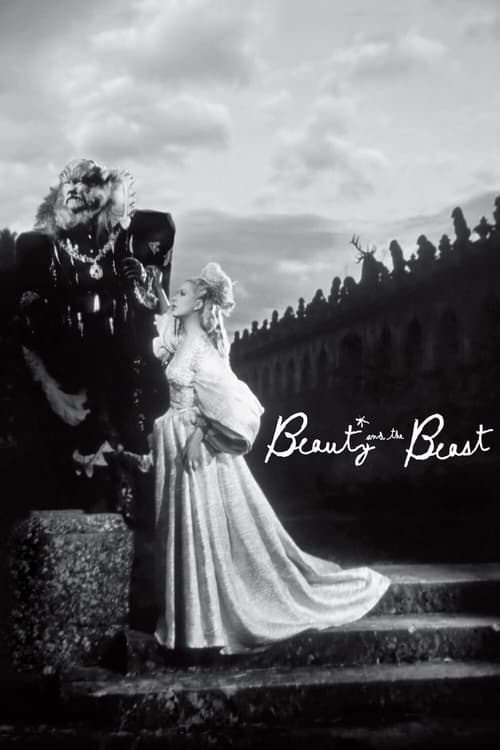
Beauty and the Beast
1946 · Jean Cocteau
For a night when you want enchantment — real black-and-white movie magic that asks for a child's faith and rewards it. Perfect for a rainy evening, a first taste of classic cinema, or falling in love with what film can do.
What it's about
A merchant's gentle youngest daughter offers herself to a Beast in her father's place and becomes the guest — and prisoner — of his enchanted castle, where the walls themselves seem alive. As she moves between the castle's dream-logic and her grasping family back home, she's drawn to the repellent, strangely noble creature who loves her, and a test of her fidelity hangs over everything.
The experience
Watching it feels like being let inside someone's dream — slow, hushed, and genuinely uncanny, with images that lodge in your memory: candelabras held by living arms, statues whose eyes follow the action, a hallway drifted through as if the floor were breathing. It's romantic in the old, dangerous sense of the word.
Performances
Jean Marais, in hours of fur makeup daily, gives the Beast a wounded-animal dignity no digital creature has matched — you believe both the danger and the heartbreak — while Josette Day makes Belle's goodness luminous rather than bland.
The craft
Jean Cocteau, working amid postwar shortages of film stock and electricity, conjures pure enchantment: Henri Alekan's photography makes Christian Bérard's castle designs seem dreamed rather than built, all achieved with in-camera trickery, mirrors, and light. It's one of the most beautiful black-and-white films ever made, and a big screen turns it into a séance.
Why it matters
The screen fairy tale all subsequent screen fairy tales must answer to — its fingerprints are on everything from French cinema's great romantics to Disney's 1991 animated version, and it fixed the idea that fantasy on film could be high art.
Jean Cocteau — poet, novelist, draftsman — came to cinema as one art among many and made the fairy tale all subsequent screen fairy tales must answer to. Shot in 1945–46 amid postwar shortages of film stock, fabric, and electricity, La Belle et la Bête opens with a handwritten plea for the audience's childlike faith, then earns it: Henri Alekan photographs Christian Bérard's designs so the Beast's castle seems dreamed rather than built — living statuary whose eyes track the action, corridors lit by candelabras held aloft by human arms emerging from the walls, Belle gliding down a hallway as though the floor itself were breathing. Jean Marais, Cocteau's partner and muse, endured hours of fur makeup daily and gives the Beast a wounded-animal dignity no digital creature has matched. Its influence runs from Jacques Demy to Disney's 1991 animated musical to Guillermo del Toro. Cocteau kept a diary of the agonized production; it reads as a manual for conjuring enchantment out of deprivation.
A Deleuzian reading
A hand comes out of the wall holding a candelabra.
The full Deleuzian reading of Beauty and the Beast →
Reception
A postwar French prestige event that won the Prix Louis Delluc in 1946, it has only grown in stature since — from admired curiosity to the near-universal pick for the most beautiful fantasy film ever made.
How Beauty and the Beast was received, from release to now →
Influences: the films it descends from and the films it influenced
- The Blood of a Poet (1930) — Cocteau's own first film established the reverse-motion, concealed-wire and mirror-as-liquid-portal in-camera tricks he later reused for the Beast's smoking gloves and the passage through the castle's walls.
- Nosferatu (1922) — Its stop-substitution and undercranked movements plus a monstrous-yet-pitiable creature staged in deep shadow prefigure the Beast's uncanny locomotion and Alekan's chiaroscuro modeling of the face.
- Vampyr (1932) — Its gauze-diffused, fog-soft photography that renders everything as a waking dream is the exact veiled, over-exposed texture Henri Alekan pursued for the enchanted castle.
- The Thief of Bagdad (1924) — A feature-length fairy tale assembled entirely from theatrical in-camera illusions — flying, vanishings, conjured objects — rather than narrative realism, the mode Cocteau adopts wholesale.
- Un Chien Andalou (1929) — Its Surrealist dream-logic editing, in which objects and bodies transform without causal explanation, is the grammar Cocteau's living castle silently obeys.
- Le Voyage dans la Lune (1902) — The founding French tradition of stage-magic substitution splices and painted-flat sets treated as pure enchantment, the practical-effects lineage Cocteau consciously revived under postwar material deprivation.
- The Scarlet Empress (1934) — Living statuary — caryatid arms, watching faces in the décor — turns Sternberg's grotesque court sculptures into an animate mise-en-scène of enchantment.
- Orphée (1950) — Cocteau extends his own mirror-portal and reverse-motion vocabulary — mercury-rippling mirrors one walks through, gloves donned in reverse — from the fairy tale into a modern Orpheus myth.
- Beauty and the Beast (1991) — Disney's anthropomorphic living household — candelabra, human-armed wall sconces holding candles — directly lifts Cocteau's living-set of disembodied caryatid arms and moving statuary.
- Donkey Skin (1970) — An explicit homage that casts Jean Marais himself as a fairy-tale king and revives the living-set and painted-tableau staging, complete with statuary that turns to watch the characters.
- Pan's Labyrinth (2006) — Del Toro's insistence on practical creature make-up, animatronics and in-camera magic over CGI is his stated debt to Cocteau's tactile enchantment and pitiable monsters.
- The Shape of Water (2017) — The sympathetic monster-as-lover realized through a physical creature suit and expressive practical make-up continues the Beast's pathos and hand-built body.
- Edward Scissorhands (1990) — A gentle gothic beast whose monstrousness is engineered as poignant costume and prosthetic, moving through a deliberately artificial storybook world built like a stage set.
- The Company of Wolves (1984) — A dream-logic fairy tale driven by practical man-to-wolf transformation effects and forest sets built as overt psychological artifice rather than location realism.
- Wings of Desire (1987) — Wenders hired the octogenarian Henri Alekan to shoot its luminous monochrome and named the film's circus 'Cirque Alekan,' a direct homage to the cinematographer's work on the Beast.
- Valerie and Her Week of Wonders (1970) — A Czech surrealist fairy tale extending the same soft, oneiric camera and unexplained transformation logic, where a child's world dissolves into enchantment by cutting rather than exposition.
- Last Year at Marienbad (1961) — Cocteau and cinematographer Henri Alekan originate the tracking shot through a corridor whose architecture is itself animate — human arms hold candelabras from the walls, velvet drapes breathe — instructing performers into slow, frozen, anti-naturalist movement that anticipates Marienbad's tableau-vivant passages where figures hold poses as the camera glides past them.
- Eyes Without a Face (1960) — Cocteau's Gothic fairy-tale architecture with the transformed figure as its moral center: Génessier's villa and Christiane's porcelain mask inherit the Beast's enchanted-space mise-en-scène directly, including the use of practical magic effects and candlelit architectural confinement to make the domestic interior a site of metamorphic dread.
- The Strange Ones (1950) — Established Cocteau's practice of authoring and narrating a tightly controlled poetic mise-en-scène inside another's direction, the exact template for his recited-myth narration here.
- The Red Shoes (1948) — A contemporaneous postwar European fairy-tale that likewise builds meaning from saturated production design and openly staged unreality rather than realism, the British counterpart to Cocteau's poetic cinema.
Similar films
- Orpheus (1950) — influence & lineage · same viewing thread
- Beauty and the Beast (1991) — influence & lineage
- Dracula (2025) — same viewing thread
- Eyes Without a Face (1960) — same viewing thread
- Un Chien Andalou (1929) — influence & lineage · often watched together
- Nosferatu (2024) — same viewing thread
- Marketa Lazarová (1967) — same viewing thread
- Vampyr (1932) — influence & lineage · often watched together
All the films related to Beauty and the Beast →
Watch it with: curated runs of related films
- Haunted Castles and Restless Ghosts — A run of enchanted ruins, restless dead, and grief that won't stay buried — watch these when you want dread and reverie sharing the same frame.