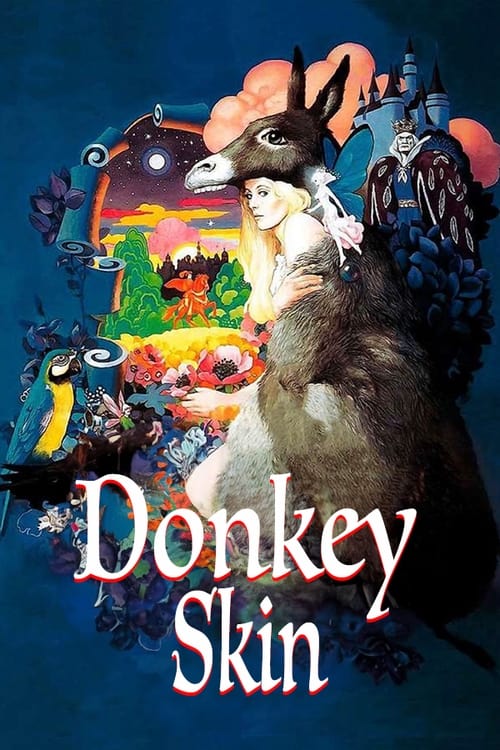
Donkey Skin
1970 · Jacques Demy
For a whimsical night when you want pure enchantment with a knowing edge — cozy on the surface, delightfully weird underneath. Great when you're tired of realism and want a film that looks like an illustrated storybook come to life.
What it's about
A king promises his dying queen he'll only remarry someone more beautiful than she was — and the only match turns out to be his own daughter. Horrified, the princess follows her fairy godmother's escalating schemes: impossible demands for magical gowns, and finally flight in the hide of the king's treasured gold-producing donkey. Disguised as a scullery drudge in a neighboring kingdom, she waits for a way back to her own life — until a prince catches a glimpse of who she really is.
The experience
A candy-colored daydream that keeps winking at you — sumptuous, silly, and stranger than it first appears, with songs threading through everything. It's light on its feet but there's a dark fairy-tale undertow beneath the frosting that keeps it from ever going soft.
Performances
Catherine Deneuve glides between princess and kitchen drudge with perfect fairy-tale poise, and Delphine Seyrig steals scenes as a chic, worldly fairy godmother who treats magic like fashion advice.
The craft
Demy commits totally to artifice: horses dyed blue and red, dresses colored like the weather and the moon, living-statue servants, and Michel Legrand songs that carry the story as much as the dialogue. The handmade, deliberately theatrical look is the point — on a good screen the color alone is a feast.
Why it matters
One of Demy's biggest hits in France and a beloved family classic there, it kept the tradition of handcrafted movie enchantment alive into the 1970s and remains a reference point for filmmakers doing fairy tale as high style.
Snapshot
Donkey Skin (Peau d'âne) is Jacques Demy's plush, deliberately artificial adaptation of Charles Perrault's 1694 verse fairy tale about a princess who flees her widowed father's proposal of marriage by hiding beneath the pelt of a gold-excreting donkey. Made after Demy's disenchanting Hollywood interlude (Model Shop, 1969) and released in France in December 1970, it reunited him with Catherine Deneuve, the muse of The Umbrellas of Cherbourg, and with composer Michel Legrand, whose songs run continuously beneath and through the action. The film is at once a children's spectacle and a knowingly adult confection: it stages incest, gender disguise, and magical wish-fulfilment in a candy-colored register borrowed openly from Jean Cocteau, while smuggling in helicopters and anachronistic jokes. Commercially it became one of Demy's most beloved and durable successes in France, and it now stands—alongside The Umbrellas of Cherbourg and The Young Girls of Rochefort—as one of the three pillars of his fairy-tale musical cinema.
Industry & production
Donkey Skin was a French production of the early 1970s, financed and produced through the network of companies Demy worked within during this period (principally Parc Film and Marianne Productions); it belonged to a moment when French cinema was still absorbing the aftershocks of the New Wave and increasingly turning toward heritage subjects, popular genre, and star vehicles. Demy had long wanted to film Perrault—he had reportedly nurtured the project for years before the American detour of Model Shop made it possible—and the return to a French folk source functioned as a homecoming after a bruising encounter with the studio system in Los Angeles.
The production leaned on France's patrimony of Loire Valley châteaux to supply its enchanted kingdoms, most famously the Château du Plessis-Bourré (the blue kingdom), the Château de Chambord (the red kingdom), and the Château de Neuville, with the location work reducing the burden on constructed sets while still delivering the fantastical scale Demy wanted. The presence of Catherine Deneuve, by 1970 a genuine international star, gave the film its commercial anchor, and the casting of Jean Marais as the king was itself an industrial-cultural statement, importing the aura of a bygone French cinema of enchantment. The picture's warm domestic reception confirmed that Demy's brand of sung, storybook cinema retained a large popular audience even as the auteurist New Wave was fragmenting.
Technology
Donkey Skin was shot on 35mm color film, and color is arguably its central technology: the film is organized around saturated, quasi-heraldic color-coding, with entire domains rendered monochromatically blue or red, and with horses, servants, and interiors dyed or painted to match. This is a cinema of chemical color pushed toward the artificial and the emblematic rather than the naturalistic. Demy also exploited straightforward but expressive optical and in-camera effects for the film's magic—slow motion, reverse motion, superimposition, and the frozen "living statue" tableaux—rather than any advanced special-effects apparatus. These are the tools of a poetic, hand-made trickery consciously descended from Georges Méliès and from Cocteau's La Belle et la Bête (1946), and their visible seams are part of the point: the enchantment is meant to look staged. The score was recorded in the era's studio conditions for a lush orchestral-and-voice soundtrack, with Deneuve's singing voice dubbed (as was standard in Demy's musicals) by playback specialist Anne Germain.
Technique
Cinematography
The cinematography is by Ghislain Cloquet, a major craftsman whose range extended from the austere naturalism of Robert Bresson (Au Hasard Balthazar, Mouchette) to, later, the pastoral lyricism of Polanski's Tess. For Demy he supplied a luminous, high-key palette that keeps the artifice legible and the colors singing. The camera favors frontal, tableau-like compositions and stately movements that present the fairy-tale world as a series of framed pictures—illustrations brought to life—rather than immersing the viewer through restless handheld realism. Light is used decoratively, glazing the châteaux and the elaborate gowns (the dress "the color of the weather," the dress "the color of the moon," the dress "the color of the sun") so that costume and set read as continuous fields of color. The result is a controlled, painterly image in which nothing looks accidental.
Editing
Editing (credited to Anne-Marie Cotret, a regular Demy collaborator) serves the film's twin logics of ballad and spectacle. Cutting is generally measured and unhurried, allowing songs to unfold and tableaux to hold, and it privileges clarity of storytelling over montage effect. The film's celebrated magical gags—objects appearing, the fairy manifesting, the donkey-skin transformations—depend on precise match-cutting and on the withholding or timing of a reveal, so that the editing itself performs the sleight-of-hand. In the musical numbers the cutting follows Legrand's phrasing, tying image rhythm to musical rhythm in the manner Demy had refined across his sung films.
Mise-en-scène / staging
Mise-en-scène is where Donkey Skin most fully declares itself. Demy stages the film as a living storybook: symmetrical arrangements, processional entrances and exits, servants and animals color-matched to their domain, and human figures posed as ornament. The two kingdoms are chromatically opposed, and the princess moves between them as a figure of transformation. The famous images—blue-painted horses, courtiers frozen mid-gesture as statuary, the princess in her filthy donkey pelt against gilded interiors—work by juxtaposing the grotesque (the reeking skin, the animal that voids gold and jewels) with the exquisite. Costume and production design carry an enormous share of the meaning, translating Perrault's escalating impossible demands into a visual crescendo; the film's design is often discussed as its true special effect, though the specific breakdown of art-direction and costume credits is a detail worth verifying against the print rather than asserting from memory.
Sound
As with all of Demy's musicals, the soundscape is dominated by Michel Legrand's score, which is near-continuous and binds the film together. Rather than the fully through-sung structure of The Umbrellas of Cherbourg, Donkey Skin alternates set-piece songs with spoken passages, but music underlies almost everything. Sung numbers—among them the fairy's counsel to the princess and the mock-domestic "recipe for a love cake"—function as narrative hinges, and recurring melodic motifs (a love theme in particular) thread through the film to knit its episodes. The decision to have Deneuve lip-sync to Anne Germain's dubbed vocal is characteristic of Demy's musicals and contributes to the film's stylized, doll-like surface, in which even the voice is a designed object.
Performance
Performance is pitched at the register of tableau and fable rather than psychological realism. Catherine Deneuve plays the princess with a cool, luminous poise that lets her double as both wronged daughter and radiant fairy-tale ideal; the role asks for iconic stillness as much as characterization, and she supplies it. Jean Marais, the star of Cocteau's La Belle et la Bête and Orphée, brings a whole cinematic lineage to the incestuous king, his presence functioning as an homage that complicates the role's disquiet with nostalgia. Delphine Seyrig, celebrated from Resnais's Last Year at Marienbad, plays the Lilac Fairy with arch, camp knowingness, her wit tilting the film toward adult irony; her fairy is a manipulator with her own designs. Jacques Perrin embodies the prince as a storybook lover. The ensemble collectively performs "in quotation marks," aware of the artifice, which is essential to the film's tone.
Narrative & dramatic mode
The narrative follows Perrault closely: a dying queen exacts from the king a promise to remarry only a woman more beautiful than she; the only such woman proves to be their own daughter; the Lilac Fairy counsels the princess to stall her father with a series of impossible demands—gowns the color of the weather, the moon, the sun, and finally the skin of the treasure-producing donkey—and then to flee disguised in that skin; working as a lowly scullery maid, the princess is glimpsed in her true splendor by a prince who falls lovesick, demands a cake baked by her hand, and identifies her when only her finger fits a ring baked into it. Demy's dramatic mode is that of the ironic fairy tale: he honors the folk structure of taboo, flight, disguise, and recognition, but frames it with self-conscious wit—narration, songs, and anachronistic intrusions that puncture the diegesis. The mode is neither pure children's fantasy nor outright parody but a sustained double register in which enchantment and knowing commentary coexist.
Genre & cycle
The film sits at the intersection of the film musical, the féerie (the French tradition of stage-and-screen fairy spectacle running back through Méliès), the fairy-tale adaptation, and romantic comedy. Within Demy's own work it belongs to a cycle of enchanted, sung films bracketed by The Umbrellas of Cherbourg (1964) and The Young Girls of Rochefort (1967) before it, and extending toward The Pied Piper (1972) and, in a different key, later works such as Lady Oscar and Une chambre en ville. In the broader landscape of fairy-tale cinema it is frequently positioned as the great European art-cinema riposte to the Disney model—an adaptation that keeps the folk material's strangeness and cruelty (incest, filth, the abject donkey skin) rather than sanitizing it, while still delivering spectacle.
Authorship & method
Donkey Skin is a fully authored Demy film, expressing his signature fusion of popular genre, saturated color, continuous music, and an undertow of melancholy beneath the sweetness. Demy wrote the screenplay himself, adapting Perrault while layering in his own anachronisms and ironies. His central collaboration was with Michel Legrand, the composer whose partnership defined Demy's musicals; Legrand's near-continuous, motif-driven score is inseparable from the film's identity. Ghislain Cloquet supplied the painterly cinematography, and Anne-Marie Cotret the editing that paces songs and magic alike. The casting itself is a form of authorship: by placing Jean Marais at the film's center, Demy explicitly summoned Cocteau, his acknowledged tutelary spirit, making the film a bridge between the poetic fantasy of 1940s French cinema and Demy's own pop-modern sensibility. Crucially, the film's later life is bound up with Agnès Varda, Demy's wife, whose company Ciné-Tamaris preserved and restored his work after his death, keeping Donkey Skin in circulation in its full color glory.
Movement / national cinema
Demy emerged from the French New Wave generation and shared its authorial ethos and cinephile self-awareness, but he always stood at an angle to it: where much of the New Wave pursued location realism and improvisatory looseness, Demy built enchanted, studio-inflected, thoroughly designed worlds set to music. Donkey Skin is emphatically a French national-cinema object—rooted in Perrault, a foundational text of French literary heritage, and shot amid the Loire châteaux that are icons of French patrimony. It participates in a distinctly French lineage of cinematic féerie running from Méliès through Cocteau, and it can be read as Demy's assertion, at the start of the 1970s, that this native tradition of poetic enchantment remained a living resource.
Era / period
Appearing at the turn of the decade, Donkey Skin reflects a France between the utopian and disillusioning aftermath of May 1968 and the more disenchanted 1970s. Demy's own recent experience of Hollywood had been sobering, and the film's retreat into fairy tale can be read both as escape and as a knowing gesture: the anachronistic intrusions—most famously the arrival of a helicopter into the medieval fable—refuse to let the audience forget that this timeless story is being told in the modern present. The film's frankness about incest and desire is also of its moment, consonant with a loosening of censorship and a willingness in European art cinema to treat folk material's darker strata openly rather than euphemistically.
Themes
The film's governing theme is forbidden desire and its evasion: the father's incestuous proposal sets the plot in motion, and the princess's flight is a flight from the collapse of familial and sexual order. Around this cluster gathers a set of Demyian preoccupations—transformation and disguise (the princess who becomes a filthy servant and then, by recognition, a bride); the tension between the beautiful and the abject (radiant gowns against the reeking donkey pelt; jewels produced by an animal's waste); and the workings of wish and destiny, personified in the ambiguous Lilac Fairy, whose "help" turns out to serve her own romantic ends. Beneath the sugared surface runs Demy's characteristic melancholy and his interest in the strangeness of love. The anachronisms introduce a meta-theme about storytelling itself—the fairy tale as a form that is timeless precisely because it is retold—while the frank treatment of taboo insists that fairy tales encode real psychic material.
Reception, canon & influence
Donkey Skin was warmly received by French audiences and became one of Demy's most popular films domestically, a status it has retained across generations as a perennial favorite; precise contemporaneous box-office and critical figures should be checked against archival sources rather than asserted here, but its enduring popularity in France is well established. Critically it has come to be regarded as one of Demy's essential works and as a landmark of fairy-tale cinema, its reputation only strengthened by the restoration overseen by Agnès Varda's Ciné-Tamaris, which returned the film's colors to their intended intensity and reintroduced it to international audiences and repertory circuits.
The influences on the film are legible and openly acknowledged: Perrault's seventeenth-century tale as source; the French féerie tradition of Méliès; and, above all, Jean Cocteau's La Belle et la Bête, invoked through the living statues, the poetic magic, and the casting of Cocteau's own star Jean Marais. Demy's prior musicals with Legrand supplied the film's formal template.
Looking forward, Donkey Skin helped keep alive a European, art-cinematic model of the fairy-tale film that resists Disneyfication, and its lush, self-aware artifice and its embrace of the source material's darkness have made it a touchstone for later filmmakers and designers drawn to storybook stylization and to fairy tales' uncanny underside; it is frequently cited by admirers within a lineage of enchanted, visually maximalist cinema. Its most concrete legacy, however, is its central place in the Demy canon: alongside The Umbrellas of Cherbourg and The Young Girls of Rochefort, it secures his reputation as the great modern poet of the film musical as fairy tale, and it remains a defining example of how a national folk inheritance can be reanimated as personal, authored cinema.
A Deleuzian reading
The horses are blue.
The full Deleuzian reading of Donkey Skin →
Reception
A genuine box-office smash in France in 1970 — Demy's biggest domestic hit — it was long waved off abroad as kitschy oddity before the 2003 restoration and re-release turned it into an internationally beloved cult classic.
How Donkey Skin was received, from release to now →
How to watch Donkey Skin: what to notice on a first viewing
- Watch every horse and servant match one solid color. One kingdom is painted entirely in blue, from the horses to the courtiers' sleeves, and the other kingdom answers in red, with nobody in the story remarking on it. Color here marks territory, not just decoration.
- Watch courtiers freeze mid-gesture like statues. Demy poses his court in symmetrical arrangements and processional entrances, with figures sometimes held completely still as if they were ornament rather than people. The staging turns the monarchy into a display case, and the courtiers into part of the display.
- Watch the donkey produce gold instead of manure. The treasury depends on an animal kept in a stable, its waste literally the kingdom's wealth, staged as plainly as any other piece of livestock. The kingdom's fortune is shown as an ordinary barnyard fact, not hidden or explained away.
- Listen for music running under almost every scene. Legrand's score barely stops, threading through both sung numbers and ordinary dialogue scenes so music and story feel continuous rather than separated into distinct segments. The film rarely feels like it steps outside music, even when nobody is singing.
- Watch the princess request a dress from the sky itself. The fairy has the princess demand gowns the color of the weather, the moon, and the sun, each one arriving as an actual piece of cloth. An impossible request turns into a wearable object right in front of you.
The whole guide to watching Donkey Skin, with the keys for a rewatch →
Influences: the films it descends from and the films it influenced
- La Belle et la Bête (1946) — Demy directly quotes Cocteau's poetic in-camera enchantments — living statuary and disembodied magic — and casts Cocteau's own star Jean Marais as the King to make the debt explicit.
- Orphée (1950) — The magic mirror as a portal, reversed-motion and slowed gestures, and dream-logic transitions in Donkey Skin descend from Cocteau's in-camera trick vocabulary of thresholds and time manipulation.
- The Kingdom of the Fairies (1903) — The substitution-splice conjuring (a wish makes objects appear, a dress materializes) and hand-painted féerie tableau are the Méliès trick-film root of Donkey Skin's optical magic.
- The Umbrellas of Cherbourg (1964) — Established the Demy–Legrand formal template Donkey Skin inherits: a near-continuous, motif-driven score with vocals dubbed over playback so the whole film floats on music.
- The Young Girls of Rochefort (1967) — Perfected the color-coded costume-and-set palette and choreographed pastel tableau staging that Donkey Skin extends into a full storybook chromatics (the blue and red kingdoms).
- An American in Paris (1951) — Minnelli's MGM Technicolor color-block dream sets and integrated fantasy staging modeled the saturated, painterly artifice Demy adopts for his sung tableaux.
- The Wizard of Oz (1939) — Pioneered narrative color-coding of the magical realm — a chromatic shift signaling the passage into fairy-tale space — the device Demy systematizes across Donkey Skin's kingdoms.
- L'Éternel retour (1943) — This Cocteau-scripted vehicle forged Jean Marais's mythic-romantic star persona, the exact iconography Demy 'casts' to summon 1940s poetic-fantasy cinema inside a 1970 musical.
- Les Chansons d'amour (2007) — A direct Demy–Legrand tribute that revives the sung-through pop-musical grammar — characters bursting into scored song within everyday realism — as authored, melancholic musical.
- Marie Antoinette (2006) — Extends Demy's ironic-fairy-tale device of deliberate anachronism — modern pop cues and idiom inside a period court — over a candy-colored, self-aware confection palette.
- Pan's Labyrinth (2006) — Carries forward the European fairy tale's uncanny dark underside rendered through practical, in-camera creature effects that pointedly resist Disneyfication.
- Tale of Tales (2015) — Reanimates a national folk inheritance (Basile) as adult art-cinema féerie, using practical effects and lush artifice rather than digital gloss, in Donkey Skin's anti-Disney tradition.
- Edward Scissorhands (1990) — Builds a pastel candy-colored suburban storybook with explicit per-house color coding and gothic melancholy beneath the sweetness — Demy's saturated artifice plus its melancholic undertow.
- La La Land (2016) — An avowed Demy homage that revives the authored film musical through saturated primary-color staging and a continuous motif-driven score wedded to melancholic romantic irony.
- Mama (1976) — Demy's sung fairy tale — a Perrault source staged in candied, artificial color with the cast lip-syncing to pre-recorded vocals — is the direct Western antecedent for Mama's French-co-production, playback-driven folk-tale musical.
- 8 Women (2002) — An explicit Demy homage: a hermetic single-set theatrical artifice with color-coded costumes assigning each character a hue, punctuated by dubbed musical numbers in quotation marks.
- The Grand Budapest Hotel (2014) — Shares Donkey Skin's living-storybook aesthetic: flat frontal tableau staging, in-camera miniatures and painted backings, and a meticulous pastel palette coded to place and era.
Similar films
- The Young Girls of Rochefort (1967) — influence & lineage · same viewing thread
- The Umbrellas of Cherbourg (1964) — influence & lineage · same viewing thread
- Beauty and the Beast (1946) — influence & lineage
- Marie Antoinette (2006) — influence & lineage
- Amélie (2001) — same viewing thread
- Ratatouille (2007) — same viewing thread
- Beauty and the Beast (2017) — shared sensibility
- Belle de Jour (1967) — shared sensibility
All the films related to Donkey Skin →
Watch it with: curated runs of related films
- Storybook France in Full Color — A run of saturated, big-hearted French confections that rhyme on candy-box color, romantic longing, and the magic hiding in an ordinary day.