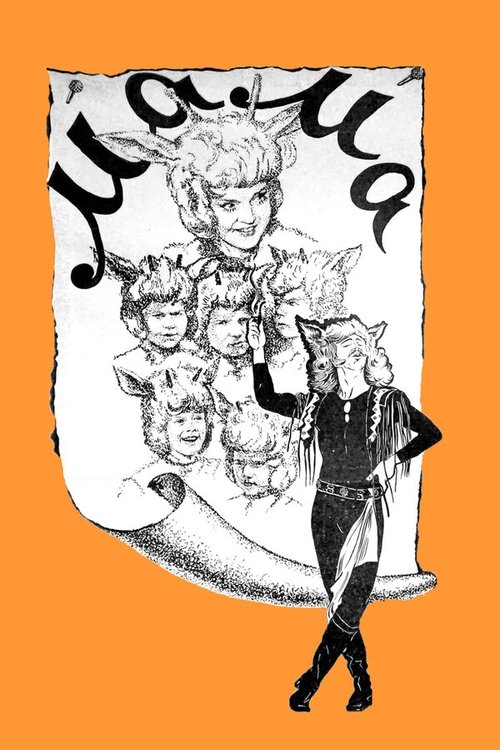
Mama
1976 · Elisabeta Bostan
For a family movie night with young kids, or when you're feeling nostalgic for old-fashioned holiday entertainment — pure comfort, zero edge.
What it's about
A mother goat leaves her five kids home alone with one rule — open the door to no one — while a scheming wolf and his ragtag accomplices plot to snatch the children the moment she's gone. It's the old European folk tale of the goat and her kids, retold as a big, bright musical spectacle in which the animals sing, dance, and even perform on ice skates.
The experience
Broad, tuneful, and cheerfully theatrical — closer to a filmed holiday pantomime than a modern animated fairy tale. It moves in musical numbers rather than suspense, so even the villainy stays playful.
Performances
Lyudmila Gurchenko as the goat mother and Mikhail Boyarsky as the wolf attack the material with full song-and-dance commitment, playing storybook animals with the energy of stage stars.
The craft
The film's boldest choice is staging musical numbers on ice, with costumed performers skating through choreography — a genuine novelty that gives the fantasy a circus-spectacle sparkle. As a Romanian–Soviet–French co-production it was mounted on a scale unusual for a children's film of its era.
Why it matters
It became a beloved perennial in the Soviet Union and Eastern Europe, passed down as Christmas and New Year family viewing across generations.
Snapshot
Mama is a tri-national musical fantasy — a Romanian–Soviet–French co-production — that reimagines a durable European folk narrative, the tale of the mother goat and her kids menaced by a wolf, as a full-blown singing-and-skating spectacle. Directed by the Romanian children's-film specialist Elisabeta Bostan, it fuses two literary sources familiar across the region: the Grimm brothers' "The Wolf and the Seven Young Kids" and the Romanian classic in the same vein, Ion Creangă's "Capra cu trei iezi" ("The Goat and Her Three Kids"). The result is a Christmas/New Year pantomime in the truest sense — broad, tuneful, physical, and pitched squarely at families. Its most distinctive formal decision is to stage much of its choreography on ice, with cast members performing musical numbers in costume on skates. In the Soviet Union the film became a perennial holiday television fixture and something close to a cult object; internationally it circulated under alternate titles, most memorably the English-language "Rock'n'Roll Wolf." It is best understood not as an auteur statement but as a high-craft entertainment machine assembled from three national film cultures, anchored by star performances from Lyudmila Gurchenko and Mikhail Boyarsky.
Industry & production
The film exemplifies the co-production model that Eastern Bloc studios used to pool resources, share technical labor, and access hard currency and wider markets. Mama brought together Romanian production (Bostan's home base, the Romanian state film sector) with Soviet participation and French involvement — a three-way arrangement that was unusual in reaching across the Iron Curtain to a Western partner. Co-productions of this kind allowed a children's fantasy to be mounted at a scale — elaborate costumes, large ensemble numbers, and specialized ice choreography — that a single national children's-film unit might have struggled to finance alone.
A defining logistical fact of the production is that it was shot in more than one language version, a common practice for co-productions intended to play as a "domestic" film in each partner territory rather than as a subtitled import. This meant coordinating a multinational cast, several of whom worked across the language divide, and it helps explain why the film enjoys genuine canonical standing in more than one country simultaneously.
Beyond these structural facts, the granular production record — budget figures, shooting schedule, precise studio credits, and box-office returns — is not reliably documented in accessible English-language sources, and I will not invent numbers. What is clear is that the picture was conceived as a prestige family entertainment for the holiday season, a market segment where Soviet and Eastern European cinema invested heavily and consistently.
Technology
Technically, Mama belongs to the mid-1970s tradition of color, sound, studio-and-location family filmmaking. Its notable technological demand was not optical or photochemical novelty but the practical engineering of filming performance on ice: capturing costumed actors and choreography on a skating surface requires camera mobility across a slick plane, careful lighting of a reflective white field, and sound strategies suited to a medium where live singing and dancing on skates is impractical. As with most musicals of the era, the songs were built around playback — pre-recorded music tracks to which performers lip-synced and moved — which freed the choreography from the constraints of live vocal capture. The specific camera systems, film stock, and recording equipment used across the three production centers are not documented in sources I can verify, and I will not attribute equipment claims I cannot support.
Technique
Cinematography
The cinematography serves spectacle and legibility rather than authorial signature. A children's musical of this type prioritizes bright, even illumination, clear staging of ensemble action, and framing that keeps costumed characters readable at a glance — the wolf must always be recognizably the wolf. The ice sequences impose their own visual grammar: wide framings that let skating choreography read as pattern and motion, and camera movement that tracks performers across the rink. The identity of the director(s) of photography is not something I can state with confidence from the available record, and rather than guess I flag this as a genuine gap.
Editing
Cutting in Mama is subordinated to musical structure. In the number-driven musical, editing rhythm is dictated by song and choreography — cuts fall on musical phrases, and the editor's task is to sustain the energy of a set piece while preserving spatial clarity. Between numbers, the film relies on the brisk, cause-and-effect cutting of pantomime comedy, where the wolf's schemes and the kids' reactions are staged as clean comic beats. The specific editor's credit is not reliably available to me.
Mise-en-scène / staging
This is the film's richest technical dimension. Mama is built as living pantomime: anthropomorphic animal characters realized through full costume and makeup, broad theatrical blocking, and a fairy-tale world of the goat family's home threatened by the predators outside it. The decision to stage numbers on ice is the central mise-en-scène gamble — it converts folk-tale action into balletic, circus-adjacent display, and it aligns the film with a strong regional tradition of ice ballet and figure-skating spectacle. Costume and character design carry enormous narrative weight, since the entire premise depends on instantly readable animal archetypes: the maternal goat, the villainous wolf and his confederates (the lynx, the donkey, and the wolf's nephew), and the vulnerable kids.
Sound
Sound is foundational rather than incidental, because Mama is a musical. The film is organized around its songs, with a pre-recorded score to which the on-screen action is choreographed. The multi-version production means the film exists with vocals in more than one language, and the songs — rather than dialogue — carry much of the storytelling and emotional register. This is a picture where the audio track is the spine and the images are hung upon it.
Performance
Performance style is theatrical, external, and generous — appropriate to pantomime. Lyudmila Gurchenko, one of the great Soviet screen actresses and a gifted singer, anchors the film as the mother goat, lending warmth and star wattage to what could have been a thin archetype. Mikhail Boyarsky, who would soon become a household name across the Soviet Union (above all as D'Artagnan in the beloved television musketeers series), plays the wolf with the swaggering, charismatic villainy that became his signature. The film also draws on circus and variety performance traditions; the presence of performers skilled in physical and clowning idioms suits a work that lives on movement and spectacle. The casting strategy is essentially a star-and-spectacle one: pair top vocal-dramatic talent with physically expressive character work.
Narrative & dramatic mode
The dramatic mode is fairy-tale pantomime with a musical-comedy engine. The plot is elemental and moral: a mother leaves her children with a prohibition (open the door to no one but me); a villain schemes to breach that prohibition; a child's disobedience — here the eldest, Matei, sneaking off to the fair — creates the opening for danger; and the story moves toward threat, rescue, and restoration of the family. This is the classic structure of the cautionary folk tale, in which the safety of the home and obedience to the mother are tested and ultimately reaffirmed. The mode is not psychological realism but archetype and repetition: clearly drawn good and evil, escalating comic jeopardy, and an emotionally legible resolution. Songs function as the film's soliloquies and set pieces, externalizing feeling and marking the rhythm of the narrative.
Genre & cycle
Mama sits at the intersection of several genres named in its own billing — adventure, family, fantasy, and music — but its center of gravity is the children's musical fairy-tale film. It belongs to a robust cycle of Soviet and Eastern European fairy-tale cinema (the skazka tradition), a genre that carried real cultural prestige and received sustained state investment as wholesome, artful entertainment for young audiences. Within that cycle, Mama is distinguished by its co-production pedigree and its ice-spectacle staging, which pull it toward the holiday variety show and the ice ballet. It is also, functionally, a New Year film — part of the seasonal-viewing tradition that made certain titles annual television rituals across the region.
Authorship & method
Elisabeta Bostan is the film's clearest authorial presence. A Romanian director who built her career almost entirely in children's and family cinema, she is best known for work centered on childhood and folklore, and Mama is consistent with that lifelong project: filmmaking that takes the child audience seriously as a craft challenge and treats folk material as living cultural inheritance. Her method here is that of the impresario-adaptor — taking canonical fairy-tale sources and staging them as large-scale musical spectacle, coordinating a multinational cast and the demands of ice choreography.
Among collaborators, the performers are the most visible co-authors: Gurchenko and Boyarsky shape the film as much through star presence and voice as any behind-camera contributor. The music is central to the film's identity and afterlife; the songs are the element audiences remember and re-consume, and the score's composer and lyricists are effectively co-authors of its cultural life. However, I want to be careful and honest: the precise, verified crediting of composer, songwriters, cinematographer, and editor is not something I can confirm from the record available to me here, and I will not attach names I cannot substantiate. This is a real gap in the English-language documentation of the film rather than an absence of collaborators.
Movement / national cinema
The film cannot be assigned to a single national cinema, which is precisely its interest. It draws on the Romanian tradition of folklore-based children's filmmaking that Bostan personified, and on the Soviet skazka and musical-comedy traditions that gave the region some of its most enduring popular cinema, while its French partnership situates it within the cross-border co-production practices of 1970s European film. It is not part of any avant-garde or "new wave" movement; it belongs instead to the mainstream, state-supported popular cinema of family entertainment. Its dual-version, multi-country existence makes it a genuinely transnational artifact that took root as a "national" holiday film in more than one culture at once.
Era / period
Mama is a product of the mid-1970s, a period of stable, heavily institutionalized film industries across the Eastern Bloc, with children's and fairy-tale cinema enjoying secure support. It reflects the era's confidence in the family musical as a prestige popular form and its investment in seasonal, television-friendly entertainment. The co-production reaching to a Western European partner also reflects the specific texture of 1970s cultural exchange, when such collaborations, while never routine across the Curtain, were possible and pursued for their market and resource advantages.
Themes
The film's themes are those of the folk tale it inherits, foregrounded rather than complicated. Chief among them is maternal protection and the sanctity of the home: the mother's departure and her prohibition frame the entire drama, and the threat is fundamentally a threat to family integrity. Closely bound to this is obedience and its testing — the eldest child's disobedience is the hinge on which danger turns, dramatizing the classic tension between the child's desire for the world (the fair) and the safety of the domestic threshold. Predation and cunning versus vigilance and solidarity structure the good-and-evil axis, with the wolf's deceit answered by the family's unity. And beneath the comedy runs the reassuring thesis of the cautionary tale: transgression brings peril, but love, courage, and the restored authority of the mother set the world right. The musical form adds a further, tonal theme — the transformation of fear into festivity, danger metabolized as song and spectacle.
Reception, canon & influence
The clearest fact about Mama's reception is its afterlife: in the Soviet/post-Soviet cultural sphere it became a beloved perennial, a holiday-season television staple whose songs and imagery are widely recognized across generations. This kind of ritual re-viewing is itself a form of canonization, and it secured the film a durable place in popular memory far beyond its initial release. In Romania it stands as a notable entry in Bostan's respected body of children's cinema. Internationally it has led a stranger double life, circulating under alternate titles — including the English-language "Rock'n'Roll Wolf" — through which it acquired a modest cult following among viewers drawn to its unusual blend of fairy tale, musical, and ice spectacle.
Looking backward, the influences ON the film are literary and traditional rather than cinematic-modernist: the Grimm tale of the wolf and the kids, the Creangă goat-and-kids story, and the broader European folk-tale corpus, filtered through the region's established fairy-tale film and ice-ballet/circus performance traditions. Looking forward, its legacy is best measured in cultural persistence rather than in a school of imitators — it helped consolidate the appetite for the musical fairy-tale as seasonal family viewing and remains a reference point for that tradition. Detailed critical reception at the time of release — specific reviews, awards, and contemporary assessments — is thinly represented in the English-language record available to me, and I have declined to manufacture quotations, prizes, or figures to fill that gap. The honest summary is that Mama's significance rests less on critical prestige than on its remarkable, enduring popular life as a shared holiday ritual.
Reception
A Romanian–Soviet–French oddity that could have vanished as Cold War children's programming, it instead became a perennial in two countries at once: a beloved fairy-tale musical in the USSR and, after NRK first aired it in 1983, a Norwegian broadcast-TV fixture that viewers refused to let die.
How Mama was received, from release to now →
Influences: the films it descends from and the films it influenced
- Morozko (1964) — Rou codified the Soviet skazka staging grammar Bostan works in — a folk tale rendered as theatrical spectacle with practical in-camera transformations and frontal, child-legible ensemble tableaux rather than psychological realism.
- Ilya Muromets (1956) — Ptushko's monumental, saturated-color fairy-tale mise-en-scène established the tradition of the folk epic staged as large-scale painterly spectacle that Mama scales down to family-musical size.
- Carnival Night (1956) — This is the film that made Lyudmila Gurchenko a playback singing star, and it fixed the Soviet musical-comedy method — pre-recorded numbers performed to lip-sync — that Mama's whole sound design rests on.
- The Circus (1936) — Aleksandrov's model of the star-vehicle musical, integrating self-contained circus/variety numbers into a narrative via playback singing, is the template for building a children's film around show-stopping performed set-pieces.
- Peau d'âne (1970) — Demy's sung fairy tale — a Perrault source staged in candied, artificial color with the cast lip-syncing to pre-recorded vocals — is the direct Western antecedent for Mama's French-co-production, playback-driven folk-tale musical.
- The Umbrellas of Cherbourg (1964) — Demy and Legrand pioneered constructing an entire film on pre-recorded vocal performance to which actors mime — the exact playback lip-sync discipline Mama depends on across its multilingual versions.
- Sun Valley Serenade (1941) — The Sonja Henie skating vehicles turned figure skating into a filmable production number, establishing the craft of choreographing and shooting a musical number on ice that Mama makes central.
- Snow White and the Seven Dwarfs (1937) — Disney fixed the fairy-tale-as-family-musical template — a folk source structured around memorable, character-defining songs and a nurturing-mother/threatened-innocents axis — that Mama transposes to live-action ice spectacle.
- Amintiri din copilărie (1964) — Bostan's own breakthrough established her method of adapting canonical folk/childhood literature (Creangă) for a child audience with ensemble-legible staging, the authorial approach she brings intact to Mama.
- Veronica (1973) — Bostan's immediate prior children's musical rehearsed the song-driven narrative structure and coordination of young-performer ensembles that Mama expands to a multinational, ice-staged scale.
- D'Artagnan and the Three Musketeers (1979) — This is the vehicle that turned Mikhail Boyarsky into the era's definitive singing-swashbuckler, extending Mama's fusion of star charisma and playback-performed songs into the adventure musical.
- Ordinary Miracle (1978) — Zakharov's TV musical fairy tale carries forward the playback-song-driven, theatrical-artifice staging of folk-fantasy material for the same holiday-television afterlife Mama enjoyed.
- Mio in the Land of Faraway (1987) — A later Soviet-Scandinavian children's fantasy co-production made in parallel multilingual versions for multiple national markets, extending Mama's transnational Eastern-bloc assembly-and-dubbing model.
- Mary Poppins, Goodbye (1983) — A Soviet family musical built on lip-synced playback numbers around a magical-caretaker figure, continuing Mama's maternal-protection theme and its life as a re-watched television standard.
- The Adventures of Buratino (1975) — Nechayev's near-contemporary TV skazka shares Mama's exact formula — a folk source built around durable playback songs that become seasonal-viewing standards — representing the same mid-70s consolidation of the musical fairy tale as family ritual.
- About Little Red Riding Hood (1977) — A sibling working the same wolf-and-child folk material as a song-driven TV musical, staging the predator-and-innocents fable through memorable numbers rather than suspense.
- The Blue Bird (1976) — The same-year Soviet-Western co-production of a fairy tale, assembling a multinational cast into a musical spectacle with parallel international versions — the transnational Eastern-bloc production model Mama exemplifies.
Similar films
- Wolf Children (2012) — shared sensibility
- The Snow Queen (1957) — shared sensibility
- Black Cat, White Cat (1998) — shared sensibility
- The Jungle Book (1967) — shared sensibility
- Monica's Gang in an Adventure in Time (2007) — shared sensibility
- Labyrinth (1986) — shared sensibility
- Rocco and His Brothers (1960) — shared sensibility
- The Tale of the Fox (1941) — shared sensibility