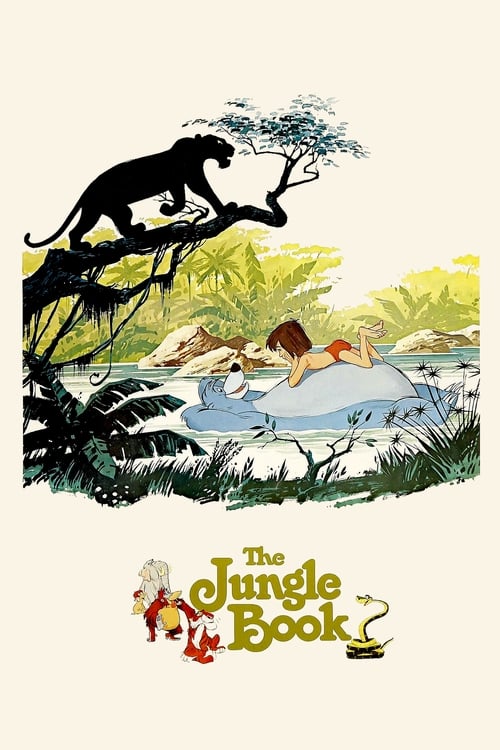
The Jungle Book
1967 · Wolfgang Reitherman
For a low-stakes family evening or a pure nostalgia hit — when you want something sunny and singable that asks nothing of you but still has real charm. Comfort viewing, full stop.
What it's about
Mowgli, a boy raised in the Indian jungle, is being escorted to the safety of the man-village by Bagheera, a wise and increasingly exasperated panther. The trip keeps getting derailed — by Baloo, a big easygoing bear who'd rather teach the kid to loaf and swing than deliver him anywhere, by a python with hypnotic eyes, and by a jazz-mad orangutan king who wants the secret of man's red fire. Hanging over it all is Shere Khan, the tiger with a grudge against humans, which is the whole reason the boy has to leave.
The experience
Loose, warm, and unhurried — it ambles from one song and character bit to the next like a hangout movie for kids, with just enough menace from the snake and the tiger to give it spine. The songs are the kind that stay lodged in your head for decades.
Performances
Phil Harris's Baloo is one of the great voice performances — a whole personality, laid-back and improvisational, that basically invented the modern celebrity-voice animated sidekick. George Sanders gives Shere Khan a silky, purring menace that's scarier than any roar.
The craft
This is Disney's mid-century character animation at its most relaxed and confident: the film runs on personality rather than plot, with animators building whole scenes around a voice actor's rhythm and swagger. The Sherman Brothers' songs and 'The Bare Necessities' do as much storytelling as the script, and the jungle backgrounds have a loose, painterly ease.
Why it matters
The last animated feature Walt Disney personally oversaw, and one of the studio's most durable hits — it set the template of star voice casting and song-driven set pieces that Disney animation ran on for decades after.
Snapshot
The Jungle Book is Walt Disney Productions' nineteenth animated feature and, famously, the last one whose production Walt Disney personally oversaw before his death in December 1966; the film was released the following October. Loosely adapted from Rudyard Kipling's The Jungle Book stories (1894), it follows Mowgli, a "man-cub" raised by wolves, as the panther Bagheera tries to shepherd him toward the safety of the man-village while the boy is repeatedly diverted — by the freewheeling bear Baloo, the hypnotic python Kaa, the swinging orangutan King Louie, and finally the tiger Shere Khan. The picture stands as a hinge in Disney history: it consolidated the studio's mid-century "personality animation" around a cast of star voice performers and songs, and it became one of the studio's most durable commercial properties across decades of theatrical reissue. Its reputation rests less on narrative innovation — the plot is famously episodic and thin — than on character, voice, music, and the buoyant charm of Baloo's philosophy of "the bare necessities."
Industry & production
The film was produced by Walt Disney Productions at the studio's Burbank facility and distributed by Buena Vista, the studio's own distribution arm — the vertically integrated model Disney had maintained since the 1950s. It arrived during a lean and anxious period for the animation division. The very expensive Sleeping Beauty (1959) had underperformed relative to its budget, prompting the studio to adopt the cheaper xerographic inking process beginning with One Hundred and One Dalmatians (1961). The Jungle Book was made within that cost-conscious, xerography-era workflow, with a relatively small cadre of veteran animators and a heavy reliance on established talent.
The best-documented production fact is Walt Disney's unusually direct creative involvement late in his life. Story development is well attested to have been contentious: Disney reportedly found early, darker and more faithful treatments of Kipling too heavy, and pushed the story team toward a lighter, more entertaining approach — instructing them, in accounts repeated by studio historians and by participants like Bill Peet, to not read the source too closely. Peet, a senior story man, developed an early version and departed the studio during the film's gestation after disagreements; Larry Clemmons subsequently shaped the story that was produced. These broad contours are well established, though specific dialogue attributed to Disney in various retellings should be treated as studio lore rather than verified quotation. Precise production budget figures are not reliably part of the public record and should not be invented; what is secure is that the film was a substantial commercial success on release and through repeated reissues, becoming one of the studio's signature titles.
Technology
The Jungle Book is a product of the xerographic era of Disney animation. Rather than hand-inking every cel, animators' pencil drawings were photographically transferred to cels via a xerox process developed at the studio in the late 1950s, which preserved the sketchy vitality of the animators' lines but imposed a characteristic scratchy black outline and constrained the color palette. This technology, first deployed at feature scale on 101 Dalmatians, defined the look of Disney features throughout the 1960s and into the 1970s, and The Jungle Book is one of its warmer, more painterly applications.
Camerawork used the studio's multiplane and standard animation-stand techniques, though the film is more restrained in showy multiplane deep-space effects than the late-1930s and 1940s features had been. Backgrounds were rendered in a soft, tropical watercolor-and-gouache style that reads as lusher than the more graphic, mid-century-modern stylization of 101 Dalmatians. The film was produced for standard theatrical projection with a conventional aspect ratio and monaural optical sound, consistent with studio animated features of its moment.
Technique
Cinematography
As a cel-animated feature, "cinematography" is a matter of layout, staging, and the animation camera rather than a photographed lens. The film's visual grammar favors clear, legible staging over ostentatious camera movement. Layout artists composed the jungle in receding planes of foliage that give scenes depth without calling attention to technique, and the "camera" typically holds steady or tracks gently to follow character action. The most cinematographically expressive passages are the musical set-pieces — Baloo and Mowgli drifting downriver during "The Bare Necessities," or the vertiginous ruined-temple choreography of "I Wan'na Be Like You" — where staging opens up into fuller movement and depth. The dominant principle throughout is readability: the frame is organized to keep the performers' expressions and gestures clear.
Editing
Editing follows classical continuity, cut to the rhythm of dialogue, gesture, and song. The film's structure is frankly episodic — a series of encounters (wolves, Bagheera, Kaa, the elephant patrol, Baloo, King Louie, the vultures, Shere Khan) strung along Mowgli's journey rather than a tightly causal plot. Within scenes the cutting is unobtrusive and performance-driven, giving comic beats and musical numbers room to land. The musical sequences are the most tightly edited, synchronized to the songs' phrasing, while the connective dramatic scenes are relatively relaxed.
Mise-en-scène / staging
Staging is the film's great strength. The animators — working in the "personality animation" tradition — build each sequence around a distinct character's physicality: Baloo's loose-limbed, scat-singing sway; Kaa's coiling, ophidian encirclements and the spiraling hypnosis motif of his eyes; King Louie's jazz-simian bounce; Bagheera's clipped, exasperated dignity. The jungle setting functions as a stage for these performances rather than as a naturalistic ecosystem, with backgrounds kept soft and warm so the boldly outlined figures pop. Reitherman and his animators frequently reused and refined poses and timing developed across the studio's 1960s features, and the film's staging shows that accumulated craft in its economy and confidence.
Sound
Sound is central to the film's identity. The music — songs largely by Richard M. and Robert B. Sherman, with the standout "The Bare Necessities" written by Terry Gilkyson — carries much of the film's tone and remains its most enduring legacy. George Bruns provided the orchestral score. The soundtrack leans into a jazz idiom unusual for a Disney fairy-tale feature, most audibly in "I Wan'na Be Like You," performed in a Dixieland/scat register. Voice performance and music are tightly interwoven: the songs emerge from character and are performed in the actors' own vocal personalities rather than by separate singing doubles in most cases. The film was released with monaural sound typical of its era.
Performance
Vocal performance is arguably the film's true medium. Phil Harris's Baloo is the defining example of Disney's mid-century shift toward casting recognizable star personalities and building characters around their vocal presence — Harris's relaxed, improvisatory delivery shaped Baloo's animation as much as the reverse. Sebastian Cabot's Bagheera supplies dry, patrician counterpoint; Sterling Holloway brings his familiar reedy, insinuating voice to Kaa; Louis Prima's King Louie channels the bandleader's own swing-era energy; and George Sanders lends Shere Khan a silken, aristocratic menace. Bruce Reitherman, the director's son, voiced Mowgli. This ensemble established a template — the celebrity voice cast as the animating spark — that the studio would return to repeatedly.
Narrative & dramatic mode
The dramatic mode is picaresque comedy with a coming-of-age spine. Mowgli's journey toward the man-village provides a through-line, but the film proceeds as a sequence of self-contained encounters, each functioning as a set-piece with its own comic or musical logic. The stakes — Shere Khan's threat — are established more by reputation than by sustained presence; the tiger appears late, concentrating the film's only real menace into its final act. Emotionally, the film is organized around the tension between belonging and safety: Mowgli's desire to stay in the jungle with Baloo versus Bagheera's insistence that the boy belongs with his own kind. This conflict is resolved not by argument but by the appearance of the girl from the man-village, which redirects Mowgli's desire and delivers the ending. The tone is predominantly warm and comic, with the darker Kipling material of predation, law, and exile largely softened.
Genre & cycle
The film sits at the intersection of the Disney animated feature, the family-adventure, and the musical. Within Disney's own output it belongs to the studio's 1960s cycle of xerography-era features — following 101 Dalmatians and The Sword in the Stone (1963) — which shifted away from the fairy-tale romance mode of the "Silver Age" toward more contemporary comedy, star voices, and looser episodic structures. It is often read as inaugurating, or at least strongly typifying, a "buddy comedy" strain in Disney animation, with the Baloo–Mowgli pairing as its centerpiece. Its jazz-inflected musical numbers also distinguish it from the operetta-adjacent scores of the earlier features, aligning it with a mid-century American popular-music sensibility.
Authorship & method
Authorship here is corporate and collaborative in the classic Disney manner, with Walt Disney's supervisory taste as the decisive shaping force in the story's lightening. Wolfgang "Woolie" Reitherman, the director, was one of Disney's "Nine Old Men" — the core cadre of veteran animators — and by the 1960s the studio's principal feature director; his sensibility favored strong entertainment values, comic momentum, and reuse of proven timing and staging. The animation was led by fellow "Nine Old Men" veterans, notably Milt Kahl, Frank Thomas, Ollie Johnston, and John Lounsbery, whose character work defines the film's performances. On the story side, Bill Peet developed an early treatment before leaving the studio, and Larry Clemmons shaped the produced version. Music — the film's most celebrated authorial contribution — came from Terry Gilkyson ("The Bare Necessities") and Richard M. and Robert B. Sherman (the remaining songs), with George Bruns scoring. There is no single-author "cinematographer" in the live-action sense; the equivalent craft credit belongs collectively to the layout and background departments. Editorial and sound craft likewise followed the studio's departmental, collaborative method.
Movement / national cinema
The film is a product of the American studio animation tradition as centered and defined by Disney itself. It does not belong to an avant-garde or art-cinema movement; rather, it exemplifies the mainstream Hollywood animated feature at mid-century — commercially oriented, technically polished, and rooted in the "personality animation" aesthetic Disney had pioneered since the 1930s. Within American animation history it stands opposite the more graphically stylized, modernist tradition of UPA and the anarchic energies of theatrical-short studios like Warner Bros.; Disney's house style prized fluid, believable character movement and emotional warmth, and The Jungle Book is a late-1960s statement of that ethos.
Era / period
Released in October 1967, the film arrives at the end of Hollywood's studio-era certainties and on the cusp of the New Hollywood. It is, within the animation division, the close of the Walt Disney era proper — the final feature he personally guided — and the beginning of a transitional period in which the studio, without its founder, would rely heavily on veteran talent and increasingly on formula. The film's jazz idiom and celebrity-voice casting reflect 1960s popular culture, even as its craft and worldview remain rooted in an older studio tradition. Historically it is often treated as the last title of Disney animation's "classic" run before the leaner, more uneven 1970s.
Themes
The film's central theme is belonging — where one's true home lies, and the pull between the freedom of the jungle and the safety (and destiny) of the man-village. Around this runs a theme of friendship and mentorship, embodied in the contrasting guardianships of the indulgent Baloo and the responsible Bagheera, and in the film's warm conviction that companionship is itself a "bare necessity." There is a gentler current about growing up and letting go: the ending's turn toward the man-village frames maturation as a movement toward one's own kind. The film also carries, more lightly than Kipling, ideas about nature, law, and predation — Shere Khan as an implacable threat, Kaa as seductive danger — though these darker registers are consistently softened in favor of comedy and song. The Kipling source's colonial and imperial subtexts are largely stripped away in Disney's adaptation, and some later commentary has scrutinized the film's characterizations — particularly the jazz-coded King Louie sequence — for racial connotations; this is a live and contested strand of the film's critical reception rather than a settled reading, and is noted here as such.
Reception, canon & influence
The Jungle Book was a major commercial success on its 1967 release and became one of Disney's most reliably profitable properties across successive theatrical reissues in the following decades, a status secure in the historical record even where exact grosses are not. Critically it has long been regarded as one of the more purely entertaining Disney features, buoyed above all by "The Bare Necessities" — an Academy Award-nominated song that became a standard — and by the vivid voice performances of Phil Harris and Louis Prima. The consensus critical view holds the film's characters and music in high regard while acknowledging its slack, episodic narrative; that dual assessment has remained remarkably stable over time.
Influences on the film (backward): The primary source is Kipling's The Jungle Book stories, though the adaptation is deliberately loose. More proximately, the film draws on Disney's own accumulated tradition of personality animation and on the mid-century American popular-music culture — Dixieland jazz, swing, and the star-bandleader persona of Louis Prima — that shapes its songs and voices. Its casting philosophy extends the studio's growing 1960s practice of building animated characters around recognizable performers.
Legacy / what it shaped (forward): The film's influence within Disney was substantial. Its buddy-comedy warmth and star-voice methodology fed directly into the studio's subsequent work; the "personality plus celebrity voice plus hummable song" formula it crystallized became a Disney template. Phil Harris was quickly re-employed in a similar register (as Baloo-like characters in later studio features), and the film's animation — economical, reuse-savvy, performance-first — typifies methods the studio carried through the 1970s. Its songs, "The Bare Necessities" above all, entered the popular songbook and the Disney canon, sustaining the property through soundtrack, home-video, stage, and eventual live-action-hybrid remake culture. The film also stands as a touchstone in ongoing scholarly and popular debates about adaptation, softening of literary sources, and racial representation in mid-century animation — a sign of its continued cultural presence rather than mere nostalgia. Where the specific historical record on production details is genuinely thin, this account has flagged it rather than filled the gap.
Reception
A massive hit in 1967 — released ten months after Walt Disney's death, it played as both a smash and a farewell, effectively bankrolling the studio's survival. Now it's remembered warmly as the end of Walt's era, though modern viewings come with more squirming over the King Louie sequence.
How The Jungle Book was received, from release to now →
Influences: the films it descends from and the films it influenced
- Snow White and the Seven Dwarfs (1937) — Established the Disney feature template Reitherman inherited: full personality animation carrying a song-driven narrative, with dwarfs whose individuated body-acting is the direct forebear of Baloo and Bagheera's performance-first characterization.
- Pinocchio (1940) — The Nine Old Men's breakthrough in nuanced acting-through-drawing (weight, hesitation, eye-line) — the Milt Kahl/Frank Thomas craft that later defines Shere Khan's feline restraint and Bagheera's dry exasperation.
- Dumbo (1941) — Model for economical, reuse-savvy production under budget pressure, and for folding hot Dixieland/scat jazz into the score ('When I See an Elephant Fly') — the crow sequence prefigures King Louie's swing number.
- Alice in Wonderland (1951) — Episodic-picaresque structure built as a string of encounters, each animated character shaped around a recognizable comic voice (Ed Wynn, Sterling Holloway) — the casting-to-persona method Jungle Book pushes further.
- Lady and the Tramp (1955) — Wrote a real jazz/blues idiom into a Disney feature via Peggy Lee's performer-built characters ('He's a Tramp'), normalizing the star-singer-as-animated-character approach Louis Prima embodies.
- One Hundred and One Dalmatians (1961) — Introduced the xerographic ink process — the sketchy, cost-saving Xerox line that Jungle Book adopts wholesale, giving it the same rough graphic outline instead of hand-inked cels.
- The Aristocats (1970) — Reitherman's direct follow-up reruns the formula — scat-singing jazz cat (Scatman Crothers/Phil Harris energy) as the King Louie/Baloo swing archetype, celebrity voices, and the same loose road-movie shape.
- Robin Hood (1973) — Recasts Phil Harris as Little John — a literal Baloo redraw — and reuses Jungle Book's animation, most notoriously recycling the dance choreography, epitomizing the studio's reuse-savvy method.
- The Many Adventures of Winnie the Pooh (1977) — Extends the episodic-picaresque construction and Sherman Brothers song scaffolding, with Sterling Holloway's celebrity-voice characterization carried over as the studio's continued casting-to-persona method.
- The Rescuers (1977) — The Nine Old Men's late collaborative feature, built like Jungle Book around name voices (Bob Newhart, Eva Gabor) whose comic timing drives the personality animation rather than plot mechanics.
- Oliver & Company (1988) — Revives the 'celebrity voice + pop idiom + hummable song' package (Billy Joel as a street-smart Dodger) directly descended from the Baloo/Louis Prima star-persona-as-character formula.
- Aladdin (1992) — Fulfillment of the celebrity-voice template Jungle Book crystallized: Robin Williams's Genie is built entirely around the star's improvisational persona, the extreme endpoint of casting animation to a performer.
- The Lion King (1994) — A Kipling-descended animal coming-of-age with a wise-mentor/comic-sidekick pairing (Timon & Pumbaa as the Baloo carefree-philosophy heirs, 'Hakuna Matata' echoing 'Bare Necessities') voiced by comedians.
- Shrek (2001) — Carries the celebrity-voice-cast plus mismatched-buddy-comedy road structure into the DreamWorks era, monetizing the star-persona casting logic Jungle Book pioneered for animated features.
- The Sword in the Stone (1963) — Immediate predecessor sharing the identical creative apparatus: Reitherman direction, Sherman Brothers songs, xerographic look, and a loose episodic mentor-pupil structure (Merlin/Wart mirroring Baloo/Mowgli).
- Mary Poppins (1964) — Concurrent showcase of the Sherman Brothers' hummable, character-defining songcraft ('Spoonful of Sugar') that the studio simultaneously channeled into Jungle Book's numbers like 'I Wan'na Be Like You.'
Similar films
- The Lion King (1994) — influence & lineage · same viewing thread
- One Hundred and One Dalmatians (1961) — influence & lineage · same viewing thread
- Mary Poppins (1964) — influence & lineage
- Shrek (2001) — influence & lineage
- Aladdin (1992) — influence & lineage · same viewing thread
- Fantasia (1940) — same viewing thread
- Puss in Boots: The Last Wish (2022) — shared sensibility
- The Boy and the Heron (2023) — shared sensibility
All the films related to The Jungle Book →
Watch it with: curated runs of related films
- Disney's Animated Golden Ages — Watch these together to trace Disney's storybook house style across three eras — the 1940 concert experiment, the hand-drawn renaissance, and the CG revival — and hear how each generation quotes the last.