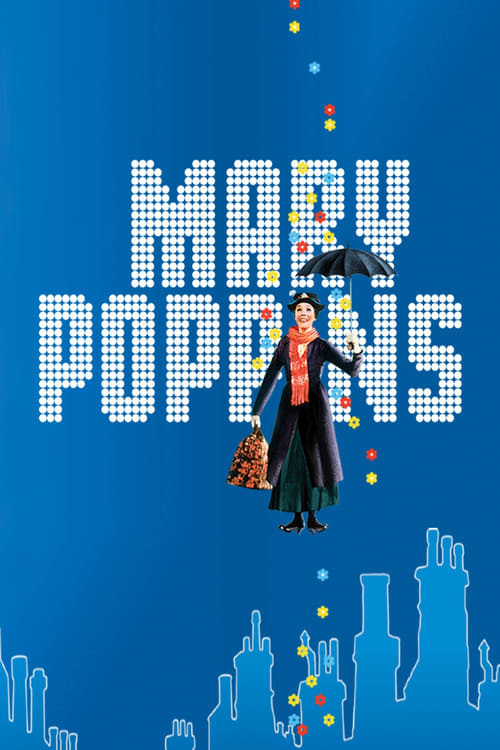
Mary Poppins
1964 · Robert Stevenson
For a family movie night or a rainy-day comfort watch when you want songs you already half-know and a world where magic is delivered with a straight face — pure, restorative pleasure.
What it's about
In Edwardian London, a banker's household is fraying — the children run through nannies, the father lives by the clock, and nobody quite talks to anyone. Then a nanny floats down out of the sky with an umbrella and a carpet bag, and her brand of matter-of-fact magic — sidewalk-chalk worlds, tea parties on the ceiling, rooftop chimney sweeps — begins nudging the whole family back toward each other.
The experience
Buoyant and generous, a parade of songs and set pieces with an unexpected melancholy underneath — it's really about a father learning to see his children. Practically perfect entertainment that earns its sentiment.
Performances
Julie Andrews, in her screen debut, is definitive as Mary Poppins — crisp, warm, and just tart enough — a performance that won her the Academy Award. Dick Van Dyke throws himself into Bert with irresistible, rubber-limbed enthusiasm.
The craft
Disney's studio craft at full stretch: the Sherman brothers' songbook ('A Spoonful of Sugar,' 'Chim Chim Cher-ee,' 'Supercalifragilisticexpialidocious'), lavish Edwardian sets, and the era's most seamless blend of live actors dancing through hand-drawn animation. The jump into the chalk drawing remains a landmark of movie magic, and it's a treat on a big screen with the songs turned up.
Why it matters
A defining triumph of Walt Disney's career — thirteen Oscar nominations, five wins — and the template against which every family musical and live-action/animation hybrid since has been measured.
Snapshot
Mary Poppins is the fullest realization of Walt Disney's mid-century ambition to fuse the storytelling machinery of the animated feature with the prestige of the live-action musical. Adapted from P. L. Travers's episodic children's books, it transposes their tart, faintly forbidding English nanny into a warmer, song-driven confection set in an Edwardian London that exists mostly as studio artifice. The film pairs Julie Andrews — in her screen debut — with Dick Van Dyke across a series of set pieces that move fluidly between photographed reality and hand-drawn fantasy. It became one of the defining commercial and critical triumphs of Disney's live-action program, earning thirteen Academy Award nominations and five wins, and it remains a touchstone for the integrated family musical, the live-action/animation hybrid, and the studio's self-image as a purveyor of wholesome spectacle.
Industry & production
The film was a passion project for Walt Disney personally, and its long gestation is one of the better-documented episodes in the studio's history — though much of the popular account has been colored by the dramatized version in Disney's own later film Saving Mr. Banks (2013), which should be treated as interpretation rather than record. Disney courted P. L. Travers for the screen rights over a period of years, and Travers's resistance to the project — her distaste for animation and for the softening of her character — is well attested in the historical record, even if specific exchanges are often reconstructed. She was eventually granted script consultation, and her dissatisfaction with the finished film is likewise well established.
Production fell within Disney's live-action division at a moment when the studio was expanding aggressively beyond animation into features, television, and theme-park development. Mary Poppins functioned as a flagship: a large-budget musical mounted almost entirely on the Disney soundstages in Burbank, drawing on the studio's animation, effects, and music departments as a single integrated apparatus. That vertical integration — songwriters, choreographers, matte painters, and animators all in-house — is central to understanding how the film achieves its seamless movement between media. The picture was a major commercial success and is generally credited as one of the studio's most profitable releases of the era; precise figures vary across sources, so they are better characterized qualitatively than quoted. Its returns are frequently linked to Disney's ability to fund later expansion.
Technology
Technically, the film's signature achievement is its traveling-matte compositing of live actors into animated environments, most spectacularly in the "Jolly Holiday" sequence. Disney's effects team refined the sodium vapor process (sometimes called the "yellowscreen" technique), in which actors are photographed against a screen lit by monochromatic sodium light; a beam-splitter prism directs the sodium wavelength to a separate matte negative while the color image is captured normally. The result is a cleaner, higher-fidelity matte edge than the blue-screen methods then common, allowing fine detail — hair, translucent fabric — to be held against the composited background. Ub Iwerks, Disney's veteran technical innovator, was closely associated with adapting and perfecting the process at the studio. The film's effects work was recognized with the Academy Award for Special Visual Effects, credited to Peter Ellenshaw, Eustace Lycett, and Hamilton Luske; Ellenshaw's matte paintings of a rooftop London are among the film's most celebrated images.
The picture was shot in Technicolor. Live action and animation had been combined at Disney and elsewhere for decades — the Alice Comedies of the 1920s, Song of the South (1946), and MGM's Gene Kelly/Jerry the Mouse dance in Anchors Aweigh (1945) are the usual antecedents — but Mary Poppins is generally regarded as the point at which the technique reached a new standard of polish and was deployed at feature length as a fully integrated musical device rather than a novelty insert.
Technique
Cinematography
Edward Colman photographed the film in a bright, high-key register appropriate to a studio-bound fantasy; the imagery is legible and saturated rather than atmospheric, which suits a musical built around continuous visibility of gesture and dance. The camera is largely at the service of staging and effects: compositions are framed to leave room for animated elements and matte extensions, and the London exteriors are constructed from painted backings and miniatures rather than location work. The artificiality is not a limitation the film apologizes for but an aesthetic — a storybook London whose flatness and painterly skies are part of the address to children.
Editing
Cotton Warburton's editing won the Academy Award for Film Editing, and the award points to the film's most demanding technical problem: synchronizing photographed performers with animated action and pre-recorded songs so that the two never slip. In the "Jolly Holiday" and "Step in Time" numbers, cutting must hold musical time, dance phrasing, and effects continuity simultaneously. The film's overall structure is episodic, inherited from Travers's stand-alone chapters, and the editing manages transitions between more or less self-contained set pieces rather than a tightly causal plot.
Mise-en-scène / staging
The film's world is a designed one throughout — the Banks household at Cherry Tree Lane, the bank, the chimney-topped rooftops — and staging is organized around the musical number as the basic unit. Choreography by Marc Breaux and Dee Dee Wood shapes the large ensemble sequences, above all "Step in Time," in which chimney sweeps dance across the rooftops in an extended production number that is the film's kinetic centerpiece. The mise-en-scène consistently subordinates realism to legibility and pattern: crowds, props, and animated companions are arranged to keep the musical action readable and frontal.
Sound
Sound is the film's organizing principle. The songs by Richard M. and Robert B. Sherman — "A Spoonful of Sugar," "Chim Chim Cher-ee," "Supercalifragilisticexpialidocious," "Feed the Birds," "Let's Go Fly a Kite" — are diegetically motivated but function as the spine of the narrative, each attached to a lesson, mood, or transformation. Irwin Kostal supervised and conducted the score, and the Sherman brothers' work won the Academy Award for Original Music Score, with "Chim Chim Cher-ee" winning Best Song. The music was pre-recorded and the numbers built to playback, standard for the integrated musical, and the film's sound design leans on the interplay of song, dialogue, and the whimsical effects punctuation of the fantasy sequences. "Feed the Birds" is frequently cited as Walt Disney's personal favorite among the film's songs; this is a durable and well-attested piece of studio lore.
Performance
Julie Andrews's Mary Poppins is the film's controlling performance — brisk, self-possessed, and lightly ironic, holding a note of Travers's original severity within an otherwise warmed characterization. Andrews won the Academy Award for Best Actress for the role, a result made especially conspicuous because she had been passed over for the screen My Fair Lady despite originating Eliza on stage; the Oscar is one of the most cited "vindication" narratives in Hollywood history. Dick Van Dyke plays Bert, the chimney sweep and chorus-figure, with broad physical comedy and a Cockney accent that has become a byword for unconvincing dialect work — a criticism Van Dyke himself has acknowledged over the years. Van Dyke also appears, heavily disguised, as the elderly banker Mr. Dawes Sr., credited under an anagrammatic pseudonym. David Tomlinson's Mr. Banks and Glynis Johns's Mrs. Banks (whose "Sister Suffragette" ties the household to the era's politics) anchor the domestic drama that the fantasy exists to repair.
Narrative & dramatic mode
The dramatic mode is the integrated musical fantasy, in which songs and magical episodes are the mechanism of change rather than ornaments to a realistic plot. The narrative is episodic and moral: a magical nanny arrives in a household where the father's rigidity and absence have estranged him from his children, conducts a series of enchanted lessons, and departs once her work is done. Crucially, the true object of transformation is not the children but the father, Mr. Banks — the film's emotional resolution is his reconciliation with his family and his rediscovery of play, sealed by the closing kite-flying. Mary Poppins herself is a static figure, an agent of change who does not change; the drama belongs to the humans around her. This structure — an outsider who heals a broken family and then withdraws — is one of the film's most reproduced narrative templates.
Genre & cycle
Mary Poppins sits at the intersection of the Hollywood musical, the family/children's fantasy, and Disney's own live-action feature cycle. It belongs to the broader 1960s boom in large-scale roadshow and family musicals — a cycle that would soon include The Sound of Music (1965), also starring Andrews — and it helped confirm the commercial viability of the lavish family musical at a moment when the genre was otherwise thought to be aging. Within Disney, it is the high-water mark of a run of live-action fantasies and comedies directed largely by Robert Stevenson, and the definitive statement of the studio's live-action/animation hybrid as a genre in itself.
Authorship & method
Authorship of Mary Poppins is genuinely collective, and the film is a useful case against pure auteurism: its guiding sensibility is Walt Disney's as producer, executed through a stable of specialist collaborators. Robert Stevenson, the British-born director, was among the most prolific and commercially successful directors of the studio era, helming a long series of Disney hits (Old Yeller, The Absent-Minded Professor, and others); his craft is efficient and self-effacing, organizing enormous logistical complexity without imposing a strong personal signature. The screenplay by Bill Walsh and Don DaGradi restructured Travers's episodes into a musical throughline and invented the reformation of Mr. Banks as the spine.
The most identifiable creative voices are musical: the Sherman brothers, whose songs shape the film's structure and tone, and choreographers Marc Breaux and Dee Dee Wood. Cinematographer Edward Colman and editor Cotton Warburton served the integrated design, while Peter Ellenshaw (mattes) and the effects team supplied the visual grammar of the fantasy. The "method," in short, was the Disney studio system operating at full capacity — an animation-house model of specialized departments applied to a live-action feature.
Movement / national cinema
The film is a product of the Hollywood studio system rather than any critical movement, and it is American in production despite its thoroughly English subject. Its Edwardian London is a Hollywood fabrication — a fact the film's history foregrounds, since it was precisely this Americanized, animated Englishness that Travers objected to. It has no meaningful connection to contemporaneous movements such as the British New Wave or the various European new cinemas that were reshaping art film in the same years; it belongs instead to the tradition of the American family entertainment machine at its most confident.
Era / period
Mary Poppins arrived in 1964, near the end of the classical studio era and the roadshow-musical boom, and just before the industry upheavals of the later 1960s. It reflects a particular early-1960s equilibrium: major studios still commanding large family audiences, the musical still a prestige form, and Disney consolidating its identity as a diversified entertainment company on the eve of Walt Disney's death in 1966. The film's Edwardian setting is itself a nostalgic gesture, looking back to a turn-of-the-century order even as the surrounding culture accelerated away from it — a doubled nostalgia that partly accounts for its enduring comfort-object status.
Themes
The film's central theme is the repair of the family, specifically the recovery of imagination, play, and tenderness within a household governed by discipline, money, and time. Mr. Banks embodies an over-rationalized adult world — the bank, the clock, the ledger — and the fantasy's purpose is to restore his capacity for wonder and connection. Secondary strands include the dignity of the humble ("Feed the Birds" and the chimney sweeps set charity and labor against banking's cold arithmetic), the tension between order and freedom (Mary Poppins is paradoxically both, "practically perfect" yet the bringer of chaos and delight), and the passage of childhood, with the nanny's inevitable departure marking the children's growth. Glynis Johns's suffragette subplot lightly registers the era's gender politics, though the film treats it comically rather than earnestly.
Reception, canon & influence
Critically and commercially the film was a major success on release, and its thirteen Academy Award nominations — extraordinary for a family musical — together with five wins (Actress, Film Editing, Original Music Score, Song, Visual Effects) cemented its prestige; it was also nominated for Best Picture. Its most famous dissenting voice was P. L. Travers herself, whose lasting displeasure with the adaptation is among the best-documented author-studio conflicts in film history.
Looking backward, the film draws on decades of accumulated craft: the Hollywood integrated musical of the 1930s–50s, the live-action/animation experiments running from Disney's own Alice Comedies through Song of the South and MGM's Anchors Aweigh, and the studio's animation-department expertise in matte and effects work. Looking forward, its influence is broad and durable. It set a benchmark for the polished live-action/animation hybrid that later films — including Disney's own Bedknobs and Broomsticks (1971, again directed by Stevenson with the Sherman brothers) and, in a different technical register, Who Framed Roger Rabbit (1988) — would build upon. It helped validate the family musical for the mid-1960s boom that The Sound of Music would crown. Its "magical outsider heals a family and departs" template recurs across children's fantasy. And the film's own afterlife — a stage musical adaptation, the sequel Mary Poppins Returns (2018), and the meta-cinematic Saving Mr. Banks — testifies to its persistence as one of Disney's foundational live-action properties and a permanent fixture of the family-film canon.
Reception
No flop-to-classic arc here — it was a colossus on arrival, earning 13 Oscar nominations (still the most ever for a Disney film) and winning five. What's shifted is the frame: it's now watched as much through the Travers-vs-Disney battle over the adaptation as on its own sugary terms.
How Mary Poppins was received, from release to now →
Influences: the films it descends from and the films it influenced
- Alice's Wonderland (1923) — The Alice Comedies pioneered the composite of a live-action performer inside a hand-drawn animated world that Disney's effects department refined into 'Jolly Holiday' four decades later.
- Fantasia (1940) — Established the studio's discipline of cutting and choreographing animation in exact synchronization to a pre-recorded score — the editing/animation-sync grammar behind Poppins's dancing penguins and rooftop numbers.
- The Three Caballeros (1944) — Disney's most ambitious pre-Poppins live-action/animation feature, working out the matte and rear-projection techniques for placing filmed actors among cartoon figures that Peter Ellenshaw's team inherited.
- Anchors Aweigh (1945) — Gene Kelly's dance duet with the animated Jerry Mouse is the direct staging template for Dick Van Dyke's dance with the animated penguin waiters.
- Song of the South (1946) — Disney's first live-action feature to fold its actors into fully animated environments (the Uncle Remus tales), proving out the hybrid feature form Poppins scaled up.
- The Wizard of Oz (1939) — Model for the high-key, wholly studio-built Technicolor fantasy and the 'magical figure arrives to reorder a family' template executed on soundstages rather than location.
- Meet Me in St. Louis (1944) — Codified the integrated musical in which songs erupt from and advance a domestic-family narrative, the structural spine Walsh and DaGradi imposed on Travers's loose episodes.
- Singin' in the Rain (1952) — Perfected the musical number as a self-contained showpiece unit built on studio artifice, the staging logic behind 'Step in Time' and 'Supercalifragilistic.'
- The Birds (1963) — Ub Iwerks' sodium vapor compositing process, refined on The Birds' bird-layering sequences, was immediately applied by Disney for the seamless live-action/animation integration of the 'Jolly Holiday' sequence — Iwerks winning an Academy Award for the same optical workflow in an entirely different tonal register.
- Bedknobs and Broomsticks (1971) — Same director and Sherman brothers reprising the live-action/animation hybrid, whose 'Beautiful Briny' underwater and Naboombu soccer-match sequences directly restage the Poppins composite method.
- Willy Wonka & the Chocolate Factory (1971) — Carries the roadshow-era family musical fantasy of a magical outsider presiding over a candy-colored, studio-fabricated wonderland with integrated song numbers.
- Pete's Dragon (1977) — Disney's continuation of the traveling-matte live-action/animation feature, compositing a hand-drawn dragon into live musical numbers built on the Poppins effects lineage.
- Who Framed Roger Rabbit (1988) — Pushed the live-action/animation composite to full character interaction and camera movement, the technical apex of the hybrid form Poppins benchmarked.
- Enchanted (2007) — Self-consciously revives the Poppins mode — hand-drawn-to-live-action transition plus integrated production-number musical staging in a real cityscape.
- Mary Poppins Returns (2018) — Deliberately reconstructs the original's 2D hand-drawn animation hybrid and Sherman-style integrated songbook rather than updating to CGI, a direct formal homage.
- Like Stars on Earth (2007) — Pioneers hand-drawn animation folded into live action as a portal into a child's imaginative world, the technical lineage behind Taare's animated daydream interludes.
- Wonka (2023) — The British-studio 'magical outsider transforms a gray city through song' blueprint whose rooftop chimney-sweep number staging is echoed in Wonka's crane-tracked street ensembles blending practical dance and effects.
- The Muppet Christmas Carol (1992) — Disney's template for songbook-driven sentiment anchored by a straight human lead moving through fantastical practical staging without winking at it.
- The Sound of Music (1965) — Reunites Julie Andrews as another singing governess who heals a motherless family, and shares Poppins's choreographers Marc Breaux and Dee Dee Wood within the same roadshow-musical boom.
- Chitty Chitty Bang Bang (1968) — Sherman brothers songbook and Dick Van Dyke fronting a live-action family fantasy musical, extending the exact songwriting-plus-whimsy formula minus the animation hybrid.
- The Jungle Book (1967) — Concurrent showcase of the Sherman Brothers' hummable, character-defining songcraft ('Spoonful of Sugar') that the studio simultaneously channeled into Jungle Book's numbers like 'I Wan'na Be Like You.'
Similar films
- The Sound of Music (1965) — influence & lineage
- Fantasia (1940) — influence & lineage
- The Wizard of Oz (1939) — influence & lineage
- Singin' in the Rain (1952) — influence & lineage
- Willy Wonka & the Chocolate Factory (1971) — influence & lineage
- Spirited Away (2001) — often watched together
- Wonka (2023) — shared sensibility
- One Hundred and One Dalmatians (1961) — shared sensibility