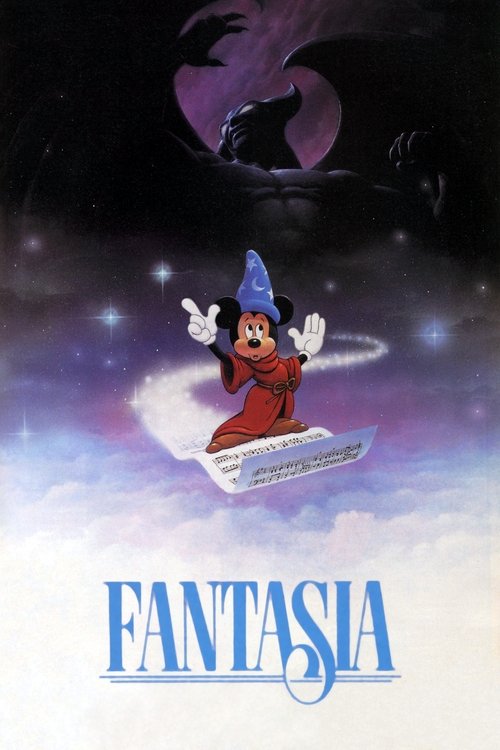
Fantasia
1940 · Samuel Armstrong
For when you want to put something beautiful on and just float — a rainy-afternoon or altered-headspace watch, great with kids for some movements and surprisingly heavy for others. Comfort viewing with occasional flashes of the sublime.
What it's about
Walt Disney's grand experiment: a two-hour concert film in eight movements, with Leopold Stokowski conducting Bach, Tchaikovsky, Stravinsky, Beethoven, Mussorgsky and more while animators give each score a visual life of its own. There's no plot — instead you get abstract shapes surfing a fugue, dancing mushrooms and fairies, Mickey Mouse in over his head as a sorcerer's apprentice, dinosaurs rising and falling to Stravinsky, and a mountaintop demon summoning the night.
The experience
Dreamlike and unhurried — you surrender to it the way you would a concert, drifting from whimsy to comedy to genuine awe and, in its darkest stretch, real menace. Some passages are pure joy; others are strange and cosmic in a way that stays with you.
The craft
Frame for frame some of the most ambitious hand-drawn animation ever attempted, from pure abstraction to painterly myth-making, married to a full orchestra recorded with pioneering multi-channel sound. It was designed as an overwhelming audiovisual event, and it still is one — the better your screen and speakers, the closer you get to what Disney intended.
Why it matters
A commercial gamble that became a landmark: the film that argued animation could be high art, introduced generations to classical music, and pushed sound technology decades ahead of its time.
Snapshot
Fantasia is Walt Disney's third animated feature and the most anomalous object in the studio's history: a two-hour "concert feature" in eight movements, without a continuous story, without dialogue except a few lines from Mickey Mouse, and hosted on camera by a music critic. Leopold Stokowski conducts musicians of the Philadelphia Orchestra through Bach, Tchaikovsky, Dukas, Stravinsky, Beethoven, Ponchielli, Mussorgsky and Schubert; the animation supplies not illustration so much as a proposed visual equivalent for each score — abstract at the start, mythological and comic in the middle, cosmological and eschatological at the ends.
The director credit here requires immediate qualification. Fantasia has no single director. Samuel Armstrong directed the Toccata and Fugue and Nutcracker Suite segments and is the name that surfaces first in most databases, but the film is a portmanteau supervised by Ben Sharpsteen, with James Algar (The Sorcerer's Apprentice), Bill Roberts and Paul Satterfield (Rite of Spring), Hamilton Luske, Jim Handley and Ford Beebe (Pastoral Symphony), T. Hee and Norman Ferguson (Dance of the Hours), and Wilfred Jackson (Night on Bald Mountain / Ave Maria) each responsible for a movement. Story development was directed by Joe Grant and Dick Huemer. Any account of Fantasia as auteur cinema has to reckon with the fact that its true author-function is Walt Disney as impresario, and its unifying voice is Stokowski's.
It failed commercially on first release, was mutilated for general distribution, and spent thirty years being reissued in compromised forms before its reputation stabilized. It is now among the most consequential experiments in the history of animation.
Industry & production
The project began small. In 1937 Disney intended a deluxe Silly Symphony built on Paul Dukas's L'apprenti sorcier, with Mickey Mouse in the title role — a deliberate attempt to refresh a character who had been overtaken in popularity by Donald Duck. The widely repeated account is that Disney and Stokowski met by chance at a Hollywood restaurant and that Stokowski volunteered to conduct without fee; the details of that meeting come down to us through studio recollection rather than documentation, but the collaboration itself is thoroughly on the record from late 1937 onward.
Costs on the short escalated past any plausible return for a two-reeler. Disney's response was characteristic: rather than cut back, he expanded, absorbing the sorcerer episode into a feature-length "concert program." Stokowski and the critic-composer Deems Taylor — then a household name in America through his radio intermission talks — helped assemble the repertoire across 1938–39 story meetings, several of which were transcribed and survive as an unusually rich record of the film's conception.
Production overlapped with Pinocchio and with the studio's move to the new Burbank lot, and the two features together strained Disney finances badly. The generally cited negative cost for Fantasia is around $2.28 million, roughly double a normal Disney feature of the period and far beyond what a roadshow release could recover. Disney distributed the film himself, initially bypassing RKO, in reserved-seat engagements beginning at the Broadway Theatre in New York on 13 November 1940 — necessary because the sound system was an installation, not a print. Fewer than a dozen theaters were ever equipped (accounts of the exact number vary), and the European market that had made Snow White enormously profitable was closed by the war.
RKO took the film over in 1941–42 and cut it to roughly eighty minutes with a conventional mono track, removing most of Taylor's narration. The financial shortfall is part of the context — though not the sole cause — of the 1941 Disney animators' strike and of the studio's retreat during the war years into package features, wartime contract work and cheaper production models. The ambition of Fantasia was not attempted again at Disney for decades.
Technology
Fantasia's central technical achievement is Fantasound, the first commercially exhibited stereophonic sound system in American cinema. Developed by Disney engineers William E. Garity and John N. A. Hawkins in collaboration with RCA, it grew directly out of the recording problem: Stokowski had participated in Bell Telephone Laboratories' stereophonic transmission experiments in Philadelphia in the early 1930s and arrived with an unusual appetite for multichannel capture.
The Philadelphia sessions (recorded in the Academy of Music, with additional work in Los Angeles) used an array of roughly thirty microphones feeding a bank of optical recorders, allowing orchestral sections to be captured on discrete tracks and remixed afterward — in effect, multitrack recording well before magnetic tape made it routine. Playback ran a separate strip of film carrying multiple optical tracks: three audio channels behind the screen plus a control track that governed amplitude and channel steering, permitting dynamic range far beyond a standard optical mono print and allowing sound to be moved across the screen. The panoramic potentiometer — the "pan pot," now standard in every mixing console in the world — was devised for this purpose. Additional loudspeakers placed in the auditorium produced early surround effects, notably in the Toccata and Fugue and Ave Maria.
The system was expensive, wartime materials were scarce, and the rollout collapsed. The Academy recognized it with honorary awards in early 1942 — to Disney, Garity, Hawkins and RCA for the sound achievement, and to Stokowski and his associates for the visualization of music — but Fantasound never became an industry standard. Its ideas returned via Cinerama and CinemaScope's magnetic tracks in the 1950s, and its logic is the ancestor of every multichannel format since.
On the image side, Fantasia is the most extensive workout the Disney multiplane camera ever received. Introduced in The Old Mill (1937), the multiplane separated artwork onto independently movable planes to produce true parallax on camera moves; the Pastoral and the closing procession of Ave Maria depend on it. Photography was three-strip Technicolor, 1.37:1, with dye-transfer printing that the film's colorists exploited for the deep chromatic saturation of the Nutcracker and the near-monochrome of Bald Mountain.
Technique
Cinematography
Fantasia has no cinematographer in the conventional sense; its images were exposed frame by frame by the animation camera department, and the film's "camerawork" is largely a matter of what the multiplane crane could be made to do. The exception is the live-action material — the orchestra in silhouette, Taylor at his lectern, the tuning sequence, Mickey's handshake with Stokowski — whose photography is generally attributed to James Wong Howe, and which is lit in hard, colored key light against darkness, closer to expressionist theater than to concert documentary.
Within the animation, the governing camera idea is movement as musical phrasing. The Toccata and Fugue opens with the camera essentially inside the orchestra and then dissolves the players into abstract fields; the Nutcracker uses long lateral tracks that follow melodic lines; the Ave Maria culminates in a single sustained forward move through a forest of Gothic arches, a shot notorious in studio lore for its difficulty and for having to be remade under deadline (the anecdotes about exactly what went wrong vary in the retellings and should be treated as such).
Editing
Cutting in Fantasia is subordinated to a pre-existing recorded performance, which inverts normal practice: the music was fixed first, then broken down on bar sheets frame by frame, and animation was timed to it with click tracks. Stephen Csillag is the credited editor, but the decisive editorial work happened in the story department and the music department before a frame was drawn. The consequence is a film whose rhythm is unusually rigorous — cuts land on structural events in the score rather than on dramatic beats — and whose macro-form is a concert program, with a deliberate arch from abstraction to comedy to apocalypse, plus an intermission and a jazz-inflected "Meet the Soundtrack" interlude to break the highbrow spell.
Mise-en-scène / staging
Each movement is designed as a discrete visual world, and the film's most striking quality is how far the art direction is willing to travel between them. The Toccata is non-objective: bows, waveforms, cloud-forms and light-shafts with no represented space. The Nutcracker is a botanical miniature, staged in dew and pollen. The Sorcerer's Apprentice is a Romanesque interior with a single vertical axis of authority. Rite of Spring is a documentary-styled deep-time landscape. The Pastoral is a candy-colored Hellenism whose kitsch has always been the film's most contested passage. Dance of the Hours is a proscenium ballet, staged flat and frontally like a stage performance. Bald Mountain is Kay Nielsen's concept art realized almost intact — silhouetted mountain, ash-and-ember palette, mass movement of small dark figures.
Sound
Beyond the technology, the sound design is itself an argument. The film opens with the orchestra tuning, in stereo, before any image resolves — a claim that recorded sound is the film's subject. Taylor's narration frames each piece in the idiom of radio music appreciation. Stokowski's performances are not neutral: the Bach is his own orchestral transcription of an organ work, the Stravinsky is cut and its movements reordered, the Beethoven and Ponchielli are trimmed. Fantasia presents itself as deference to the concert repertoire while treating the repertoire as raw material.
Performance
Performance here is distributed across animators, live-action reference models, and one conductor. Bill Tytla's Chernabog is the outstanding case — a figure whose weight, boredom and cruelty are established almost entirely through shoulder and hand movement; Bela Lugosi was brought in as a live-action reference model, though the extent to which Tytla actually used that footage has been disputed in later accounts by the artists involved. Fred Moore's redesign of Mickey (pear-shaped body, pupils in the eyes) is a performance decision as much as a graphic one, giving the character a capacity for chagrin he had not previously had. Art Babbitt's Chinese mushrooms and the ostrich-hippo-alligator troupe of Dance of the Hours are studies in comic timing built on rotoscoped and observed ballet, with Marge Champion among the dancers who provided reference. Walt Disney voices Mickey; Deems Taylor performs the role of cultural intermediary on camera.
Narrative & dramatic mode
Fantasia is a non-narrative feature that repeatedly smuggles narrative back in. Only The Sorcerer's Apprentice is a story in the ordinary sense. Rite of Spring is a chronicle — cosmogony, abiogenesis, evolution, extinction — with no protagonist. The Pastoral is a day's cycle. Dance of the Hours is a burlesque with a chase. Bald Mountain / Ave Maria is a single dramatic argument (night and its dissolution) staged as ritual rather than plot. The film's dramatic mode is closer to the suite, the masque and the ballet than to the feature film, and its emotional logic is sequential intensification rather than causation. This is also its structural weakness: the movements do not build on each other, and the film's evenness has been a standing critical complaint since 1940.
Genre & cycle
The film belongs to no genre that existed before it and founded none that took hold. Its nearest kin are the European abstract-animation tradition (Ruttmann, Fischinger, Len Lye), the ballet film, and the 1930s cycle of prestige musical films that put concert artists on screen — including Stokowski's own appearances in The Big Broadcast of 1937 and 100 Men and a Girl (1937). Within Disney it is the terminus of the Silly Symphonies, the series begun in 1929 that had spent a decade establishing music-first animation, and the direct ancestor of the wartime package features (Make Mine Music, Melody Time) that repackaged the anthology idea at a fraction of the cost.
Authorship & method
Walt Disney functioned as producer, editor-in-chief and arbiter rather than director; the surviving story-meeting transcripts show him pushing constantly toward legibility and away from pure abstraction. Stokowski is the decisive collaborator — repertoire, performance, orchestration, and the impetus behind the sound system. Deems Taylor supplied the narration and the film's middlebrow framing. Joe Grant and Dick Huemer ran story development across all segments and are the closest thing to a unifying screenwriting intelligence.
Two other contributions deserve naming. Oskar Fischinger, the German abstract animator, was hired to develop the Toccata and Fugue and left in frustration as his designs were progressively figured and softened; the sequence as released is a diluted Fischinger, and the episode is the clearest evidence of the limits Disney placed on abstraction. Kay Nielsen, the Danish illustrator, supplied concept art for Bald Mountain and Ave Maria that survives into the finished film with unusual fidelity. Effects animation — water, fire, smoke, light — under Josh Meador and colleagues is arguably the film's greatest sustained technical achievement.
Movement / national cinema
Fantasia sits at the point where the European avant-garde's "visual music" project was absorbed into American mass entertainment. Ruttmann, Fischinger, Alexeieff and Parker (whose 1933 pinscreen Une nuit sur le mont chauve set the same Mussorgsky piece) had been pursuing music-image synthesis for two decades on tiny budgets; Disney did it with a studio of a thousand people and a symphony orchestra. The film also belongs to a specifically American 1930s project of cultural uplift — the music appreciation movement, network radio's symphonic broadcasts, the paperback-classics mentality — in which the classical canon was to be delivered to a mass audience with a guide attached.
Era / period
Released three weeks after the 1940 presidential election and thirteen months before Pearl Harbor, Fantasia is a pre-war film that arrived into a wartime market. Its apocalyptic final movement, its extinction sequence, and its imagery of massed dark figures dispersed by dawn bells have been read retrospectively against 1940, though the film was in development from 1937 and no such intention is documented. Its later life is inseparable from other periods: the 1969 reissue, marketed with psychedelic artwork to a counterculture audience, finally made the film profitable; a 1982 reissue substituted a wholly new recording conducted by Irwin Kostal and re-recorded Taylor's narration; the 1990 fiftieth-anniversary restoration returned to the Stokowski tracks. The Pastoral's racially caricatured black centaurette servant has been cut from prints since 1969, and its excision — and the cropping used to accomplish it — is now part of the film's own historical record.
Themes
Three preoccupations run through the program. First, creation and destruction as a single process: the Rite of Spring's cosmology and mass extinction, the sorcerer's flood, Chernabog's harvest of the dead answered by the procession toward light. Second, the danger of power without mastery — The Sorcerer's Apprentice is the film's moral center and its most durable image, a fable about summoning forces one cannot revoke that has proved endlessly portable as a metaphor for technology, bureaucracy and now machine autonomy. Third, and most self-reflexive: the question of whether music means anything visual at all. Taylor's introductions explicitly sort the pieces into "absolute," narrative and pictorial categories, and the film's structure is a working-through of that taxonomy.
Reception, canon & influence
Critical reception in 1940 was sharply divided and largely along the fault line the film itself had drawn. Popular reviewers were enthusiastic about the technical achievement; a significant body of music criticism objected to the cuts, the reorchestrations, and the imposition of fixed images on abstract music, treating the enterprise as vulgarization. Stravinsky, the only living composer represented, later characterized the adaptation of Le Sacre du printemps in dismissive terms in his published conversations with Robert Craft; Disney maintained he had approved it at the studio, and the two accounts have never been fully reconciled. The film's commercial failure was decisive in the short term, and the shortened RKO version circulated for years as the version most audiences knew.
Backward, the film draws on the Silly Symphonies as a decade-long laboratory, on The Old Mill as the multiplane proof of concept, on European abstract animation via Fischinger, on nineteenth-century illustration (Nielsen, and the Doré tradition behind Bald Mountain), on ballet, and on contemporary popularizations of natural history — scientific consultants including the paleontologist Barnum Brown were engaged for the evolution sequence.
Forward, its influence is broad and often unattributed. It established effects animation as a discipline and set a standard for water, fire and smoke that governed hand-drawn animation for fifty years. It made the image-set-to-music short a permanent form, with a direct line to Yellow Submarine, to Bruno Bozzetto's Allegro non troppo (1976) — a film that is simultaneously homage and satire — and to the visual grammar of the music video. Its stereophonic experiment prefigures the entire multichannel era. Chernabog remains the template for a strain of Disney villain design, and the sorcerer's-apprentice sequence has become one of the few pieces of animation to function as general cultural shorthand. Terrence Malick's creation sequence in The Tree of Life (2011) has been widely compared to the Rite of Spring movement, and Disney's own Fantasia 2000 finally executed Walt's stated intention of a perpetually revised program, sixty years late.
Fantasia was selected for the National Film Registry in 1990. Its standing today rests less on its success as a whole than on the fact that no major studio has since risked anything comparable — a two-hour animated feature with no story, no stars and no market, made because its producer wanted to find out whether it could be done.
Reception
A famous flop-to-classic story: its 1940 roadshow run lost money (the war had closed off Europe, and audiences found it highbrow), but a 1969 re-release — marketed with a psychedelic poster to the counterculture crowd — turned it into a hit, and it's now untouchable animation canon.
How Fantasia was received, from release to now →
How to watch Fantasia: what to notice on a first viewing
- Listen to the orchestra tune before any picture starts. Before a single frame of animation appears, you hear the musicians tuning their instruments in stereo, as if the film wants you to notice you are listening to a live performance. The film opens by declaring that sound, not image, is what you are really here for.
- Track how completely the art style changes between pieces. Abstract shapes give way to a botanical miniature, then a Romanesque interior, then a deep-time landscape, then a flat stage ballet. Each new piece of music gets an entirely different visual world. The film never settles into one style because it is not trying to tell one story.
- Watch for shots with real depth between foreground and background. Several sequences use the multiplane camera to shoot layers of art at different distances from the lens, giving certain shots an actual sense of foreground and background moving at different speeds. Some of this depth is a physical camera trick, not just careful drawing, decades before that kind of parallax became common.
- Notice how closely the cuts land on the music's beats. The music was recorded first, and the animation was built to match it beat by beat. Cuts arrive on structural moments in the score rather than on any dramatic cue. The film is edited like a piece of music, not like a story, and you can feel the difference.
- Watch how expressive Mickey's face gets in his segment. Disney's animators redesigned Mickey with a rounder body and pupils in his eyes just for this film, giving him a new capacity for worry and chagrin he never had before. A small design change lets one drawing carry real feeling, not just cute charm.
The whole guide to watching Fantasia, with the keys for a rewatch →
Influences: the films it descends from and the films it influenced
- The Skeleton Dance (1929) — The founding Silly Symphony inverted the sound-cartoon workflow — Carl Stalling's bar sheets and metronomic beat track were composed first and the drawings timed to them, establishing the click-track-to-exposure-sheet discipline that made Fantasia's frame-accurate sync to a pre-recorded Stokowski performance possible.
- Flowers and Trees (1932) — First three-strip Technicolor release under Disney's exclusivity deal, which forced the studio to rebuild ink-and-paint around dye-transfer color separation — the pigment control behind Fantasia's Bald Mountain flame palette and Nutcracker seasonal washes.
- The Old Mill (1937) — The multiplane camera's proof of concept and the first sustained showcase of atmospheric effects animation — rain, lightning, wind-driven water — which set the department (later Josh Meador's) and the technique Fantasia scaled to feature length in the storm and Ave Maria movements.
- Snow White and the Seven Dwarfs (1937) — Established the rotoscope-as-reference method — live-action dancers filmed and traced-then-stylized rather than copied — which Fantasia extended to ballerinas and Marge Champion footage for the Nutcracker and Dance of the Hours choreography.
- Komposition in Blau (1935) — Fischinger's absolute-film method of geometric solids advancing in rhythmic counterpoint to a classical score is the direct source for the Toccata and Fugue abstraction, and he was hired onto that sequence before leaving as his forms were progressively figured.
- Une nuit sur le mont Chauve (1933) — Alexeieff and Parker's pinscreen animation set the same Mussorgsky piece to a chiaroscuro, mezzotint-like gradient of light and shadow rather than line — the tonal-engraving approach to the Night on Bald Mountain material that Kay Nielsen's concept art parallels.
- Faust (1926) — Murnau's Mephisto unfurling enormous wings over the rooftops of a miniature town supplies the staging logic for Chernabog — a demon defined by silhouette scale against a receding village, which Bill Tytla animates as a single sustained mass gesture rather than a series of poses.
- Orphan's Picnic (1936) — Represents the apotheosis of the Mickey-Mousing music-to-action synchronization principle that shorts of this kind had made routine studio craft.
- A Corny Concerto (1943) — A shot-for-shot structural parody: Elmer Fudd in white tie at a Deems Taylor lectern, proscenium framing, and cartoon bodies choreographed as ballet to Strauss — the earliest proof that Fantasia's presentational apparatus had become a legible form to burlesque.
- 2001: A Space Odyssey (1968) — Uses existing concert repertoire (Strauss, Ligeti) as structural spine over dialogue-free image, and stages the Star Gate as pure abstract visual music — plus the roadshow six-track magnetic stereo presentation that Fantasound's installed multichannel exhibition first attempted.
- Yellow Submarine (1968) — Rebuilt the portmanteau-set-to-music feature — discrete song-length sequences in incompatible graphic styles, including Heinz Edelmann's non-narrative abstract passages — establishing the template that becomes music-video grammar.
- Allegro non troppo (1976) — Explicit homage-and-satire: six classical movements, a live-action framing conductor and impresario replacing Taylor and Stokowski, and a Ravel Boléro evolution sequence that answers Fantasia's Rite of Spring with entropy instead of grandeur.
- Apocalypse Now (1979) — Walter Murch's split-surround quintaphonic mix is the commercial fulfillment of Fantasound's core inventions — discrete channels plus the pan pot moving a source continuously around the auditorium, as the helicopters do in the opening.
- Koyaanisqatsi (1982) — A feature with no story, dialogue or characters whose cutting rate is governed by Philip Glass's score in a reciprocal picture-to-music, music-to-picture pass — the same non-narrative wager Disney made, with the sync relation as the film's only architecture.
- Fantasia 2000 (1999) — Executes Walt's stated perpetual-revision program literally — retaining the Sorcerer's Apprentice reel, keeping the live-orchestra-and-host proscenium, and giving Eric Goldberg's Rhapsody in Blue the Fischinger-adjacent graphic freedom the 1940 Toccata was denied.
- The Tree of Life (2011) — The creation sequence reprises the Rite of Spring movement's structure — cosmological-to-biological montage with no dialogue, cut against pre-existing concert repertoire, with practical in-camera fluid and chemical effects supervised by Douglas Trumbull standing in for hand-drawn effects animation.
- The Red Shoes (1948) — Establishes the 'composed film' principle — image cut and choreographed to a pre-recorded musical track — the exact method Brian Easdale's pre-scored ballet sequence depends upon.
- Akira (1988) — Codifies the prescore method — animation timed and cut to a finished, pre-composed audio track — the Disney workflow Akira adopts via Geinoh Yamashirogumi's prerecorded score and its rare-for-anime prescored, lip-synced voice acting.
- The Prince of Egypt (1998) — Ancestor in music-driven animation: the 'Night on Bald Mountain' precedent of animating to a symphonic score with abstract, awe-inducing imagery underwrites Prince of Egypt's plague and burning-bush sequences built as music-image spectacle rather than gag-driven cartooning.
- Interstella 5555: The 5tory of the 5ecret 5tar 5ystem (2003) — Established the wordless feature built as a suite of animated set-pieces cut to a fixed, pre-existing musical program — the exact 'album-as-score, no dialogue' architecture Interstella inherits.
- Pinocchio (1940) — Produced simultaneously on the same stages; its opening multiplane descent into the sleeping village is the identical forward-move technique — successive glass planes tracked at differential rates — that Fantasia uses to plunge through cloud into the Pastoral and down onto Bald Mountain.
- Dumbo (1941) — 'Pink Elephants on Parade' is Fantasia's abstraction smuggled into a narrative feature — metamorphic, non-representational forms driven entirely by musical structure, made by the same effects and character crews on a fraction of the budget.
- Bambi (1942) — Carries the effects-animation standard forward as its central achievement — Josh Meador's rain, fire and light, and multiplane forest depth — with music-led sequences (the April Showers storm) cut to score rather than dialogue.
Similar films
- 2001: A Space Odyssey (1968) — influence & lineage
- Faust (1926) — influence & lineage
- The Jungle Book (1967) — same viewing thread
- Beauty and the Beast (1991) — same viewing thread
- The Lion King (1994) — same viewing thread
- One Hundred and One Dalmatians (1961) — same viewing thread
- Beauty and the Beast (1946) — often watched together
- Apocalypse Now (1979) — influence & lineage · often watched together
All the films related to Fantasia →
Watch it with: curated runs of related films
- Disney's Animated Golden Ages — Watch these together to trace Disney's storybook house style across three eras — the 1940 concert experiment, the hand-drawn renaissance, and the CG revival — and hear how each generation quotes the last.