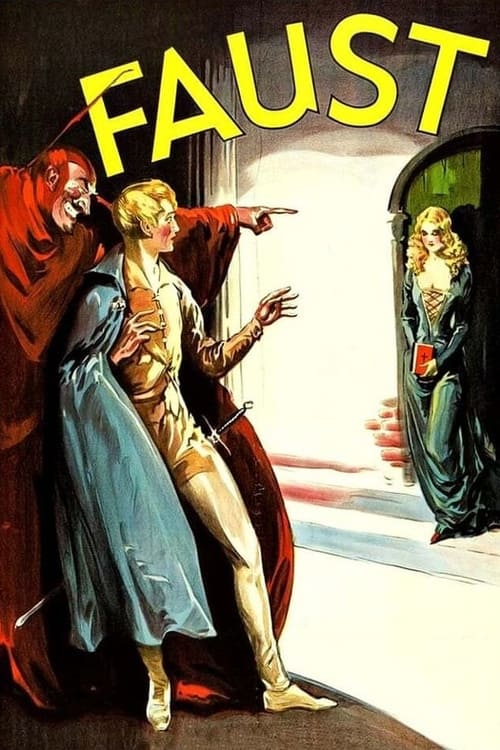
Faust
1926 · F. W. Murnau
When you want spectacle with a soul — a rainy-night epic that feels like being told a dark fairy tale. Silent film pacing asks a little patience, but this is one of the most accessible entry points to the era.
What it's about
God and the Devil make a wager over the soul of an aging alchemist in a plague-stricken medieval town. Desperate to save the dying, the old scholar strikes a bargain with the demon Mephisto — and gets his youth back into the bargain, which leads him to a village girl named Gretchen and a love story that raises the stakes of the bet far beyond one man's soul. It's the Faust legend told as a grand silent-era folktale, all shadow, smoke, and myth.
The experience
Sweeping and genuinely awe-inducing — the imagery still lands almost a century on, from a giant winged devil looming over a town to a flight through the clouds. It moves between horror, romance, and tragedy with real emotional weight; expect to be startled by how modern its visual imagination feels.
Performances
Emil Jannings' Mephisto is the reason to come: leering, funny, and terrifying by turns, one of the great screen devils, a performance that dominates the film without a word of spoken dialogue.
The craft
Murnau built this at the height of the German studio system, and it shows: colossal handcrafted sets, in-camera effects that still provoke 'how did they do that,' and light and shadow painted onto the frame like a Rembrandt. Every image is composed for maximum pictorial power — this is a film to see as big as you possibly can, ideally with a good live or recorded score.
Why it matters
Murnau's last German film before Hollywood, it stands as a summary of what silent-era craft could achieve and a peak of German Expressionist spectacle whose devil-imagery and effects work echo through fantasy and horror cinema ever since.
Snapshot
Faust — Eine deutsche Volkssage ("Faust — A German Folktale") is F. W. Murnau's last German film, a lavish UFA prestige production that stands as one of the great monuments of late silent cinema and a summary statement of what the German studio system could achieve in handcrafted spectacle. Adapting the Faust legend in its broad mythic outline — the wager over a soul, the bargain with the devil, the seduction and ruin of Gretchen, and a final redemption through love — the film is less a faithful rendering of Goethe than a synthesis of multiple sources filtered through pure pictorial imagination. It is remembered above all for its imagery: the colossal winged figure of Mephisto brooding over a plague-stricken town, the rejuvenation of the aged scholar, and the celebrated flight through the clouds. Made on the eve of Murnau's departure for Hollywood, it marks both a high point and an endpoint, the moment when German Expressionist craft reached its most refined and expensive form just as the movement's energies were dispersing.
Industry & production
Faust was produced by Universum Film AG (UFA), Germany's dominant studio, at its Neubabelsberg facilities outside Berlin. By 1926 UFA was pursuing a strategy of grand, internationally exportable prestige pictures — the same ambition that drove Fritz Lang's Die Nibelungen (1924) and Metropolis (in production concurrently) — and Faust was conceived in that mold as a costly showcase of German artistry. The production was large and protracted, built almost entirely within the studio so that landscape, sky, and architecture could be controlled and stylized rather than photographed from nature.
The casting reflected UFA's international aspirations. Emil Jannings, then among Germany's most celebrated actors and a frequent Murnau collaborator, took the role of Mephisto. The Swedish star Gösta Ekman played Faust in both his aged and rejuvenated forms. For Gretchen, UFA entered negotiations with Lillian Gish, whose participation would have strengthened the film's appeal in the American market; the arrangement collapsed — the historical record attributes this variously to Gish's conditions regarding her cinematographer and her own presentation — and the part went instead to the comparatively unknown Camilla Horn, who had worked on the production in a minor capacity before being elevated to the lead. The French diseuse Yvette Guilbert, immortalized decades earlier in Toulouse-Lautrec's posters, played Marthe Schwerdtlein, and Wilhelm Dieterle — later, as William Dieterle, a notable Hollywood director — appeared as Gretchen's brother Valentin.
A defining production fact, frequently discussed by archivists, is that Faust survives in materially different versions. Following standard practice for films intended for export, multiple negatives were assembled. But the case of Faust is unusually fraught: Murnau did not simply select alternate takes from twin cameras, he often staged and shot scenes differently for different negatives, so that the "German domestic" version and the various export versions diverge in performance, framing, and editing. Restoration efforts in later decades — notably by the Murnau-Stiftung and associated archives — have had to reckon with the fact that there is no single authoritative cut, and that some widely circulated prints are inferior secondary negatives. Any close analysis of the film must therefore specify which version is under discussion, and claims about "the" definitive Faust should be treated cautiously.
Technology
The film is a product of orthochromatic black-and-white silent technology, exposed on film stock insensitive to red and tuned to the dramatic rendering of light and shadow. Its real technological distinction lies in the elaborate use of in-camera and optical effects, model work, and atmospheric manipulation. Smoke, fog, and controlled light were used extensively to dissolve the boundary between solid set and luminous void. The famous flight sequence — Faust and Mephisto soaring over mountains, towns, and waterfalls toward Italy — was achieved through miniatures, matte work, and multiple exposures, integrating live figures with constructed landscapes in a manner that pushed the period's effects craft to its limits. Prints were originally exhibited with tinting and toning, conventional for the era, and the film was scored for live orchestral accompaniment rather than recorded sound.
Technique
Cinematography
The cinematography is credited to Carl Hoffmann, one of the great German cameramen of the era (he had shot Lang's Die Nibelungen). The visual signature of Faust is its sculptural use of light: figures and faces emerge from enveloping darkness, beams cut through fog, and the screen is organized as a play of luminous masses against black. The most reproduced image in all of silent cinema may be Mephisto's gigantic shadow-form, wings outspread, lowering over the miniature rooftops of the town as plague descends — an effect of scale and menace achieved through superimposition and forced perspective. Throughout, Hoffmann and Murnau favor a heavily atmospheric, chiaroscuro register, with light used as a moral and metaphysical agent: the radiance of the divine and of Gretchen's innocence set against the smoky murk of Mephisto's domain.
Editing
Editing in Faust is generally subordinated to pictorial composition and to the architecture of individual tableaux, in keeping with Murnau's preference for the expressive single image and the fluid movement within the frame over montage-driven construction. The film advances through a sequence of grand set pieces — the celestial prologue, the plague, the rejuvenation, the idyll and seduction of Gretchen, her downfall, and the finale — with transitions often handled by dissolves and superimpositions that bind images together rather than cut sharply between them. Because the surviving versions differ in their cutting, precise judgments about pacing and rhythm depend on which negative one examines; the divergence is itself a reminder that the film's editing was not fixed but variously realized.
Mise-en-scène / staging
Mise-en-scène is the film's supreme achievement, and here the art directors Robert Herlth and Walter Röhrig — a partnership central to Murnau's work, including The Last Laugh and Tartuffe — are nearly as important as the director. The world of Faust is wholly constructed: crooked medieval streets, a cathedral interior, the alchemist's cluttered study, and above all the stylized landscapes and skies of the studio. Herlth and Röhrig built sets that compress and distort space for emotional effect, with low ceilings, looming gables, and forced perspectives that make the human figure small against an oppressive or transcendent environment. The integration of figures into painted and modeled backgrounds, and the treatment of the sky as a dramatic surface across which clouds and supernatural forms move, give the film its quality of a living engraving or illuminated manuscript brought into motion.
Sound
As a silent film, Faust carried no synchronized dialogue or recorded sound; it was designed for live musical accompaniment and supported by intertitles. An original score was composed by Werner Richard Heymann for the German release, intended to underscore the film's oscillation between the diabolical and the sacred. As with most silent features, accompaniment varied by venue and by version, and modern presentations frequently substitute new or reconstructed scores.
Performance
Performance style ranges across registers. Emil Jannings's Mephisto is the film's bravura turn — sardonic, corpulent, by turns menacing and grotesquely comic, particularly in the byplay with Yvette Guilbert's Marthe, which leavens the tragedy with a vein of earthy humor. Gösta Ekman plays Faust in two distinct keys, the trembling, white-bearded scholar and the smooth young gallant, and the contrast is itself part of the film's meaning. Camilla Horn's Gretchen is pitched toward luminous innocence and then anguished suffering, her ordeal in the snow with her dead child forming the film's emotional climax. The acting is broadly within the expressive silent idiom, but Murnau modulates it toward the intimate where the drama demands.
Narrative & dramatic mode
The narrative is structured as a cosmic frame enclosing a human tragedy. It opens in the heavens with a wager: an emissary of God and the demon Mephisto contend over whether the soul of the righteous can be corrupted, with the aged alchemist Faust as the test case. Plague is loosed upon the earth; Faust, unable to save the dying and despairing of God, turns to Mephisto, who offers first relief and then, through a trial day, eternal servitude. Rejuvenated, Faust is drawn into worldly pleasure and then into love for the innocent Gretchen, whose seduction precipitates a chain of catastrophe — the death of her brother, her disgrace, the loss of her child, and her condemnation. The film resolves not in damnation but in redemption: Gretchen's love, and the invocation of that word before the heavens, voids the wager. The dramatic mode is thus that of moral allegory and folk legend rather than psychological realism — a morality play staged on a metaphysical scale, in which individual characters double as cosmic stakes.
Genre & cycle
Faust sits at the intersection of fantasy, tragic drama, and horror. It belongs to the cycle of German "art films" of the early-to-mid 1920s that drew on legend, fairy tale, and the supernatural — a lineage that includes Murnau's own Nosferatu (1922), Lang's Der müde Tod and Die Nibelungen, and Paul Wegener's Der Golem. Within that cycle it represents the prestige, large-budget tendency: mythic source material treated with maximal pictorial grandeur. Its horror elements — the plague, the devil's looming presence, the imagery of pestilence and death — are fused with the consolations of romantic tragedy and religious fantasy, so that the film resists any single generic label and is best understood as a Volkssage, a folk-legend film, the term the title itself proposes.
Authorship & method
The film is unmistakably Murnau's, but it is also one of the clearest cases of German collective studio authorship. The screenplay is credited to Hans Kyser, working from the Faust legend and from Goethe and earlier sources; UFA's ambitions to associate the production with high literary prestige are part of its context, though the finished film privileges image over text. Murnau's method, as throughout his career, subordinated narrative mechanics to the expressive control of light, space, and movement — the "unchained camera" and the engineered environment. He worked in close partnership with the art directors Herlth and Röhrig, whose constructed worlds were not backdrops but the very substance of his cinema, and with the cinematographer Carl Hoffmann, whose lighting realized the film's metaphysical contrasts. Werner Richard Heymann supplied the original musical accompaniment. The pattern is one of a director orchestrating a team of master craftsmen, each indispensable, toward a unified pictorial vision — and the existence of multiple, separately staged negatives underscores how thoroughly the film was built rather than simply filmed.
Movement / national cinema
Faust is a central, late work of Weimar German cinema and is conventionally grouped with German Expressionism, though it belongs to that movement's more pictorial, less angular wing — closer to the romantic, atmospheric stylization of Der müde Tod than to the painted distortions of The Cabinet of Dr. Caligari. It exemplifies the UFA studio aesthetic at its most ambitious: total environmental control, stylized design, and the treatment of national legend as the basis for an exportable art cinema. It thus stands at the confluence of Expressionism, the prestige literary adaptation, and the international commercial strategy that defined UFA in the mid-1920s.
Era / period
The film was made and released in 1926, premiering in Berlin in October of that year, at the close of the German silent cinema's most celebrated period and just before the disruptions of sound and the accelerating emigration of German talent to Hollywood. It belongs to the same moment as Metropolis, then in production, and it marks the end of Murnau's German career: he departed for Fox in the United States, where he would make Sunrise (1927). Faust is therefore a threshold work, the last full flowering of one tradition before its principal artists were scattered and the medium itself transformed by synchronized sound.
Themes
The film's governing theme is the contest between the sacred and the diabolical for the human soul, dramatized through the classic Faustian bargain of knowledge and power exchanged for damnation. Around this turn several others: the despair of reason before suffering, as the learned Faust finds his books and alchemy useless against the plague; the corruption of innocence, embodied in Gretchen's seduction and ruin; and redemption through love, the film's resolving claim that selfless love can overrule even a cosmic wager. Underlying these is a meditation on light and darkness as moral absolutes — a duality the film's very photography enacts. The treatment is mythic and theological rather than ironic; where Goethe's Faust is shot through with philosophical ambiguity, Murnau's is closer to the older folk legend's stark oppositions, resolved by grace.
Reception, canon & influence
Looking backward, Faust draws on a deep well of sources — the historical Faust legend, Christopher Marlowe's Doctor Faustus, Goethe's two-part drama, and the puppet-play and folk traditions — as well as on the visual culture of Northern Renaissance art, engraving, and woodcut, whose stylized figures and dramatic light the film consciously evokes. Within cinema it builds directly on Murnau's own Nosferatu and on the established conventions of the German legend film and Expressionist design as developed by Herlth, Röhrig, Hoffmann, and their peers.
Contemporary critical reception is reported to have been mixed: while the film's pictorial splendor was admired, some critics found its treatment of Goethe and its tonal range — particularly the broad comedy of the Mephisto–Marthe scenes against the tragedy of Gretchen — uneven. I want to be careful here: detailed and reliable contemporary box-office figures and the full texture of the original critical response are not something I can quote precisely, and the period record as commonly summarized should be treated as approximate rather than authoritative.
The film's forward influence, by contrast, is substantial and well attested at the level of imagery and craft. Its visual conception of the devil and of supernatural menace, and above all the iconic shot of the winged demon enveloping a town, became part of the permanent grammar of fantasy and horror cinema, frequently cited and imitated. Its mastery of atmosphere, model work, and light fed into the visual vocabulary that German émigrés — Murnau himself, and figures like Dieterle and the many cinematographers and designers who went to Hollywood — carried into American cinema, shaping the look of 1930s horror and the noir tradition. Faust is today firmly within the canon of silent film, studied as the culmination of Murnau's German period and as one of the most visually accomplished films of the silent era, even as its textual divergences and multiple versions keep questions of its definitive form productively open.
A Deleuzian reading
Start with the image everyone keeps: a black shape opening its wings over a sleeping town, until the wings are wider than the rooftops and the dark pours down into the streets as plague.
The full Deleuzian reading of Faust →
Reception
In 1926 it underwhelmed — German critics grumbled about the liberties taken with Goethe, and the lavish UFA production lost money — but it's since been reclaimed as one of the visual pinnacles of the silent era and the film that got Murnau his ticket to Hollywood and Sunrise.
How Faust was received, from release to now →
Influences: the films it descends from and the films it influenced
- Der Golem: How He Came into the World (1920) — Hans Poelzig's sculpted, organically warped studio architecture established the legend-film's hand-built world that Herlth and Röhrig extend in Faust's medieval village and Gothic interiors.
- The Cabinet of Dr. Caligari (1920) — Codified Expressionist staging where painted light, raked angles, and stylized space externalize a moral/psychic state — the design logic Faust applies to its cosmic struggle of light and dark.
- Nosferatu (1922) — Murnau's own template for supernatural menace built from silhouette, negative-film and stop-trick in-camera effects, and a town-stalking evil — directly reworked in Faust's plague and the demon's wings over Gretchen's town.
- Destiny (Der müde Tod) (1921) — Personified Death negotiating for a soul inside an episodic cosmic-frame allegory — the supernatural-pact narrative architecture Faust inherits for its Mephisto/God wager.
- The Last Laugh (1924) — Perfected the 'unchained camera' (entfesselte Kamera) with Karl Freund — the mobile, subjectively gliding camera that Faust deploys in Mephisto's flight sequences.
- Die Nibelungen (1924) — Carl Hoffmann's monumental fog-bound lighting and forced-perspective sets plus large-scale model/creature work (the dragon) are the same craftsman's vocabulary he brings to Faust's metaphysical chiaroscuro.
- Warning Shadows (1923) — Built drama from layered shadow-play and superimposition as a narrative device, anticipating Faust's superimposed visions and apparitions.
- The Phantom Carriage (1921) — Stages a personified supernatural agent gliding over the world via massive superimposition composites, the same fusion of effects spectacle and soul-accounting drama.
- Sunrise (1927) — Murnau ports Faust's forced-perspective sets and dense superimposed dreamscapes into Hollywood, fusing the Expressionist constructed world with the moving camera.
- Vampyr (1932) — Extends Faust's superimposition for soul/spirit imagery and diffuse atmospheric light into a metaphysical horror of dread rather than shock.
- Frankenstein (1931) — Universal horror's chiaroscuro modeling and the creation-by-light spectacle descend from the Expressionist lighting grammar German émigrés carried west from films like Faust.
- The Black Cat (1934) — Ulmer, who assisted on Faust and Sunrise, transplants Murnau's architectural set-as-character and satanic-pact design into a Hollywood horror.
- Fantasia (Night on Bald Mountain) (1940) — Chernabog spreading his wings over a sleeping village is a near-direct animation of Faust's iconic winged-demon-enveloping-a-town shot.
- The Seventh Seal (1957) — Revives the personified-Death medieval allegory and woodcut-derived imagery of the German legend film for a modern existential cosmic frame.
- The Night of the Hunter (1955) — Stanley Cortez's stark Expressionist chiaroscuro and the literal good-vs-evil moral allegory descend from the Murnau/UFA light grammar Faust epitomizes.
- Faust (1994) — Reworks the puppet-play and folk-legend roots Murnau drew on, foregrounding the marionette/constructed-artifice dimension latent in Faust's built world.
- Sunrise: A Song of Two Humans (1927) — Carl Hoffmann's atmospheric shadow photography and the massive forced-perspective Wittenberg set — constructed so the camera could travel through a geometrically distorted townscape — gave Murnau his immediate technical precedents for Sunrise's fog-swamp and city-horizon shots, made the same production year.
- Nosferatu the Vampyre (1979) — Murnau's pestilence sequences — charnel piles staged as Bosch tableaux, plague-clothed figures strewn across blighted squares — are the direct visual model for Herzog's rat-infested Wismar; both marshal medieval German pictorial iconography to frame supernatural contagion as historical catastrophe.
- Heart of Glass (1976) — Murnau translates Caspar David Friedrich's compositional grammar into cinema—miniaturized figures before sublime fog-bound vistas, aerial overviews that dissolve human scale—providing the specific visual vocabulary Schmidt-Reitwein adopts for Heart of Glass's landscape sequences.
- Nosferatu (2024) — Models the painterly chiaroscuro and the plague-bringer's vast wings/smoke spreading over a town done with in-camera effects — German Romantic-painting composition translated to looming supernatural threat.
- Häxan (1922) — Renders the devil and infernal tableaux straight out of Northern-Renaissance woodcut and engraving — the same medieval graphic-art sourcing behind Faust's conception of Mephisto and Hell.
- Metropolis (1927) — Contemporary UFA superproduction sharing Faust's reliance on in-camera optical effects, miniature/model cityscapes, and engineered studio environments built rather than filmed.
- Faraway, So Close! (1993) — Ancestor in German-Romantic visual theology: vast aerial views of a celestial being surveying earth and a wager over a human soul, the expressionist iconography Wenders secularizes into the watching angel.
- Phantom of the Paradise (1974) — Expressionist iconography of the blood-signed pact with a Mephistophelean patron, restaged as Winslow signing Swan's contract in blood under theatrical shadow.
- Die Nibelungen: Kriemhild's Revenge (1924) — Built entire worlds inside the UFA studio through matte, forced perspective and modeled architecture, the peak-Weimar craft of total studio artifice that Nibelungen shares.
Similar films
- Nosferatu (1922) — influence & lineage
- Metropolis (1927) — influence & lineage
- Häxan (1922) — influence & lineage
- The Cabinet of Dr. Caligari (1920) — influence & lineage
- The Last Laugh (1924) — influence & lineage
- The Seventh Seal (1957) — influence & lineage
- Vampyr (1932) — influence & lineage
- Mephisto (1981) — shared sensibility
All the films related to Faust →