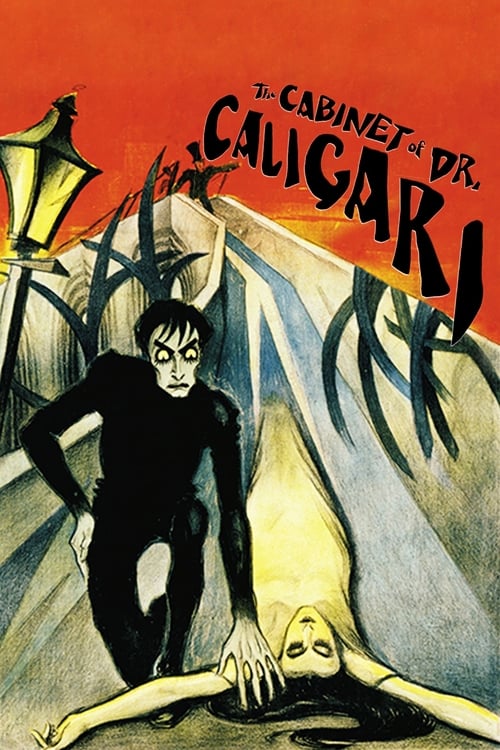
The Cabinet of Dr. Caligari
1920 · Robert Wiene
For when you're in the mood for something uncanny rather than gory — a late-night, lights-off curiosity that rewards patience and pairs beautifully with a good score. A challenge for anyone new to silent film, but a doorway once you're in.
What it's about
A young man recounts the nightmare that recently swallowed his town: a traveling fair arrives, and with it a sinister showman exhibiting Cesare, a sleepwalker who has slept for years and wakes only at his master's command. When the somnambulist prophesies a death and murders begin, the young man turns detective — and the story keeps twisting under his feet.
The experience
Genuinely eerie a century on — the painted, jagged sets make you feel like you're trapped inside someone's bad dream, and the dread comes less from shocks than from a world where nothing stands straight. Strange, hypnotic, and shorter than you'd expect.
Performances
Conrad Veidt's Cesare — gaunt, black-clad, moving like a puppet on invisible strings — is one of the first great horror performances, and Werner Krauss makes the doctor a portrait of leering menace. Both are pure silent-era acting at its most expressive.
The craft
The sets are the star: painted shadows, crooked doors, streets that tilt like a fever — an entire world built to look the way madness feels. It's the boldest example of design doing the storytelling, and its framing story delivers one of cinema's first great rug-pulls.
Why it matters
The founding work of German Expressionism, it seeded a century of horror, film noir shadows, and unreliable narrators — arguably no film did more to prove that a movie's look could carry its meaning.
Snapshot
The Cabinet of Dr. Caligari is the founding document of German Expressionist cinema and one of the most consequential films in the history of the art form. Produced by Erich Pommer for Decla-Bioscop and released in Berlin in February 1920, it introduced to the screen a visual language borrowed wholesale from the painterly distortions of Expressionist art: crooked doorways, rhomboidal windows, streets of jagged geometry, and shadows drawn directly onto the canvas sets rather than cast by light. Its story — a carnival hypnotist who commands a somnambulist to murder on his behalf — was organized around a frame narrative whose twist ending repositioned the entire preceding film as the unreliable fantasy of a madman. Within a decade it had traveled the world, seeded the nightmares of horror and noir, and become the default example for any argument that cinema could be unambiguously, self-consciously "art."
Industry & Production
The film emerged from the specific pressures of the early Weimar Republic. Post-war Germany had imposed restrictions on foreign film imports to protect its domestic industry, and German studios — especially Decla-Bioscop under Erich Pommer — were actively seeking prestige projects that could compete artistically and commercially. Pommer, who would become one of the most important producers of the Weimar era, recognized the script by Hans Janowitz and Carl Mayer as something unusual and shepherded it into production.
The budget was modest. Rather than constructing three-dimensional sets, the production turned entirely to painted backdrops and flats — a decision that was simultaneously an economic constraint and an aesthetic manifesto. The painted environments allowed the designers to impose impossible angles and distorted geometries that would have been technically prohibitive to build. Three artists — Hermann Warm, Walter Röhrig, and Walter Reimann — designed the visual world of the film. Warm, the lead designer, is associated with the principle that the film image should function as an animated drawing; the Caligari sets are the most thoroughgoing realization of that idea in the silent era.
Robert Wiene was not the first director attached to the project. Fritz Lang, then a rising figure at Decla, was reportedly approached but was committed to other work, as was F. W. Murnau. Wiene, a competent studio director with no prior claim to avant-garde credentials, took the assignment and delivered what remains the single most artistically radical film of his career.
Technology
Caligari was photographed on orthochromatic stock, which rendered blues as pale and reds as dark — a characteristic that reinforced the pallor and shadow of the Expressionist sets. Cinematographer Willy Hameister worked within the physical constraints of the built-and-painted spaces: the camera is predominantly static, positioned to show the full depth of the distorted flats, with only occasional panning movements. There are no tracking shots and no aerial perspectives; the visual drama is generated entirely by the design of the frame within the image rather than the movement of the camera.
Original theatrical prints were tinted: blue for night sequences, warm amber or sepia for interior daylight, giving the film a chromatic range that is often lost in later preservation copies. Various tinting schemes have been documented across surviving prints, and establishing a single "authentic" color version remains a curatorial challenge. The film is silent, accompanied in its initial exhibition by a piano or small orchestra following a cue sheet, as was standard practice. A notable restoration by the Friedrich Wilhelm Murnau Foundation with a newly researched tint scheme was undertaken in later decades, and several modern commissions have provided orchestral accompaniments for archival exhibition.
Technique
Cinematography
Hameister's camera serves the designs rather than interpreting them. Framing tends toward the theatrical: figures are placed within the distorted architecture so that the geometry itself becomes a statement about psychological enclosure. The famous compositions — Cesare carrying Jane across the angular rooftops, Caligari hunched in his tent — derive their power from the relationship between the human body and the inhuman angles of the built environment. Where later Expressionist cinematography (as in Murnau's work) would use lens optics and lighting to achieve distortion, Caligari achieves it through flat design, which gives the film an almost hand-made quality, closer to a stage tableau than to naturalistic photography.
Editing
The editing is unremarkable by the standards of contemporaneous Hollywood production, but the structure of the screenplay — a frame story enclosing a nested flashback — gives the cutting a formal significance that exceeds its technical ambition. The return to the frame at the film's close forces a retrospective re-reading of every cut within the inner story, since what appeared to be continuity editing turns out to have traced the associative logic of a disturbed mind. Whether this effect was fully intentional or partially accidental (given the disputed circumstances of the frame's addition) remains a productive scholarly question.
Mise-en-scène / Staging
The sets by Warm, Röhrig, and Reimann are the film's central achievement. Walls lean inward and outward without plumb; staircases ascend at irrational angles; streets are arranged in vectors that deny perspective. Shadows — the visual signature of Expressionism — are painted directly onto floors and walls, so that the shadow world exists independent of any actual light source. Doors and windows are shaped as irregular polygons. Furniture is distorted: chairs look as though they have been viewed through a funhouse mirror. The staging of actors within these environments is deliberately stylized; movement is angular and gestural, reaching toward the conventions of Expressionist theater rather than the emerging naturalism of screen performance.
Sound
The film is silent. Contemporary exhibition would have included live musical accompaniment, typically improvised or drawn from a cue sheet. No original score specific to Caligari survives from the 1920 premiere. Subsequent restorations have been accompanied by newly composed or arranged scores — among them a score by Timothy Brock prepared for the Murnau Foundation restoration — but these are modern interpretations rather than historical documents.
Performance
The two central performances are exercises in opposite stylizations. Werner Krauss as Caligari projects a hunched, twitching menace — the performance is theatrical in the heightened, declamatory mode of Expressionist stage acting, relying on exaggerated physical gesture and extreme facial expression. Conrad Veidt as Cesare is the more uncanny achievement: rigid, somnambulistic, eyes stretched to their widest extent, body moving in a slow glide that suggests something between life and death. Veidt, who would go on to significant careers in both German and Hollywood cinema, created in Cesare one of the iconic figures of early film horror. Lil Dagover as Jane and Friedrich Fehér as Francis are less stylized, occupying a more conventional romantic register that throws the extremity of Krauss and Veidt into sharper relief.
Narrative & Dramatic Mode
The film operates through a nested narrative with a twist ending — among the earliest deployments of this structure in cinema. An outer frame shows Francis telling his story to a fellow patient in what appears to be a peaceful garden; the inner story traces the carnival of Dr. Caligari, Cesare's murders, Francis's investigation, and the revelation that Caligari is the director of a mental asylum. At the frame's close, we discover that both Francis and the people he named as victims are patients in that asylum, and the figure he called Caligari is in fact the benevolent director.
The ideological stakes of this structure are fiercely debated. The screenwriters Hans Janowitz and Carl Mayer later claimed — primarily through Janowitz's account, written years after the fact — that their original script had no framing device, and that the story was conceived as an anti-authoritarian allegory: Caligari representing military and state authority, Cesare the conscripted soldier compelled to kill. In their reading, the frame was added by Wiene or Pommer to defang this critique, transforming a subversive political parable into a madman's delusion. Whether the original script was in fact as Janowitz described it, and whether the framing decision was made against the writers' wishes, has been questioned by subsequent historians — the primary source is Janowitz's own retrospective account. What is certain is that the frame produces a film structurally committed to epistemological instability: the viewer cannot know, after the final intertitle, what in the inner story was "real."
Genre & Cycle
Caligari inaugurated or crystallized several generic formations simultaneously. It is the originating text of German Expressionist horror — a cycle that would include Paul Wegener's Der Golem (1920), F. W. Murnau's Nosferatu (1922), Paul Leni's Waxworks (1924), and the Weimar productions of the mid-decade. It established the hypnotist-and-somnambulist pairing as an archetype of horror cinema, one that recurs in disguised forms throughout the genre's subsequent history. It also contributed to the emerging mode of psychological horror — horror rooted in perception and mental instability rather than in supernatural visitation — that would run through film noir and into the psychological thriller.
Beyond horror, Caligari belongs to the broader carnival/fairground subgenre of Weimar cinema, which returned repeatedly to the itinerant entertainer as a figure of uncanny danger (see also Leni's Waxworks, and later Fritz Lang's Dr. Mabuse the Gambler).
Authorship & Method
Robert Wiene remains a minor figure in the directorial canon despite Caligari. His other work — including Genuine (1920) and Raskolnikov (1923), both Expressionist in ambition — did not achieve comparable success, and he is largely understood as a competent director who was fortunate in his collaborators. The question of authorship is genuinely complicated here: the visual world was designed by Warm, Röhrig, and Reimann; the narrative architecture was built by Janowitz and Mayer; the performances were shaped by Veidt and Krauss's own theatrical training. Wiene coordinated these elements but cannot be credited with originating any of them.
Carl Mayer, the co-screenwriter, is the more significant figure in retrospect. His subsequent collaborations with Murnau — The Last Laugh (1924), Tartuffe (1925), Sunrise (1927) — mark him as one of the central architects of Weimar cinema's artistic peak. Mayer's contributions to Caligari's tight psychological structure are well-attested.
Erich Pommer's role as producer was decisive: he committed to the ambitious design scheme, managed the budget, and saw the film to international distribution. His career at Decla-Bioscop and later at UFA would shape German cinema through the remainder of the silent era and into the sound period.
Movement / National Cinema
Caligari is the canonical example of German Expressionism in cinema, the movement in which the visual style of Expressionist painting — associated with Die Brücke and Der Blaue Reiter, and extending through Expressionist theater and literature — was translated into the moving image. The movement's characteristic visual lexicon (angular distortion, violent chiaroscuro, the subordination of realistic representation to psychological or emotional truth) is more purely and consistently realized here than in any other single film.
Siegfried Kracauer's From Caligari to Hitler (1947) placed the film at the head of a long argument about the relationship between Weimar cinema and the psychological preconditions for fascism. In Kracauer's reading, the films of the period — and Caligari especially — betrayed a cultural disposition toward tyranny and submission that expressed itself symbolically before it found political form. This argument, while enormously influential in establishing the film's canonical importance, has been substantially criticized for its teleological framing and selective use of evidence. Lotte Eisner's The Haunted Screen (L'Écran démoniaque, 1952) offered a more formalist and less deterministic account of the same tradition.
Era / Period
The film was made in 1919 and released in February 1920, during the earliest and most unstable phase of the Weimar Republic. Germany had surrendered in November 1918; the Republic was declared amid revolutionary upheaval; the Spartacist uprising of January 1919 had been violently suppressed. Economic hardship, political violence, and social disorientation were the immediate context. Whether Caligari consciously registers this historical anxiety or simply absorbs it is a question that has organized decades of scholarship.
The film also appeared at a moment when the German film industry was experiencing unusual protection and prosperity due to import restrictions on foreign films — a circumstance that gave German producers both the commercial incentive and the creative room to experiment.
Themes
The film's dominant theme is the relationship between authority and submission. Caligari controls Cesare absolutely; Cesare has no volition of his own. The terror of the film, in its inner story, is the terror of a self entirely subordinated to an external will — a concern that resonated in a culture just emerged from a war in which millions of men had functioned precisely as instruments of command. The framing device introduces a second theme: the uncertainty of perception and the relativity of sanity. If Francis's account is delusion, then sanity is the name the institution gives to its own perspective.
Hypnosis and the unconscious connect the film to the Freudian discourse then current in German intellectual life, though the film does not make this connection explicit. The double — Caligari is also the asylum director; Francis's story inverts the power relationship between doctor and patient — is a recurrent structural motif. The fairground setting invokes a liminal space outside bourgeois order, in which different rules apply and the ordinary are at the mercy of the spectacular.
Reception, Canon & Influence
The film was a critical and commercial success in Germany and was quickly exported. In France it was received with significant enthusiasm among the Surrealists and the early film-theory community; Louis Delluc was among its early advocates. It reached the United States in 1921 and was exhibited in New York to considerable notice, contributing to an international awareness of German cinema as a serious artistic enterprise.
Backward influences: The primary artistic sources are German Expressionist painting and theater — Edvard Munch's psychological distortions are a persistent reference point, and the work of Ernst Ludwig Kirchner and other Die Brücke painters is visually proximate. Expressionist stage design, particularly that associated with Max Reinhardt's productions, provided the theatrical vocabulary for the film's staging and performance style. Paul Wegener's earlier Der Golem productions (1915 and 1920) had experimented with distorted architecture on screen.
Forward legacy: Caligari's influence on subsequent cinema is wide and deep. It established the distorted-architecture vocabulary that would pass into film noir through the expressionist emigration to Hollywood in the 1930s. Its use of shadow as a direct signifier of psychological menace became a fundamental noir technique. The somnambulist figure and the hypnotic villain contributed directly to the Universal horror cycle of the 1930s. F. W. Murnau absorbed and transformed the Expressionist visual program in Nosferatu and The Last Laugh. In later decades, Tim Burton's stylized architectural distortions are among the most legible citations of the film's visual language. The unreliable narrator with a framing twist — from Stage Fright (1950) to The Usual Suspects (1995) — traces a genealogy back to Caligari's structure, though few subsequent films have used it with the same ideological density. The film is a permanent fixture of university film curricula and occupies a canonical position in virtually every major film history, from Kracauer and Eisner through contemporary accounts.
A Deleuzian reading
Look at the floor of Holstenwall.
The full Deleuzian reading of The Cabinet of Dr. Caligari →
Reception
A sensation from the start — it stunned audiences in 1920s Berlin, Paris and New York rather than needing rescue — but it's been re-argued ever since, most famously by Siegfried Kracauer, who read it as a premonition of German authoritarianism. A century on it's less a movie people discover than a monument they finally visit.
How The Cabinet of Dr. Caligari was received, from release to now →
Influences: the films it descends from and the films it influenced
- Der Student von Prag (1913) — Established the German Schauerfilm tradition of theatrical staging and the Faustian malevolent-authority/controlled-protagonist duality — the precise structural blueprint that Caligari's Janowitz-Mayer script inherits and Expressionizes.
- Der Golem (1915) — Wegener's clay figure — compelled to murder by a human master who holds the animating power — is the direct prototype for Cesare the somnambulist, establishing the controlled-killer-as-instrument formula that Caligari's scenario adopts wholesale.
- Nosferatu (1922) — Murnau translates Caligari's painted-shadow technique into optical cinematography: Schreck's silhouetted hand climbing the staircase inherits the shadow-as-character device but achieves it through lighting angle and lens placement rather than pigment applied directly to set flats.
- Dr. Mabuse der Spieler (1922) — Lang explicitly extends the Caligari template of the hypnotic criminal mastermind who subjugates victims through domination of the will, transposing the carnival tent to Weimar gambling dens while retaining Expressionist staging of surveillance, enclosure, and submission.
- Wachsfigurenkabinett (1924) — Leni structures the film around a fairground wax-museum framing device — directly inheriting Caligari's carnival setting and authority-of-display motif — and nests three Expressionist anthology episodes within it, each deploying distorted-geometry staging.
- Orlacs Hände (1924) — Wiene applies Caligari's psychological-horror apparatus — a protagonist trapped in a traumatic delusion whose external reality remains undecidable — to a body-horror scenario, retaining the distorted Expressionist mise-en-scène as architectural index of subjective unreality.
- The Cat and the Canary (1927) — Leni, emigrating from Germany after Waxworks, imports Caligari's distorted-corridor staging and sinister-carnival atmosphere directly into Universal production, establishing the tilted-geometry/looming-shadow grammar as the structural template for American horror film design.
- Bride of Frankenstein (1935) — Whale deploys the mad-scientist/created-instrument authority structure and Expressionist lighting grammar — extreme low angles, stark shadow pools, canted compositions — as the inherited genre conventions for the horror film's treatment of overreaching creation and submission.
- Rashomon (1950) — Kurosawa extends Caligari's unreliable-narrator frame structure into a multi-testimony format: four mutually contradictory nested accounts are embedded within a rain-shelter frame that, like Caligari's asylum prologue, retroactively renders every interior narrative epistemically suspect.
- Repulsion (1965) — Polanski uses production design distortion — walls cracking open, hands thrusting through plaster, corridors impossibly elongating — to externalize a character's psychotic subjective state as spatial reality, applying Caligari's principle that built environments can render inner pathology legible as architecture.
- The Tenant (1976) — Polanski revisits Caligari's frame-narrative unreliability: a protagonist's dissolving identity is rendered through mise-en-scène — silent neighbors as coordinated, enclosing watchers — that externalizes paranoid subjective experience as Expressionist spatial menace rather than as explicable social fact.
- Resurrection (2025) — Painted, distorted forced-perspective sets and the framing of the whole story as a madman's dream supply Resurrection's expressionist staging and its dream-anthology architecture, a film Bi names directly.
- Citizen Kane (1941) — German Expressionist architectural staging — sets built as distorted projections of institutional authority — supplies the visual grammar of canted angles and enclosing walls that Welles naturalizes into Kane's ceilinged rooms and upward-looming compositions.
- Metropolis (1927) — Wiene's system of painted-set expressionism — jagged architectural geometry, raked planes, hard-edged shadow deployed as psychological externalization rather than naturalistic light — is the visual grammar Lang's art directors Otto Hunte and Erich Kettelhut adapted for the underground machine-halls and Rotwang's anachronistic house.
- Der Golem: Wie er in die Welt kam (1920) — Art director Hans Poelzig constructs massively warped Gothic arches and tapered plaster towers in three dimensions from the same Expressionist design vocabulary as Caligari's painted flats, making the two the twin pillars of distorted-architecture staging in the same production season.
- Genuine (1920) — Wiene's immediate follow-up redeploys the identical design team — Reimann, Röhrig, and Warm — on the same painted-flat, distorted-geometry method, functioning as a direct laboratory replication of Caligari's visual apparatus on a new script.
- The Phantom Carriage (1921) — Sjöström constructs a triple-nested flashback structure — present frame → first recall → second recall embedded within the first — that parallels Caligari's frame-story device for generating retrospective uncertainty about the ontological status of the interior narrative.
- Destiny (1921) — Lang adopts Caligari's staging of an omnipotent authority figure within enclosed theatrical volumes and elaborates the nested-story structure across three historical episodes separated by a frame that casts doubt on the reality of what the protagonist — and viewer — has been shown.
- Schatten (1923) — Robison extends Caligari's painted-shadow principle to its logical limit: a conjuror performs a shadow play whose cast shadows become autonomous narrative agents that predict and enact the film's events — Caligari's shadow-as-character elevated to shadow-as-diegesis.
- 1984 (1956) — The film's high-contrast monochrome surface — flattened shadow, oppressive interiors signaling a deranged authority — inherits the German Expressionist vocabulary of using distorted light to externalize a controlling state of mind.
- Häxan (1922) — Codifies German Expressionist chiaroscuro and designed shadow as externalized psychology, the lighting idiom Johan Ankerstjerne echoes in Häxan's Sabbath and inquisition scenes.
- The Face of Another (1966) — Expressionist template for the mad-clinician-in-a-distorted-space: architecture as psychological derangement, the debt Isozaki's disorienting glass-and-anatomy clinic set pays forward into modernist design.
- Doctor Strange in the Multiverse of Madness (2022) — Ancestor of the gothic high-contrast lighting and canted, unstable geometry that German Expressionism bequeathed to horror, which Raimi and DP John Mathieson channel into the Dutch-angle vocabulary.
- Fury (1936) — Anchors the Weimar-expressionist chiaroscuro Ruttenberg tempers into Fury — pooled shadow and hard side-light used to morally distort ordinary faces at the moment they turn cruel.
Similar films
- Repulsion (1965) — influence & lineage · often watched together
- The Phantom Carriage (1921) — influence & lineage · often watched together
- Nosferatu (1922) — influence & lineage
- Dr. Mabuse, the Gambler (1922) — influence & lineage
- Persona (1966) — often watched together
- Rashomon (1950) — influence & lineage · often watched together
- Resurrection (2025) — influence & lineage · often watched together
- The Testament of Dr. Mabuse (1933) — often watched together
All the films related to The Cabinet of Dr. Caligari →
Film essays and courses that include it
- Shadow, Psyche, Flesh: The Formal Breakthroughs of Horror Cinema
- Painted Shadows: German Expressionism and the Grammar of Dread
- The Grammar of Shadow: Black & White Cinema from Caligari to Raging Bull
- The Lying Eye: A Century of the Unreliable Narrator
- The Hidden Frame: A Century of the Cinematic Twist
- Frames Within Frames: Cinema's Art of the Nested Story
- The Grammar of Dread: Twelve Films That Built Cinema's Language of Unease
- The Grammar of Dreams: Cinema's Surreal Century
- The Tyranny of Reason: Cinema Inside the Breaking Mind
- Worlds with Rules: The Deadpan Grotesque Fable
- The Shadow That Outlived the Light
- The Tilt That Says Something Is Wrong
- The Time Traveler