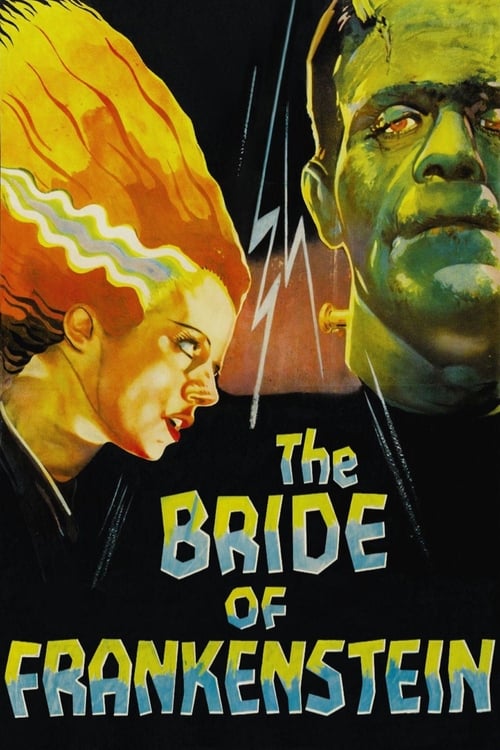
Bride of Frankenstein
1935 · James Whale
For a Halloween night or an old-Hollywood mood when you want your horror playful, stylish, and secretly big-hearted — a classic that's far more fun than homework.
What it's about
Dr. Frankenstein survived the mob, and so did his Monster. The scientist wants nothing more than to escape his past and marry, but a sinister old mentor, Dr. Pretorius, arrives with gin, blackmail, and a proposal: create again — this time, a mate for the creature. Meanwhile the Monster wanders the countryside, feared everywhere, looking only for a friend.
The experience
Witty, strange, and surprisingly moving — it swings from macabre comedy to genuine tenderness (the Monster's scene with a blind hermit is one of the gentlest things the studio era produced) and races by in under 80 minutes. The camp is intentional and delicious.
Performances
Boris Karloff deepens the Monster into cinema's great lonely outsider, wringing pathos from a handful of words; Ernest Thesiger's arch, gin-sipping Dr. Pretorius steals scenes wholesale; Elsa Lanchester does double duty as Mary Shelley and the hissing, unforgettable Bride.
The craft
James Whale, granted total creative freedom, laced the gothic imagery with camp, blasphemy, and sly subversion right under the Production Code's nose. The expressionist sets, lightning-lab spectacle, and crisp black-and-white photography still look magnificent, and the Bride's design remains one of the most iconic images in movie history.
Why it matters
The rare sequel widely held to surpass its original, it set the template for horror that winks without losing its soul, and it's been read for decades as a landmark of queer sensibility smuggled into 1930s Hollywood.
The rare sequel that towers over its original, and the moment Hollywood horror discovered wit. James Whale resisted returning to Frankenstein, then agreed on the condition of total creative freedom — and used it to smuggle camp, blasphemy, and open subversion past the newly enforced Production Code. Ernest Thesiger's Dr. Pretorius, all arched eyebrows and gin, tempts Henry Frankenstein away from his wedding night toward forbidden acts of creation; generations of critics have read the film through Whale's own openness about being gay in 1930s Hollywood, a reading the film wears lightly but unmistakably. Boris Karloff deepens the Monster into cinema's great lonely outsider — the interlude with a blind hermit is as tender as anything in the studio era — while Elsa Lanchester plays both Mary Shelley in the prologue and the Bride herself, hissing beneath that lightning-streaked tower of hair, onscreen for barely three minutes and immortal anyway. Franz Waxman's score, with its pealing wedding bells gone wrong, and Charles D. Hall's expressionist sets complete one of the studio system's most perverse and perfect entertainments. Whale shot the Bride's scenes with Lanchester swathed in bandages so the crew wouldn't spoil the reveal.
A Deleuzian reading
For most of the shoot, Elsa Lanchester walked the Universal lot wrapped head to foot in bandages.
The full Deleuzian reading of Bride of Frankenstein →
Reception
A hit with critics and audiences in 1935, it's since climbed even higher — now routinely named the crown jewel of Universal horror and the textbook example of a sequel that surpasses the original.
How Bride of Frankenstein was received, from release to now →
Influences: the films it descends from and the films it influenced
- Frankenstein (1931) — The direct predecessor whose vocabulary Bride extends—Jack Pierce's flat-skulled monster makeup, Kenneth Strickfaden's arcing electrical lab apparatus, and Karloff's mute pathos are all inherited and elaborated.
- The Cabinet of Dr. Caligari (1920) — Established the painted, angularly distorted studio sets and stylized shadow that Whale's crypts and watchtower interiors quote directly.
- Metropolis (1927) — Its ringed-electrode 'birth' of the artificial woman Maria is the template for Bride's creation sequence—the crackling coils, the shrouded body raised toward the storm, the animation of a female automaton.
- The Golem: How He Came into the World (1920) — Codified the sympathetic man-made creature who craves tenderness and is destroyed by fear, the emotional architecture Whale gives Karloff's Monster.
- Nosferatu (1922) — Modeled the expressionist use of looming shadow and the monster rendered as pitiable rather than merely fearsome, a tone Bride pushes toward outright tragedy.
- The Man Who Laughs (1928) — Leni's Universal import taught the studio the expressionist grotesque; Conrad Veidt's frozen carved face is the direct antecedent of makeup-bound pathos in the Monster.
- The Phantom of the Opera (1925) — Universal's original tragic grotesque—an unmasked monster who is both horrifying and heartbreakingly lonely—set the sympathetic-monster mold Whale refines.
- The Old Dark House (1932) — Whale's own dry rehearsal for Bride's arch comedy-of-menace tone, and the film that introduced Ernest Thesiger's fey, insinuating manner that becomes Dr. Pretorius.
- Son of Frankenstein (1939) — Directly continues Bride's franchise and its expressionist set design, giving Karloff his final Monster performance and adding Lugosi's Ygor as the new deforming sidekick.
- Young Frankenstein (1974) — Parodies Bride using the actual surviving Strickfaden lab equipment and recreates specific beats—the shock-haired mate's hissing rejection and the 'she's alive' reveal—shot for shot.
- The Rocky Horror Picture Show (1975) — Extends Bride's camp and queer subtext into open text, restaging the creation-of-a-mate as Frank-N-Furter's musical manufacture of a lover.
- Gods and Monsters (1998) — A biopic that reads Whale's authorship back into Bride, explicitly framing the film's camp and queer coding as expressions of its director's sensibility.
- Edward Scissorhands (1990) — Transposes the sympathetic-manufactured-outsider and expressionist storybook set design into suburban fable, its gentle monster longing for touch as Karloff's did.
- The Spirit of the Beehive (1973) — Builds its entire emotional logic around a child absorbing the Frankenstein Monster's pathos, treating Whale's sympathetic-creature staging as sacred text.
- Ed Wood (1994) — Homages the camp-horror auteur mode—affectionate outsiders making monster movies—drawing on Bride's marriage of the ghoulish and the tenderly absurd.
- Poor Things (2023) — Whale's foundational staging of the created being's physical education — the creature's awakening to sensation, its threshold straddling of the monstrous and the domestic, the horror-comedy of the created exceeding the creator's moral intentions — is directly legible in Bella's developmental arc and its genre register.
- Avengers: Age of Ultron (2015) — Its monster-builds-a-mate plot prefigures Ultron assembling a synthetic 'perfect' body in a tank that the heroes hijack into the Vision.
- Alien: Covenant (2017) — The literate monster who demands a mate and quotes scripture prefigures David's project to engineer a perfect companion-species and his self-mythologizing eloquence.
- The Fly (1986) — Established the Universal-monster template of the creature as a figure of pathos and tragic melodrama rather than mere threat — the emotional register Cronenberg grafts onto lurid material.
- Beetlejuice (1988) — Whale's fusion of Universal-horror macabre with arch comic theatricality and a sympathetic, misunderstood monster is the tonal blueprint for Beetlejuice's morbid-whimsical balance.
- Dracula (1931) — The co-founding pillar of the Universal horror cycle whose gothic house-style, atmospheric staging, and monster-as-star economics Bride shares and refines.
- Frankenstein (2025) — Whale's expressionist staging of the Creature's first halting speech and his yearning for companionship is the emotional precedent del Toro extends into full Shelley-style eloquence.
- Lisa Frankenstein (2024) — Establishes the reanimated-mate as a wordless, jerkily physical performance and the source myth's camp-macabre register that Sprouse's near-silent creature and the film's title conceit directly rework.
- The Invisible Man (1933) — Perfects the same horror-comedy tonal braid and deploys Fulton's optical effects, made by the identical Whale authorial team one film later.
Similar films
- Frankenstein (1931) — influence & lineage
- The Spirit of the Beehive (1973) — influence & lineage
- Gods and Monsters (1998) — influence & lineage
- Nosferatu (1922) — influence & lineage
- The Cabinet of Dr. Caligari (1920) — influence & lineage
- The Rocky Horror Picture Show (1975) — influence & lineage
- The Bride! (2026) — shared sensibility
- Frankenstein (2025) — shared sensibility