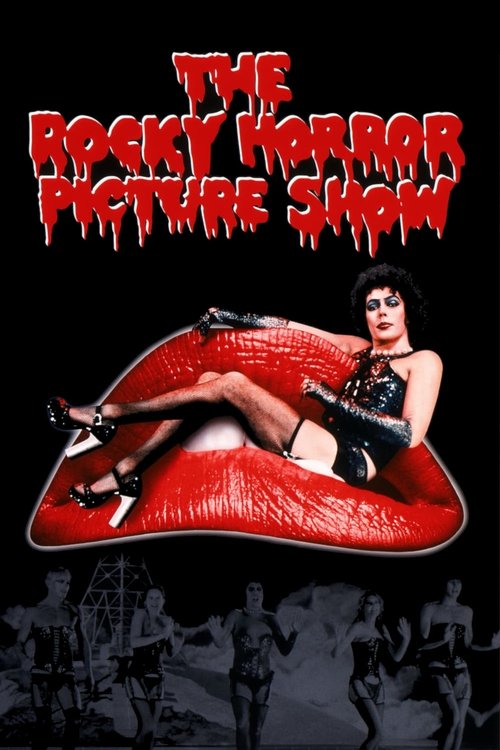
The Rocky Horror Picture Show
1975 · Jim Sharman
For a midnight screening, a Halloween party, or any night you want to be loud, dress up, and shed some inhibition — ideally with a crowd. The polar opposite of a quiet, respectful watch.
What it's about
A squeaky-clean engaged couple gets a flat tire on a stormy night and knocks at the door of a remote castle, where the flamboyant Dr. Frank-N-Furter is about to unveil his newest creation — a perfect, muscular man — to a houseful of very strange guests. What follows is a glam-rock musical send-up of every mad-scientist and B-movie cliché ever filmed, with seduction as its main event.
The experience
Gleefully campy, raucous, and impossible to watch politely — the songs are genuinely great, the innuendo is wall-to-wall, and the whole thing feels like being initiated into a delirious secret club.
Performances
Tim Curry's Frank-N-Furter — corseted, imperious, and utterly unbothered — is one of the most magnetic and liberating performances ever put on film; he doesn't steal the movie so much as own it outright.
The craft
Richard O'Brien's songbook is the engine: real rock-and-roll bangers stitched into an affectionate demolition of Universal horror and atomic-age sci-fi, staged with full theatrical flourish. It was built for a crowd — the bigger and rowdier the audience, the better it plays.
Why it matters
A flop on release, it was reborn at midnight screenings where audiences began talking back, dressing up, and performing along — inventing participatory cinema, launching the longest continuous theatrical run in history, and becoming a touchstone of queer liberation.
A flop on release in 1975, Richard O'Brien and Jim Sharman's glam-rock Frankenstein pastiche found its true form a year later at midnight screenings in Greenwich Village, where audiences began talking back, dressing up, and throwing rice — inventing, more or less, participatory cinema. It has never stopped playing since: the longest continuous theatrical run in film history. The film itself is a loving demolition of B-movie inheritance — Universal horror, atomic-age sci-fi, the RKO logo winked at in song — staged with West End theatricality and powered by O'Brien's genuinely great songbook. At its center stands Tim Curry's Frank-N-Furter, corseted, imperious, and wholly unbothered, one of the most liberating performances ever filmed; for generations of queer viewers the movie was less entertainment than permission. Sharman shoots it in lurid reds and laboratory silvers at Bray Studios, Hammer horror's old home, so the parody haunts the actual haunted house. Half a century on, the shadow-cast ritual persists in theaters worldwide — audiences performing beneath the screen, completing a film that was never quite finished without them.
A Deleuzian reading
The slab tilts up.
The full Deleuzian reading of The Rocky Horror Picture Show →
Reception
A genuine flop on its 1975 release — pulled from theaters after weeks of empty seats — before midnight screenings at New York's Waverly Theatre in 1976 turned it into the longest-running theatrical release in film history. The reappraisal wasn't critical; it was communal, invented by audiences themselves.
How The Rocky Horror Picture Show was received, from release to now →
Influences: the films it descends from and the films it influenced
- Frankenstein (1931) — Frank-N-Furter's 'birth of Rocky' laboratory tableau directly restages Whale's creation sequence — the elevated slab, gauze-wrapped body, and Kenneth Strickfaden's crackling Tesla/Van de Graaff electrical rig.
- Bride of Frankenstein (1935) — Whale's queer-coded, arch-camp treatment of the mad-creator-and-his-made-mate is the tonal template O'Brien pastiches, down to fetishizing the monster as an object of the maker's desire.
- The Invisible Man (1933) — Explicitly conjured by the 'Claude Rains was the Invisible Man' line in 'Science Fiction/Double Feature,' whose whole lyric is a curated catalog of the Universal/RKO iconography the film reanimates.
- The Day the Earth Stood Still (1951) — Named in the opening song ('Michael Rennie was ill…'); its benevolent-then-menacing alien visitor arriving among ordinary Americans is reworked into Frank's Transylvanian 'visitation' of Brad and Janet.
- Forbidden Planet (1956) — Cited via 'Anne Francis stars in Forbidden Planet'; supplies the pulp-sci-fi register — id-monsters, ray-gun tech, a decadent host in an isolated domain — that the castle's Transylvanian mission satirizes.
- King Kong (1933) — Invoked by the 'Fay Wray' verse; the B-movie awe/terror it stands for is the exact register the 'Science Fiction/Double Feature' overture asks the audience to worship and then camp up.
- The Curse of Frankenstein (1957) — Hammer's lurid Eastmancolor gothic — and the very Bray/Oakley Court gothic sets and props recycled for the castle — give the film its blood-red laboratory palette and silver anatomical hardware.
- The Wizard of Oz (1939) — Structural debt: rain-soaked, monochrome-drab innocents (Brad and Janet as Dorothy) are swept from a mundane home into a saturated Technicolor otherworld ruled by a flamboyant humbug.
- Pink Flamingos (1972) — Fellow midnight-movie-ritual object: transgressive queer camp that weaponizes low-budget bad-taste horror-comedy and courts an audience that returns to perform along with the film.
- Beyond the Valley of the Dolls (1970) — Inherits BVD's fusion of rock score, polymorphous sexual transgression, and self-aware camp, and carries it onto the very midnight-movie circuit that resurrected Meyer's film.
- Shock Treatment (1981) — The Sharman/O'Brien companion piece reuses the same creative DNA — Curry-less but O'Brien-scored glam songs, arch theatricality, and a satirical 'controlled world' — extending the troupe's stage-to-screen method.
- Little Shop of Horrors (1986) — Inherits the exact formula of adapting a stage musical that lovingly parodies 1950s B-movie horror, complete with a campy man-made/alien 'monster' and doo-wop-inflected numbers as narrative engine.
- Velvet Goldmine (1998) — Extends the glam-rock-1970s queer-liberation aesthetic — Bowie/Ferry-era androgyny, glitter and feather-boa mise-en-scène, and lip-synced performance as a mode of gender revolt.
- Hedwig and the Angry Inch (2001) — Direct heir to the queer glam-rock stage-to-screen musical: a gender-transgressive frontperson delivering original glam anthems to camera, cultivating the same participatory cult-performance afterlife.
- Repo! The Genetic Opera (2008) — Consciously chases the Rocky Horror model — a sung-through horror-rock musical with grotesque surgical/lab spectacle, cult midnight screenings, and shadow-cast audience participation built into its release.
- To Wong Foo, Thanks for Everything! Julie Newmar (1995) — Provides the 'conversion to fabulousness' template — glamorous gender-outlaws descend on repressed middle-American innocents and liberate them from their squareness through sheer theatrical excess.
- But I'm a Cheerleader (2000) — Establishes the queer-camp musical template of heightened artifice with a sincere liberationist core, the same tonal balance Babbit strikes between parody and earnest queer affirmation.
- The Perks of Being a Wallflower (2012) — Directly cited and staged within Perks; supplies the midnight-movie participatory ritual as an on-screen subculture haven where outcasts perform and belong.
- Hairspray (1988) — The midnight-movie musical's formal settlement — proscenium-frontal number staging, high-key theatrical lighting, and a drag lead whose glamour is presented as genuinely desirable rather than as a joke — the circuit and the register Waters inherited and then domesticated.
- Cabaret (1972) — Shares the decadent-emcee-as-sexual-ringmaster device — a corseted, sexually ambiguous host performing directly at the camera under hot front-light while offstage repression curdles into menace.
- Phantom of the Paradise (1974) — The exact contemporaneous experiment: a glam-rock horror-musical built as pastiche of classic gothic (Phantom/Faust/Frankenstein), fusing camp theatricality with pop songcraft and a monstrous, made-up creator-figure.
- Tommy (1975) — Same-year British rock-opera maximalism — narrative carried almost entirely through wall-to-wall pop numbers staged as delirious, sexually charged theatrical set-pieces rather than book-musical scenes.
- The Little Shop of Horrors (1960) — Inherits the exact public-domain-style cult afterlife mechanism — a cheap horror-comedy that became a beloved participatory midnight-movie ritual rather than a first-run hit.
- Female Trouble (1976) — Proscenium staging and direct-to-camera numbers designed for the midnight circuit's participatory exhibition model, with Frank-N-Furter's drag built as confrontation rather than illusion — the Divine template, working the same theaters in the same years.
Similar films
- Little Shop of Horrors (1986) — influence & lineage
- Phantom of the Paradise (1974) — influence & lineage
- Frankenstein (1931) — influence & lineage
- Bride of Frankenstein (1935) — influence & lineage
- King Kong (1933) — influence & lineage
- Pink Flamingos (1972) — influence & lineage · same viewing thread
- Beyond the Valley of the Dolls (1970) — shared sensibility
- The Greatest Showman (2017) — shared sensibility
All the films related to The Rocky Horror Picture Show →
Watch it with: curated runs of related films
- The Grotesque Sublime — Watch these when you want cinema that pushes the body to hallucinatory, grotesque extremes — each a lurid transformation, half ecstasy and half horror, that dares you to keep looking.