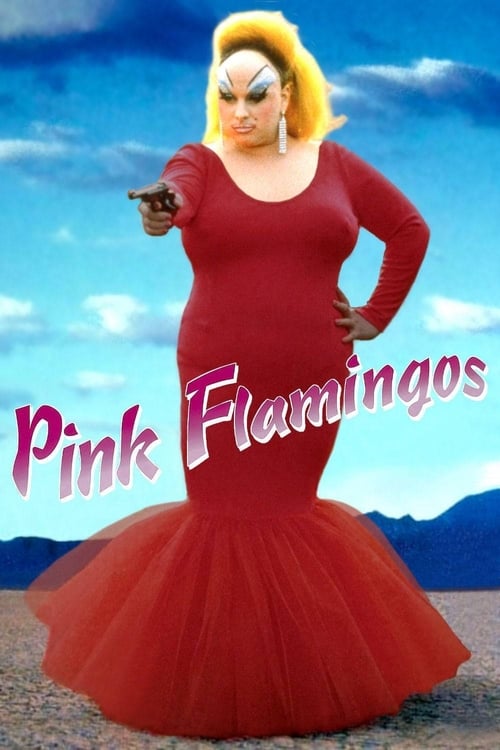
Pink Flamingos
1972 · John Waters
For when you want to be scandalized — a midnight movie to spring on brave friends. Absolutely a challenge watch, not a comfort watch: come for the transgression, stay for the weirdly pure conviction.
What it's about
Baltimore, 1972. Divine — trailer-dwelling matriarch, tabloid legend, and reigning 'Filthiest Person Alive' — is challenged for her title by Connie and Raymond Marble, a smug suburban couple who fund their lifestyle through a genuinely vile black-market scheme. What follows is an escalating war of outrages between the two households, staged as a deadpan mock-epic of one-upmanship.
The experience
Gleefully, deliberately disgusting — a dare of a movie that keeps topping itself, played with a flat comic sincerity that makes it funnier and more shocking at once. You'll laugh, you'll groan, and at least once you'll question your life choices.
Performances
Divine is a genuine force of nature — imperious, hilarious, and utterly committed, delivering every outrage with the grandeur of a screen goddess. It's one of the defining drag performances in film history.
The craft
Shot on 16mm around Baltimore for about ten thousand dollars, and every rough edge is part of the point: John Waters weaponizes amateurism into a style, with eye-scorching thrift-store costumes and a killer jukebox of vintage rock and roll. The famous final scene is unfaked, and the film never lets you forget it.
Why it matters
The movie that turned underground filth into a commercial phenomenon, cemented the midnight-movie circuit, and made Waters and Divine icons — punk cinema before punk had a name.
Snapshot
Pink Flamingos is the film that made underground cinema into a commercial proposition without making it respectable. Shot on 16mm in and around Baltimore on weekends, financed for a sum John Waters has consistently placed at roughly ten thousand dollars, it stages a contest between two households over the tabloid title "The Filthiest Person Alive": Divine, living in a trailer with her egg-obsessed mother Edie, her son Crackers, and her traveling companion Cotton; and Connie and Raymond Marble, a suburban couple who fund their lifestyle by kidnapping women, impregnating them, and selling the infants to lesbian couples. The Marbles' claim is bureaucratic and acquisitive; Divine's is ontological. The film exists to prove her right, and it closes the argument with an unsimulated act — Divine eating fresh dog excrement in a single unbroken shot — that functions less as a gag than as a notarized signature.
Its historical significance is threefold. It consolidated the midnight-movie circuit as a viable exhibition economy. It established Divine (Harris Glenn Milstead) as a screen presence whose influence on drag performance is still being paid forward. And it demonstrated that a regional amateur production, made outside every institution of the film industry, could enter the culture permanently. In 2021 the Library of Congress added it to the National Film Registry; Criterion issued a restoration for its fiftieth anniversary in 2022. Few films have traveled so far from a Baltimore trailer.
Industry & production
Waters made Pink Flamingos entirely outside the studio system, and outside even the loose institutional support that sustained the New York underground. Production was organized through his own banner, Dreamland, and staffed by the recurring company known as the Dreamlanders — friends, neighbors, and Baltimore eccentrics who worked without meaningful pay. Waters has said the budget came in around $10,000, partly through a loan from his father that he repaid; figures in the $10,000–$12,000 range circulate, and the precise accounting was never formal enough to reconstruct. Shooting proceeded on weekends over roughly a year in 1971, in the Baltimore area, with the trailer sequences filmed in rural Maryland.
Distribution is the more consequential story. The film played locally in Baltimore before Ben Barenholtz — whose Elgin Theatre in New York had already turned Alejandro Jodorowsky's El Topo into the founding midnight attraction — took it onto the midnight circuit through Libra Films in 1973. That booking pattern was the film's business model: no advertising budget to speak of, no critical endorsement, an audience assembled by word of mouth and repeat attendance at a single weekly showtime. The strategy proved durable enough that Barenholtz would later apply it to Eraserhead. New Line Cinema, which became Waters' distributor across the subsequent decade, handled the film's later theatrical life and released a twenty-fifth anniversary version in 1997 with restored outtake material and an introduction by Waters, rated NC-17 where the original had been X.
Reported grosses for the midnight run should be treated skeptically; the exhibition arrangements of the period generated no reliable audited figures, and the numbers repeated in profiles vary widely.
Technology
The film was shot on 16mm — the format of the American underground since the 1950s, cheap enough to be bought in short ends and processed at a commercial lab. Its visual character follows directly from that choice and from the absence of lighting resources: heavy grain, blown highlights in exteriors, muddy interiors, saturated color that veers toward the crude. The Academy-ratio frame (1.37:1) and the reversal-stock contrast produce an image closer to home movies and industrial films than to anything theatrical, and Waters made no attempt to disguise it.
Sound was the harder constraint. Dialogue was recorded on location with minimal equipment, producing the hollow, boxy, room-dominated track that is one of the film's most immediately identifiable features; levels shift between setups, and some passages are audibly reworked in post. Waters' earlier films had been largely post-dubbed, and the move toward location recording here is a technical advance that reads as a stylistic decision. For wider theatrical bookings the 16mm original was blown up to 35mm, a process that coarsens grain further — meaning that most audiences encountered a degraded copy of an already rough negative. The 2022 restoration, undertaken with Waters' participation, resolves detail without pretending the source was ever polished.
Technique
Cinematography
Waters shot the film himself. The camerawork is functional in the strict sense: it points at the thing happening. Coverage is sparse, framing frontal, and the dominant grammar is the static wide shot broken by a zoom when emphasis is required. Hand-held passages wobble; focus is approximate. The single most characteristic figure is the long take held past the point of comfort — the film's transgressions are almost always presented whole, in one shot, because a cut would introduce the possibility of a trick. The unbroken final shot is the extreme case of a method used throughout. Available light dominates, and exteriors are frequently overexposed, which lends the Maryland woods around the trailer an unpleasant flatness that suits the material.
Editing
Also Waters' work. The assembly is episodic rather than dramatic: scenes are laid end to end as discrete exhibits, connected by narration rather than by cause. Cuts within scenes are minimal and occasionally mismatched, and the film makes no effort to conceal continuity errors. What organizes the whole is not rhythm but escalation — each tableau must exceed the last, and the editing's job is simply to deliver them in ascending order. The birthday-party sequence, which strings together a series of performances for Divine's guests, is the structural principle made literal.
Mise-en-scène / staging
Vincent Peranio's production design is the film's most underrated achievement and the beginning of a collaboration that would run through Waters' entire career. The two households are opposed as design arguments. Divine's trailer is a real trailer, cramped and authentic, ornamented with the plastic lawn flamingos of the title — objects that are simultaneously the film's emblem of bad taste and, in Waters' hands, a genuine aesthetic. The Marbles' house is a thrift-store maximalism of clashing color and grotesque furnishing, a bourgeois interior pushed into hallucination. Staging is proscenium-like: performers arrange themselves facing the camera and deliver, a habit inherited from theatrical and burlesque traditions rather than from film.
Van Smith's costume and makeup designs are inseparable from the film's iconography. His decision to shave Divine's hairline far back, opening the forehead as a field for enormous arced eyebrows and heavy shadow, produced a face that reads at any distance and has been copied continuously ever since.
Sound
There is no composer and no score. The soundtrack is built from needle-drops of 1950s and early-'60s rock, R&B, and novelty records — The Trashmen's "Surfin' Bird" is the best-known cue — selected for their cheapness, their period vulgarity, and their ironic gaiety against the images. Music enters and exits abruptly, without underscoring in the conventional sense. Waters' own narration, delivered in a carnival-barker register as a tabloid voice-of-God, is the film's most stabilizing sonic element: it supplies exposition the scenes cannot, and it establishes the mock-documentary frame that lets the whole thing pass as reportage.
Performance
The cast are non-professionals, and the film converts that into a style. Delivery is declamatory, over-articulated, aimed past the camera at an imagined audience. Divine's performance is the anchor: a diva register built out of Hollywood glamour iconography — the wide-screen gestures of a Taylor or a Mansfield — and pushed to a pitch of aggression that no studio star was permitted. The speech to the assembled reporters ("filth are my politics, filth is my life") is played straight, as a manifesto, and its conviction is what keeps the film from collapsing into a joke.
David Lochary and Mink Stole as the Marbles play their villainy with the brittle affect of community theater, which is exactly right for characters whose evil is fundamentally aspirational. Edith Massey, a Baltimore bar employee whom Waters cast for her presence rather than her skill, gives a performance as Edie the Egg Lady that is beyond critical vocabulary — unactable, unrepeatable, and the film's most tender element. Mary Vivian Pearce, Danny Mills, Cookie Mueller, Channing Wilroy, and Paul Swift complete a company Waters would draw on for years.
Narrative & dramatic mode
The structure is a duel: two parties compete for a title, escalate, and settle it by execution. This is closer to the morality play or the fairground contest than to the psychological narrative dominant in 1972. There is no interiority, no arc, no change. Characters announce what they are and then demonstrate it repeatedly.
Waters' narration frames the events as tabloid journalism, and the film's climax literalizes that frame: the Marbles are tried before an audience of reporters and executed, after which Divine addresses the press directly. The final act with the dog is presented as documentary proof appended to a claim — the narration explicitly certifies that what we have seen is real and unfaked. The film's dramatic mode is therefore evidentiary rather than fictional; it asks not to be believed but to be verified.
Genre & cycle
Pink Flamingos sits at the junction of several disreputable traditions: the exploitation roadshow picture, the gore film, the nudie and the "roughie," and the camp comedy. It is best understood as belonging to the midnight movie cycle — a category defined by exhibition rather than content, which through the 1970s gathered El Topo, Night of the Living Dead, The Rocky Horror Picture Show, Eraserhead, and Reefer Madness into a single circuit and a single audience.
Its relationship to camp is more complicated than it appears. Susan Sontag's 1964 "Notes on 'Camp'" described a sensibility of affectionate appreciation for failed seriousness. Waters' camp is not appreciative; it is offensive by design, and it takes the middle-class taste hierarchy as an enemy rather than a playground. The film effectively founds the "trash" mode as something distinct from camp — deliberately produced bad taste, made by people who know precisely what they are doing.
Authorship & method
Waters is credited as director, writer, producer, cinematographer, editor, and narrator, which understates rather than overstates his role. But the film is a company product, and its consistency comes from collaborators who stayed: Peranio on design, Smith on costume and makeup, Pat Moran in casting and production, and above all Divine, whose persona Waters had been constructing since their Lutherville childhood — the name itself lifted from Jean Genet's Notre-Dame-des-Fleurs, an attribution Waters has confirmed and which situates the whole enterprise in a literary tradition of criminal sanctity.
Waters' method was to write for known bodies and known voices, to shoot on weekends around everyone's jobs, and to treat the limitations of amateurism as content. He described the film himself as "an exercise in poor taste," a formulation that is both accurate and a marketing instrument. The absence of a composer, a professional crew, or a script supervisor is not incidental; the film's authority derives from its evident lack of resources.
One production element requires plain statement: a live chicken is killed during a sex scene. Waters has addressed this repeatedly and noted the animal was eaten afterward, but it remains the film's most defensible-only-with-difficulty moment and has driven censorship actions and cuts in multiple territories.
Movement / national cinema
The film belongs to the American underground descending from Jack Smith's Flaming Creatures, Kenneth Anger, the Kuchar brothers, and the Warhol Factory films — a tradition of amateur means, drag performance, and deliberate affront. What Waters added was regionalism. Where the underground was overwhelmingly a New York phenomenon dependent on a metropolitan avant-garde audience, Waters worked in Baltimore, cast Baltimore, and made the city's specific textures — its rowhouses, its bars, its accents, its class geography — into subject matter. This regional commitment is the through-line of his entire filmography and the thing that eventually made him legible to a mass audience.
Set against contemporaneous New Hollywood — The Godfather was 1972 — Pink Flamingos represents the alternative American cinema of the same moment: not auteurism inside the studios but production outside them entirely.
Era / period
The film is precisely dated by its permissions and its anxieties. The Production Code had given way to the MPAA rating system in 1968, and the legal boundary of obscenity was in flux: Miller v. California would arrive in 1973, shortly after the film began its midnight run, replacing a national standard with community standards and making prosecution a local lottery. Pink Flamingos was banned or refused classification in a number of territories and faced obscenity actions in the United States, and its censorship history is inseparable from that legal turbulence.
Culturally it sits after Stonewall but refuses the assimilationist register that gay politics was beginning to adopt — Divine is not a plea for tolerance. It also sits inside the long tabloid aftermath of the Manson case, a fascination Waters has never disowned, and its treatment of murder as celebrity and celebrity as achievement reads directly off the early-1970s American news cycle.
Themes
Filth is treated as a vocation and a competitive field, complete with rankings, publicity, and challengers — which turns the film into a satire of achievement culture rather than a simple provocation. The two households oppose chosen family against the bourgeois couple: Divine's group is a genuine unit of affection, the Marbles' marriage a business partnership curdled into mutual contempt. Property and the home organize the plot; the Marbles' final punishment is delivered on their own lawn.
Class and taste are the deep subject. The film knows exactly which objects signify poverty and which signify aspiration, and it insists on loving the former. Bakhtin's carnivalesque — the grotesque, permeable body against official decorum — is the most useful available frame, and the film's insistence on eating, excreting, and copulating in full view is systematic rather than random. Gender is presented as construction and performance without argument or apology, a full two decades before that position acquired academic vocabulary.
Reception, canon & influence
Contemporary critical reception was hostile where it existed at all; Variety's review is widely quoted as calling the film "one of the most vile, stupid and repulsive films ever made," a line Waters happily repurposed as advertising. Mainstream outlets largely ignored it. Its reputation was built by audiences, over years of repeat midnight attendance, and only subsequently ratified by critics — J. Hoberman and Jonathan Rosenbaum's Midnight Movies (1983) is the study that established the film's historical place, and Stuart Samuels' 2005 documentary of the same name extended the account. Waters' own Shock Value (1981) remains the primary source for production detail, with the caveat that it is a performance as much as a memoir.
Influences on the film run backward to Smith, Anger, the Kuchars, and Warhol; to Herschell Gordon Lewis and Russ Meyer for exploitation grammar; to William Castle for the ethics of the gimmick; to Genet and Tennessee Williams for the romance of criminality; and to Baltimore burlesque and the tabloid press for tone.
Forward, the film's reach is disproportionate to its means. It made the midnight circuit an economy, clearing ground for Rocky Horror and Eraserhead. William S. Burroughs' designation of Waters as "the Pope of Trash" fixed a lineage that runs through punk's visual culture, the transgressive cinema of the 1980s and '90s, Gregg Araki and Bruce LaBruce, Harmony Korine and Todd Solondz, and the mainstream gross-out comedy of the Farrelly brothers and Jackass — the last of which inherits the unfaked-single-take principle intact. Divine's influence on drag is foundational and continuously acknowledged, not least by RuPaul; the character design of Ursula in Disney's The Little Mermaid (1989) was modeled on Divine, a rare case of an underground figure entering the corporate iconography that outlived them.
Waters' own subsequent path supplies the sharpest irony: Female Trouble (1974) and Desperate Living (1977) extended the mode, Polyester (1981) added Odorama, and Hairspray (1988) — Divine's last major role before his death that year — became a mainstream success and eventually a Broadway musical and a studio remake. The director who filmed the ending of Pink Flamingos ended up with a family show running eight times a week. That trajectory is not a betrayal of the earlier film so much as its final proof: that taste hierarchies are contingent, and that the culture will eventually make room for anything sufficiently sure of itself.
A Deleuzian reading
Two pink plastic birds planted in the dirt outside a real trailer in the Maryland woods.
The full Deleuzian reading of Pink Flamingos →
Reception
Reviled on release — Variety called it 'one of the most vile, stupid and repulsive films ever made,' a quote Waters gleefully used in the ads — it became a midnight-movie legend at NYC's Elgin Theatre, got a 25th-anniversary re-release in 1997, and in 2021 was added to the Library of Congress's National Film Registry. From 'exercise in poor taste' to official American heritage in fifty years.
How Pink Flamingos was received, from release to now →
How to watch Pink Flamingos: what to notice on a first viewing
- Watch the camera hold a static wide shot, then zoom for emphasis. Waters shoots most scenes frontally from a fixed position, breaking the stillness only with a zoom when a moment needs pointing at. The plainness of the camera is doing a job: it insists you're watching something real, not staged for you.
- Watch the two households argue through their furniture. Divine's trailer is cramped and real, decorated with plastic lawn flamingos, while the Marbles' house is a thrift-store maximalism of clashing color and grotesque taste. Each home is making a competing argument about what counts as good taste before anyone says a word.
- Listen for Waters narrating like a carnival barker. There is no score at all, only needle-drops of cheap old records and Waters's own tabloid voice-of-God narration supplying whatever the scenes leave out. The narration frames everything that follows as reportage, whether or not you believe it.
- Watch Divine strike poses built from old Hollywood glamour. The wide-screen gestures of a studio-era star are pushed to a pitch of aggression no actual studio would have allowed, delivered straight to camera rather than to a scene partner. The performance is a claim to a kind of stardom nobody was going to hand her, so she takes it.
- Notice each new scene trying to outdo the last one. The film is assembled as a series of discrete tableaus laid end to end, connected by narration rather than by cause, each one required to exceed what came before it. There's no plot pulling you forward, only the promise that the next thing will go further.
The whole guide to watching Pink Flamingos, with the keys for a rewatch →
Influences: the films it descends from and the films it influenced
- Freaks (1932) — Casts real sideshow performers rather than simulating them with makeup, frames them frontally in flat wides, and closes on a ritual initiation of an outsider by an assembled clan — the exact structure of the Marbles' trial and Divine's 'filthiest person alive' coronation.
- Mondo Cane (1962) — Establishes the carnival-barker voice-over that asserts documentary authority over plainly staged atrocity; Waters' own narration adopts the mondo announcer's evidentiary cadence to certify the Marbles' dossier as 'fact.'
- What Ever Happened to Baby Jane? (1962) — Builds a two-woman escalating-humiliation duel around faces caked into grotesque masks — the makeup-as-character logic Van Smith weaponizes for Divine's shaved-back hairline and arched brows, and the contest structure Waters transposes to Divine vs. Connie Marble.
- Blood Feast (1963) — Invents the exploitation rule that the atrocity must be held frontally in an unbroken wide so the audience can verify nothing was cut around — the grammar governing Pink Flamingos' closing dog-feces shot.
- Flaming Creatures (1963) — Shoots outdated 16mm stock in available light so overexposure and emulsion damage become the glamour, posing amateur drag performers in fixed frontal tableaux; Waters lifts both the blown-out image economy and the friends-as-stars casting method.
- Scorpio Rising (1963) — Replaces composed score entirely with wall-to-wall pop needle drops cut against ritual and transgression, making the jukebox the film's only music department — the precise sound architecture of Pink Flamingos.
- Faster, Pussycat! Kill! Kill! (1965) — Frames a declamatory female heavy in hard low-angle high-contrast compositions and writes dialogue to be barked rather than spoken, supplying the diva-register performance mode Divine inflates.
- Hold Me While I'm Naked (1966) — Stages full-pitch melodrama on 16mm in real apartments with friends and location-recorded room tone, treating amateurism as the style rather than a limitation — the Kuchar method Waters imported wholesale to Baltimore.
- Chelsea Girls (1966) — Runs reel-length takes on a locked-off camera while non-professionals improvise, fumble and outlast their material; Waters keeps the same unbroken durations and lets the resulting flubs and continuity breaks stand in the cut.
- Multiple Maniacs (1970) — Directly rehearses the machinery — the Cavalcade of Perversions barker, single-system 16mm direct sound, and Divine addressing the lens in full declamatory register — that Pink Flamingos reassembles two years later.
- Beyond the Valley of the Dolls (1970) — Waters, an avowed BVD admirer, extends its gleeful exploitation-morality parody and grotesque heightened-declarative performance into outright transgressive camp.
- Female Trouble (1974) — Extends the episodic-escalation structure into a career arc, using Van Smith's progressive makeup destruction of Divine's face as the film's chronology; the crime-equals-beauty thesis is Pink Flamingos' filth contest given a plot.
- The Rocky Horror Picture Show (1975) — Inherits the repeat-attendance midnight exhibition economy Pink Flamingos proved viable, and the proscenium-frontal staging of a transgressive host figure who addresses the house directly.
- Eraserhead (1977) — Self-financed and shot over years on weekends with a tiny stable company, then released into the midnight circuit Pink Flamingos had built — the same distribution-as-incubator model substituting for a theatrical opening.
- The Little Mermaid (1989) — Ursula's character design copies Van Smith's Divine template — brows painted up to a shaved hairline, beauty mark, wide-shouldered silhouette and low chest voice — carrying an underground makeup scheme into studio animation.
- Gummo (1997) — Casts non-professional locals for their actual faces and speech, abandons plot for episodic escalation, and films unfaked acts performed straight to camera in held takes rather than cutting them into safety.
- Happiness (1998) — Plays taboo material in symmetrical static frontal wides with no score, letting the deadpan proscenium framing rather than editing carry the transgression — Waters' composition strategy stripped of camp delivery.
- Jackass: The Movie (2002) — Preserves the unfaked-act-in-one-take principle intact: the camera holds, the crew stays visible, and the structure is an escalating one-upmanship contest with no coverage to hide behind.
- But I'm a Cheerleader (2000) — Waters' camp-trash aesthetic — reveling in artifice, kitsch, and drag performers playing gender as broad theater — is the direct model for Babbit's tone and her casting of RuPaul out of drag.
- The Adventures of Priscilla, Queen of the Desert (1994) — Establishes drag-as-transgressive-spectacle and the outsized costume as an act of defiant self-assertion, the camp lineage Priscilla sands down into a mainstream register.
- Desperate Living (1977) — Codifies the Dreamland 'contest of filth' structure and the anti-glamour flat 16mm lighting that renders the grotesque as deadpan document, the exact technique applied to Mortville.
- Hairspray (1988) — Sets the Dreamlanders' planimetric grammar — actors squared to a flat rear plane, shot head-on in long-ish takes with minimal coverage — and Van Smith's practice of building hair and makeup as freestanding sculpture that the camera frames like statuary.
- Cecil B. Demented (2000) — Establishes the frontal presentational blocking — performers planted square to the lens declaiming to an implied crowd rather than to each other — and the practice of casting a standing gang of non-actors as heightened versions of themselves under adopted names.
- The Texas Chain Saw Massacre (1974) — Independently arrives at the same regional formula: 16mm blown up for theatrical release, a non-professional local company cast for voice and body, and a narrated 'account of the tragedy' prologue that lends staged horror evidentiary standing.
Similar films
- The Rocky Horror Picture Show (1975) — influence & lineage · same viewing thread
- Freaks (1932) — influence & lineage · often watched together
- Eraserhead (1977) — influence & lineage · often watched together
- Gummo (1997) — influence & lineage
- Female Trouble (1976) — same viewing thread
- Desperate Living (1977) — same viewing thread
- The Substance (2024) — same viewing thread
- Duck Soup (1933) — often watched together
All the films related to Pink Flamingos →
Watch it with: curated runs of related films
- The Grotesque Sublime — Watch these when you want cinema that pushes the body to hallucinatory, grotesque extremes — each a lurid transformation, half ecstasy and half horror, that dares you to keep looking.