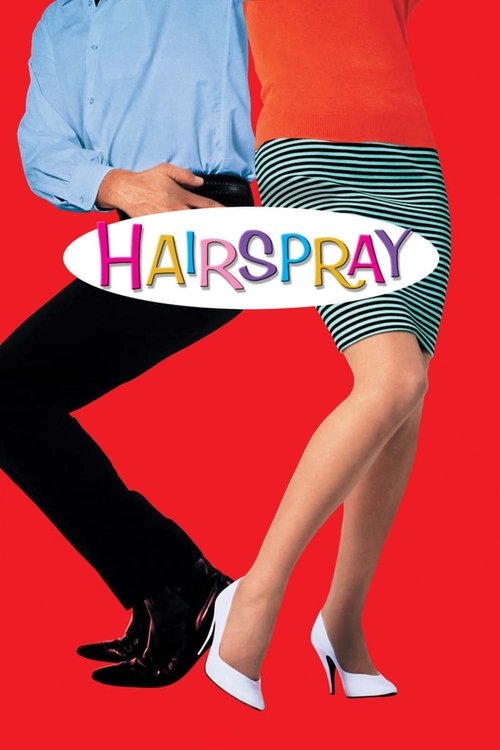
Hairspray
1988 · John Waters
For when you want a feel-good party of a movie that still stands for something — put it on with friends, dance in your living room, and root for the underdog. Total comfort, zero homework.
What it's about
Baltimore, 1962: Tracy Turnblad, a big girl with bigger hair, out-dances the competition to land a spot on the Corny Collins Show, the local TV dance program every teenager worships. Overnight fame turns her into a hometown hero — and she uses it to push for the one thing the show won't allow: Black and white kids dancing together. That puts her on a collision course with dethroned queen bee Amber Von Tussle and Amber's scheming, pro-segregation parents.
The experience
Pure candy-colored joy with a real spine — it bounces along on early-'60s dance crazes and deadpan absurdity, and its jokes about hairdos and pageant moms land right next to sincere anger about segregation. You come out grinning with a couple of songs stuck in your head.
Performances
Divine, in a dual role, is the heart of it — playing Tracy's mother Edna with such unexpected tenderness that the joke becomes love. Ricki Lake, in her debut, makes Tracy irresistible: confident, kind, and never a punchline.
The craft
John Waters recreates the Baltimore of his own teenage years with fanatical affection — the beehives, the sock hops, the local-TV cheapness — and stocks the soundtrack with period R&B and novelty dance records that do half the storytelling. The dance numbers are staged with documentary-style glee rather than Hollywood polish, which is exactly the point.
Why it matters
This was the film that carried Waters from midnight-movie infamy into the mainstream without sanding off his voice, and it kept multiplying — into a Broadway smash and a second screen life. It made integration-era Baltimore pop mythology.
Snapshot
Hairspray is the film in which John Waters, the Baltimore underground's most notorious provocateur, walked into the multiplex without appearing to change his clothes. Made for New Line Cinema and released in February 1988, it was Waters's first PG-rated feature after two decades of work defined by obscenity trials, midnight-movie infamy, and the transgressive spectacle of Pink Flamingos (1972). The shock here is that the film loses almost none of its authorial signature in the crossing. The camp is intact, the Baltimore is intact, the affection for outsiders and grotesques is intact — only the shock tactics have been retired, replaced by a genuinely warm-hearted teen musical about a fat girl who dances her way onto local television and then integrates it.
The film's ostensible subject is 1962–63 Baltimore and the Corny Collins Show, a barely veiled fiction of the real Buddy Deane Show, the local teen dance program that WJZ-TV aired from 1957 to 1964 and that Waters watched obsessively as a child. Its actual subject is the collision of two things Waters understood natively: the ecstatic conformity of teen pop culture and the ugliness of the segregation that structured it. Tracy Turnblad (Ricki Lake, in her screen debut) wants to be on television; the film's plot machinery converts that want into a civil-rights argument almost without the character noticing.
Hairspray also carries the weight of an ending. It was the last film Divine — Harris Glenn Milstead, Waters's collaborator since childhood and the face of his entire filmography — completed before his death on March 7, 1988, weeks after the film's release. Divine plays Tracy's mother Edna Turnblad, and also, in a second role, the racist station owner Arvin Hodgepile. The performance became a valediction nobody planned.
Industry & production
Waters made Hairspray for New Line Cinema, the company that had distributed his early work theatrically and that by the mid-1980s had money from the Nightmare on Elm Street franchise. The budget was small by studio standards but represented a substantial escalation over the guerrilla economics of Pink Flamingos and Female Trouble (1974) — films shot on 16mm with friends, borrowed equipment, and sums in the low tens of thousands. Hairspray was a union production shot on 35mm in Baltimore with a real crew, a real production designer, and completion requirements. Waters has spoken frequently in interviews about the discipline of that transition; his own account, across decades of press and his books, is that he found the constraint clarifying rather than compromising.
The casting strategy is one of the film's most legible industrial gestures. Waters assembled a deliberately promiscuous roster: Divine and Mink Stole from his own repertory company; Ricki Lake, an unknown; Sonny Bono and Debbie Harry as the villainous Von Tussle parents; Jerry Stiller as Wilbur Turnblad; Ruth Brown, the R&B singer, as record-shop proprietor and DJ Motormouth Maybelle; and Pia Zadora and Ric Ocasek in a beatnik cameo. This is casting as curation — pop-culture flotsam arranged so that each face carries its own footnote. It is also, practically, how a low-budget film buys recognizability.
The film's theatrical performance was modest but genuinely profitable relative to cost, and more importantly it functioned as a proof of concept: Waters could be released wide. His next film, Cry-Baby (1990), was made for Universal with Johnny Depp — a considerably larger budget and a considerably more troubled reception. In hindsight, Hairspray is the sweet spot in the Waters career curve, small enough to stay personal and legitimate enough to be seen.
Technology
Hairspray is technologically unassuming, and that is a choice. Shot on 35mm color negative, cut on film, mixed conventionally, it uses no optical trickery beyond what a 1988 low-budget comedy would ordinarily deploy. The one technological subject of the film is inside it: broadcast television. The Corny Collins Show sequences reconstruct the visual grammar of early-1960s local live TV — the flat frontal camera positions, the studio-bound proscenium, the crawl of the sponsor plug, the on-air host address. Waters and his crew reproduce the look of a medium that predates the film's own production by twenty-five years, which is itself a period-technology argument: the film is about a moment when a single local channel could dictate what an entire city's teenagers wore, danced, and desired.
The period reconstruction extends into consumer technology as prop and theme — the hair dryer, the aerosol can, the beehive as an engineering problem. The title is not incidental. Aerosol hairspray is the film's emblem of postwar American chemical modernity applied to the body, and Waters treats it with a mixture of nostalgia and horror. The joke about the ozone layer that a later era would supply is not in the 1988 film; the fascination with hair as architecture entirely is.
Technique
Cinematography
David Insley shot the film. The visual approach is bright, high-key, and frontal — closer to television light than to the moody naturalism that dominated late-1980s American features. Compositions favor the flat, planimetric frame: characters arranged parallel to the picture plane, often centered, often looking more or less at the lens. This is the Corny Collins Show aesthetic bleeding out of the diegetic TV screen and into the film's own grammar, and it is also the flatness of a comic strip or a Sunday-supplement advertisement.
Color is the primary expressive instrument. Insley and the design team push a saturated palette of period pastels and hard primaries — turquoise, hot pink, lemon — that reads as a fetishization of early-'60s consumer surfaces. Camera movement is limited and mostly functional; the film prefers to stage than to track. Where the camera does move, it tends to be in the dance numbers, where it follows bodies with unfussy energy rather than showing off. The overall effect is a film that looks cheerful and slightly artificial on purpose, refusing the desaturated "authenticity" that period dramas of the era typically reached for.
Editing
Janice Hampton cut the film. The editing's central problem is rhythm: Hairspray alternates between dialogue comedy played in relatively long, stagey takes and dance sequences that need to swing. Hampton's solution is a cutting pattern that stays patient in scene work — letting Waters's dialogue land in wide two-shots, giving Divine room to occupy a frame — and gets brisk in the musical numbers, cutting on the beat of the source records without ever fragmenting the choreography into the unreadable montage that later musicals would favor. Dances are legible as dances. Bodies stay whole in the frame. This is a small technical decision with a large thematic consequence in a film about a body that the culture wants to hide.
The film also uses television-style inserts and cutaways — reaction shots of viewers watching at home, the show's own "camera" perspective — to keep the double frame active, so the audience is continually aware of watching people watch.
Mise-en-scène / staging
This is where Hairspray is richest. Vincent Peranio, Waters's production designer since the early films, builds a Baltimore of overstuffed rowhouse interiors, plastic-covered furniture, wood paneling, and the Turnblads' laundry-cluttered domesticity. Van Smith, Waters's costume and makeup designer and the man who created Divine's iconic look, supplies the period silhouettes and — crucially — the hair. The beehives are not merely period-accurate; they are escalated into sculpture, a running visual gag that also functions as a class and status index. Who has the biggest hair, and who sprayed it, tells you where a character sits.
Staging is deliberately theatrical. Waters composes scenes as tableaux, groups characters in frontal arrangements, and permits a broadness of gesture that would read as amateurish in a naturalistic film and reads as style here. The dance floor of the Corny Collins Show is the film's central stage — a bounded arena where social hierarchy is literally choreographed, with the segregated "Negro Day" as the structural exclusion the plot exists to break.
Sound
The soundtrack is a curated archive of early-'60s R&B, novelty, and dance records — the music of the very radio and TV culture the film reconstructs, much of it Black music consumed by white teenagers whose parents wanted the performers kept off the air. That contradiction is the film's argument, delivered through the needle drops rather than through speeches. Kenny Vance, formerly of Jay and the Americans, served as music supervisor/producer, and the film's use of period recordings rather than newly composed score is a structural decision: the songs are diegetic-adjacent, playing on the show, in the record shop, at the dance, so that the film's music is always the characters' music.
Ruth Brown's presence is the sound design's thesis made flesh. Casting an actual Atlantic Records R&B pioneer as the character who presides over Black Baltimore's musical life imports real historical authority into a comedy. Dialogue recording and mix are straightforward; Waters's ear is for the line, not the sound field, and the film trusts its script.
Performance
The performances are calibrated to a register that has no exact equivalent elsewhere: sincere camp. Ricki Lake plays Tracy with total, unironized conviction — she is not winking, and the film's warmth depends entirely on that. Against her, Divine gives what is probably the most restrained performance of that career. Edna Turnblad is not a drag turn in the confrontational Pink Flamingos mode; she is a housebound Baltimore mother, played with genuine tenderness and comic timing, whose eventual emergence from the house is the film's second emotional arc. Divine's doubling as Arvin Hodgepile is a Waters signature — the actor as repertory, the same body playing love and hate.
Debbie Harry and Sonny Bono play the Von Tussles as pure vaudeville villainy, which the film needs; Jerry Stiller anchors Wilbur in a gentler comic tradition; Mink Stole and the rest of the Dreamlanders supply the connective tissue between this film and Waters's underground past. The tonal risk is enormous — a fraction more knowingness and the civil-rights plot would curdle into a joke — and the ensemble's discipline in playing it straight is the reason it holds.
Narrative & dramatic mode
Structurally, Hairspray is a backstage teen musical bolted to a social-problem picture, and the seam is the point. The A-plot follows a familiar shape: outsider auditions, is rejected on the grounds of her body, gets on the show anyway, becomes a star, wins the rival's boyfriend, and triumphs at the Miss Auto Show 1963 pageant. The B-plot is desegregation — Tracy's growing alliance with the Black teenagers relegated to the show's monthly "Negro Day," and the escalating confrontation that culminates in protest.
Waters's dramaturgical trick is to make the two plots the same plot. Tracy's exclusion for fatness and her Black friends' exclusion for race are not equated — the film is careful about the difference in stakes — but they are made to rhyme, so that a body-acceptance story and an integration story share a single antagonist: the people who decide who is allowed to be seen. The mode is comic throughout; nobody dies, the villains are ridiculous, and the resolution is a wish-fulfillment fantasy that the historical record pointedly did not supply. The Buddy Deane Show was in fact canceled in 1964 rather than integrated, a fact Waters has discussed often and which the film's optimistic ending silently answers.
The film's dialogue mode is aphoristic and quotable, built on the collision of teen-magazine idiom with Waters's own baroque vulgarity, cleaned to PG but not neutered.
Genre & cycle
Hairspray sits at the intersection of at least four traditions. It is a teen dance musical descended from the AIP beach-party cycle and from the American Bandstand culture those films fed on. It is a Baltimore film — a regional cinema of one, essentially, though it converses with the American independent regionalism of the 1980s. It is a camp comedy in the lineage of the Warhol Factory films, Kenneth Anger, and the midnight-movie circuit. And it is, structurally, a Cinderella story.
Within the 1980s cycle of nostalgic period films about the early '60s — a cycle that includes Diner (1982), also set in Baltimore, and Peggy Sue Got Married (1986) — Hairspray is the one that refuses to let nostalgia be innocent. It wants the records and the hair and the cars, and it insists on remembering who was kept out of the frame.
Authorship & method
Waters's method is repertory. The film's key collaborators had been with him for years: Vincent Peranio (production design) and Van Smith (costumes and makeup) had shaped the visual identity of the Dreamlanders films since the early 1970s, and their work here is the direct reason a modestly budgeted picture reads as sumptuous. Pat Moran, Waters's longtime casting director, assembled the ensemble. Divine's presence since Mondo Trasho (1969) makes the Waters filmography one of the great sustained actor-director collaborations in American independent film.
Waters wrote the screenplay himself, as he has for all his features. The authorial method is autobiographical archaeology: he built the film out of his own Baltimore childhood viewership, and the specificity — the roach-infested record shop, the rowhouse, the exact texture of the dance-show hierarchy — comes from memory rather than research alone. Cinematographer David Insley and editor Janice Hampton were the newer professional additions, and the film's relative technical polish is partly theirs.
There is no composed score of the traditional kind; Kenny Vance's music supervision does the work a composer would. This is consistent with Waters's practice across his career, where found pop music functions as both period marker and emotional vocabulary.
Movement / national cinema
Hairspray belongs to American underground/transgressive cinema's transition into the independent commercial sector — the same broad passage that carried figures from midnight-movie and avant-garde contexts into the 1980s–'90s indie boom. Waters's specific lineage runs through the New York underground of the 1960s (Warhol, Jack Smith, the Kuchar brothers) filtered through Baltimore working-class culture and Hollywood melodrama. He is regionally singular: virtually no other major American director has built an entire body of work in and about one mid-Atlantic city with this degree of fidelity.
The film is also a document of American national self-mythology under revision. Its subject is the moment when postwar consensus culture — white, suburban, televised — was forced to account for who it excluded, and it is made in the Reagan-to-Bush transition, a period of aggressive nostalgia for exactly that consensus.
Era / period
Two eras operate simultaneously. The depicted era is 1962–63, the narrow window between the early rock-and-roll boom and the British Invasion, when local television dance shows still exercised enormous regional power and when Southern and border-state segregation was under active, escalating challenge. Baltimore's own status as a border city — neither wholly Southern nor Northern — is essential; the film's integration plot is plausible precisely because Baltimore's segregation was social and institutional rather than legally uniform.
The production era is 1987–88: the tail of Reagan's second term, the height of the AIDS crisis, the moment when New Line and other minis were building the infrastructure that would produce the 1990s independent film boom. Divine's death in March 1988, at 42, sits at the intersection of those contexts and permanently altered how the film reads.
Themes
The film's governing theme is visibility as a civil right — who gets to appear on screen, in what body, at whose invitation. Tracy's fatness and the Black students' exclusion are both violations of that right, prosecuted by the same class of gatekeepers.
The politics of appearance runs through everything: hair, weight, clothing, dance style. Waters treats the surfaces of consumer culture not as trivial but as the actual arena where social power is contested. Beehives are politics.
Camp as ethics is the film's method-as-argument. Waters's affection for the tacky, the excessive, and the déclassé is a moral position: it refuses the hierarchy that separates good taste from bad, and by extension the hierarchies that separate acceptable bodies from unacceptable ones.
Nostalgia interrogated — the film loves 1962 and indicts it in the same shot, which is a genuinely difficult tonal achievement.
Finally, integration as joy rather than sacrifice. The film's civil-rights argument is delivered as pleasure: the Black kids' dancing is better, the music is better, and the film's position is simply that the party improves when everyone is let in.
Reception, canon & influence
Critical reception in 1988 was broadly favorable and frequently surprised. Reviewers noted the paradox of a Waters film suitable for family audiences and generally read the mainstreaming as a gain rather than a loss, with the film's warmth and Divine's performance drawing particular praise. The reviews were also inevitably inflected by Divine's death shortly after release, which turned the Edna Turnblad performance into an elegy.
Influences on the film (backward): the Buddy Deane Show itself, as primary source; American Bandstand and the national teen-dance-show format; the AIP beach-party cycle; Douglas Sirk-descended melodrama, which Waters has repeatedly cited as formative and whose color and emotional excess are visible throughout; the Warhol Factory films and the New York underground; and the Hollywood women's picture as a general reservoir of feeling that Waters mines without irony.
Legacy (forward): Hairspray's afterlife is extraordinary and largely posthumous to the film itself. The 2002 Broadway musical adaptation, with songs by Marc Shaiman and Scott Wittman and book by Mark O'Donnell and Thomas Meehan, became a major commercial success and swept the Tony Awards. That musical was in turn adapted into the 2007 film directed by Adam Shankman, with John Travolta in the Edna role — meaning the property has been remade twice, once for each medium, with the tradition of casting a man as Edna preserved as a direct inheritance from Divine. A live television broadcast, Hairspray Live!, followed in 2016.
Within Waters's career, the film established the register — affectionate, period-specific, pop-saturated — that Cry-Baby and Serial Mom (1994) would extend. More broadly, it demonstrated that transgressive-underground sensibilities could be translated for mainstream audiences without disowning their origins, a proof that mattered to the independent filmmakers who followed in the 1990s.
Its most durable cultural contribution may be simplest: it put a fat teenage girl at the center of an American musical, let her be desired, funny, and politically right, and made that unremarkable. Very little in American film before it had done so, and the fact that the property has been continuously revived for four decades suggests how badly the position was needed.
A Deleuzian reading
Look at the hair first.
The full Deleuzian reading of Hairspray →
Reception
A modest box-office performer in 1988, it quietly became the most beloved thing John Waters ever made — spawning a Tony-sweeping Broadway musical, a 2007 movie remake, and a live TV special, turning the Pope of Trash into an unlikely family-franchise founder.
How Hairspray was received, from release to now →
How to watch Hairspray: what to notice on a first viewing
- Watch whose hair is tallest in any given scene. Van Smith builds each character's beehive as its own sculpture, and the size and shape of the hair works as a visible index of who has status in this world. Hair alone tells you where a character stands before they say a word.
- Notice characters facing the camera almost like a class photo. Waters and Insley shoot scenes flat and frontal, arranging people parallel to the picture plane and often looking more or less right at the lens. The stiff, posed framing borrows straight from the TV dance show the story is about, blurring the two.
- Notice how bright and candy-colored every set and costume is. Insley and the design team push turquoise, hot pink, and lemon far past anything documentary, so color feels manufactured on purpose rather than naturalistic. The candy palette makes a cheerful surface out of a story that is also about who gets excluded.
- Watch whole bodies stay in frame during the dance numbers. Hampton cuts the musical numbers on the beat of the records but never breaks a dancer's body into fragments the way later musicals would. Keeping the whole body visible while dancing matters most in a film about a body the culture wants hidden.
- Listen for period songs playing as the characters' own music. Instead of a composed score, the film uses real early-'60s R&B and dance records as source music playing on the show, in the record shop, at the dance. The soundtrack carries the film's argument by itself: the music teenagers loved was made by people the show tried to keep off screen.
The whole guide to watching Hairspray, with the keys for a rewatch →
Influences: the films it descends from and the films it influenced
- Female Trouble (1974) — Establishes the Divine dual-role gag Hairspray reuses wholesale — Divine plays both Dawn Davenport and her male rapist Earl Peterson, exactly as she later plays both Edna Turnblad and station owner Arvin Hodgepile, with Van Smith's makeup engineering the split.
- Pink Flamingos (1972) — Sets the Dreamlanders' planimetric grammar — actors squared to a flat rear plane, shot head-on in long-ish takes with minimal coverage — and Van Smith's practice of building hair and makeup as freestanding sculpture that the camera frames like statuary.
- Polyester (1981) — The direct rehearsal: Divine plays a Sirkian suburban housewife straight rather than as burlesque, and Peranio's rowhouse interiors first commit to saturated period decor as sincere melodramatic environment instead of trash-tableau backdrop.
- Imitation of Life (1959) — Waters's cited template for hyper-saturated Technicolor melodrama in which a racial-passing plot is played with full emotional conviction and no ironic distance — the color-as-feeling and the refusal to wink both transfer to the integration plot.
- The Girl Can't Help It (1956) — Stages R&B and rock acts as direct-to-camera frontal performance blocks inserted into a comic narrative, with cartoon-flat compositions and candy color — the structural model for Hairspray's Corny Collins numbers as self-contained proscenium units.
- Beach Party (1963) — The AIP cycle's method of building ensemble dance set-pieces from frontally-massed teen bodies cut on the downbeat, with adult authority figures played as broad grotesques by veteran character actors — the casting logic behind Divine, Sonny Bono and Debbie Harry as the parents.
- Bye Bye Birdie (1963) — Structures a teen musical entirely around a live television broadcast as the arena of social power, cutting between studio floor, control booth and living-room viewers — the exact spatial architecture of the Corny Collins Show and its home audience.
- Flaming Creatures (1963) — The underground source for drag staged as static, overloaded tableau in which costume and makeup, not psychology, carry the performance — Waters's beehive-as-sculpture and frozen frontal groupings descend from Smith's costume-first mise-en-scène.
- Chelsea Girls (1966) — Codifies the superstar-repertory method Waters adopted: casting non-professionals as amplified versions of their own personae and holding them in fixed frontal setups, so that presence substitutes for technique — the operating principle of the Dreamlanders company.
- American Graffiti (1973) — Proves a period film can run wall-to-wall on licensed pop with no composed score, the needle-drops functioning as both dating device and emotional register — precisely the job Kenny Vance's music supervision does in place of a composer.
- The Rocky Horror Picture Show (1975) — The midnight-movie musical's formal settlement — proscenium-frontal number staging, high-key theatrical lighting, and a drag lead whose glamour is presented as genuinely desirable rather than as a joke — the circuit and the register Waters inherited and then domesticated.
- Cry-Baby (1990) — Runs the Hairspray formula again with a bigger budget: 1950s Baltimore, needle-drop rockabilly instead of a score, tableau-frontal musical numbers, and stunt-cast ensemble of pop-culture exiles (Iggy Pop, Traci Lords, Patty Hearst) filling the Dreamlanders slots.
- Serial Mom (1994) — Extends the high-key, television-flat lighting scheme and squared-to-camera suburban staging to a mainstream star, letting Kathleen Turner play atrocity with the same unbroken sincerity Divine gave Edna's ironing board.
- Hairspray (2007) — Inherits the casting rule as law — a man in fat suit and Van Smith-derived makeup as Edna, John Travolta by way of Divine — while replacing planimetric stasis with mobile Steadicam choreography, which isolates exactly what the frontality was doing.
- But I'm a Cheerleader (1999) — Rebuilds the saturated pastel palette and dead-center frontal framing as a queer coming-of-age idiom, using production design that is unmistakably artificial while the performances stay sincere — the sincere-camp calibration taken directly from Waters.
- Muriel's Wedding (1994) — Models the camp reclamation of disposable pop culture and a plump, un-starry misfit heroine framed in saturated primary color, treating kitsch as sincere emotional currency rather than punchline.
- Superstar: The Karen Carpenter Story (1987) — Contemporaneous experiment in the same operation: period pop needle-drops carrying the emotional load, Sirkian melodramatic pitch played without irony, and a body-politics narrative staged in deliberately artificial frontal tableau.
- Little Shop of Horrors (1986) — Deploys an early-sixties Black girl-group trio as a diegetic doo-wop Greek chorus, choreographed frontally to the camera in a stylized period streetscape — the same conversion of R&B performance convention into narrative machinery.
- Pee-wee's Big Adventure (1985) — Shares the television-derived visual system — flat high-key light, primary-and-pastel saturation, proscenium-frontal blocking — applied to a protagonist whose refusal of adult body norms is played as fact rather than pathology.
Similar films
- Pink Flamingos (1972) — influence & lineage
- American Graffiti (1973) — influence & lineage
- Female Trouble (1976) — shared sensibility
- To Wong Foo, Thanks for Everything! Julie Newmar (1995) — shared sensibility
- The Wiz (1978) — shared sensibility
- But I'm a Cheerleader (2000) — shared sensibility
- House Party (1990) — shared sensibility
- Some Like It Hot (1959) — shared sensibility