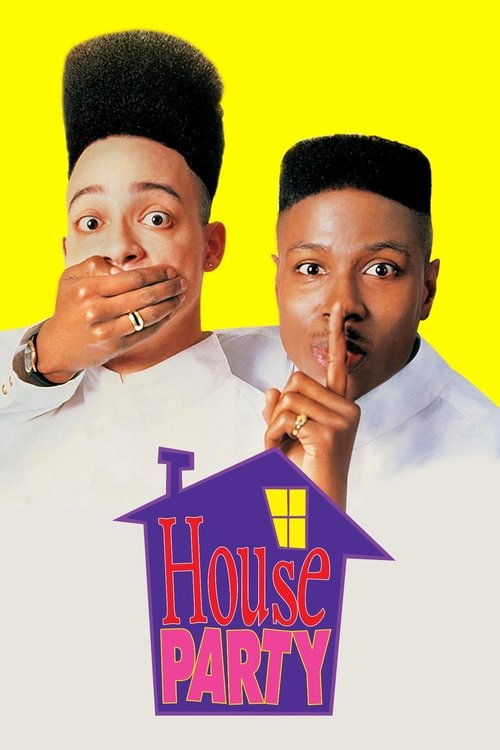
House Party
1990 · Reginald Hudlin
For when you want pure fun with friends — a party movie that actually feels like a party, comfort viewing with a beat. Reach for it when you're nostalgic for high-school mischief and want to end the night grinning.
What it's about
Kid just wants to get to the party his friend Play is throwing while his parents are out of town — but a school fight gets him grounded, so he sneaks out after his father falls asleep. What follows is one long night of dodging three vengeful bullies, winning over a girl, and trying to make it home before dawn, all set in a Black teenage world where hip-hop is simply the air everyone breathes. Rap duo Kid 'n Play essentially play themselves, and the party itself — the dancing, the DJ battles, the basement games — is as much the subject as the plot.
The experience
Fast, warm, and genuinely funny — a farce that keeps escalating but never turns mean. The energy of the dance floor carries into every scene, and the whole thing radiates the giddy invincibility of being seventeen on a Friday night.
Performances
Kid 'n Play (Christopher Reid and Christopher Martin) have real chemistry and pull off a legitimately great dance-off, while stand-up legend Robin Harris steals every scene as Kid's exasperated father; a young Martin Lawrence and Tisha Campbell round out a cast full of future stars.
The craft
Reginald Hudlin expanded his own student short into a feature with confident comic timing and a cinematographer, Peter Deming, who lights Black skin and nighttime parties with unusual care — the film won the cinematography prize at Sundance in 1990. The soundtrack and dance sequences are the payoff: turn the volume up.
Why it matters
A Sundance winner that proved a hip-hop teen comedy could be a mainstream hit, it launched Hudlin's career, helped build New Line Cinema, spawned sequels, and opened the door for a wave of Black-led studio comedies in the 1990s.
Snapshot
House Party is a one-night teen farce built on the oldest comic engine there is — a boy wants to get to a party, and everything conspires against him — retooled as the first mass-audience American film to treat hip-hop not as spectacle to be explained but as the ordinary air its characters breathe. Reginald Hudlin, adapting his own Harvard undergraduate thesis short, cast the rap duo Kid 'n Play (Christopher Reid and Christopher Martin) as versions of themselves, surrounded them with stand-up comedian Robin Harris, a pre-fame Martin Lawrence, Tisha Campbell and A.J. Johnson, and handed the camera to Peter Deming, a cinematographer then best known for horror. The result took the Filmmakers Trophy and the cinematography award at the 1990 Sundance Film Festival before New Line Cinema released it in March of that year, where a film made for a reported budget in the low millions returned many times its cost.
Its importance is out of proportion to its modesty. Released fifteen months before the 1991 wave that made "Black film" a studio category — Boyz n the Hood, New Jack City, Straight Out of Brooklyn, Daughters of the Dust — it made the commercial argument those films inherited, and it made it in a register the wave largely abandoned: comedy, pleasure, and a refusal of tragedy. It has since entered the Library of Congress National Film Registry, and its DNA runs directly through Friday, Barbershop, and three decades of Black ensemble comedy.
Industry & production
The production history is a textbook case of the 1980s independent-to-studio pipeline working as designed. Hudlin made House Party first as a short at Harvard in the early 1980s, where he studied film. That short circulated on the festival and campus circuit and functioned as the proof-of-concept that a first-time feature director otherwise cannot supply. His brother Warrington Hudlin produced; Warrington was a co-founder of the Black Filmmaker Foundation, the New York organization that from the late 1970s onward built distribution, screening and mentorship infrastructure for Black independents when almost no institutional support existed. The Hudlin Brothers were, in effect, their own studio system in miniature before a studio was involved.
New Line Cinema financed and distributed. This matters. New Line in 1990 was not a major — it was a scrappy operation whose balance sheet ran on the Nightmare on Elm Street franchise and which would have its biggest year to date on the back of Teenage Mutant Ninja Turtles. It was precisely the kind of company that could say yes to a low-budget picture with no stars recognizable to a white executive class, because its economics depended on exactly that arbitrage: cheap films with pre-identified audiences. The music-industry recognition of Kid 'n Play — their singles and videos were in heavy rotation on Yo! MTV Raps and BET — supplied the marketing that a star did not.
The commonly cited figures are a budget around $2.5 million against a domestic gross above $26 million. Whatever the precise numbers, the ratio is what circulated in Hollywood, and the ratio is what produced the following year's greenlights. Studios did not conclude from House Party that Black audiences wanted comedies; they concluded that Black-cast films were cheap and profitable, and then largely commissioned crime dramas. That misreading is part of the film's history.
The release carries a shadow. Robin Harris, whose performance as Kid's father anchors the film emotionally, died of a heart attack days after it opened. He was in the middle of a breakout — he had appeared in Do the Right Thing the year before, and his "Bébé's Kids" stand-up routine would be adapted posthumously into an animated feature. House Party became, unintentionally, his monument.
Technology
The relevant technologies here are not on screen so much as around the film. The end of the 1980s brought markedly faster color negative stocks into general use, which is what permits a movie set almost entirely between dusk and dawn to be shot with saturated color and visible shadow detail rather than flattened by brute lighting. Deming exploits this: interiors read as though lit by lamps, party lights and kitchen fluorescents, and night exteriors keep their darkness instead of being day-for-nighted or blasted into legibility.
On screen, the governing technology is the turntable and the sampler. Bilal's DJ rig is staged as an instrument, not a prop, and the film assumes an audience that understands what a DJ does — no character stops to explain the culture, which was itself a break from the mid-1980s hip-hop films that functioned partly as ethnography for outsiders. Marcus Miller's score leans on programd drums and synthesized bass, the studio vocabulary he had been working in through the late 1980s, so that score and source music share a sonic world rather than sitting in separate registers.
The other decisive technology is distribution. The soundtrack album, the music-video pipeline, and the cable and home-video aftermarket made a film like this viable in a way it would not have been a decade earlier. House Party is an early, unusually clean instance of the film-plus-soundtrack cross-promotion model that dominated the 1990s.
Technique
Cinematography
Peter Deming's Sundance award was not a courtesy. He came to the film from horror — he had shot Evil Dead II — and he brings that school's appetite for a mobile, expressive, low-slung camera into a genre that usually settles for flat coverage. Wide lenses press into faces; the camera dollies and cranes through the party rather than observing it; angles cant when the film wants to feel the room tilt.
The more consequential achievement is the lighting of Black skin. Deming keys hard and uses strong rim and backlight to separate dark faces from dark backgrounds, and he lets colored gels — magentas, cyans, deep ambers — do the atmospheric work in the party scenes without muddying the actors. This sounds like a technical footnote and is not: the standard practice of the period, built around film stocks and lighting conventions calibrated to white skin, routinely rendered Black performers as underlit silhouettes. House Party looks luxurious, and looking luxurious on a small budget was an argument.
Editing
Earl Watson's cutting does two distinct jobs. The first is farce architecture: the film runs three or four parallel strands — Kid's obstructed journey, Pop's pursuit, the three bullies, two hostile cops — and crosscuts them on a tightening schedule so the night compresses toward collision. The second is restraint. When the dancing arrives, the film largely stops chopping. The celebrated Kid 'n Play kick-step routine is held in sustained wide framings so the choreography reads as choreography, a decision that runs against the accelerating music-video grammar of the moment and is the main reason the sequence remains watchable and imitable rather than dated.
Mise-en-scène / staging
The film's spatial idea is simple and rigorous: a single house, invaded and progressively colonized over one night, with the rest of the world reduced to corridors leading toward it — school hallway, street, police station, another family's living room. The house itself is unremarkable middle-class stock, which is the point. This is not a project or a tenement; it is a suburb, with parents who go away for the weekend.
The costume palette — color-blocked brights, oversized silhouettes, Kid's vertical high-top fade functioning as both character design and running gag — locks the film to a precise moment in hip-hop's visual self-presentation, just before the streetwear boom of the early 1990s. Notably, the film never names its city. The geography is deliberately generic, universalizing the milieu in a way that the location-specific 'hood films that followed pointedly refused.
Sound
The mix treats the party as a body of overlapping voices, competing conversations and bass that bleeds through walls, so that rooms are audibly distinguished from one another. Music is nearly always motivated by the house sound system, which keeps score and source in dialogue. The rap battle between Kid and Play is staged as a genuine performance set piece rather than a montage, with the crowd's reactions functioning as the scene's real soundtrack.
Performance
Hudlin builds performance around personae rather than technique. Reid and Martin were not trained actors, and the film uses their amateur charm as texture, giving them rhythm-based comic business — the battle, the dance, the physical bickering — rather than dramatic weight. The weight goes to Robin Harris, whose Pop is essentially stand-up transposed: long riffing monologues, comic aggression concealing devotion, timing honed in clubs. Martin Lawrence's Bilal is broad, physical and scene-stealing in a way that reads clearly, in retrospect, as a star being discovered. Tisha Campbell and A.J. Johnson give Sidney and Sharane distinct class textures — one from an affluent, orderly household, one from a crowded, noisy one — and both push past the ingénue slots the script could have left them in. Full Force, the Brooklyn R&B production group, play the three bullies, musicians cast as heavies, which gives the antagonists a lumbering comic-book quality that keeps genuine menace at bay.
Narrative & dramatic mode
The mode is classical farce under a unity of time: one night, escalating obstacles, converging pursuers, resolution at dawn with the protagonist chastened and slightly wiser. Structurally it belongs with American Graffiti, Animal House, Risky Business and Ferris Bueller's Day Off — the American one-night-of-freedom picture — and more immediately with Michael Schultz's Cooley High, the 1975 film that first gave that structure a Black cast and a memory-piece tenderness.
What distinguishes House Party is its tonal control. It repeatedly permits real danger to enter — a police stop that curdles, a jail cell, a father's belt — and each time metabolizes it back into comedy without pretending it wasn't there. The dramatic contract is that nothing irreversible will happen, but the film is honest that irreversible things could. That balance is the hardest thing it does.
Genre & cycle
The film sits at the hinge between two cycles. Behind it is the hip-hop showcase film — Wild Style, Beat Street, Breakin', Krush Groove, Tougher Than Leather — pictures organized around performances, in which the culture is the subject and the plot is scaffolding. House Party inverts the ratio. Hip-hop is not the subject; it is the medium in which perfectly conventional teen-comedy business is conducted. That inversion is what let hip-hop become a general-purpose American film language rather than a genre unto itself.
Ahead of it is the 1990s Black ensemble comedy, which it essentially founds: a defined social space, a large cast of comic types, episodic incident, and a soundtrack doing narrative work. Friday, five years later, is the direct descendant.
Authorship & method
Hudlin's method is best described as vernacular classicism: rigorously conventional structure, executed with unusual craft, in service of material Hollywood had not seen. He wrote the screenplay alone and directed from his own short, which gave him a degree of authorial control rare for a first feature. His later career — Boomerang with Eddie Murphy, The Great White Hype, Marshall, a run as president of entertainment at BET, and a producer credit on Django Unchained — traces a figure as interested in institutional power as in directing.
The key collaborators shaped the film decisively. Deming's photography supplied the visual seriousness. Marcus Miller — a jazz bassist and producer with major credits alongside Miles Davis — brought a musician's ear to a score that had to coexist with wall-to-wall source music without competing. Earl Watson's editing sustained the farce mechanics and, crucially, knew when to stop cutting. Warrington Hudlin's producing supplied the independent-sector infrastructure that made the project exist at all.
Movement / national cinema
House Party belongs to the East Coast strand of the Black independent surge of the late 1980s — the Black Filmmaker Foundation, NYU and Harvard, Spike Lee's She's Gotta Have It route from self-financed indie to studio deal, Robert Townsend's Hollywood Shuffle. It is distinct from the L.A. Rebellion tradition of Charles Burnett, Julie Dash, Haile Gerima and Billy Woodberry, which pursued formal experiment and Third Cinema politics with little interest in commercial genre. Hudlin's project was the opposite: to demonstrate that the commercial forms themselves were available.
Its Sundance premiere is also a marker in the institutional history of American independent film. 1990 sits at the beginning of Sundance's transformation into a studio acquisition market, and House Party is one of the festival's early demonstrations that an award there could translate into real theatrical money.
Era / period
The film arrives at the close of the Reagan-Bush era, amid a national moral panic about rap music — the 2 Live Crew obscenity prosecutions were unfolding in 1990 — and about young Black men generally. Its politics are argued through setting rather than speech. By locating its characters in a comfortable, unremarkable, unnamed suburb with a working father, homework, and college in the middle distance, the film contradicts the era's dominant media image of Black adolescence without ever mentioning it.
It also engages the AIDS crisis directly and without sermon: a scene in which Kid and Sidney negotiate contraception treats safer sex as a matter of practical, slightly awkward competence. In 1990, in a teen comedy, that was genuinely unusual.
Themes
The governing tension is autonomy against authority — parental, institutional, and police. Pop's discipline is played for laughs but built on evident love and evident fear for his son; the film's most affecting register is a single father who cannot say what he means.
Class stratification within Black communities is the film's quiet second subject, developed almost entirely through production design: Sidney's orderly, affluent house against Sharane's crowded one. The film observes the difference clearly and, to its credit, does not resolve it into a moral.
Masculinity is examined through the gap between performance and experience — the battle raps, the boasting, the entirely unearned confidence of boys who have done far less than they claim. And the party itself functions as a temporary utopia: a space, bounded by one night and the parents' return, in which the ordinary rules are suspended.
Two elements deserve a fair critical note. The jail sequence trades on gay-panic humor that reads badly now and read badly to some observers then. And the young women, vividly played, are given less interiority than the boys. Neither invalidates the film; both belong in an honest account of it.
Reception, canon & influence
Contemporary critical reception was broadly enthusiastic, with reviewers responding to the craft as much as the comedy — Deming's photography and Robin Harris's performance drew consistent praise, and Roger Ebert was among the film's prominent champions. The Sundance awards preceded the reviews and gave the film critical legitimacy before commercial release, an unusual sequence for a studio-distributed teen comedy.
Backward, the lines of influence run to Cooley High and Michael Schultz's Car Wash and Krush Groove for the structure and the ensemble texture; to Animal House and Risky Business for the party-comedy machinery; to Spike Lee's School Daze for the Black-campus musical energy and for several cast members; and to Robin Harris's own stand-up, which supplies the film's comic voice as surely as the script does.
Forward, the legacy is large. It launched a franchise — House Party 2 the following year, further sequels through the 1990s and 2000s, a direct-to-video entry, and a 2023 reboot — though Hudlin directed none of them. It made Martin Lawrence a star in waiting. It established the soundtrack-driven Black film as a commercial template that ran through the decade. Most importantly, it demonstrated the market that made 1991 possible, and it left the comedic branch of that tradition its founding text: Friday, Boomerang, the Wayans films, Barbershop, ATL, Dope and the contemporary Black hangout comedy all descend from a night when a kid climbed out his bedroom window. Its induction into the National Film Registry in 2022 confirmed institutionally what the culture had already settled: that a small, funny, beautifully shot picture about a party turned out to be a load-bearing wall.
A Deleuzian reading
A kid climbs out a bedroom window.
The full Deleuzian reading of House Party →
Reception
A Sundance prize-winner and sleeper hit in 1990 (made for peanuts, grossed over ten times its budget), it's only risen since — from party-movie favorite to certified landmark, entering the National Film Registry in 2022 as a cornerstone of the early-'90s Black film wave.
How House Party was received, from release to now →
How to watch House Party: what to notice on a first viewing
- Look at the rim light separating faces from dark backgrounds. Deming came from horror and keys hard, throwing strong backlight around every actor. Magenta, cyan, and amber gels carry the party atmosphere while the skin stays clean and lit. Most films of this period left Black performers as silhouettes after dark. Here you can read every face, which is what makes the feeling in them available.
- Count how many separate chases the film cuts between. Earl Watson runs Kid's blocked journey, Pop's pursuit, the three bullies, and two hostile cops at once. The intervals get shorter as the night goes on until the strands run into each other. The oldest suspense machine in movies is driving a comedy. The tightening schedule is what makes the night feel like it is closing.
- Notice when the film stops cutting during the kick-step routine. Hudlin holds Kid and Play in sustained wide framings and lets the choreography play whole. Against the fast music-video cutting of 1990, the camera simply stands back and watches two bodies work. Nothing in the plot needs this dance. Time opens up and the bodies carry it, which is why the routine outlived everything else in the film.
- Listen for where in the house the music is coming from. Almost every track is motivated by the sound system. Bass bleeds through walls, conversations overlap, and the mix makes each room sound like a different place in the same party. You can hear the geography. The score and the records the characters are playing stay in the same world instead of separate layers.
- Notice how close the wide lens gets to people's faces. Deming presses in on wide glass, dollies and cranes through the rooms rather than covering them from outside, and tilts the frame when a scene wants the room to feel unsteady. The camera is a guest at the party, not an observer of it. That mobility is why a house with four rooms never feels small.
The whole guide to watching House Party, with the keys for a rewatch →
Influences: the films it descends from and the films it influenced
- Stormy Weather (1943) — Establishes the Black musical convention House Party revives — holding a dance number in a sustained full-figure wide (the Nicholas Brothers finale) so the choreography, not the cutting, carries the rhythm, exactly the discipline Earl Watson exercises by refusing to cut Kid 'n Play's kick-step routine.
- Cooley High (1975) — Supplies the template of the episodic Black teen ensemble whose scene transitions are governed by a wall-to-wall catalog of source music rather than a composed score, with the comedy carried by loose group riffing between plot beats.
- Car Wash (1976) — Builds a whole feature from unity of place plus a diegetic radio DJ who functions as clock and continuity device, crosscutting vignettes among a fixed ensemble in one location — the structural machine Hudlin relocates from a workplace to a house.
- Animal House (1978) — Codifies the party-comedy machinery House Party runs on: the house party as third-act destination, adult/authority figures staged as farce obstacles, and escalating parallel mishaps converging on one address.
- Risky Business (1983) — Provides the parents-away one-night structure and, crucially, the precedent for shooting a teen party as a deliberately stylized color event — hard gelled sources and silhouette staging treated with the seriousness of an adult drama rather than sitcom flat light.
- Wild Style (1983) — Invents the filmed rap battle as a stagable set piece — MCs in profile, crowd geography established in wide, reaction cutaways timed to punchlines — and casts performers as fictionalized versions of themselves, the persona-casting logic Kid 'n Play inherit.
- Krush Groove (1985) — Proves a narrative feature can be constructed around hip-hop acts playing themselves, with performance numbers shot as musical set pieces inside a conventional three-act plot — the direct commercial precedent for building House Party's climax on a rap routine.
- Evil Dead II (1987) — The film Peter Deming shot immediately before House Party, and the source of his hyper-mobile wide-angle grammar — camera swooping through tight interior sets on rigs, wide lenses distorting proximity — repurposed here to make a single suburban house feel spatially inexhaustible.
- Hollywood Shuffle (1987) — Demonstrates the method House Party formalizes — a feature assembled around stand-up and sketch material, with comic timing derived from the club rather than the writers' room, financed and produced outside studio development.
- School Daze (1988) — Source of both personnel (Tisha Campbell) and the sustained-wide musical number in a Black social space, where a dance sequence is staged as an ensemble production number with the camera holding back to keep bodies whole in frame.
- Do the Right Thing (1989) — Ernest Dickerson's exposure and lighting for dark skin — keying for the range of Black complexions rather than correcting toward a Caucasian reference, with saturated colored practicals — is the immediate precedent for Deming's gel-lit party photography, and Robin Harris's Sweet Dick Willie is the same stand-up persona transposed to screen.
- House Party 2 (1991) — Directly reproduces the original's grammar without Hudlin — persona-cast leads, the pajama-jam as gel-lit color set piece, source-music-driven scene rhythm — making explicit which elements were transferable formula and which were authorial.
- Boomerang (1992) — Hudlin's own extension of the method into glossy adult comedy, again scoring with Marcus Miller so the composed cues sit under rather than compete with a wall of licensed source music, and again casting comedians to play calibrated versions of their stage personas.
- Friday (1995) — Takes the one-day unity-of-place farce and shrinks it to a single block and a single porch, with Chris Tucker's performance functioning as transposed stand-up — riffs that run past their plot function because the routine, not the scene, is the unit.
- Belly (1998) — Malik Hassan Sayeed pushes the gel-lit-party-color idea to its extreme — a nightclub rendered in monochrome blue and hard backlight on dark skin, exposed for the skin rather than the room — the music-video maturation of the lighting approach Deming used on the basement.
- Barbershop (2002) — Rebuilds the Car Wash/House Party engine for the 2000s: one location, one day, a fixed ensemble whose comedy is riff-based monologue delivered by stand-up-trained performers, with plot mechanics kept minimal to protect the talk.
- 8 Mile (2002) — Formalizes the rap-battle set piece House Party staged as comedy into dramatic climax using the same coverage logic — establishing wide for crowd geography, alternating tight singles on the MCs, cutaways cut to the beat — with a rapper cast as a fictionalized self.
- Dope (2015) — Runs the one-night farce structure — a party that pulls the protagonist out of his safe orbit and a plot resolved by dawn — with Rachel Morrison lighting the party in saturated gels tuned to dark skin, and hip-hop deployed diegetically as the characters' own cultural apparatus rather than as needle-drop commentary.
Similar films
- Do the Right Thing (1989) — influence & lineage
- Project X (2012) — shared sensibility
- Superbad (2007) — shared sensibility
- Boyz n the Hood (1991) — shared sensibility
- Dazed and Confused (1993) — shared sensibility
- mid90s (2018) — shared sensibility
- Black Dynamite (2009) — shared sensibility
- American Graffiti (1973) — shared sensibility