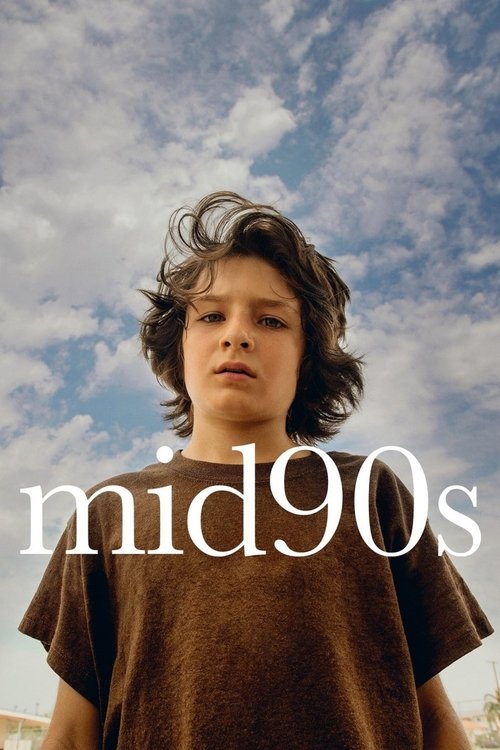
mid90s
2018 · Jonah Hill
For when you're nostalgic for being young and dumb with your friends — or when you want a short, tender film that sneaks up on you emotionally. Easy to watch, but it leaves a mark.
What it's about
Los Angeles, the mid-1990s. Stevie is thirteen, small for his age, stuck in a house with a stretched-thin single mom and an older brother whose attention mostly arrives as fists. Then he wanders into a skate shop on Motor Avenue and falls in with a crew of older skaters — and spends one summer learning how to fall, how to be liked, and what it costs to belong.
The experience
Loose, warm, and quietly bruising — it drifts like a long summer afternoon, then lands a gut-punch when you're not braced for it. The hangout scenes are so natural you feel like the sixth kid on the curb, laughing at jokes you're half-embarrassed by.
Performances
Sunny Suljic carries the film with an open, wounded eagerness that never feels coached, and Lucas Hedges makes Stevie's brother genuinely scary and genuinely sad at once. The skater crew, mostly non-actors, talk over each other like real friends do.
The craft
Jonah Hill shot his debut on grainy Super 16mm in a boxy old-TV frame, and the whole thing looks and sounds like a found artifact of 1996 — the era-perfect soundtrack does half the storytelling. At 85 minutes it's ruthlessly trimmed, all texture and no fat.
Why it matters
One of the defining actor-turned-director debuts of the late 2010s and a key entry in A24's run of intimate coming-of-age films, it helped make lo-fi period naturalism a house style for a generation of small American movies.
Snapshot
mid90s is Jonah Hill's directorial debut, an 85-minute coming-of-age drama set among the skateboarders of mid-1990s Los Angeles. It follows Stevie (Sunny Suljic), a slight thirteen-year-old who escapes a volatile home — a single mother stretched thin and an older brother, Ian, whose affection arrives mostly as violence — by attaching himself to an older crew he meets at a Motor Avenue skate shop. The film is less a plot than an immersion: a summer of small initiations, borrowed cigarettes, first parties, and the hard education of trying to be liked by people you admire. Produced and distributed by A24 and shot on Super 16mm in the boxy Academy ratio, it is deliberately modest in scale and unusually precise in texture. It arrived as one of a cluster of late-2010s actor-turned-director debuts and staked its identity on naturalism, period fidelity, and an anthropological patience with adolescent male friendship. Its reputation rests less on innovation than on the sincerity and specificity of its observation.
Industry & production
mid90s was made and released by A24, the independent distributor whose brand by 2018 had become a magnet for auteur-driven, mid-budget features and for first-time directors with strong personal voices. The producing team paired Hill with figures central to that ecosystem, including Scott Rudin and Eli Bush, alongside Ken Kao. The exact production budget is not something I can state with confidence, and I will not invent a figure; the film's aesthetic — a short runtime, a largely unknown and non-professional cast, single-city location shooting, and 16mm capture — is consistent with a deliberately economical production rather than a studio-scale one.
The casting strategy was the defining industrial choice. Hill built the crew from real skateboarders rather than trained actors: Na-kel Smith (Ray) and Olan Prenatt (Fuckshit) were established figures in skate culture, and the ensemble's credibility depends on their being, essentially, versions of themselves. This is a well-documented lineage in skate cinema, and Hill leaned into it, reportedly workshopping the group over an extended period so the on-screen crew would read as an actual friend group. The film premiered at the Toronto International Film Festival in September 2018 and opened theatrically in the United States that October, positioned as a specialty release rather than a wide commercial one.
Technology
The most consequential technological decision was the choice of film over digital. mid90s was shot on Super 16mm, a format whose grain, softer resolution, and color rendition evoke the amateur and semi-professional imaging of the era it depicts — camcorder footage, skate videos, and the disposable snapshots of the period. Crucially, this is not merely nostalgic affectation: skate culture of the 1990s was itself a culture of self-documentation, built around VHS "skate videos" shot on handheld cameras. By choosing a film stock and format adjacent to that visual world, the production aligns its own image-making with its subject's. The film also incorporates diegetic video-making — one crew member is constantly filming the others — folding the period's DIY documentary impulse into the narrative itself. The 4:3 Academy frame reinforces the analog, archival feel, evoking the pre-widescreen aspect ratio of home video and 1990s television.
Technique
Cinematography
The cinematography is by Christopher Blauvelt, best known for his long collaboration with Kelly Reichardt (Meek's Cutoff, Night Moves, Certain Women, later First Cow). Blauvelt's Reichardt work is defined by patient, unshowy framing and attention to landscape and light, and he brings a comparable restraint here. The film's two most conspicuous formal signatures are the Super 16mm stock and the 1.33:1 Academy ratio. The squared frame concentrates attention on faces and bodies, isolates Stevie within domestic and social spaces, and refuses the horizontal sweep that widescreen skate photography might otherwise invite; the effect is intimate and slightly hemmed-in, appropriate to a child navigating worlds too big for him. Coverage favors handheld and observational setups over choreographed spectacle, and the skating itself is generally shot to feel witnessed rather than staged — closer to the vernacular of a skate video than to the glossy sports montage.
Editing
The editor is Nick Houy, who cut Greta Gerwig's Lady Bird the previous year — another economical, tightly observed coming-of-age film. Houy's work on mid90s serves the film's compression: at roughly 85 minutes, the picture is built from a series of scenes and vignettes rather than a strongly plotted throughline, and the editing has to establish rhythm, ellipsis, and emotional accumulation without a conventional armature. Transitions tend to be clean and unfussy, letting scenes breathe to their natural conclusion, with the montage logic of a summer passing. The cutting also has to reconcile documentary-style hangout footage with the film's sharper dramatic beats — the escalating home-life violence, the climactic accident — and the balance largely holds.
Mise-en-scène / staging
Period production design is the film's most obsessive register. Wardrobe, footwear, skate decks, bedroom-wall posters, video-game hardware, and the physical space of the skate shop are all marshaled to reconstruct a specific mid-1990s Los Angeles milieu. The staging is naturalistic: crew scenes are blocked as loose, overlapping social clusters where dialogue overlaps and status is negotiated physically — who stands where, who gets handed what, who is being tested. Stevie's home is staged in pointed contrast, its interiors tighter and more charged. The mise-en-scène consistently reads class and status through objects, and much of the film's meaning is carried by what characters own, wear, and covet.
Sound
The score is by Trent Reznor and Atticus Ross, the Nine Inch Nails principals whose film work (beginning with The Social Network) had by 2018 made them among the most sought-after composers in American cinema. Their original music here is spare and atmospheric rather than propulsive, a restrained undertow beneath the period soundtrack. That soundtrack is the film's louder sonic strategy: an extensive selection of era-defining hip-hop and rock needle-drops that function as both cultural signifier and emotional shorthand for the characters' inner lives. Sound design elsewhere is grounded and tactile — the scrape and clack of skateboards, the ambient noise of the city and the shop — reinforcing the observational, lived-in texture.
Performance
Performance is where the film's method is most visible. Sunny Suljic anchors the film as Stevie with a watchful, largely reactive presence; much of his work is listening, absorbing, and imitating, which is precisely the character's condition. Lucas Hedges, the most established young actor in the cast, plays the older brother Ian with a coiled, inarticulate menace, and Katherine Waterston plays the overwhelmed mother. Surrounding them, the crew — Na-kel Smith, Olan Prenatt, Ryder McLaughlin (Fourth Grade), and Gio Galicia (Ruben) — deliver performances that draw directly on the actors' real relationship to skate culture, so that the film's ensemble scenes carry a documentary authenticity that trained actors would struggle to counterfeit. Na-kel Smith's Ray, the crew's conscience and its most emotionally legible member, was singled out in much of the film's reception as a standout.
Narrative & dramatic mode
mid90s operates in an episodic, observational mode rather than a tightly plotted one. Its dramatic engine is initiation: a younger boy's entry into an older group, and the moral and physical costs of belonging. The film accumulates meaning through incident — a first drink, a first kiss, small betrayals and loyalties, the slow revelation of each crew member's home damage — rather than through a rising-action plot. Its through-line is Stevie's self-endangerment: he courts danger to earn status, both in his skating and in a pattern of self-harm that the film treats with unsettling matter-of-factness. The dramatic mode is fundamentally naturalist and sympathetic, withholding overt moralizing; the crew are shown to be, by turns, cruel, generous, reckless, and protective, and the film resists reducing them to a warning. Its emotional climax — an accident that forces the group's tenderness to the surface — resolves feeling rather than plot.
Genre & cycle
The film sits at the intersection of the coming-of-age drama and the skate film, two lineages it self-consciously braids. As a coming-of-age story it belongs to a long tradition of adolescent-summer films built on the loss of innocence and the search for a surrogate family. As a skate film it descends from a specific cycle running from Larry Clark's Kids (1995, written by Harmony Korine) through Clark's later Wassup Rockers and Korine's Gummo, as well as the vast informal genre of the skate video itself. mid90s is notably gentler than Kids, trading that film's provocation and nihilism for nostalgia and warmth, but the kinship — non-professional urban teenagers, unglamorous naturalism, a period-specific subculture rendered from the inside — is unmistakable. It also belongs to a late-2010s micro-cycle of intimate, A24-inflected coming-of-age films.
Authorship & method
mid90s is Jonah Hill's debut as writer-director, and it is emphatically a personal project: an actor known for broad comedy pivoting to a small, sincere, autobiographically inflected drama about the culture that shaped him. Hill has spoken (in press around the release) about the film's roots in his own attachment to 1990s skate and hip-hop culture, and his method — casting real skaters, extended rehearsal to build a genuine group dynamic, shooting on film in the aspect ratio of the era's home video — is of a piece with a first-time director trying to protect authenticity above polish. The authorship is best understood as curatorial and observational rather than stylistically flamboyant; Hill defers to his subject.
The key collaborators extend that project. Cinematographer Christopher Blauvelt brings the patient naturalism of his Reichardt work. Editor Nick Houy brings the compressed, emotionally exact rhythm of Lady Bird. Composers Trent Reznor and Atticus Ross supply a restrained score that lets the period soundtrack carry the cultural weight. The result is a debut in which the director's taste and the collaborators' craft are aimed at the same modest, exacting goal: to make a small world feel completely real.
Movement / national cinema
The film is a work of American independent cinema, specifically the A24-branded independent scene of the 2010s, which foregrounded distinctive directorial voices working at modest budgets. It draws on the American tradition of naturalist, non-professional-cast filmmaking associated with Larry Clark and Harmony Korine, and more distantly on the international lineage of the child-centered coming-of-age film, with François Truffaut's The 400 Blows an obvious ancestor in its sympathetic, unsentimental attention to a boy adrift between a failing home and the street. It does not belong to a formal movement so much as to a sensibility — the intimate, personal American indie — and to the specific institutional moment of A24's ascendancy.
Era / period
Setting is central to the film's identity: mid-1990s Los Angeles, a period the film reconstructs with near-fetishistic care through music, fashion, technology, and skate culture. The title itself declares the subject to be the era. The film treats the period both as lived reality and as an object of nostalgia — a pre-smartphone, analog world of physical scenes, video stores, and self-made subcultures. That nostalgic charge is central to its appeal and also, for some critics, its limitation: the film's tenderness toward its moment can read as memory softened by affection. As an artifact of its own release moment (2018), it participates in a broader late-2010s cultural nostalgia for the 1990s.
Themes
The film's dominant theme is the construction of masculinity in adolescence — how boys teach one another to be hard, to absorb pain, to perform toughness, and how that education is passed down through crews and older siblings. Closely tied to it is the theme of found family: Stevie's crew becomes the affection and structure his home cannot provide, and the film is clear-eyed that this surrogate family is both a refuge and a source of new harm. Class runs throughout, legible in the different home lives of the crew and in the objects that mark status. Self-harm and the courting of danger form a persistent, disquieting thread. And beneath all of it is the theme of belonging — the willingness to endure almost anything to be accepted — rendered with sympathy rather than judgment.
Reception, canon & influence
mid90s was generally well received on release, particularly praised for the authenticity of its performances, the specificity of its period recreation, and the surprise of Hill's assured, unshowy direction. Na-kel Smith's Ray drew notable admiration. The most common critical reservations concerned the film's slightness and its nostalgic vantage: some reviewers found it thin on plot, occasionally more atmosphere than story, and observed that its warmth toward the era and toward its male world sometimes softened its harder edges. I'll note plainly that a comprehensive, quantified account of its critical consensus or box-office performance is beyond what I can verify here, and I won't fabricate figures.
Its backward influences are legible and largely acknowledged: Larry Clark and Harmony Korine's Kids as the foundational skate-verité text, the broader tradition of skate videos, and the child-adrift naturalism of Truffaut. Its release coincided closely with Bing Liu's acclaimed skateboarding documentary Minding the Gap (2018), and the two films are often discussed together as a moment when skate culture and its intersection with masculinity, class, and family trauma received serious cinematic treatment — though they were made independently and should not be treated as influencing one another. Forward influence is harder to assess for so recent a film, and it would be premature to claim a distinct school in its wake; its clearest legacy is as evidence that Jonah Hill possessed a genuine directorial voice, and as a durable, affectionately regarded entry in the small canon of American skate cinema.
Reception
Greeted in 2018 with 'the actor wants to be a director now' skepticism and constant Kids comparisons, it landed as a solid-not-stunning debut — but it's since settled in as a beloved comfort rewatch for a generation of young film fans, the soft-hearted corner of 2018's great skate-movie trifecta alongside Minding the Gap and Skate Kitchen.
How mid90s was received, from release to now →
How to watch mid90s: what to notice on a first viewing
- Notice the frame is square, not widescreen. The film uses the boxy 1.33:1 Academy ratio, concentrating attention on faces and bodies rather than letting the eye drift wide. The tight frame makes Stevie feel hemmed in by worlds too big for him, even in open skate spots.
- Watch for specific 1990s objects: decks, posters, game consoles. Wardrobe, skate gear, and bedroom walls are assembled with near-obsessive period accuracy, and status gets read through what characters own. The objects are doing character work, telling you who has what and who is still catching up.
- Watch how the crew stands and moves when they're all together. Crew scenes are blocked as loose, overlapping clusters where status gets negotiated by who stands where and who gets handed what. You can read the group's pecking order in the blocking before anyone says a word about it.
- Listen for a song shift matching a change in the crew's mood. Era-defining hip-hop and rock needle-drops carry the characters' inner lives, layered over a spare, atmospheric score. The soundtrack often says what the dialogue, sparse and inarticulate, won't.
- Watch Stevie mostly listen and imitate rather than speak. Suljic plays him as absorbing and mimicking the older boys, his performance built from watching more than acting. His character's whole arc is visible in what he starts copying from the crew.
The whole guide to watching mid90s, with the keys for a rewatch →
Influences: the films it descends from and the films it influenced
- Kids (1995) — The foundational skate-verité text mid90s draws from directly: casting real skaters as semi-fictional versions of themselves and shooting their downtime with a documentary flatness that treats hanging out as the subject.
- Gummo (1997) — Establishes the episodic-vignette architecture Hill borrows — plot dissolved into loosely-strung observed fragments of marginal youth, carried by non-actors rather than dramatic causality.
- The 400 Blows (1959) — The child-adrift naturalism Hill's dossier acknowledges: a camera trailing a boy through a neglectful adult world, ending on an unresolved image of a kid mid-flight rather than a plot resolution.
- Paranoid Park (2007) — Precedent for intercutting skate footage with degraded small-gauge film texture and fracturing chronology into elliptical memory, fronted by a non-professional skater lead.
- Elephant (2003) — Model for the long observational take trailing teenagers through mundane space with non-professional performers and a deliberate refusal of moralizing dramatic emphasis.
- Dazed and Confused (1993) — The hangout-ensemble template where a wall-to-wall period needle-drop soundtrack carries the cultural weight and structure that a conventional plot would otherwise provide.
- Meek's Cutoff (2010) — The Blauvelt/Reichardt method Hill hired directly — patient, unhurried naturalism composed inside a boxy near-academy frame that withholds coverage and lets duration do the work.
- Lady Bird (2017) — Direct collaborator link: editor Nick Houy applies the same compressed, emotionally exact vignette-ellipsis cutting — scenes clipped to their essential beat — that shapes mid90s.
- Dìdi (弟弟) (2024) — Skate/BMX crew coming-of-age with non-professional friend-group casting and obsessive period production design, structured as hangout vignettes — the direct genre-and-texture precursor Dìdi's summer crew descends from.
- George Washington (2000) — Shares the lyrical observational drift among a non-professional child cast in a hyper-specific working-class milieu, atmosphere prioritized over narrative propulsion.
- Fish Tank (2009) — Parallel handheld, boxy-ratio coming-of-age built on a first-time non-professional lead whose behavior is observed rather than scripted into tidy arcs.
- American Honey (2016) — The same 1.37 academy-ratio, non-professional-ensemble, episodic-road structure in which a curated needle-drop soundtrack defines a subculture from the inside.
- Beach Rats (2017) — Near-contemporary Super-16mm handheld study of adolescent masculinity, using grain and shallow intimacy to observe a boy performing for his male peer group.
- The Florida Project (2017) — Extends the non-professional-cast, episodic-observational naturalism of a marginal milieu seen at child's-eye level, warmth and specificity standing in for plot.
- We the Animals (2018) — Contemporary Super-16mm portrait of boyhood shot in tactile academy-adjacent intimacy with non-professional child leads, memory rendered as texture.
- Minding the Gap (2018) — Coincident (non-influencing) skate-verité work that ties first-person skateboarding cinematography to masculinity, class, and family trauma — the documentary mirror of Hill's fiction.
- Skate Kitchen (2018) — Released the same year, casts real skaters and captures their crew dynamic through verité skate cinematography, authenticity of the group prioritized over acting.
- Waves (2019) — Contemporary A24 coming-of-age built on a naturalist youth ensemble, boxed aspect ratio, and period needle-drops — the same late-2010s house-style current Waves participates in.
Similar films
- Dazed and Confused (1993) — influence & lineage · same viewing thread
- Lady Bird (2017) — influence & lineage · often watched together
- Minding the Gap (2018) — influence & lineage
- Kids (1995) — influence & lineage
- American Honey (2016) — influence & lineage
- The Perks of Being a Wallflower (2012) — same viewing thread
- Fast Times at Ridgemont High (1982) — same viewing thread
- Rushmore (1998) — same viewing thread
All the films related to mid90s →
Watch it with: curated runs of related films
- Restless Youth, Rigid Walls — Watch these as one long walk through the school years — the teachers who crack you open, the friends who pull you off the sidelines, the first loves and the institutions you push against — where a beloved tearjerker and a surreal boarding-school revolt turn out to be cousins.