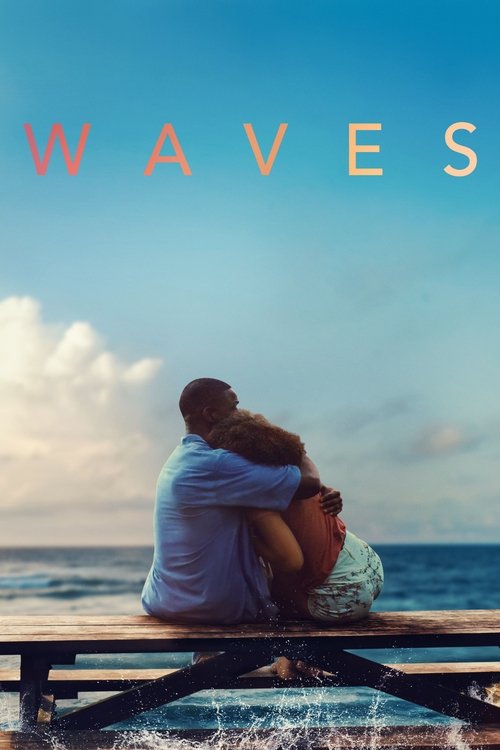
Waves
2019 · Trey Edward Shults
For a night when you want to be put through something and come out the other side — this is challenge-then-comfort in one sitting, best watched when you have space to feel it. Not background viewing.
What it's about
A prosperous Black family in South Florida, and a father whose relentless standards are meant as armor for his children. His son Tyler, a star high-school wrestler with a girlfriend and a future, starts to crack under an injury he's hiding and pressure he can't escape — and when tragedy hits, the film hands itself to his younger sister Emily, who has to figure out how a family goes on. It's really two movies: one about a fall, one about what grows after.
The experience
The first half is almost unbearably intense — neon-lit, propulsive, the camera spinning with a kid coming apart — and then the film exhales into something tender and slow and healing. Few movies swing this hard from dread to grace; it's an emotional workout and it earns the tears.
Performances
Kelvin Harrison Jr. is ferocious as a teenager drowning in expectation, and Taylor Russell's quiet, open-hearted turn as Emily is the film's grace note — she carries the entire second half on stillness and small gestures.
The craft
Trey Edward Shults makes the screen itself register the family's state: the aspect ratio literally narrows as Tyler's world closes in, the camera revolves inside cars and parties, and a Trent Reznor and Atticus Ross score threads through a killer contemporary soundtrack. This one genuinely rewards the biggest screen and best sound you have.
Why it matters
A high-water mark of A24's late-2010s run of formally bold family dramas, and the film that announced Taylor Russell as a major talent.
Snapshot
Waves is Trey Edward Shults's third feature and his first working at a larger scale and in color-saturated register — a two-part family melodrama set among an affluent Black household in South Florida. The film is built as a diptych: its first movement is a propulsive tragedy tracking Tyler (Kelvin Harrison Jr.), a high-school wrestler crushed between a father's expectations, a shoulder injury, and a collapsing relationship, until an act of catastrophic violence; its second movement decelerates into a quieter register of grief and repair centered on his younger sister Emily (Taylor Russell). Released by A24 after a fall-festival launch, the film is notable less for narrative novelty than for the intensity of its formal apparatus — mutating aspect ratios, revolving camerawork, an aggressive contemporary needle-drop soundtrack folded around an original score by Trent Reznor and Atticus Ross — deployed in service of an intimate story about pressure, rupture, and forgiveness.
Industry & production
Waves was produced and distributed within the A24 orbit, the studio-distributor with which Shults had already worked on It Comes at Night (2017). The project emerged from Shults's collaboration with Kelvin Harrison Jr., who had starred in It Comes at Night; the two developed the material together, and Shults has described drawing on Harrison's experiences and on his own fraught relationship with his father to build the film's emotional architecture. Shot in and around South Florida, the production leaned on regional light, humidity, and coastal geography as active elements rather than backdrops.
Precise budget and box-office figures for the film are not reliably documented in the public record in a form I can cite with confidence, and A24 characteristically discloses little; I will not invent numbers here. What is clear is the film's positioning: a mid-scale specialty release aimed at the awards-season corridor, premiering at the Telluride and Toronto festivals in the autumn of 2019 before a platform theatrical rollout. Its commercial profile was modest, consistent with an ambitious auteur drama rather than a wide crowd-pleaser.
Technology
The film was shot digitally by cinematographer Drew Daniels, and its most conspicuous technological gesture is the systematic manipulation of the frame itself. Rather than committing to a single aspect ratio, Waves changes shape across its runtime — widening to an expansive scope frame in Tyler's early scenes of freedom and momentum, constricting toward squarer, more claustrophobic ratios as his world tightens, then opening again in Emily's half. This is an editorial-technological choice made possible by contemporary digital capture and finishing pipelines, where reframing and ratio changes can be executed in post without the generational penalties of optical work. Equally important is the color pipeline: the film's neon-drenched grade — hot reds, electric blues and purples, sodium-vapor oranges — is a product of controlled digital grading married to practical colored light sources on set. The camera's fluid, sometimes weightless mobility likewise depends on stabilized rigs and gimbals that allow the continuous 360-degree revolutions and untethered gliding that define the film's kinetic passages.
Technique
Cinematography
Daniels's photography is the film's signature. In the first movement the camera is restless and centripetal: it circles the car interiors and the wrestling mat in unbroken revolutions, spins around characters until orientation dissolves, and pushes color to expressionist extremes so that emotional states register chromatically before they register in dialogue. The mobile long take and the roving 360 are used not as flourishes but as a grammar of subjectivity — the camera behaves as Tyler feels, euphoric and then vertiginous. In the second movement the visual language deliberately calms: framings settle, the palette softens toward naturalistic daylight, and the camera's restlessness gives way to a more grounded observational stillness. The contrast between the two halves is engineered as much through lensing and movement as through story.
Editing
Shults edited the film with Isaac Hagy, and the cutting is inseparable from the soundtrack. The first half is montage-driven and music-led, with cuts falling to the rhythm of contemporary tracks so that whole passages play as extended music-video-adjacent sequences — compressing time, eliding transitions, and generating a sense of acceleration toward disaster. The aspect-ratio shifts function editorially as well as photographically, marking emotional thresholds. After the film's central catastrophe, the editing changes character entirely: rhythms lengthen, ellipses become gentler, and the film breathes. The structural gamble — a hard tonal and point-of-view pivot at the midpoint from one sibling to the other — is the film's defining editorial decision, dividing viewers precisely because it refuses the momentum of its own first act.
Mise-en-scène / staging
The Florida setting is staged as a world of suburban comfort shot through with menace and beauty — churches, wrestling gyms, family dinners, neon-lit night drives, and coastal light. The household interiors, and the recurring space of the family car, are staged as pressure vessels: sites where Ronald's (Sterling K. Brown) discipline and love collapse into the same gestures. Color and light are staged practically within scenes, so that a bedroom or a nightclub becomes an emotional field. The physical world of adolescence — phones, group chats, parties — is rendered with specificity rather than as generic teen texture.
Sound
Sound design and music are arguably the film's primary expressive channel. The needle-drop soundtrack is dense and deliberate, drawing on contemporary artists — Frank Ocean, Kanye West, Kendrick Lamar, Radiohead, Animal Collective, and others are widely documented among its selections — used not as ambient scoring but as interior monologue, the tracks standing in for what the characters cannot or do not say. Around and beneath these songs sits the original score by Trent Reznor and Atticus Ross, which supplies dread, texture, and continuity. The mix is muscular in the first half — enveloping, bass-forward, sometimes overwhelming — and recedes in the second, so that sound itself enacts the film's arc from sensory overload toward quiet.
Performance
The performances anchor the stylistic excess. Kelvin Harrison Jr. carries the first movement with a physically committed portrait of a young man buckling under expectation, moving from charisma to panic to breakdown. Taylor Russell's Emily is the film's discovery — a performance of interiority and restraint that the second half depends upon entirely, and one widely credited as her breakout. Sterling K. Brown gives the father a fearsome, tender complexity that resists caricature, and Renée Elise Goldsberry, Lucas Hedges, and Alexa Demie fill out the family and its orbit with precision. The ensemble's naturalism is a deliberate counterweight to the maximalist camera and cutting.
Narrative & dramatic mode
The film's dramatic mode is tragedy fused with melodrama, split into two contrasting movements. The first is a classical tragic arc: a young man of promise, driven by hubris and external pressure, makes a series of escalating errors that culminate in irreversible catastrophe. The second is a melodrama of recovery — patient, forgiving, oriented toward grace rather than fate. The structural bifurcation is the film's central formal argument: that the aftermath of tragedy deserves as much screen time and dignity as the tragedy itself, and that the story of a family is not only the story of its most destructive member. This diptych structure, and the way it withholds a single protagonist, is what most divided critics and audiences.
Genre & cycle
Waves sits at the intersection of the American family melodrama, the coming-of-age drama, and the auteur art film. It belongs to a late-2010s cycle of formally aggressive, music-saturated indie dramas about American youth, and to a parallel A24-associated cycle of stylized, festival-driven auteur cinema. Its neon-Florida palette and its focus on a Black family place it in conversation with a recognizable contemporary current in American independent film, even as its two-part architecture sets it apart from more conventional entries in any of these categories.
Authorship & method
Shults is an auteur in the strong sense: writer-director-editor, working repeatedly with the same core collaborators. His method across Krisha (2015), It Comes at Night, and Waves draws on personal and familial material transposed into genre frameworks, and on close, developmental relationships with his actors — here especially Harrison, whose life fed the script. His key collaborators are consistent and central: cinematographer Drew Daniels, who has shot his features and whose photography defines their look; composers Trent Reznor and Atticus Ross, whose score supplies the film's atmospheric spine; and co-editor Isaac Hagy, with whom Shults built the film's rhythmic, music-driven cutting. The authorship question that shadowed the film — a white filmmaker directing a story centered on a Black family — became a genuine part of its critical reception; Shults addressed it by grounding the material in Harrison's collaboration and experience, though the debate over that arrangement remained live among critics.
Movement / national cinema
The film is a work of contemporary American independent cinema, specifically the auteur-driven, distributor-branded specialty sector exemplified by A24 in the 2010s. It does not belong to a formal movement in the manifesto sense, but it participates in an identifiable American art-cinema sensibility of the period: personal, stylistically maximal, festival-launched, and marketed on directorial vision. Its lineage runs through the experiential, camera-forward tradition of American cinema associated with Terrence Malick — with whom Shults has an early-career connection — and through a broader international art-film influence visible in its embrace of sensory immersion.
Era / period
Waves is precisely of its late-2010s moment. It is saturated in the texture of contemporary adolescence — smartphones, streaming-era music culture, social media — and its soundtrack functions as a time capsule of a specific pop and hip-hop landscape. Formally, it reflects the era's convergence of music-video grammar, digital-color expressionism, and prestige indie ambition. Thematically, its interest in masculinity, pressure, and repair speaks to conversations circulating in American culture at the decade's end. Few films of its year are as legible as period documents of their exact instant.
Themes
The film's central subject is pressure — paternal, athletic, racial, and self-imposed — and the way it deforms a young man until he breaks. Around that core it develops a cluster of themes: masculinity and its costs; the double-edged nature of a father's love and discipline; grief and its long aftermath; guilt, forgiveness, and the possibility of grace. Faith and church recur as sources of both comfort and pressure. The diptych structure encodes a thematic thesis: that families contain both destruction and healing, and that redemption belongs as much to those left behind as to the one who caused the wound. The film's insistence on extending compassion past catastrophe — toward the perpetrator, the family, and the survivors — is its moral center.
Reception, canon & influence
Critical reception was strong but genuinely divided. Praise concentrated on the film's formal audacity, its soundtrack, and its performances — with Taylor Russell's work singled out as a breakout and Sterling K. Brown's and Kelvin Harrison Jr.'s widely admired. Skeptical responses centered on two points: whether the film's stylistic intensity overwhelmed its emotional substance, and whether the tonal and structural pivot at the midpoint cohered; the question of a white director's authorship of a Black family's story was also part of the conversation. The result was a film more admired for its ambition and craft than universally embraced.
Its influences run backward to the experiential American cinema of Terrence Malick (the roving, subjective camera and the primacy of sensation); to a lineage of formally aggressive, color-and-sound-forward filmmaking; and to a contemporary current of stylized Florida-set American film exploring color, youth, and Black experience — a current within which Waves is best understood as a participant rather than an originator. Its forward influence is best measured through its collaborators' trajectories and its role in confirming a house style of maximal, music-driven A24 auteur drama; most concretely, it served as a launch for Taylor Russell's career. Any larger claim about a specific school of filmmaking descending directly from Waves would overstate what the record currently supports, and I flag that as a genuine limit rather than filling it with invention.
Reception
It premiered at Telluride 2019 to real awards buzz — then got completely shut out on Oscar nomination morning, one of that year's most-cited snubs. Since then it's settled in as a young-cinephile favorite, the Letterboxd-era 'this movie destroyed me' pick, even as the debates around it never fully cooled.
How Waves was received, from release to now →
How to watch Waves: what to notice on a first viewing
- Notice the frame's shape change as scenes go on. Shults widens the image toward scope when Tyler feels free and narrows it toward a tighter, boxier ratio as pressure closes in on him. The screen's own shape is telling you how much room this character has left.
- Watch the camera circle all the way around the car. Daniels spins the camera in unbroken revolutions around the wrestling mat and the car interiors until your sense of direction starts to slip. The camera is not just showing Tyler's state, it is performing it.
- Notice colors turn hot and saturated as scenes intensify. Reds, electric blues, and sodium oranges push past anything a real room would look like, so the color itself carries feeling before a line of dialogue does. You can read a scene's emotional temperature straight off its color.
- Listen for songs playing full and uncut over scenes. Whole passages run on a single track rather than dialogue, so the lyrics carry what a character will not say out loud. The soundtrack works as the characters' interior monologue, not as background music.
- Watch what happens inside the family car each time. Ronald's love and his discipline keep arriving in the same gestures, in the same tight interior, so the car becomes a recurring pressure point for the whole family. One space keeps holding both the affection and the strain in this family.
The whole guide to watching Waves, with the keys for a rewatch →
Influences: the films it descends from and the films it influenced
- The Tree of Life (2011) — The roving, unmoored subjective Steadicam and the primacy of sensation and whispered interiority over plot mechanics is the direct template Shults borrows for the film's floating point-of-view.
- Days of Heaven (1978) — Establishes the magic-hour, elemental naturalist lensing where landscape and light carry emotional weight — the impressionist image-over-narrative grammar Drew Daniels' photography extends.
- Krisha (2015) — Shults' own prototype: family trauma transposed into a pressure-cooker frame, shot by Drew Daniels with the same circling, anxiety-inducing camera and personal-material-as-script method.
- Enter the Void (2009) — Pioneers the first-person/360-degree roving camera gliding through neon-saturated space, the disorienting subjective float Waves deploys in its party and driving sequences.
- Spring Breakers (2012) — The Florida-set neon color-expressionism fused with an electronic score and hypnotic, music-locked montage of intoxicated youth is the direct stylistic forebear of Waves' first half.
- Moonlight (2016) — Parallel current of stylized Florida cinema: chaptered structure and lushly graded, saturated color used to render Black interiority and coming-of-age tenderness.
- Requiem for a Dream (2000) — Establishes the music-locked rapid-cut montage that builds a subjective physiological rush, the editing engine Shults and Isaac Hagy adapt for the film's escalating first movement.
- Mommy (2014) — Uses expressive aspect-ratio shifts as emotional punctuation and wall-to-wall needle-drop pop scoring over volatile youth — both formal devices Waves inherits directly.
- The Social Network (2010) — Reznor and Ross's breakthrough as film composers, whose atmospheric synth-and-drone scoring as emotional undertow becomes the same duo's spine for Waves.
- Beautiful Boy (2018) — Fractures a family-trauma narrative across formal ruptures and drives it with a wall-to-wall eclectic needle-drop soundtrack.
- I Killed My Mother (2009) — Fuses emotional-maximalist needle-drops, shifting aspect ratios, and hyper-saturated color into a single sensibility that reads as a direct extension of Dolan's grammar.
- Aftersun (2022) — Extends the A24 memory-drama mode, using sensory fragmentation and needle-drop music rather than exposition to render grief and a fracturing parent-child bond.
- Bones and All (2022) — Built on Taylor Russell's Waves breakout, casting her as a road-romance lead — the most concrete forward line of influence Waves demonstrably launched.
- It Comes at Night (2017) — Same Daniels collaboration using an expanding-and-contracting frame and slow dread-lensing to make a family unit's psychology physically legible in the aspect and camera.
- American Honey (2016) — Naturalist youth ensemble captured with roving handheld intimacy and a nearly continuous needle-drop soundtrack that carries the drama's emotional register.
- The Florida Project (2017) — Shares the hyper-saturated Florida color palette and reliance on naturalist, near-documentary performance to ground stylization in lived texture.
- mid90s (2018) — Contemporary A24 coming-of-age built on a naturalist youth ensemble, boxed aspect ratio, and period needle-drops — the same late-2010s house-style current Waves participates in.
- Zola (2020) — Florida-set, digitally-textured color-expressionism rendering Black experience with stylized formal audacity, a parallel A24-era experiment in look and tone.
- If Beale Street Could Talk (2018) — Drives an immersive Black family melodrama through roving saturated color and a wall-to-wall pop-and-score soundtrack, using palette and music as primary emotional carriers the way Jenkins does.
- The Iron Claw (2023) — A24 family chronicle sharing the grief-as-accumulation architecture and a wrestling son crushed under a demanding father, using formal control and elegiac scoring to structure catastrophe.
Similar films
- Aftersun (2022) — influence & lineage
- Bones and All (2022) — influence & lineage
- Blue Heron (2026) — shared sensibility
- Nickel Boys (2024) — shared sensibility
- Riceboy Sleeps (2023) — shared sensibility
- Breaking the Waves (1996) — shared sensibility
- Mudbound (2017) — shared sensibility
- Beautiful Boy (2018) — shared sensibility