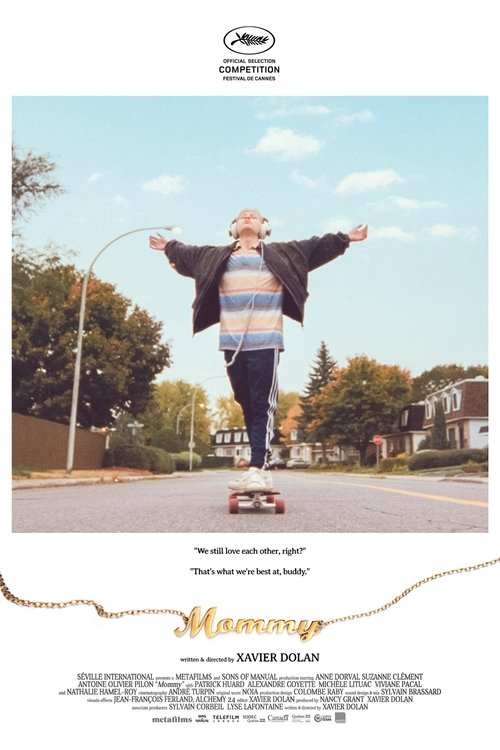
Mommy
2014 · Xavier Dolan
For when you want to feel something at full volume — a film to ugly-cry to, not to unwind to. Reach for it when you can handle a story that hugs you with one arm and shakes you with the other.
What it's about
Die is a brassy, broke, recently widowed mother in working-class Quebec who pulls her teenage son Steve — explosive, loving, diagnosed with ADHD and prone to violence — out of an institution to raise him herself. Barely holding the household together, they're joined by Kyla, a withdrawn neighbor with a stutter, and the three of them improvise something like a family. The question hanging over every scene is whether love is actually enough.
The experience
Loud, raw, and swinging between euphoria and dread — kitchen fights erupt out of nowhere, then a pop song turns a car ride into pure joy. It's emotionally exhausting in the way that leaves you wrung out and grateful.
Performances
Anne Dorval is ferocious and heartbreaking as Die, all armor and exposed nerve at once; Antoine-Olivier Pilon makes Steve terrifying and adorable in the same breath; and Suzanne Clément does quiet, devastating work as the stuttering neighbor. The three-way chemistry is the engine of the film.
The craft
Dolan boxes the whole film into a square frame that traps the characters like a phone screen or a cell — and when the image changes shape, it's one of the great sensory rushes in recent cinema, worth seeing big. The pop soundtrack is used shamelessly and brilliantly, turning karaoke and car stereos into emotional detonations.
Why it matters
A Cannes prizewinner that made the twenty-five-year-old Dolan an international name, it became the defining film of his career and a touchstone for how boldly a young filmmaker could bend form to feeling.
Snapshot
Mommy is the fifth feature by Québécois writer-director Xavier Dolan, made when he was twenty-five, and the film that consolidated his reputation as the most precocious figure in twenty-first-century Canadian cinema. It tells the story of Diane "Die" Després (Anne Dorval), a brassy, widowed working-class mother who brings her teenage son Steve (Antoine-Olivier Pilon) — violent, impulsive, diagnosed with ADHD and attachment disorder — home from an institution, only to find that loving him is not the same as being able to hold him. Their volatile dyad is mediated by Kyla (Suzanne Clément), a withdrawn neighbor with a debilitating stutter who becomes, briefly, the third point of a fragile surrogate family. The film is best known for two formal gambits: a near-unprecedented 1:1 square aspect ratio that boxes its characters into the frame, and a celebrated moment in which Steve physically pushes the image open to widescreen. Mommy premiered in competition at the 2014 Cannes Film Festival, where it shared the Jury Prize with Jean-Luc Godard's Goodbye to Language — a pairing of the cinema's youngest and oldest provocateurs that the press treated as symbolically apt. It was subsequently selected as Canada's submission for the Academy Award for Best Foreign Language Film.
Industry & production
Mommy was produced within the Québec film ecosystem that had nurtured all of Dolan's work, financed through the customary mix of Canadian public agencies (Telefilm Canada, SODEC) and Dolan's own production entities. By 2014 Dolan was no longer an unknown quantity raising money on the strength of a teenage debut; Laurence Anyways (2012) and Tom at the Farm (2013) had established him on the festival circuit, and Mommy arrived as a kind of homecoming — a return to the maternal terrain, the joual-inflected Québécois milieu, and the central muse (Dorval) of his 2009 debut I Killed My Mother. The film was shot in and around Montreal. Dolan, characteristically, multiplied his own credits: he is director, writer, editor, costume designer, and a producer, an authorship-saturating practice that has defined his career. The square frame was itself an economic and aesthetic provocation — a format with no commercial precedent in contemporary theatrical distribution, which exhibitors and projectionists had to accommodate. The precise budget and box-office figures are not something I can state reliably here, but the film operated at the modest scale typical of Québécois auteur cinema rather than as an international co-production.
Technology
The film was shot digitally by cinematographer André Turpin. Its defining technological decision is the 1:1 aspect ratio — a square image bordered by black on either side of a standard screen. This is not a found or archival format but a deliberate constraint imposed in production and preserved through post; the framing had to be composed for a square from the moment of shooting, governing lens choice, blocking, and headroom throughout. The square's two expansions to a wider ratio (roughly 1.85:1) are achieved as in-image transitions rather than reel changes, which means the production had to capture a wider field of view at those moments and mask it for the rest of the film — a workflow consideration that shaped how scenes were lit and staged. Beyond the aspect ratio, the film's technological profile is conventional for mid-2010s digital arthouse production; its innovation is compositional and conceptual rather than a matter of new capture hardware.
Technique
Cinematography
Turpin's photography is built around the tyranny and intimacy of the square. The 1:1 frame removes the lateral space in which conventional shot-reverse-shot and two-shots breathe, forcing faces into close, vertically-oriented compositions and pressing the characters against the edges of the image. The effect is claustrophobic by design — the frame as a cell, a literalization of Steve's confinement and Die's entrapment in her circumstances. Turpin favours handheld camerawork that stays tight on his performers, saturated daylight, and a warm, slightly overexposed palette that reads as both nostalgic and harsh. The two ratio-openings are the film's signature images. In the first, Steve, skateboarding down a sunlit suburban street to Oasis's "Wonderwall," literally reaches out and pushes the black borders apart with his hands, and the frame blooms to widescreen — a moment of pure exhilaration and possibility. The widescreen returns later for an idealized fantasy montage. Crucially, the frame contracts back to the square when hope collapses, making the aspect ratio itself a dramatic instrument that tracks the characters' horizon of freedom.
Editing
Dolan edited the film himself, as he does most of his work (credited under his full name). His cutting alternates between long, dialogue-driven scenes that let the actors' volatility play out in extended takes and lyrical, music-scored montage sequences that compress time and lift the film into a register of fantasy or memory. The rhythm is deliberately uneven, mirroring Steve's emotional dysregulation: passages of jagged, escalating confrontation give way to slow-motion reverie. The most discussed editorial-formal fusion is the dream montage in which Die imagines a future for Steve — graduation, marriage — a sequence whose temporary widescreen and elliptical cutting are eventually revealed as wishful projection, the cut back to reality landing as a devastating reversal.
Mise-en-scène / staging
The film's world is resolutely working-class and suburban — the cluttered house, the strip-mall and karaoke aesthetics, the loud fashions that Dolan (as costume designer) gives Die: leopard print, denim, costume jewelry, a defiantly unrefined glamour that the film refuses to condescend to. Staging exploits the square by arranging bodies in tight, frontal clusters and using doorways, hallways, and windows as internal frames that compound the sense of enclosure. The recurring motif of windows and thresholds — light beyond a pane, a door that may or may not open — culminates in the film's final image of Steve straining toward an opening.
Sound
Mommy is saturated with curated pop music, deployed not as ironic counterpoint but as emotional amplification — the characters' inner lives externalized through the songs they would actually love. The soundtrack draws on accessible, often unfashionable mainstream tracks (Oasis, Lana Del Rey, Dido, Celine Dion, Counting Crows, Eiffel 65, among others), a populist sensibility that critics noted as central to the film's affect. Dialogue is delivered in thick Québécois joual, its profanity and rhythm integral to characterization; Kyla's stutter is a sonic and dramatic presence in its own right, an impediment that the film stages with painful patience. (Precise composer credits for any original underscore I won't assert here, since the film's sonic identity is so overwhelmingly defined by its source-music selections.)
Performance
Performance is the film's engine. Anne Dorval, Dolan's recurring on-screen mother, gives Die a ferocious, profane vitality — tender and abusive, hopeful and exhausted, never sentimentalized. Antoine-Olivier Pilon's Steve is a study in barely-contained eruption: charm and menace inseparable, capable of sudden violence and equally sudden, heartbreaking neediness. Suzanne Clément's Kyla is the film's still center, a portrait of suppressed trauma whose stutter and reticence make her brief breakthroughs — including a scene in which she physically subdues Steve — all the more startling. The three-hander structure gives each actor extended emotional arias, and the film's reputation rests heavily on the rawness of these performances.
Narrative & dramatic mode
The film opens with a title card establishing a fictional, alternate Canada in which a law permits parents to commit troubled children to public care without judicial process — a speculative legal frame that hangs over the story as a constant threat and, ultimately, a terrible option. (I'd flag that the exact statutory designation in that card is a detail worth verifying against the film rather than taking on my word.) Within that frame the narrative is intimate and chamber-scaled: a domestic melodrama of three people in and around one house. The dramatic mode is heightened realism shading into lyrical fantasy — naturalistic, improvisatory-feeling confrontations punctuated by stylized musical interludes that voice the characters' yearnings. The arc is tragic: the fantasy of a self-sufficient family is built up and then dismantled, ending with Die's wrenching decision and Steve's confinement, and a final burst of motion toward light that reads as both hope and its impossibility.
Genre & cycle
Mommy belongs to the tradition of the maternal melodrama, updated and roughened — a "woman's picture" about the limits of love, recast in working-class Québec with a violent, disabled son at its center. It also participates in the cycle of films about families coping with mental illness and neurodivergence, though it resists the genre's redemptive conventions. Within Dolan's own filmography it forms a clear cycle with I Killed My Mother, returning to the mother-son relationship and to Dorval as its incarnation; critics frequently read Mommy as a more mature reprise of the debut's autobiographical preoccupations.
Authorship & method
Dolan is the film's near-total author: director, screenwriter, editor, costume designer, producer. His method is recognizable across his work — emotionally maximalist, music-driven, formally bold, anchored in a recurring stock company. The key collaborations here are with cinematographer André Turpin, whose square-frame compositions realize the film's central conceit, and with the actors Anne Dorval and Suzanne Clément, both Dolan regulars who had appeared in his earlier films and whose trust enabled the performances' rawness. Antoine-Olivier Pilon had previously worked with Dolan on a music video before Mommy, a relationship that carried into the casting of Steve. Dolan's authorship is notable for collapsing the usual division of labor — he designs the look of his characters as deliberately as he writes their lines — and for an unembarrassed sincerity that runs against arthouse irony.
Movement / national cinema
The film is a landmark of contemporary Québécois cinema, rooted in the province's distinct language, class textures, and cultural self-understanding. Dolan emerged as the figurehead of a generation of Québec filmmakers who achieved international festival prominence in the late 2000s and 2010s, and Mommy is among the most globally visible Québécois films of its decade. Its joual dialogue and its fictional-Canada premise are inseparable from a specifically Québécois vantage. At the same time Dolan is often discussed as a transnational auteur whose sensibility — the pop soundtracks, the queer-inflected emotionalism, the formal showmanship — exceeds national framing.
Era / period
Mommy is a product and document of the mid-2010s: digitally shot, pop-saturated, and arriving at a moment when aspect-ratio experimentation and "elevated" festival melodrama were live concerns. Its 2014 Cannes premiere placed it at a high-water mark of Dolan's early ascendancy, and its concerns — neurodivergence, single motherhood, the precarity of working-class life — sit squarely within the social preoccupations of its decade. The fictional near-future legal frame gives it a faint speculative tinge, but its texture is contemporary.
Themes
The film's governing theme is maternal love as both salvation and insufficiency — the gap between the depth of Die's love and her capacity to contain her son. Freedom and confinement structure everything, made literal in the square frame and its openings: the image expands when the characters dare to hope and contracts when reality closes in. Class is constant and unsentimental, the film insisting on the dignity and vitality of a milieu that other cinemas patronize. Mental illness and neurodivergence are treated without therapeutic tidiness. And running beneath it all is the Dolanian preoccupation with idealized fantasy — the human need to imagine a better life, and the cruelty of having that fantasy exposed as fantasy.
Reception, canon & influence
Critical reception was strong and widely emotional; the Cannes Jury Prize, shared with Godard, became the film's defining laurel and a frequently-cited symbol of generational handoff. Reviewers singled out the performances, the audacity of the square frame, and the "Wonderwall" ratio-opening as an instantly canonical sequence. The film was Canada's official submission to the Academy Awards' foreign-language category. Influences on the film (backward): Dolan's own I Killed My Mother is the clearest precursor, alongside the broader tradition of maternal melodrama; his magpie use of pop music descends from a lineage of needle-drop-driven directors, and his frame experiment recalls a history of filmmakers who have used aspect ratio as expressive content rather than fixed convention. Legacy (forward): Mommy is now widely regarded as Dolan's signature achievement and a key reference point in discussions of aspect ratio as dramatic device — its square frame and its two expansions are routinely cited in film-school and critical conversations about how format can carry meaning. It cemented Anne Dorval's and Suzanne Clément's international visibility and launched Antoine-Olivier Pilon. More broadly it stands as evidence of Québécois cinema's global reach in the 2010s and as the work that fixed Dolan's reputation as a formally daring, emotionally unguarded auteur. Claims about specific later films directly imitating its square frame should be made cautiously, but its currency as the touchstone example of expressive aspect-ratio use is secure.
A Deleuzian reading
Halfway through *Mommy*, a boy on a skateboard reaches up and shoves the world apart.
The full Deleuzian reading of Mommy →
Reception
An instant sensation at Cannes 2014 — the 25-year-old Dolan shared the Jury Prize with 83-year-old Godard, a passing-of-the-torch moment the press adored — and a decade on it's settled as the consensus peak of his career, the film his later, choppier work gets measured against.
How Mommy was received, from release to now →
Influences: the films it descends from and the films it influenced
- I Killed My Mother (2009) — Dolan's autobiographical mother-son war established the maternal-melodrama template, the slow-motion music montage, and the casting of Anne Dorval as the mother that Mommy directly re-stages and refines.
- Laurence Anyways (2012) — Extends Dolan's maximalist method — operatic needle-drop montages, falling-confetti tableaux, and Suzanne Clément's raw close-up rage — that Mommy concentrates into a domestic three-hander.
- Imitation of Life (1959) — Sirk's unembarrassed maternal melodrama, wringing operatic feeling from mother-child sacrifice through heightened color and emotional excess, is the classical mode Dolan revives against arthouse irony.
- Stella Dallas (1937) — The self-sacrificing-mother weepie, structured around a parent surrendering a child for the child's own good, is the melodramatic skeleton beneath Diane's institutionalization of Steve.
- Chungking Express (1994) — Wong's magpie pop needle-drops (repeated diegetic songs as emotional anchors) plus step-printed handheld motion are the direct precedent for Dolan's music-driven, smeared-handheld emotional surges.
- Mean Streets (1973) — Scorsese's wall-to-wall jukebox scoring, cutting character movement to commercial pop records rather than orchestral underscore, founds the needle-drop-montage tradition Dolan inherits.
- Napoléon (1927) — Gance's Polyvision climax, physically widening the frame from one panel to a triptych for emotional and spectacular release, is the silent-era precedent for using aspect-ratio expansion as a liberation device.
- Fish Tank (2009) — Arnold's 4:3 handheld working-class realism, fusing a volatile mother-child household with diegetic pop and overexposed natural light, prefigures Mommy's framing and texture.
- Autumn Sonata (1978) — Dolan's sustained extreme close-ups in mother-son confrontation — faces filling the frame in moments of rage, need, and collapse — and his use of diegetic music as an emotional pivot point directly apply Autumn Sonata's close-up and music grammar to the damaged parent-child dyad.
- We Need to Talk About Kevin (2011) — Dolan's choice of a 1:1 aspect ratio that constricts the frame around mother and son formally enacts Kevin's tight partial framings as ideology — the format itself produces claustrophobic mutual confinement, making the closed circuit of the mother-son relationship a spatial condition rather than a psychological metaphor.
- C.R.A.Z.Y. (2005) — Next-generation Québécois family melodrama built on needle-drop pop montage and lyrical rupture (the widescreen 'Wonderwall' expansion), the heir Vallée's music-forward style enabled.
- A Ghost Story (2017) — Lowery adopts a boxed 1.33 frame with rounded corners as a melancholy, memory-like enclosure, part of the post-Mommy wave treating the square-ish frame as emotional architecture.
- The Lighthouse (2019) — Eggers pushes the near-square 1.19 Movietone ratio as a tool of psychological confinement, extending Mommy's logic that a tall, narrow frame can dramatize entrapment.
- American Honey (2016) — Arnold sustains the 4:3 handheld youth-odyssey aesthetic with a relentless needle-drop pop soundtrack carrying the emotional through-line, the same sound-and-frame fusion Mommy popularized.
- First Reformed (2017) — Schrader selects the 1.37 Academy ratio specifically to box in his protagonist's spiritual claustrophobia, another marquee instance of aspect-ratio-as-drama in Mommy's wake.
- It's Only the End of the World (2016) — Dolan doubles down on Mommy's method — suffocating telephoto close-ups, a chamber ensemble of overlapping family shouting, and pop-scored emotional climaxes — pushing the three-hander intensity further.
- Aftersun (2022) — The 1:1 aspect ratio deployed as formal argument — the frame expands at a single moment of imagined liberation, then contracts — establishing the precedent for using frame format not as period flavor but as an epistemological claim about constraint and the limits of a character's freedom.
- Sinners (2025) — Dolan's variable aspect ratio device — the 1:1 frame expanding to 16:9 at a moment of emotional breakthrough, treating format shift as a formal event marking a threshold in narrative consciousness — establishes the precedent Arkapaw and Coogler extend in the vision sequence's aspect ratio transformation into the palimpsest temporal register.
- Waves (2019) — Uses expressive aspect-ratio shifts as emotional punctuation and wall-to-wall needle-drop pop scoring over volatile youth — both formal devices Waves inherits directly.
- Heartbeats (2010) — Dolan's slow-motion-walk-set-to-pop-song idiom and saturated, over-stylized handheld youth aesthetic are the grammar Mommy deploys in its 'Wonderwall' liberation sequence.
- Meek's Cutoff (2010) — Reichardt's deliberate choice of the boxy 1.33 Academy frame to constrain and confine her characters' horizon is the contemporaneous case for aspect ratio as expressive content, not convention.
- The Grand Budapest Hotel (2014) — Released the same year, Anderson likewise weaponizes shifting aspect ratios — switching among 1.37, 1.85 and 2.35 to encode distinct time registers — making format itself a narrative signal.
- Volver (2006) — Openly Almodóvarian descendant using color-saturated frames and volatile maternal love as its engine, extending the craft of melodrama-as-mother-portrait to a new generation.
- System Crasher (2019) — An explosive, un-institutionalizable son and the mother who cannot stop loving him, told through bold formal risk (aspect-ratio shifts, saturated grade) and raw maternal longing.
Similar films
- I Killed My Mother (2009) — influence & lineage
- Laurence Anyways (2012) — influence & lineage
- The Grand Budapest Hotel (2014) — influence & lineage · often watched together
- Monster (2023) — often watched together
- Vortex (2021) — shared sensibility
- Boyhood (2014) — shared sensibility
- Young Mothers (2025) — shared sensibility
- C.R.A.Z.Y. (2005) — shared sensibility