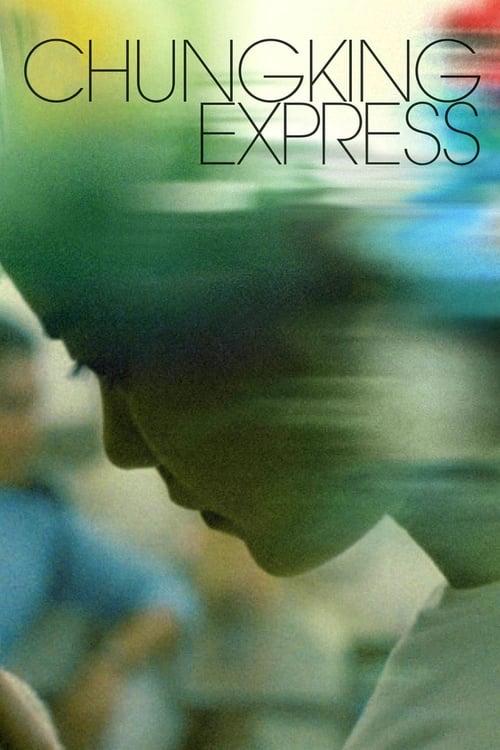
Chungking Express
1994 · Wong Kar-Wai
Generates discourse without new films: the Blossoms Shanghai TV pivot, In the Mood for Love's ascension up the Sight & Sound poll, and his permanent status as Letterboxd's most romanticized stylist.
For when you're a little heartbroken, or want to remember what a crush feels like — a late-night comfort film that's cool without being cold.
What it's about
Two lovesick Hong Kong cops, two stories, one neon-lit snack bar. The first cop, freshly dumped, counts down expiration dates on canned pineapple and crosses paths with a mysterious woman in a blonde wig who moves through the city's underworld. The second falls for the daydreaming counter girl at his regular food stall — who, unknown to him, has started slipping into his apartment while he's out and quietly rearranging his life.
The experience
Light on its feet and drunk on feeling — smeary handheld images, pop songs on repeat, wistful voiceover, and jokes that sneak up on you. It's melancholy without ever being heavy; you float out of it grinning.
Performances
Faye Wong is pure charm as the counter girl, all restless energy and secret mischief; Tony Leung makes quiet loneliness magnetic; Takeshi Kaneshiro and Brigitte Lin give the first half its rueful, noir-tinted romance.
The craft
Shot fast — in roughly three weeks — with a caught-on-the-run visual style: smeared motion, stolen street corners, faces isolated in crowds. The soundtrack is inseparable from the film; a certain 60s pop song plays so often it becomes a character. It rewards good speakers as much as a big screen.
Why it matters
The film that broke Wong Kar-Wai internationally and became a touchstone for a generation of filmmakers and romantics — shorthand for a whole style of dreamy, music-driven urban cinema.
Snapshot
Chungking Express is a two-part romantic drama set in the corridors and stairwells of Tsim Sha Tsui and Mong Kok, Hong Kong. The film braids two episodes of urban longing: in the first, a heartbroken cop (Takeshi Kaneshiro) fixates on May 1st expiration dates and drifts into a cryptic overnight encounter with a drug-running woman in a blonde wig (Brigitte Lin); in the second, a different policeman (Tony Leung Chiu-Wai) slowly realizes that the restless food-stall worker he has fallen for (Faye Wong) has been secretly redecorating his apartment while he is away. Shot in approximately twenty-three days on the margins of the production of Ashes of Time (1994), it became the more widely seen of the two films released that year and the work that first broke Wong Kar-Wai's reputation beyond Hong Kong into the international art-house circuit. Its Chinese title, 重慶森林 (Chungking Forest), points to a recurring metaphor: the human density of Hong Kong as an urban ecosystem in which people pass close enough to touch but seldom connect.
Industry & production
Wong Kar-Wai conceived Chungking Express as a spontaneous counter-project while Ashes of Time—his martial-arts epic—sat in an extended, arduous post-production. Jet Tone Productions, the company Wong had co-founded, financed the film on a modest budget. Production began in mid-1993 and was completed with remarkable speed; the entirety of principal photography took roughly three to four weeks by most accounts. Rather than working from a finished script, Wong arrived on location with loose narrative premises and wrote scenes the morning they were to be shot—a method he had begun developing on Days of Being Wild (1990) and that would become the defining condition of his practice.
The Hong Kong film industry of the early 1990s was commercially dominated by action cinema, Category III genre films, and star vehicles. Wong occupied a recognized but commercially marginal position within it, making personal films under the protection of Jet Tone while drawing on the industry's pool of established talent. The film's production circumstances—its speed, its embrace of accident, its use of actual Hong Kong locations like Chungking Mansions and the Lan Kwai Fong-adjacent escalator system—gave it a documentary-adjacent texture that distinguished it from the polished artifice of the mainstream.
Quentin Tarantino championed the film in the West, distributing it through Rolling Thunder Pictures, a joint label he had formed with Miramax/Buena Vista. Tarantino's endorsement opened the film to American art-house audiences in 1996 and significantly amplified its reputation at a moment when Hong Kong cinema was generating intense international enthusiasm. Martin Scorsese also publicly advocated for Wong's work during this period. No reliable box-office figures for the film's initial runs are available for citation here, and this dossier declines to invent them.
Technology
The film was shot on 35mm, but its most distinctive visual trait—the smeared, stroboscopic motion of figures moving against relatively static backgrounds—came from the extensive use of step-printing, sometimes called skip-frame printing: a laboratory process in which selected frames are repeated during optical printing to create a temporal multiplying effect. The result elongates and fragments motion so that a body in movement registers as a series of overlapping ghostly impressions rather than smooth kinetic flow.
Step-printing had been used before in Hong Kong and elsewhere, but Chungking Express deployed it as an expressive system rather than a special effect, anchoring it to the film's thematic preoccupation with time's unevenness and the impossibility of sustained attention. Crucially, this was a photochemical intervention rather than a digital post-production process, which gave it a grain and material weight that later digital approximations of the same effect conspicuously lack.
Handheld cameras were used throughout, often in genuinely confined spaces—the narrow corridors around Chungking Mansions, the tight counter of the Midnight Express food stall—where a stabilized setup would have been physically impractical as much as aesthetically undesirable. Available light supplemented artificial illumination in many sequences, particularly in the first story's nighttime exteriors, contributing to the film's sense of being stolen from real Hong Kong rather than constructed on a stage.
Technique
Cinematography
The film carries two cinematography credits: Christopher Doyle (known in the Chinese-language industry by the name Dugulong, 杜可風), Wong's primary visual collaborator through the 1990s, and Lau Wai-keung (Andrew Lau), who would later become a celebrated commercial director. Precise accounts of who shot which sequences are not uniformly established in the scholarly record; most commentary attributes the film's dominant visual sensibility to Doyle, while acknowledging Lau's contribution throughout production.
Doyle's approach in Chungking Express extended the grammar he and Wong had developed on Days of Being Wild: wide-angle lenses used at extreme close range to distort and crowd the frame; shallow focus that isolates a face from the city behind it even when the camera is only inches away; a restless, searching handheld movement that tracks bodies through tight urban corridors. Wide-angle distortion, in Doyle's practice, is not a special-effects choice but a spatial argument—proximity is always also a kind of deformation, and the city presses figures into the frame from every direction.
The step-printed sequences, most prominent in the first story, create a dissociation between figure and ground: a crowd flows past Takeshi Kaneshiro's frozen face in accelerated liquid smear. This formalizes the first cop's interior condition—his feeling of standing still while the city rushes past him—as a directly visible perceptual experience rather than a metaphor delivered through editing or voice-over alone.
Editing
William Chang Suk-ping edited the film, as he did almost every Wong Kar-Wai project of this period, while simultaneously serving as production designer and costume designer—a trifecta of creative control unusual even in strongly auteur-identified filmmaking. Chang's editing approach in Chungking Express is elliptical and sensation-oriented rather than narratively expository. Cause and effect are present but subordinated to affect; cuts move by rhythm and emotional rhyme, sometimes eliding scenes that conventional storytelling would treat as essential transitions. The two stories do not formally connect through intercutting. They are presented sequentially—the first story ending before the second begins—though their temporal overlap is implied and the two narratives share a brief, easily overlooked point of contact when Cop 223 appears near the Midnight Express food stall in the second story's opening moments.
Mise-en-scène / staging
Location shooting anchors both stories in specific, legible Hong Kong geography. Chungking Mansions—the vast, labyrinthine commercial and residential complex in Tsim Sha Tsui housing budget hostels, restaurants, and small businesses serving Hong Kong's South Asian and African immigrant communities—provides the setting for the first story. Its corridors are dense, polyglot, and unglamorous: a space of transit and marginality rather than tourist spectacle. The Midnight Express food stall, a fictional but locally plausible counter operation, anchors the second story with warmth and informality that contrasts with the first story's cooler, more nocturnal textures.
Props and objects carry disproportionate thematic weight throughout both halves. The first cop's ritual acquisition of thirty cans of pineapple, all expiring on May 1—one for each day since his breakup—transforms a mundane supermarket shelf into a meditation on how desire manufactures meaning from arbitrary deadlines. In the second story, Faye's covert substitution of objects in Cop 663's apartment (new soap, new fish, rearranged furniture) stages intimacy as trespass, desire as secret renovation of another person's life.
Sound
Music in Chungking Express is not scored in the conventional sense but curated and embedded in the characters' diegetic worlds. The Mamas & the Papas' "California Dreamin'" (1965) becomes the anthem of Faye's story and her longing for elsewhere—she plays it repeatedly at the food stall, the song functioning as externalized interior monologue, a desire she can neither articulate nor suppress. The Cranberries' "Dreams" (1992) appears at key moments, particularly in the Mid-Levels escalator sequence that encapsulates the film's grammar of near-miss connection. These are diegetic or semi-diegetic deployments rather than underscoring: the music exists in the characters' world, not applied to it from a position of narrative authority outside it.
Michael Galasso, who would contribute more substantially to subsequent Wong films including In the Mood for Love (2000), provided original ambient compositions that thread through the film's quieter passages. The pre-existing pop tracks, however, dominate Chungking Express's sonic memory for most viewers, a fact that reflects something deliberate: Wong was embedding his characters in a specific pop-cultural moment rather than creating a hermetically composed sound world.
The film's ambient sound design maintains the texture of real urban Hong Kong—air conditioners, street noise, Cantonese conversation bleeding in from adjacent spaces—without aestheticizing it into seamlessness. The environment remains acoustically present and slightly uncomfortable, reinforcing the sense of people living in enforced proximity with strangers.
Performance
Wong's method of working without a fixed script required actors capable of inhabiting character states rather than executing prepared scenes. Takeshi Kaneshiro's performance in the first story is physically buoyant and verbally playful—his voice-over narration is wry rather than mournful—while Brigitte Lin's drug courier communicates almost entirely through appearance and movement. She speaks very little; beneath the wig, her face is largely unreadable, her interiority locked behind the performance's controlled surface. The pairing of Lin's inscrutability with Kaneshiro's expansive emotionality creates a tonal collision that is both comic and genuinely strange.
Tony Leung Chiu-Wai, by 1993 already an established television and film actor, brings bemused, domestic vulnerability to Cop 663: a man who talks to his soap and his canned fish, whose emotional life is conducted in monologue addressed to inanimate objects. The comedy of this is never condescending. Faye Wong—already famous as a Cantonese pop singer before the film—plays her character as all restless surface energy, dancing at the counter, singing along to the cassette player, moving through the frame with an impulsiveness that reads simultaneously as youthful vitality and unexamined melancholy. The performance made Faye Wong, already a star, into a cultural icon of a different order.
Narrative & dramatic mode
The film operates in what might be called a lyric-episodic mode: narrative events occur, but the film's organizing principle is tonal and thematic rather than plot-driven. The two stories are structurally parallel—a policeman nursing a romantic wound encounters a woman who redirects his longing—but tonally divergent. The first is cooler, more stylized, more nocturnal; the second warmer, more comedic, more saturated with color and with the specific rhythms of working life. Neither story achieves conventional romantic resolution; both end in states of suspension, possibility, or beginning rather than closure.
Voice-over narration, a recurring device across Wong's work, serves here not to clarify narrative but to expose the gap between how characters articulate their experience and what the images show of it. The first cop's cheerful accounting of his pineapple project is simultaneously a coping strategy and a demonstration that the grieving mind makes its own odd order from whatever materials are available.
Time is the film's central subject and its central formal problem. Expiration dates, schedules, calendars, and clocks appear throughout, but the film's rhythm refuses the precision such objects promise. Scenes dilate or contract according to emotional weight rather than clock time; the step-printing technique makes duration itself physically strange, a material property of the image rather than a neutral condition of viewing.
Genre & cycle
Chungking Express works within and against the conventions of both romantic comedy and urban melodrama. It imports genre elements—the meet-cute, the comic misunderstanding, the longing montage—but fragments them so that they do not produce the satisfactions genre promises. The criminal subplot of the first story borrows from Hong Kong crime cinema and from film noir's femme-fatale iconography, but the film is not interested in the thriller's forward momentum; the crime plot resolves offscreen, almost parenthetically, the camera's attention already elsewhere.
The film belongs to a broader international moment of the early 1990s in which urban romantic cinema turned the city into a space for philosophical and emotional drifting rather than plot-driven action—Richard Linklater's Slacker (1990), Whit Stillman's Metropolitan (1990), and, in a different key, Before Sunrise (1995) share this orientation. Hong Kong's version was inflected by the specific pressures of the approaching 1997 handover and by the city's geography of transit, density, and perpetual displacement.
Authorship & method
Wong Kar-Wai functions as writer, director, and de facto producer-auteur within Jet Tone, and his films are best understood as collaborative constructions in which the auteur's role is less to control outcomes than to shape the conditions under which discovery becomes possible. He did not work from a completed script on Chungking Express—or on almost any of his films—arriving on set with sketched character premises and writing dialogue the morning of each shoot day.
Christopher Doyle is the crucial visual co-author of Wong's 1990s output. Their collaboration, which began with Days of Being Wild and extended through Happy Together (1997), produced a consistent visual language—wide-angle handheld intimacy, rich saturated color, sustained formal experimentation with photochemical processes—so strongly identified with Wong that it is routinely described as his style alone rather than their shared invention. That Doyle's visual approach has been recognizably consistent across his work with other directors (Zhang Yimou on Hero, Edward Yang on A Brighter Summer Day, Gus Van Sant in later years) complicates but does not dissolve that attribution; it suggests a genuine creative partnership rather than a director simply directing a technician.
William Chang Suk-ping deserves separate emphasis. His role as editor, production designer, and costume designer across Wong's career makes him a total creative collaborator rather than a departmental contributor. The integration of production design and costume with editing—a unity of space, texture, and rhythm—in these films is substantially Chang's achievement, and it is what gives them their unusual quality of coherence across registers.
Movement / national cinema
Chungking Express is a work of Hong Kong cinema's second New Wave generation—distinct from the first wave of directors (Ann Hui, Tsui Hark, Allen Fong, Patrick Tam) who had emerged in the late 1970s and early 1980s with roots in the then-new television industry and in overseas film-school training. Wong had arrived cinematically with As Tears Go By (1988); by 1994 he was the most internationally prominent of a cohort—alongside Stanley Kwan, Johnnie To, and others—reshaping what Hong Kong cinema could look and feel like at the level of form and sensibility, not only genre.
The film is saturated with the political anxiety of the approaching 1997 handover to the People's Republic of China, though this anxiety is expressed obliquely through tone and metaphor rather than political statement. The obsession with expiration dates is legible as an allegory for a city watching its own political clock run down. Faye's longing to go to California reads as one variant of the emigration anxiety—the question of whether to leave—that preoccupied many Hong Kongers throughout the early 1990s. The film does not moralize this material; it simply lives inside it, letting the historical pressure show through texture rather than argument.
Era / period
The early 1990s were a moment of creative intensity in Hong Kong cinema, with the industry producing large volumes of genre entertainment alongside an art-film sector with genuine international presence. The context internationally was the global circulation of what festival circuits were grouping as "world cinema": films from Taiwan (Hou Hsiao-hsien, Edward Yang), mainland China (Zhang Yimou, Chen Kaige), Iran (Kiarostami, Makhmalbaf), and Hong Kong were finding audiences in North America and Europe through art-house distribution and aggressive festival programming. Chungking Express appeared at precisely the moment when interest in Hong Kong cinema was at its Western peak, and its style—more accessible and kinetic compared to the slower registers of Hou or Yang—made it particularly portable across cultural contexts.
Themes
Time and its discontents form the primary thematic field. The film proposes that love and loss are experienced in a time entirely different from clock time: a month of heartbreak can be longer than years of contentment, and thirty cans of pineapple expiring on the same day is both objectively absurd and, within the film's own emotional logic, a fully coherent act of devotion. The expiration date motif connects personal loss to a broader sense of things wearing out or being superseded—including, at the level of political allegory, a city.
Longing and deferral: both stories are structured around what does not happen as much as what does. The first story's overnight encounter is too strange and brief to resolve into anything; the second story's romance barely begins before Faye departs for California, the film ending on the edge of something rather than in the middle of it. The desire for connection is present throughout, but connection itself remains elusive—glimpsed rather than achieved.
Urban anonymity and accidental encounter: Chungking Mansions, the escalator, and the food-stall counter are all spaces of enforced proximity without relationship. The film treats the possibility of actual connection—of being genuinely seen by another person—as rare and therefore genuinely precious rather than inevitable.
Elsewhere and the fantasy of escape: Faye's California is a desire for another life rather than a plan; the first story's blonde wig is a disguise that makes its wearer simultaneously more visible and less knowable. Both figure the desire to become someone else in another place—a desire the film treats with sympathy rather than irony, even while suggesting that the elsewhere is always a projection.
Reception, canon & influence
Critical reception. The film opened in Hong Kong in 1994 and was immediately recognized as a significant work; it won the Hong Kong Film Award for Best Director that year. On its wider Western release through Rolling Thunder in 1996, it received sustained critical attention, with reviews consistently emphasizing its visual distinctiveness and emotional intelligence. It has since entered the stable canon of 1990s world cinema and appears regularly on critical surveys of the decade's essential films, including prominent placement on the British Film Institute's retrospective lists.
Influences on the film. The French New Wave is the most cited precedent: Godard's breathless cutting and his sense of the city as a space for romantic contingency, Truffaut's lightness of touch and affection for character caprice. Wong has spoken about his admiration for these filmmakers, and the influence is structural as well as atmospheric. Alain Resnais's treatment of time and memory—particularly in Hiroshima Mon Amour (1959) and Last Year at Marienbad (1961)—provides a more philosophical antecedent for the film's interest in how experience is stored and distorted. Within Hong Kong cinema, Patrick Tam—who edited Days of Being Wild and whose own directorial work is formally inventive—is a significant influence on the elliptical cutting sensibility, though Tam was not involved with this film. American crime cinema of the 1970s, particularly its interest in marginal urban figures and location texture, feeds into the first story. Wong has also acknowledged the importance of Japanese literature and cinema to his development; a broadly Japanese-inflected attention to solitude and the interior life of ordinary people is discernible throughout his work.
Legacy. Chungking Express's most direct progeny is Fallen Angels (1995), also directed by Wong, which was originally planned as a third story within the same film before being expanded and released separately. It extends the Chungking Mansions world into darker, more violent territory while sharing Chungking Express's fragmented structure and sensory approach.
Beyond Wong's own filmography, the film's influence has operated at the level of style and sensibility rather than through traceable imitation. The step-printing technique was widely adopted by music-video directors and filmmakers in the mid-to-late 1990s. The use of pre-existing pop songs as emotional anchors—placed diegetically rather than applied as underscoring—contributed to a broader shift in art cinema's relationship to popular music that has continued through to the present. The film's approach to urban space—the city as a texture of near-miss encounters rather than a backdrop for action—has been absorbed into a wide range of contemporary romantic filmmaking.
Sofia Coppola's Lost in Translation (2003) shares the film's interest in urban dislocation, emotional suspension, and the aesthetics of longing, though the resemblance is one of sensibility and preoccupation rather than direct citation. The film's influence on East Asian independent cinema has been extensive, particularly in mainland Chinese and Taiwanese work of the 2000s, where its visual and emotional grammar was adopted and modified by younger filmmakers working in what became recognizable as a Wong Kar-Wai tradition—often to the point where the influence itself became a critical problem, a style so legible as to invite parody.
Chungking Express remains the most accessible entry point into Wong's body of work and the film most frequently cited when his name enters general cultural discourse. Its two stories have accrued separate afterlives: the first revisited in discussions of urban melancholy and temporal aesthetics, the second for Faye Wong's performance and for "California Dreamin'" as a figure of romantic escapism that has somehow survived endless repetition with its emotional charge intact. Few films of its length—each story runs roughly forty to forty-five minutes—make a more economical argument that time, in cities, is both the medium in which longing lives and the force that makes longing, ultimately, futile.
A Deleuzian reading
Start with the smear.
The full Deleuzian reading of Chungking Express →
Reception
It arrived as Wong Kar-Wai's international breakthrough — Quentin Tarantino loved it so much he made it the first release of his Rolling Thunder distribution label in the US. Three decades on it's gone from festival darling to full canon: a Sight & Sound list regular and one of the most beloved '90s films on Letterboxd.
How Chungking Express was received, from release to now →
Influences: the films it descends from and the films it influenced
- Days of Being Wild (1990) — Doyle's wide-angle-at-close-range distortion grammar, shallow focus isolating faces against urban blur, and Wong's no-fixed-script production method were all codified here; Chungking Express directly inherits and accelerates this visual and working language.
- À bout de souffle (1960) — Godard's handheld camera deployed through city streets as spatial argument rather than documentary texture, and his jump-cut discontinuity as grammar of restless interiority, are the direct sources for Wong's mobile-camera elliptical-editing approach.
- Hiroshima Mon Amour (1959) — Resnais organized editing around interiority rather than cause-and-effect, and deployed first-person voice-over as an instrument of time-consciousness rather than plot delivery—both structural principles underlying Wong's elliptical editing and narrator-as-consciousness voice-over.
- Le Samouraï (1967) — Melville's genre template of the trench-coated, emotionally opaque protagonist navigating an urban grid of corridors and rendezvous points is the direct prototype for the drug runner in the blonde wig and the heartbroken cop of Chungking Express's first story.
- Raging Bull (1980) — Scorsese and Chapman's use of step-printing—optical lab printing that repeats selected frames to multiply and ghost motion—to render subjective temporal distortion as directly visible form is the technical precursor Doyle and Wong extended into a sustained narrative grammar.
- The Double Life of Véronique (1991) — Kieślowski's bifurcated narrative—two self-contained episodes where the first generates an emotional undertow the second carries without resolving—is the formal template for Wong's two-cop structure, where the second story's warmth is tonally shaped by the first's melancholy.
- Pierrot le Fou (1965) — Christopher Doyle's smeared handheld and hypersaturated Eastman-like color, paired with abrupt genre and tonal pivots, carries Coutard's unstable-but-painterly frame forward.
- Band of Outsiders (1964) — Christopher Doyle's available-light handheld cinematography deliberately channels Coutard's unglamorous texture, and Wong Kar-wai's elliptical time-gaps and popular-song punctuation within criminal romance digression are direct structural descendants of Band of Outsiders' formal method.
- L'Eclisse (1962) — Wong extends L'Eclisse's closing sequence logic — architecture and environment persisting after human presence has withdrawn — into Hong Kong genre filmmaking: city spaces and objects carry emotional charge as residue of the person who has left, treating the urban environment as an index of feeling rather than backdrop for it.
- Terrorizers (1986) — Two loosely tethered stories of urban strangers grazing past each other in a claustrophobic city, with alienation rendered through cramped apartment framing and near-miss coincidence rather than plot.
- Until the End of the World (1991) — Carries forward the curated-pop-soundtrack-as-authorial-voice and Doyle's available-light urban cinematography, the Müller/Wenders sensibility Wong openly absorbed.
- Choose Me (1984) — Doyle's reflections, foreground obstructions, and smeared handheld drift around a single food-stall hub, with 'California Dreamin'' repeated until it becomes ambient continuum — a lovelorn roundelay of near-misses assembled from precisely Choose Me's toolkit.
- Fallen Angels (1995) — Originally conceived as Chungking Express's third story, shot by Doyle with identical step-printing, wide-angle distortion, and Chungking Mansions location staging—the same visual and production grammar transplanted into a darker, more explicitly noir register.
- In the Mood for Love (2000) — The step-printing grammar is refined into controlled slow-motion corridor choreography; the props-as-theme system—the cheongsam as temporal marker, a cigarette as relational object—directly extends the expiration-date and sardine logic of Chungking Express into a more formalized architecture.
- Millennium Mambo (2001) — Cinematographer Mark Lee Ping-bing applies step-printing directly in the opening club sequence—frame repetition blurring Vicky's movement against a static crowd—adopting the Doyle/Wong temporal-distortion grammar for a female protagonist's urban drift set against diegetic club music.
- Lost in Translation (2003) — Coppola has cited Wong Kar-Wai as a direct influence; the lyric-episodic structure organized around character states rather than plot events, ambient diegetic pop music as emotional counterpoint, and the romantic encounter treated as sufficient narrative matter all extend the grammar of Chungking Express.
- Spring Breakers (2012) — Korine deploys step-printing as a sustained visual grammar throughout—not as a special effect—combined with fragmented, repetitive voice-over and diegetic pop music as emotional architecture, directly extending the photochemical temporal-distortion system Doyle and Wong established as a narrative mode.
- Happy Together (1997) — Step-printing as subjective time-dilation and pre-existing Western pop music as emotional counterpoint ('California Dreamin'') established the visual and sonic vocabulary Happy Together intensifies.
- Her (2013) — The handheld tracking shot that follows figures in perpetual urban motion — camera moving with characters rather than placing them — as the visual form of emotional displacement becomes Her's dominant staging strategy for Theodore moving through future Los Angeles.
- Morvern Callar (2002) — Pop source music ('California Dreamin'') used as a structuring emotional device rather than scoring, paired with restless handheld camera and mood-over-narrative drift — the template for Morvern's mixtape-as-score.
- Mommy (2014) — Wong's magpie pop needle-drops (repeated diegetic songs as emotional anchors) plus step-printed handheld motion are the direct precedent for Dolan's music-driven, smeared-handheld emotional surges.
- Code 46 (2003) — Shoots handheld, available-light urban romance fast and loose in found city spaces, the documentary-grade intimacy Zyskind's camera echoes.
- Last Life in the Universe (2003) — Christopher Doyle's smeared-neon handheld and reflective surfaces here become the mood-cinema visual grammar he carries directly into Last Life.
- All About Lily Chou-Chou (2001) — Handheld, smeared-light urban youth alienation scored to an obsessively repeated pop refrain that functions as a character's private emotional lifeline.
- Pulp Fiction (1994) — Both films deploy a two-part episodic structure and diegetic pop music as ironic emotional counterpoint to on-screen action; Tarantino's recognition of this formal kinship led him to distribute Chungking Express through Rolling Thunder Pictures.
- Before the Rain (1994) — Manchevski's triptych of self-contained episodes that circulate rather than sequence—each generating an emotional field the others complete—is a contemporaneous formal experiment in the lyric-episodic multi-part structure Wong simultaneously developed.
- Beau Travail (1999) — Denis organizes narrative around bodies in states—physical sensation and mood as primary dramatic units rather than plot events—and uses elliptical editing to withhold causal connective tissue; this character-state grammar runs parallel to Wong's, developed independently from shared Nouvelle Vague influences.
- Tropical Malady (2004) — Apichatpong's two-part structure—where the second half reconfigures the first's meaning without explaining it, each episode self-contained yet incomplete alone—develops the lyric-episodic bifurcated form in a parallel tradition of Southeast Asian art cinema without deriving from Wong directly.
- Man on Fire (2004) — Christopher Doyle's step-printing — dropping frames so motion smears into stuttered, time-stretched blur — is the exact technique Scott and Wagner repurpose for Creasy's drunken/wounded subjectivity.
- Lost in Starlight (2025) — Neon night-city romance organized around analog fetish-objects (a dated can, a recorded cassette) and lovers who keep missing each other across distance.
- Ashes of Time (1994) — Shot mid-production with the same Doyle/William Chang crew, deploying the identical step-print smear as a time-lapse blur of feeling within stalled, longing-filled encounters.
Similar films
- Fallen Angels (1995) — influence & lineage · often watched together
- In the Mood for Love (2000) — influence & lineage · often watched together
- Days of Being Wild (1990) — influence & lineage
- Lost in Translation (2003) — influence & lineage · same viewing thread
- Millennium Mambo (2001) — influence & lineage · often watched together
- Happy Together (1997) — often watched together
- Vive L'Amour (1995) — often watched together
- 2046 (2004) — shared sensibility
All the films related to Chungking Express →
Watch it with: curated runs of related films
- Strangers Who Walk and Talk — Watch these back to back for the particular magic of two people, a city, and a few borrowed hours of talk that may not outlast the night.