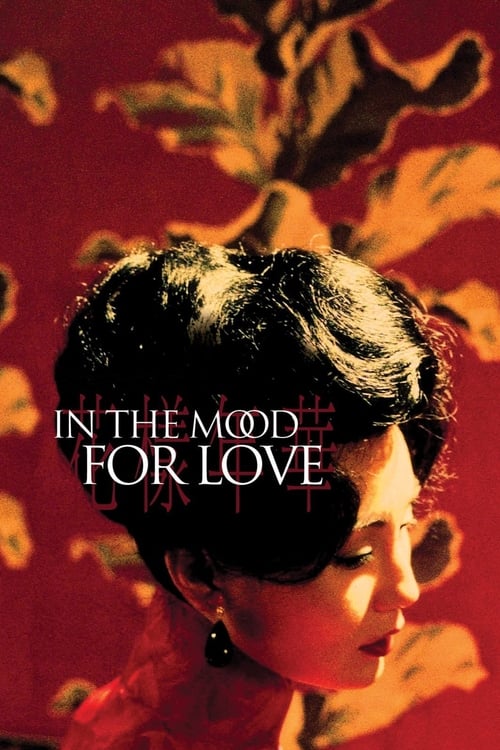
In the Mood for Love
2000 · Wong Kar-Wai
Generates discourse without new films: the Blossoms Shanghai TV pivot, In the Mood for Love's ascension up the Sight & Sound poll, and his permanent status as Letterboxd's most romanticized stylist.
For a late night when you want to feel romantic melancholy at full strength — heartbreak as a mood you sink into rather than a plot you follow. Bring someone, or bring the memory of someone.
What it's about
Hong Kong, 1962: a newspaper editor and a shipping-office secretary rent rooms next door to each other in a crowded tenement, their spouses always conveniently away. Then they discover why — their husband and wife are having an affair with each other. Drawn together by the betrayal, the two neighbors begin meeting, rehearsing conversations, and circling a feeling they refuse to let become an act.
The experience
Swooningly beautiful and quietly heartbreaking — it moves like slow music, all glances and near-touches in narrow corridors, and the restraint makes the longing hit harder than any love scene could. It leaves an ache that stays with you for days.
Performances
Tony Leung and Maggie Cheung give two of the great screen performances of restraint — everything happens in their eyes and the space they keep between their bodies. Cheung, in a wardrobe of high-collared dresses, carries whole scenes on posture alone.
The craft
Every frame is composed like a painting: saturated reds and greens, rain-slicked alleys, slow motion set to a waltzing string theme that will live in your head for weeks. Wong Kar-Wai shoots through doorways and mirrors so you feel like a neighbor glimpsing a secret — it absolutely rewards the biggest, darkest screen you can find.
Why it matters
It became the defining film of modern romantic melancholy and one of the most imitated visual styles in world cinema, later voted among the greatest films ever made in the Sight & Sound poll.
Snapshot
A married man and a married woman, neighbors in a crowded 1962 Hong Kong tenement, discover that their absent spouses are having an affair with each other. What follows is not revenge, not consummation, but something more elusive: the slow, aching rehearsal of a feeling that is never permitted to become an act. In the Mood for Love distills its drama into texture — the slide of silk against a narrow corridor wall, a bowl of noodles retrieved in slow motion, a held glance that costs everything. Wong Kar-Wai's most formally controlled film, it transformed the Hong Kong art cinema into a global touchstone for romantic melancholy and became, by the 2022 Sight & Sound poll, one of the five greatest films ever made.
Industry & production
The film was produced by Block 2 Pictures and Wong Kar-Wai's own Jet Tone Productions, with co-production support from Paradis Films and France's Orly Films. By 2000 Wong had established a pattern of long, costly, improvisational shoots funded partly on the reputation of each previous film; In the Mood for Love followed the commercially disappointing The Fallen Angels (1995) and the international breakthrough Happy Together (1997), which had won Wong the Best Director prize at Cannes. No detailed production budget has been publicly confirmed, and the film's notoriously extended and piecemeal shoot makes any single figure unreliable. Filming stretched roughly from 1998 to 2000, with multiple interruptions and location changes. Because Hong Kong's physical fabric had been so thoroughly transformed by demolition and redevelopment, much of the film was shot not in Hong Kong at all but on constructed sets, in Macau, and in Bangkok — an act of displacement that paradoxically deepened the film's atmosphere of inaccessible pastness. The print that premiered at Cannes in May 2000 was, by Wong's own account, still unfinished, assembled under pressure in the final days before the screening.
Technology
In the Mood for Love was shot on 35mm film, a deliberate material choice that gave cinematographers Christopher Doyle and Mark Lee Ping-bin access to the grain, latitude, and color rendition they exploited throughout. The slow-motion sequences — technically achieved through high-speed undercranked or overcranked shooting, then printed to standard 24fps — were integral to the conception rather than added in post. The film used anamorphic lenses for certain passages, though it is not shot uniformly in anamorphic; the shifting aspect ratios and lens choices are part of how the visual space is modulated. Color grading in the photochemical era was achieved through push-processing and timed prints; Doyle's and Mark Lee's distinctive palette — supersaturated reds and greens, deep shadows with hot highlights — was built into the exposure and development, not added digitally. The film's Cannes print and subsequent international release prints carried a color timing that was revisited for later restorations.
Technique
Cinematography
The film is shared between two cinematographers: Christopher Doyle (Chungking Express, Happy Together) shot the majority of the Hong Kong and Bangkok material, while Mark Lee Ping-bin (Hou Hsiao-hsien's longstanding collaborator, Flowers of Shanghai, Flight of the Red Balloon) contributed extensive sequences. The collaboration was not always harmonious — Wong has spoken of the production in characteristically oblique terms — but the result is among the most visually unified of any film with divided cinematographic credit.
The signature formal strategy is systematic obstruction: the camera watches the characters from behind doorframes, through beaded curtains, across the shoulders of unnamed extras, through the amber glass of office partitions. This is not merely decorative. The technique enacts the social surveillance that governs every aspect of the characters' behavior; the neighbors — Mrs. Suen (played by Rebecca Pan) and her mah-jong circle — are a permanent, unseen pressure even when absent from frame. The stairwell and corridor sequences reprise this logic through narrowed space: both characters must pass each other in a hallway barely wide enough for one, a proximity that is charged precisely because it cannot be acted upon.
The slow-motion passages — Maggie Cheung's Su Li-zhen descending the exterior staircase to collect noodles, the fabric of her cheongsam flowing at one-quarter speed — belong to a register distinct from the film's normal temporality. They function as involuntary memory: a moment stretched because consciousness cannot bear to release it. The handheld and the static are both deployed, but the slow-motion passages are almost invariably on a fluid, gliding track or crane.
Editing
William Chang Suk-ping is credited as editor alongside Kai Kit-Wai and Chan Ki-hop, but Chang's role extends so deeply into every department — he also served as production designer and costume designer — that the editorial logic is inseparable from the visual scheme he built. The film's temporal structure is elliptical and compressed. Scenes are cut before their dramatic payoff; we arrive in the middle of conversations and leave before conclusions. The repetition of the staircase sequence, with small variations in costume and time of day, gradually reveals that we are watching not a linear chronicle but a layered, folded duration. The intertitles — spare, dated, in a period typeface — act as ellipsis markers, jumping weeks or months without announcement.
Mise-en-scène / staging
The film's mise-en-scène is almost entirely the work of William Chang, whose production design and costume conception are integral to the film's meaning. Su Li-zhen wears a continuous series of cheongsams (qipao) — accounts vary, but the number is commonly cited at more than twenty — in ever-changing patterns: floral, geometric, muted, intense. The dresses do not denote character development in any conventional sense; they are the film's equivalent of musical variation, returning the eye to the same form in new registers. The constrictive fit of the cheongsam — high collar, fitted body — is both period-accurate and formally expressive: it figures the character's containment.
The spatial architecture of the film is deliberately theatrical: the main characters inhabit two adjoining units in an anonymous rooming house, and the film keeps returning to the same physical nodes — the doorways, the stairwell, the noodle stall — so that space becomes cyclical rather than exploratory.
Sound
The sound design deploys silence and ambient texture with great precision, but the film is defined above all by its music. Shigeru Umebayashi's "Yumeji's Theme," originally composed for Seijun Suzuki's 1991 film Yumeji, becomes the film's emotional leitmotif, recurred each time the staircase sequence is repeated until it is inseparable from the image. Its lush string waltz, in 3/4 time, is both sensuous and mournful. Wong supplements this with a suite of Spanish-language songs recorded in the late 1940s and 1950s by Nat King Cole: "Quizás, Quizás, Quizás," "Te Quiero Dijiste," "Aquellos Ojos Verdes." These songs were genuinely popular in 1960s Hong Kong, introduced through the Latin American broadcasting market that reached Southeast Asia, and their presence is historically grounded — but their emotional effect is estrangement: the desire is spoken in a language neither character understands, by a voice that has traveled a vast, unmappable distance to arrive here. Michael Galasso contributed additional original music.
Performance
Tony Leung Chiu-wai and Maggie Cheung Man-yuk are both actors of international standing who had worked repeatedly with Wong. Leung won the Best Actor prize at Cannes 2000 for this performance. Wong's working method — extended improvisation, scenes written day-by-day and sometimes hour-by-hour, locations discovered in the process of shooting — demands from his actors a sustained emotional readiness rather than conventional scene preparation. Both Leung and Cheung have described the shoot as disorienting and exhausting. What the camera captures is a performance mode that is almost entirely interior: the restraint is not suppression but precision. Desire is registered in microgestures — the angle of a lowered gaze, the slight hesitation before a sentence, the hands that do not touch. The film's climactic moments are not confrontations but avoidances, and the actors must carry the full weight of what is not done.
Narrative & dramatic mode
The film adapts — loosely, obliquely — from the literary fiction of Hong Kong writer Liu Yichang (劉以鬯), specifically his novella Intersection (Duidao), which interlaces the interior monologues of two characters whose lives run in parallel without quite meeting. Wong has acknowledged Liu as a source, and the film's opening quotation ("He remembers those vanished years. As though looking through a dusty window pane, the past is something he could see, but not touch...") sets the epistemological register: the past as object of helpless contemplation. The narrative mode is lyric rather than dramatic. There is no plot in the conventional sense — no climax, no resolution, no revelation of the spouses' affair that is shown rather than implied. The film is structured around suppression: it does not depict what is happening between the spouses, it depicts the negative space around it.
Genre & cycle
In the Mood for Love belongs to the tradition of the melodrama of restraint — films in which desire is expressed through what is withheld rather than what is enacted. This connects it, on one axis, to the Hollywood "weepie" tradition (Douglas Sirk, Max Ophüls) and, on another, to the European art cinema of Michelangelo Antonioni, whose spatial and temporal attenuations of emotional incommunicability provide a clear formal precedent. It is simultaneously a period film — its 1960s setting is rendered with obsessive physical specificity — and a film about the impossibility of returning to the past. Within Hong Kong cinema, it occupies the space of the art film made primarily for international festival circulation, a positioning Wong had established since Days of Being Wild (1990).
Authorship & method
Wong Kar-Wai works without a completed screenplay. He has described writing scenes on paper napkins the morning before shooting, and his production method involves extended, open-ended shoots in which the material's final form emerges from the footage itself. This is not spontaneity but a disciplined form of discovery: Wong shoots extensive coverage and then constructs the film in the editing, a process more analogous to jazz improvisation than to classical narrative filmmaking.
William Chang Suk-ping is the indispensable collaborator without whom this film's visual world is unthinkable. His triple role as production designer, costume designer, and editor means the film's look and feel are integrated at a structural level that is rare in any cinema. Christopher Doyle brought his characteristic combination of kinetic handheld work and extreme compositional risk; Mark Lee Ping-bin contributed the more reflective, ruminative passages associated with his work with Hou Hsiao-hsien. The music was largely chosen before or during shooting, not afterward, a practice Wong uses to set emotional atmosphere on set.
Movement / national cinema
In the Mood for Love occupies a complex position within Hong Kong cinema. The Second Wave of Hong Kong filmmaking — associated with directors including Tsui Hark, Ann Hui, and Allen Fong in the early 1980s — had established a domestic art cinema distinct from both the Cantonese popular tradition and the martial arts export cinema. Wong belongs to a subsequent generation that came to prominence in the late 1980s and early 1990s. His work is consistently in dialogue with Hong Kong's particular historical anxiety about temporal discontinuity — the handover of 1997, the loss of a Cantonese-speaking social world to mainland integration — but In the Mood for Love displaces that anxiety onto the 1960s, setting the film in the period before the cultural transformations of the 1970s. The film was made, in significant part, outside Hong Kong; it represents a Hong Kong that was already gone, reconstituted from a filmmaker's memory and imagination.
Era / period
The film is set with great precision in 1962 Hong Kong, in a crowded Shanghainese immigrant neighborhood. The period detail — the decor, the costumes, the music, the social conventions — reflects a particular stratum of Hong Kong society: the Shanghainese diaspora that had arrived in the late 1940s following the Communist victory in the Chinese Civil War. Wong himself is from this community; his family emigrated from Shanghai to Hong Kong in 1963, and the film carries the weight of personal as well as historical memory. The 1960s setting is also significant as the last decade before Hong Kong's rapid economic modernization — the period of high-rises and mass development that erased the urban fabric the film depicts.
Themes
The film's primary thematic preoccupation is the untakeable step: the moment of decision that is perpetually approached and perpetually deferred. The two protagonists twice explicitly agree not to become like their spouses — not to do what is being done to them — and this resolution functions not as moral clarity but as a mutual act of romantic suffering. The repression of desire becomes, paradoxically, its intensification.
Memory and its inaccessibility are a second major theme, built into the film's temporal structure and into its final movement — Chow Mo-wan visiting the ancient stones of Angkor Wat, whispering his secret into a crack in the wall and sealing it with mud. The past cannot be inhabited; it can only be buried or glimpsed through glass.
The film is also concerned with the social architecture of restraint: the neighbors, the rooming house, the conventions of mid-century Shanghainese society in Hong Kong all function as an external pressure that mirrors and enables the characters' internal discipline. Privacy is structurally impossible; desire must therefore become inward and self-consuming.
Reception, canon & influence
In the Mood for Love premiered in competition at the Cannes Film Festival in May 2000, where Tony Leung Chiu-wai won the Best Actor prize (Prix d'interprétation masculine) and the film received the Jury Prize for technical achievement. Critical reception was immediately strong in Europe and among international art-cinema audiences; the film was less commercially prominent in Hong Kong itself, where Wong's slow, fragmented style had long been more valued abroad than at home.
The film's ascent through the critical canon has been exceptional. It appeared in the 2002 Sight & Sound decennial poll and rose dramatically in subsequent editions, reaching fifth place in the 2022 poll — the highest placement of any film from the Chinese-speaking world in that survey's history. It is routinely cited alongside the work of Andrei Tarkovsky and Terrence Malick as an argument for cinema as a primarily sensory and temporal rather than narrative art.
Influences on the film (backward): The most direct literary source is Liu Yichang's Intersection. Cinematically, the film's spatial obstruction and temporal ellipsis recall Alain Resnais, particularly Hiroshima Mon Amour (1959). The use of slow motion to exalt the everyday connects to the lyric documentary tradition. The melodrama of suppression has precedents in Max Ophüls's circular tracking shots and Douglas Sirk's use of décor as emotional displacement. Within Chinese-language cinema, Hou Hsiao-hsien's long-take minimalism and Stanley Kwan's attention to period atmosphere are visible antecedents. The Shanghainese popular music tradition — particularly the shidaiqu (time songs) of the 1940s — provides the cultural register against which the Nat King Cole songs are heard.
Legacy (forward): In the Mood for Love reshaped the international perception of Hong Kong cinema and established Wong Kar-Wai as a canonical world director. Its influence on subsequent filmmaking is diffuse but pervasive: the use of slow motion for lyric intensification rather than action spectacle entered the visual grammar of commercial and art cinema alike. The film's color work — saturated jewel tones, deep ambient shadow — influenced a generation of cinematographers working digitally. Desire expressed through restraint and proximity rather than declaration became a template returned to repeatedly in East Asian romantic cinema. The film's relationship with its sequel/companion piece, 2046 (2004), anticipates the modular, cross-film narrative structures that Wong continued to develop. Fashion designers, music video directors, and photographers have cited the cheongsam sequences with unusual frequency, making the film one of the more extensively appropriated works in contemporary visual culture. Wong Kar-Wai himself returned to its world in The Grandmaster (2013), and the figure of Chow Mo-wan recurs across multiple works as a kind of authorial avatar — the man who arrives too late, who keeps the secret, who cannot go back.
A Deleuzian reading
She goes down for noodles.
The full Deleuzian reading of In the Mood for Love →
Reception
Acclaimed out of Cannes in 2000 as an arthouse triumph, it has only climbed since — topping BBC-and-critics polls of 21st-century cinema and landing at #5 on the 2022 Sight & Sound list, the highest of any film made this century. Few films have gone from 'festival darling' to 'consensus masterpiece' so completely.
How In the Mood for Love was received, from release to now →
Influences: the films it descends from and the films it influenced
- Spring in a Small Town (1948) — Fei Mu's systematic use of domestic thresholds — stairs, corridors, doorways — as positions characters occupy in lieu of crossing establishes the architectural grammar of blocked desire that Wong and William Chang codify in every stairwell and doorframe composition.
- Letter from an Unknown Woman (1948) — Ophüls's gliding 360-degree tracking shots circle proximate bodies that cannot emotionally reach each other, providing the choreographic model for Wong's slow-motion stairwell passages where fluid camera movement traverses space the characters cannot affectively cross.
- All That Heaven Allows (1955) — Sirk's systematic placement of domestic objects — television screens, flower arrangements, window glass — as surrogate expressions of socially imprisoned desire is the direct precedent for William Chang's décor strategy, in which every cluttered foreground element functions as emotional displacement rather than neutral background.
- Hiroshima Mon Amour (1959) — Resnais's editing method of inserting memory-fragment cuts without temporal brackets — making past and present indistinguishable mid-sequence — is the structural model for Wong's elliptical organization, where scenes are fragmentarily returned to with withheld information rather than linearly resolved.
- L'Avventura (1960) — Antonioni's formal device of placing characters at the edge or exterior of widescreen frame while holding the center empty — making architectural space perform psychic absence — is the spatial precedent Wong's own facets explicitly acknowledge; Doyle's framing of Leung and Cheung against columns and doorframes directly extends this grammar.
- Rouge (1987) — Kwan uses 1930s Cantonese opera costumes and shidaiqu-inflected music not as period decoration but as the primary carriers of structural nostalgia, establishing for Wong the template of period costume and period sound as load-bearing emotional registers — the direct model for the cheongsam sequences and Nat King Cole leitmotif.
- Days of Being Wild (1990) — Wong and Doyle first developed the push-processed high-grain color strategy and the 1960s Hong Kong confined-apartment visual grammar here; ITMFL directly inherits Chow Mo-wan as a character and the +2-stop-pushed negative as its photographic base stock.
- Chungking Express (1994) — Wong first systematizes the borrowed-leitmotif device here — 'California Dreamin'' played obsessively until a pre-existing pop song becomes synonymous with a character's refusal to release — establishing the precise methodology that turns Nat King Cole's 'Quizás, Quizás, Quizás' in ITMFL into an auditory surrogate for desire never declared.
- Happy Together (1997) — Doyle's extreme push-processing experiments across multiple stocks — near-monochrome desaturation, explosive color ruptures, amplified grain — served as the technical laboratory from which ITMFL's calibrated jewel-tone palette was derived; the film also deploys Caetano Veloso's 'Cucurrucucú Paloma' as an aching leitmotif, directly rehearsing the Nat King Cole strategy.
- The Flowers of Shanghai (1998) — Mark Lee Ping-bin developed his fixed-camera, tungsten-candlelit interior method here — extreme shallow depth, opium smoke and decorative objects creating multiple foreground planes between lens and actor — and imported this specific approach directly into ITMFL's amber-saturated, depth-stratified room compositions.
- Vertigo (1958) — Doyle and Li Ping-bing's cinematography develops Vertigo's color-as-psychological-register: saturated greens and ambers track obsessive desire, and slow-motion repetition of the woman's cheongsam appearance figures compulsive return with the same structural grammar as Vertigo's Madeleine surveillance sequences.
- Three Colors: Blue (1993) — Wong deploys Umebayashi's 'Yumeji's Theme' as an intrusion cut — the waltz begins mid-shot without preparation over slow-motion corridor imagery — applying Kieślowski's music-intrusion-cut technique to romantic grief; Doyle and Lee's warm color-filtering cinematography extends the color-as-interiority approach to a different affective register.
- 2046 (2004) — William Chang extends his triple-role authorship by designing the future-train sequences as visual rhymes for ITMFL's hotel rooms; the overcranked slow motion, now applied to androids in transit, confirms that for Wong slow motion is the syntactic unit for time experienced as unresolvable longing.
- The Grandmaster (2013) — Wong systematically extends ITMFL's overcranked slow-motion device from domestic scenes to martial arts action — rain droplets, flying fabric, suspended fists — establishing slow motion as the primary register for both erotic tension and physical confrontation; William Chang's triple authorship continues, maintaining the integrated visual model.
- The Assassin (2015) — Mark Lee Ping-bin transposes the ruminative-obstruction strategy he developed on ITMFL — shooting through gauze curtains, beaded screens, and foliage to multiply translucent planes between camera and subject — into Tang Dynasty action cinema, proving these devices transfer to genre material when applied by the originating cinematographer.
- Moonlight (2016) — Jenkins, citing Wong Kar-Wai as a primary influence, works with cinematographer James Laxton to apply ITMFL's push-processed jewel-tone palette — deep blues and ambers, extreme bokeh, shallow depth of field — to contemporary American drama; the film's performance methodology of desire communicated through sustained gaze and arrested gesture is a direct methodological inheritance.
- Portrait of a Lady on Fire (2019) — Sciamma and cinematographer Claire Mathon apply the sustained-gaze microgesture performance method — desire communicated through held eye contact and the precise direction of attention rather than declaration or physical contact — that Tony Leung and Maggie Cheung developed under Wong's direction, constructing the same melodrama-of-restraint architecture around withheld rather than performed emotion.
- Drive My Car (2021) — Hamaguchi structures the film around conversations that orbit a withheld emotional truth — characters who cannot say what they most need to say, with dialogue functioning as displacement rather than disclosure — extending ITMFL's lyric-suppression narrative strategy into Japanese literary cinema across a duration that accumulates the weight of what remains unspoken.
- Resurrection (2025) — Christopher Doyle's saturated neon romanticism and step-printed smeared motion is the explicit visual texture Bi quotes in the final chapter.
- Lady Vengeance (2005) — Chung Chung-hoon has cited Wong's use of saturated color temperature and suppressed-emotion performance framing as a formative influence; specifically, encoding interior psychological states through controlled palette and calibrated tight close-ups rather than camera movement.
- Infernal Affairs II (2003) — WKW's amber-tinted shallow-focus compositions — protagonists isolated against warm bokeh in widescreen frames where they occupy margins rather than centers — established the post-handover visual idiom for Hong Kong period nostalgia that IA2 adapts to crime cinema's staging of the 1997 moment.
- Her (2013) — Hoyte van Hoytema directly cited Christopher Doyle as a formative influence; the warm amber-ochre palette, rack-focus close-ups on faces and fabric registering suppressed longing, and slow-motion figure-in-transit staging migrate directly into Her's cinematographic grammar.
- Kaili Blues (2016) — Wong's use of diegetic music as a sensory trigger that collapses temporal distance — the repeated Shigeru Umebayashi theme as involuntary memory device — is operative in Kaili Blues' Miao folk song sequences, where regional music anchors the film in a specific cultural memory while also dissolving temporal boundaries.
- Long Day's Journey Into Night (2018) — Bi Gan borrows Wong's specific color palette (deep greens, warm ambers, saturated reds in wet streets) and his technique of building romantic longing entirely through withheld rather than shown encounters, with pop ballads deployed as sudden emotional punctuation in an otherwise withholding film.
- Yi Yi (2000) — Yang composes shots through plate-glass windows and mirror surfaces so a character's face and the world behind them share the same frame simultaneously — making urban architecture visible as a grammar of interiority — the sibling strategy to ITMFL's systematic obstruction cinematography, developed independently in the same release year.
- The Currents (2025) — Conveys suppressed feeling through expressive saturated color and framing-through-thresholds, a maximal example of emotion delivered via the unsaid.
- All About My Mother (1999) — Released the same year, Wong independently deploys the same formal constellation: a circular melodic theme (Yumeji's Theme) that returns to structure longing, saturated color-coded mise-en-scène where costume patterns track emotional state, and unhurried editing that holds shots beyond narrative necessity to let feeling accumulate.
- Crouching Tiger, Hidden Dragon (2000) — Simultaneous crystallization of proxemic desire as a formal register: both films independently stage longing through calibrated framings of physical proximity that cannot complete its movement, using the space between bodies—not dialogue—as primary dramatic argument.
- The Double Life of Véronique (1991) — Christopher Doyle and Mark Lee Ping-bin's warm amber cinematography — tungsten-balanced stock, slow-motion exposure, practical Chinese lanterns pushed to overexposure — and Shigeru Umebayashi's 'Yumeji's Theme' deployed as a constitutive leitmotif rather than atmospheric underscore both directly parallel Idziak's filtration system and Preisner's score architecture, achieving the same jewel-like enclosure of interiority.
- Punch-Drunk Love (2002) — Both films use rack-focus to isolate figures against saturated practical-light color fields and treat romantic narrative as a problem of withheld exposition rather than accumulated event, forcing color and sonic texture to carry emotional weight the plot refuses to deliver.
- Lost in Translation (2003) — Shares the shallow-focus telephoto two-shot of two restrained near-lovers and the use of a recurring musical motif as co-author of longing, withholding consummation to the end.
- Written on the Wind (1956) — Extends the Sirkian craft of color-coded repression and mirror-/frame-bounded longing, staging emotional impotence through saturated decor and recurring musical motif.
- The Handmaiden (2016) — Sibling in pan-Asian period sensuousness: opulent production design and repetition-with-variation editing that aestheticizes restrained then released desire.
- Brokeback Mountain (2005) — Repression-as-compression at its purest: physical reticence and unconsummated, recurring near-meetings sustained over years, longing intensified precisely by its formal containment.
- Far from Heaven (2002) — A contemporaneous melodrama of unconsummated desire that, like Far from Heaven, uses saturated period color, framing-through-thresholds and doorways, and a recurring romantic musical theme to externalize repression — parallel Sirkian revival in another idiom.
- Millennium Mambo (2001) — Shares cinematographer Mark Lee Ping-bing; the neon-and-smoke nightworld and slow, mood-forward romantic urban melancholy are a direct visual cousin.
Similar films
- Happy Together (1997) — influence & lineage · same viewing thread · often watched together
- Days of Being Wild (1990) — influence & lineage · same viewing thread
- Chungking Express (1994) — influence & lineage · often watched together
- 2046 (2004) — influence & lineage
- Yi Yi (2000) — influence & lineage
- The Grandmaster (2013) — influence & lineage
- Fallen Angels (1995) — same viewing thread · often watched together
- Lust, Caution (2007) — same viewing thread
All the films related to In the Mood for Love →
Watch it with: curated runs of related films
- Love Against the Grain — A run of films where desire refuses the shape its world demands — opera stages, drought-struck Taipei, an honor-bound Lahore household, drenched Buenos Aires — and burns brighter, and more dangerously, for the refusal.
Film essays and courses that include it
- Wong Kar-wai
- Radical Attention: A Century of Art Cinema
- The Ache of Distance: Cinema's Language of Longing
- The Wound of Time: Cinema's Elegiac Masters
- The Shape of Longing: How Cinema Reinvented Romance
- The Vow and Its Violation: A Century of Marriage on Screen
- The Grammar of Longing: Cinema's Great Forbidden Love
- In-Yeon: Impossible Love and the Immigrant Self
- What Light Remains: The Impressionist Memory Film
- Wanted: The Erotic Triangle from Film Noir to Now
- Light Made Visible: Cinema's Great Image
- The Face That Cannot Act
- A City Filming Its Own Disappearance
- The Cinema of the Near Miss
- The Camera That Feels
- Alone in the Crowd
- The Art of Wanting