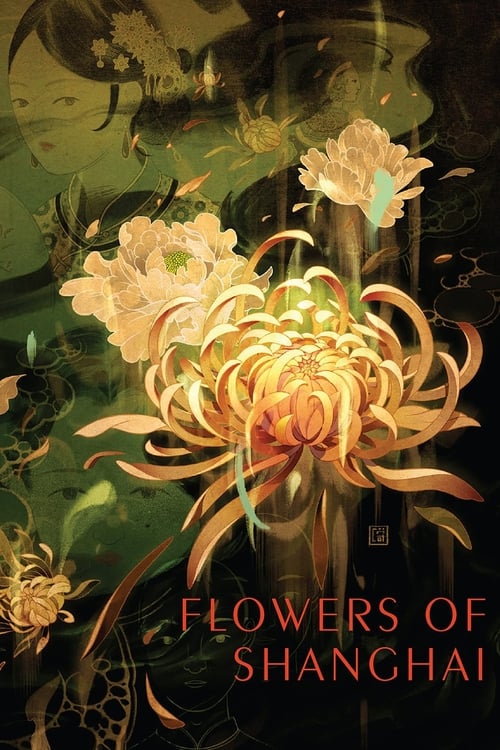
Flowers of Shanghai
1998 · Hou Hsiao-hsien
For when you want pure immersion in a vanished world — a slow, gorgeous chamber piece to watch late at night with the lights off. Comfort for the patient viewer, a challenge if you need plot to hold on to.
What it's about
In the opulent 'flower houses' of 1880s Shanghai — luxurious brothels where the city's male elite conduct their real social lives — courtesans and their patrons play a long game of jealousy, negotiation, and debt. The film moves between a handful of these lamplit salons, following the shifting fortunes of women whose security depends entirely on managing men's affections, and men who are far less in control than they believe.
The experience
Like sinking into an opium haze — the film glides through golden lamplight in long, unhurried takes, each scene fading to black like a chapter closing. It's intimate and hushed; the drama is all in glances, etiquette, and what goes unsaid.
Performances
Tony Leung Chiu-wai anchors the film as a quiet, wounded patron, saying almost nothing while an entire drama of pride and heartbreak plays out in his silences.
The craft
Composed of a small number of very long takes, each a slow drift through a single lamplit room, with no exteriors at all — the whole world is interiors, silk, smoke, and mahjong tiles. The candlelit cinematography is ravishing, among the most beautiful ever put on film, and the enclosed staging makes a big screen feel like being seated at the banquet table.
Why it matters
Widely regarded as one of the most formally radical and beautiful films of the 1990s, it pushed Hou's long-take style to its purest extreme and became a touchstone for slow cinema and period filmmaking alike.
Snapshot
Flowers of Shanghai (海上花, Hǎishàng huā) is Hou Hsiao-hsien's chamber drama of the late-Qing courtesan houses, or "flower houses," of the British concession in 1880s–90s Shanghai. Adapted from Han Bangqing's 1892 novel The Sing-song Girls of Shanghai — a book famous for being written in the Wu (Shanghainese) dialect and later rendered into Mandarin and English by Eileen Chang — the film unfolds entirely indoors, in lamplit rooms thick with opium smoke, mahjong, banquets and the slow attrition of money, obligation and feeling. It is Hou's most hermetic and formally radical work: a film composed of a small number of very long takes, each separated by a fade to black, with no exterior shots and almost no conventional dramatic incident. Where Hou's earlier films breathe the open air of Taiwanese landscape and history, this one seals itself inside a hothouse where affection is a transaction and every gesture is choreographed by ritual. It premiered in competition at the 1998 Cannes Film Festival and stands, alongside A City of Sadness and The Puppetmaster, as one of the central achievements of his career.
Industry & production
The film is a product of the mature phase of Taiwan New Cinema's international art-house circuit, financed and produced across the Taiwan–Japan axis that sustained Hou through the 1990s. It was made through Hou's regular Taiwanese production base in partnership with Japanese backing; the Japanese distributor and cultural conglomerate Shochiku is associated with the project, reflecting the long relationship between Hou's cinema and Japanese art-house patronage that also shaped Good Men, Good Women and Goodbye South, Goodbye. Precise budget and box-office figures are not something I can state reliably, and the film — dialogue-heavy, dialect-specific, and set wholly in interiors — was never conceived as a commercial vehicle. Its economics were those of the festival auteur film: recouped through prestige, international sales and cultural subsidy rather than domestic returns.
The production's defining industrial fact is that it was shot almost entirely on constructed sets on a soundstage in Taiwan rather than on location in Shanghai. The flower-house interiors — the carved wooden screens, the beds, the lamps, the banqueting tables — were built and dressed with painstaking period detail, allowing Hou total control over light and space. This studio-bound method is unusual for a director associated with location realism, and it is inseparable from the film's aesthetic: the enclosed world of the courtesans is literally a world with no outside.
Technology
Flowers of Shanghai was shot on 35mm color film in the late-1990s photochemical idiom, and its technology is in the service of a single problem: rendering low, warm, practical-source light. The interiors are lit to read as if illuminated by oil lamps and candles, producing a pervasive amber-gold cast and deep pools of shadow. Achieving usable exposure and that particular glow on film stock, with sources kept low and diffuse, is a considerable technical feat, and it is one of the reasons the film is so often discussed as a landmark of cinematographic craft. Sound was recorded and mixed to foreground the intimate acoustics of enclosed rooms — the clatter of mahjong tiles, the murmur of overlapping conversation, the rustle of silk — rather than any wide sonic field. The film predates the digital-intermediate era, so its color is a photochemical achievement of lighting and stock rather than a graded electronic image.
Technique
Cinematography
The photography, by Mark Lee Ping-bing (Lee Ping-bin), is the film's most celebrated element and among the most admired in all of 1990s cinema. Every scene is a long take in which the camera makes slow, restrained lateral moves — gentle pans and reframings, drifting from one figure to another around a table or bed — rather than cutting. The light is uniformly warm and low, the frame dense with lamps, smoke, lacquer and embroidered cloth, so that the image seems to glow from within. Lee's camera never goes outside and never breaks the enclosure; the effect is of a continuous, unhurried observation that lets the viewer settle into the temperature of the room. This is Hou's characteristic long-take realism turned inward and made pictorially sumptuous, and the film is frequently cited as a high point of Lee Ping-bing's career, which also includes his work for Wong Kar-wai on In the Mood for Love.
Editing
The editing, by Hou's longtime collaborator Liao Ching-sung, is defined by radical economy: the film is built from a small number of long takes — commonly described as roughly three dozen shots for the entire feature, though I would not want to fix an exact count — each set off from the next by a fade to black. There is essentially no cutting within scenes. The fades function as chapter breaks and as ellipses, marking the passage of time and the movement between houses and couples without ever showing a transition or an exterior. This structure gives the film its distinctive rhythm of self-contained episodes surfacing out of darkness and dissolving back into it, mirroring the enclosed, cyclical, time-suspended life of the houses.
Mise-en-scène / staging
Staging is the film's true dramaturgy. Because the camera holds and the cuts are absent, meaning is carried by blocking, décor and the ceremonial choreography of the flower house: the pouring of wine, the lighting and passing of opium, the seating at banquets, the negotiations conducted through intermediaries and etiquette. The sets are extraordinarily detailed and function as social maps — who sits where, who serves whom, which room belongs to which courtesan. Hou stages conversation as ritual, so that the smallest deviation in gesture or address registers as event. The mise-en-scène does the work that plot would do in a conventional film.
Sound
The soundscape is intimate and diegetic: overlapping talk, mahjong tiles, the small domestic noises of the houses. The score is credited to the Japanese composer Yoshihiro Hanno, whose contribution is spare and recurrent, a restrained musical motif rather than a lush orchestral accompaniment; Tu Du-chih, Hou's regular sound designer, shaped the film's acoustic intimacy. A crucial and much-discussed dimension of the film's sound is language: the dialogue is performed largely in Shanghainese (Wu) dialect, in fidelity to Han Bangqing's original novel, with Cantonese also present given the Hong Kong cast. This linguistic texture — a "secret" regional tongue that is itself part of the enclosed world — is central to the film's ethnographic authenticity.
Performance
Performance is pitched to the same key of restraint and ritual. The ensemble includes Tony Leung Chiu-wai as the reticent, brooding patron Wang; the Japanese actress Michiko Hada as the courtesan Crimson (Shen Xiaohong); Michele Reis as Emerald (Jade); Carina Lau as Pearl; and Rebecca Pan and Jack Kao among the company. The acting is minutely controlled — glances, silences, the withholding and granting of small favors — with jealousy, humiliation and tenderness conveyed through the smallest inflections. That several leads are Cantonese-speaking Hong Kong stars performing in Shanghainese adds a layer of estrangement and effort to the performances that is part of the film's texture.
Narrative & dramatic mode
The film is anti-dramatic by design. Rather than a single throughline, it interweaves several loosely connected episodes centered on different courtesans and their patrons: the fraught, jealous bond between Wang and Crimson; the shrewd, self-emancipating Emerald negotiating her own freedom; the household intrigues around Pearl and the younger women. There is no rising action or climax in the classical sense; instead the film accretes mood, obligation and the slow economics of desire. Dialogue is oblique, saturated with the coded manners of the milieu, and much is left implied. The dramatic mode is observational and elliptical — closer to a novelistic cross-section of a social world than to a plotted story — which is faithful both to Han Bangqing's episodic source and to Hou's lifelong preference for duration and indirection over incident.
Genre & cycle
Nominally a costume drama or period melodrama, Flowers of Shanghai systematically frustrates the pleasures of both. It belongs to the loose category of the literary-adaptation art film and to the Chinese-language "courtesan" tradition, but it strips out the spectacle, sweep and moralizing that mark most period pictures. It arrives in the wake of the lavish 1990s mainland Chinese historical films (the internationally successful works of Chen Kaige and Zhang Yimou) and can be read as a deliberate counter-statement to them: where those films are operatic, brightly colored and expansive, Hou's is hushed, monochromatically amber and claustrophobic. Within Hou's own filmography it stands somewhat apart as his fullest excursion into another time and place, yet it is continuous with his commitment to long takes and enclosed social observation.
Authorship & method
The film is a summation of Hou Hsiao-hsien's method and of the creative collective he built over two decades. His authorial signature is everywhere: the long take, the fixed or slowly reframing camera, the refusal of exterior context, the treatment of social ritual as drama, the trust in duration. The screenplay is by Chu Tien-wen (Zhu Tianwen), the novelist and Hou's essential writing partner across nearly his entire career, who shaped Han Bangqing's dense dialect novel into the film's elliptical structure. Cinematographer Mark Lee Ping-bing supplied the lamplit long takes; editor Liao Ching-sung the fade-punctuated architecture; composer Yoshihiro Hanno the spare score; and sound designer Tu Du-chih the acoustic intimacy. Han Bangqing's 1892 novel — and behind it Eileen Chang's role in transmitting and translating that novel — forms the literary foundation on which the whole enterprise rests. The film is thus doubly authored: a Hou film and a faithful conjuring of a specific literary and linguistic world.
Movement / national cinema
Flowers of Shanghai is a late, refined product of Taiwan New Cinema, the movement that emerged in the early 1980s and whose two towering figures are Hou and Edward Yang. By 1998 that movement's collective moment had passed, but its aesthetic principles — long takes, non-melodramatic observation, historical and social seriousness, resistance to Hollywood grammar — reached one of their purest expressions here. The film also exemplifies the transnational condition of Taiwanese art cinema at the time: Taiwanese authorship and crew, Japanese financing and scoring, a cast drawn largely from Hong Kong stardom, and a mainland-Chinese historical subject. It is a Taiwan-centered film about the Chinese past, made possible by pan-East-Asian collaboration, and it belongs to the broader canon of 1990s Asian art cinema that festival audiences in the West were then discovering.
Era / period
The film is set at the end of the 19th century, in the treaty-port Shanghai of the foreign concessions, and it is meticulously specific about the institution of the flower houses: the prohibition that kept Chinese officials from ordinary brothels and funneled elite male sociability into these establishments; the intertwining of sex, dining, opium, gambling and business; the debt, contracts and quasi-marital arrangements that structured a courtesan's life. This was a world with its own etiquette, hierarchy and language, and the film treats it with an almost anthropological patience. Its portrait of opium as an everyday social lubricant, and of courtesanship as a career of negotiation rather than simple victimhood, gives it a historical texture rarely seen with such fidelity on screen.
Themes
The film's governing themes are enclosure, obligation and the commodification of intimacy. Every relationship is simultaneously emotional and financial; tenderness and calculation are inseparable, and the women navigate a system that both constrains and, in limited ways, empowers them — most sharply in Emerald's cool campaign to buy her own freedom. Jealousy, face, humiliation and loyalty circulate as a kind of currency. Time itself is a theme: the film's suspended, cyclical rhythm and its refusal of any outside world evoke a gilded stasis, a life sealed off from history. Underlying it all is a melancholy about desire that can never be freely given because it is always already bought — a meditation on power, gender and money conducted entirely through manners.
Reception, canon & influence
Critically, Flowers of Shanghai was received as a major work by admirers of Hou and of slow, formally rigorous cinema, and its cinematography in particular has been near-universally praised; it is regularly named among the most beautifully photographed films of its decade. Its Cannes competition berth in 1998 confirmed its stature on the festival circuit, and in subsequent decades its reputation has only grown, aided by restoration and re-release. It appears with some frequency on critics' lists of the great films of the 1990s and of Hou's finest work, though I would not attach specific poll rankings without checking them.
Looking backward, the film's influences are literary and pictorial before they are cinematic: Han Bangqing's dialect novel and Eileen Chang's mediation of it; the intimate scale and interior focus of classical Chinese fiction; and Hou's own prior long-take practice, here purified to an extreme. Looking forward, its legacy lies less in imitation than in exemplarity — it became a touchstone for a certain ideal of "slow cinema," of the film built from durational long takes and ambient observation, and its lamplit interiors are frequently invoked in discussions of period atmosphere and of Mark Lee Ping-bing's broader body of work, including In the Mood for Love. It stands as one of the definitive demonstrations that a period film can achieve its power entirely through duration, staging and light rather than plot and spectacle.
A Deleuzian reading
Start with the pouring of wine.
The full Deleuzian reading of Flowers of Shanghai →
Reception
In competition at Cannes '98 it left plenty of critics restless and went home empty-handed, dismissed by some as gorgeous wallpaper. A quarter-century of reappraisal — capped by a 4K restoration and a 2021 Criterion release — has made it a fixture in best-of-the-90s conversations and, for many, Hou's supreme achievement.
How Flowers of Shanghai was received, from release to now →
How to watch Flowers of Shanghai: what to notice on a first viewing
- Notice each scene ends with a fade to black. Hou builds the film from roughly three dozen long takes, each one separated from the next by a fade, with no cuts at all inside a scene. Each episode surfaces out of darkness and sinks back into it, like a room you keep returning to.
- Watch the camera drift slowly around a table instead of cutting. Mark Lee Ping-bing's camera makes gentle lateral pans and reframings, moving from face to face around a banquet or bed rather than switching shots. The unbroken watching lets you settle into the room's temperature instead of being steered scene by scene.
- Watch who pours the wine and who receives it. Hou stages small courtesies, pouring wine, passing an opium pipe, seating at a banquet, as precise social choreography, so a tiny deviation in gesture registers as a real event. These rituals carry the whole social order of the house, who owes what to whom, without a line of dialogue explaining it.
- Listen for the Shanghainese dialect running under the whole film. The dialogue is performed largely in Wu, a regional dialect that itself functions like a private tongue belonging to this enclosed world of courtesans and patrons. Even the language keeps you outside a world that speaks only to itself.
The whole guide to watching Flowers of Shanghai, with the keys for a rewatch →
Influences: the films it descends from and the films it influenced
- Sisters of the Gion (1936) — Establishes the pleasure-quarter economy observed in one-scene-one-shot long takes, where the transaction between courtesan and patron is staged as ritual rather than narrated — the template Hou inherits for treating brothel commerce as duration.
- The Life of Oharu (1952) — Mizoguchi's laterally tracking camera gliding alongside a woman circulated as commodity supplies Hou's core grammar of the reframing-not-cutting shot that follows figures through screened interiors.
- The Earrings of Madame de... (1953) — The continuously repositioning lateral camera through candlelit, mirror-and-drapery salons — reframing to keep bodies composed without a cut — is the exact camera behavior Hou distills to a fixed pivot in the flower-house rooms.
- Gertrud (1964) — A chamber drama built entirely from long static takes, averted faces and minimalist vocal restraint, refusing exterior action — the precedent for Hou's performance of suppressed feeling within enclosed rooms.
- L'Avventura (1960) — Dedramatization and dead time — withholding the plot event and letting scenes run past their narrative purpose — is the anti-drama structuring principle Hou pushes to its extreme in the elliptical dinner-and-negotiation scenes.
- Late Spring (1949) — Ozu's elliptical construction, which omits the ostensibly dramatic events (the wedding, the departure) and dwells on ritual domestic gesture, models the fade-punctuated omissions of Hou's structure that Chu Tien-wen built from Han Bangqing's novel.
- A City of Sadness (1989) — Hou's own fixed-frame long take treating communal meals and gatherings as the primary dramatic site, with history kept offscreen, is the method Flowers purifies to a single interior world.
- The Puppetmaster (1993) — The immediate precursor in Hou's practice: durational long takes punctuated by fades and a refusal of establishing context, which Flowers refines into the fade-to-black ellipsis architecture cut by Liao Ching-sung.
- India Song (1975) — Amber lamplit colonial-brothel interiors, languid long takes, a recurring musical motif, and systematic off-screen elision of the dramatic event — India Song's decaying-interior tableau and slow tempo in another register.
- Sansho the Bailiff (1954) — The slowly encircling long take orbiting figures in interior tableaux, with restraint substituting for melodrama — a direct extension of Mizoguchi's mobile-camera contemplation of women's confinement.
- Chikamatsu Monogatari (1954) — Extended candlelit long takes staging women's entrapment inside a courtesan house's cash economy, an avowed extension of Mizoguchi's depth-staged duration and moral framing.
- When a Woman Ascends the Stairs (1960) — Courtesan-house economics staged as nothing but negotiation in lamp-lit interiors, where every scene is a lateral pan across people discussing sums and the film fades to black between rooms — an extreme-ellipsis structure that never once shows the outside world or the sexual transaction the money is for.
- In the Mood for Love (2000) — Shot by the same cinematographer Mark Lee Ping-bing, it shares the lamplit period interior, framing bodies through doorways and drapery, and the restraint-as-eroticism where consummation is displaced into decor and duration.
- Norwegian Wood (2010) — Mark Lee Ping-bing carries the soft lamplit, ambient-light long-take aesthetic forward, staging interior emotional stasis through the same durational, atmosphere-over-plot photography.
- The Assassin (2015) — Hou extends the exact technique — lamplit silk-draped interiors, laterally reframing long takes screened by gauze curtains, spare diegetic sound — from the courtesan house into wuxia, its clearest self-descendant.
- Goodbye, Dragon Inn (2003) — Pushes the durational long take and ambient diegetic sound to near-empty extremity, building drama from time passing in a space rather than event — the slow-cinema logic Flowers helped canonize.
- Still Life (2006) — Long-take ambient observation with non-professional dialect performance and refusal of dramatic climax extends Hou's durational realism into contemporary China.
- Syndromes and a Century (2006) — Inherits the elliptical, twin-panel anti-dramatic structure and the trust in ambient duration and diegetic quiet that made Flowers a slow-cinema touchstone.
- Kaili Blues (2016) — Hou's extended single-setting takes in which the camera moves autonomously and slowly, reframing independently of dramatic action within a specifically Chinese cultural and linguistic space, and his elliptical editing that implies temporal passage without marking it, are the nearest Chinese-language formal precedents for Kaili Blues' visual language.
- Millennium Mambo (2001) — Mark Lee Ping-bing's available practical-lamp lighting and slowly drifting long takes inside enclosed interiors — the candlelit precursor to Mambo's neon-lit rooms.
- Cemetery of Splendor (2015) — Perfects the deep-staged static long take lit by warm practical sources, where action recedes into the depth of the frame—the deep-staging Cemetery uses across its dormitory rows.
- Resurrection (2025) — Slow-cinema long takes drifting through lamplit interiors establish the durational, plan-séquence ethic Bi inherits from Hou's slow-cinema lineage.
- House of Pleasures (2011) — The governing formal template: a brothel filmed entirely in interiors with no exterior shot at all, lit by practical oil lamps to a warm amber falloff, built from slowly drifting long takes that circle the room and are separated by fades to black rather than cuts.
- Springtime in a Small Town (2002) — Again lensed by Mark Lee Ping-bing, a period chamber piece of contained longing built from slow reframing long takes and minimalist performance within a single enclosed household.
- Maborosi (1995) — Kore-eda's distant static tableaux and elliptical treatment of grief, letting figures move within a held frame lit by available light, is a direct absorption of Hou's fixed-long-shot observation.
- Sátántangó (1994) — A contemporaneous pole of the same slow-cinema movement, constructing meaning from extended long takes with no internal cutting and choreographed real-time staging rather than montage.
- Fireworks (1997) — Hou sustains a stationary frontal camera inside closed interiors, compresses time through cuts that remove transitions entirely, and withholds emotional confrontation—a parallel tableau-editing practice to Kitano's, developed independently within the same late-1990s festival circuit.
Similar films
- A City of Sadness (1989) — influence & lineage · same viewing thread
- Goodbye, Dragon Inn (2003) — influence & lineage · same viewing thread
- The Assassin (2015) — influence & lineage
- In the Mood for Love (2000) — influence & lineage
- The Life of Oharu (1952) — influence & lineage
- The Earrings of Madame de... (1953) — influence & lineage
- Raise the Red Lantern (1991) — same viewing thread
- Millennium Mambo (2001) — same viewing thread
All the films related to Flowers of Shanghai →
Watch it with: curated runs of related films
- Sinophone Slow Cinema — A run of Chinese-language films — Taiwan's New Wave and its mainland and Bi Gan heirs — where time pools and city, family, and memory recur; watch them near each other, from A Brighter Summer Day to An Elephant Sitting Still, for how they rhyme on drift and the weight of the past.