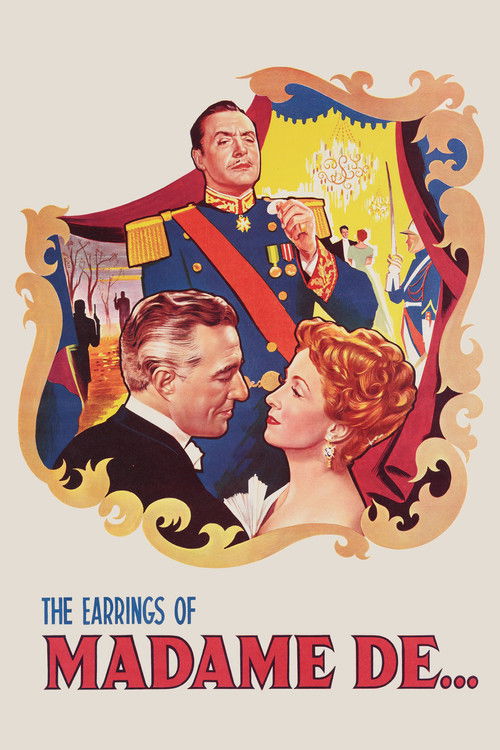
The Earrings of Madame de...
1953 · Max Ophüls
For when you want a grand, grown-up romance that actually hurts — something beautiful to sink into on a quiet night, knowing it will leave a bruise. More heartbreak than comfort, delivered in the most luxurious wrapping imaginable.
What it's about
In late 19th-century Paris, a countess quietly sells the diamond earrings her husband, a general, gave her on their wedding day, then claims she lost them. The lie should be small, but the earrings keep changing hands — pawnbroker, mistress, a charming Italian baron — and each time they resurface they pull the countess, her husband, and her new love deeper into a trap of pride and heartbreak.
The experience
Gliding and gorgeous on the surface, quietly devastating underneath. The ballrooms and waltzes keep spinning while the emotional stakes tighten notch by notch, and by the end the elegance itself starts to feel like a cage.
Performances
Danielle Darrieux makes the countess's journey from frivolous flirt to a woman genuinely, dangerously in love feel seamless; Charles Boyer gives the general a wounded dignity that keeps him from being a simple villain, and Vittorio De Sica is effortless charm as the baron.
The craft
The camera almost never stops moving — it waltzes through ballrooms, up staircases, past mirrors — so the whole film feels like one continuous dance. Ophüls builds the story around a single pair of earrings passed from hand to hand, and the black-and-white images of gowns, candlelight, and glass are some of the most sumptuous ever shot.
Why it matters
Widely held up as one of the most perfectly made films in existence, it became the touchstone for how camera movement alone can carry emotion, and generations of directors have studied it for exactly that.
Snapshot
A pair of diamond earrings travels in a circle — from a countess's jewelry box to a pawnbroker, to a general's mistress, to a bazaar in Constantinople, to an Italian baron's pocket, back to the countess's ears — and by the time it completes the loop, it has destroyed every party who touched it. The Earrings of Madame de... is Max Ophüls's most concentrated statement of his major themes: the imprisonment of women within elegant social forms, the fatal gap between performance and feeling, and the cruelty of a world that insists on decorum precisely when the heart demands rupture. Adapted from Louise de Vilmorin's brief, mordant 1951 novella, the film transforms a society tale into one of the most formally rigorous tragedies in the cinema. Its camera never stops moving, its waltzes never stop spinning, and its central character is destroyed not by villainy but by the logic of her own ornamental world catching up with her.
Industry & production
The film was a French-Italian co-production, backed by Franco London Film and the Italian company Indus Film, with Ralph Baum producing. Ophüls, who had returned to France after a productive if turbulent Hollywood period, was in the midst of his final creative surge: La Ronde (1950), Le Plaisir (1952), Madame de... (1953), and Lola Montès (1955) form a quartet of late masterworks made in quick succession before his death in 1957. The budget was substantial for the period, driven by the elaborate period production design, the continuous camera movements that required extensive rigging, and the layered costume work by Georges Annenkov, whose gowns for Danielle Darrieux became as integral to the film's meaning as any line of dialogue.
The screenplay was written collaboratively by Ophüls, Marcel Achard, and Annette Wademant — a process Ophüls characteristically controlled while drawing on collaborators he trusted. De Vilmorin's novella is spare almost to the point of parable; the film amplifies the emotional stakes while preserving the novella's key formal conceit: the countess's surname is never given. "Madame de..." remains an incomplete sentence, a social signifier without an anchor, appropriate for a woman whose entire existence is defined by surfaces and whose husband — the General — is the name she carries.
The cast was assembled at the height of its collective powers. Danielle Darrieux, already a major star of French cinema since the 1930s, brought to Louise both the glittering shallowness required by the character's society world and the genuine anguish of a woman discovering authentic feeling too late. Charles Boyer, returning to French-language cinema after years in Hollywood, plays General André with patrician authority and a quiet, devastating irony — a man who understands everything and feels, or allows himself to feel, very little. Vittorio De Sica, then at the zenith of his prestige as the director of Bicycle Thieves and Umberto D., here appears only as an actor; his Baron Donati carries an Old World romantic gravity ideally suited to the role.
Technology
Madame de... was shot in standard 35mm, in the Academy ratio (approximately 1.37:1), on sets constructed at the Studios de Boulogne in Paris. Ophüls and his cinematographer Christian Matras relied on extensive dolly and crane work — pre-Steadicam techniques requiring elaborate track-laying for each setup. The waltzing sequences, which necessitated the camera moving in sustained arcs through ballroom sets while tracking multiple dancers, were technically demanding: the crew reportedly rebuilt the same ballroom set multiple times at different scales to accommodate the camera's path without obstruction. Whether specific technical records survive documenting this process is unclear; such production detail from French studio films of the early 1950s is often sparsely archived.
The sound was recorded with the synchronous-sound conventions of the period, but Ophüls and his collaborators used the music — the recurring waltz associated with the lovers — with near-musical-score precision, integrating it into the visual structure rather than deploying it as accompaniment.
Technique
Cinematography
Christian Matras, who photographed all four of Ophüls's final French films, is central to the film's visual identity. The camera in Madame de... is in nearly perpetual motion — not restless or chaotic motion, but gliding, purposeful movement that seems to model the film's tragic logic. The famous tracking shots follow characters through doorways, around corners, and across rooms while simultaneously registering what lies to the side and behind: the social world that frames every private act. Matras's lighting is soft, luminous, and highly controlled, conjuring a late-19th-century world of candlelight and gaslight without period pastiche. Close-ups are deployed sparingly, which makes them land with unusual weight when Ophüls finally cuts into one — most devastatingly when Louise registers the significance of the earrings in another character's hands.
Editing
Borys Lewin edited the film, and the editing works in intimate counterpoint with Ophüls's long takes. The most celebrated structural device involves the four waltz sequences, in which the developing love affair between Louise and Donati is compressed through a montage of ballroom encounters. Each sequence is shorter than the last — the waltzes literally contract as the relationship deepens toward its crisis. This temporal compression, mapping the passage of weeks or months into a few minutes of screen time via matched cuts on the spinning dancers, is one of cinema's great editorial conceits: time is not merely shown passing but felt accelerating toward catastrophe. The editing is otherwise restrained; Ophüls builds scenes through camera movement rather than cut.
Mise-en-scène / staging
The film's staging is inseparable from its meaning. Ophüls consistently places his characters within elaborate architectural and decorative frames — doorways, arches, mirrors, picture frames — that suggest simultaneous enclosure and display. Louise is perpetually framed as an ornament, as beautiful and as purposelessly valuable as the earrings themselves. The social spaces — ballrooms, salons, churches — are rendered with archaeological richness, but the camera never allows them to become simply decorative; it moves through them in ways that expose their underlying structure as a system of surveillance and constraint.
The film uses mirrors throughout to suggest a world of reflections and surfaces, a society that mistakes image for substance. When Louise wears the earrings for Donati, she is performing love; when she cannot remove them at the end, performance and feeling have fused into something irreversible.
Sound
Oscar Straus and Georges Van Parys composed the score, with the recurring waltz motif — associated with the Countess and Donati — doing structural as well as emotional work. The waltz is heard first in full, lush orchestration; its later recurrences are modified, abbreviated, or ironically displaced. The use of a single recurring melody to track the emotional trajectory of a doomed affair connects Madame de... to the Viennese operetta tradition from which Ophüls himself drew deep autobiographical roots, and forward to the leitmotif practices of later film scoring.
Performance
Darrieux's performance is a feat of controlled transformation. Louise enters the film as all surface: vain, playful, emotionally evasive in the manner of a woman who has never needed depth. Darrieux conveys this with perfect lightness, making the gradual intrusion of genuine feeling into Louise's manner something the audience registers before Louise herself does. Boyer plays the General as a man of absolute, almost aesthetic self-possession — his cruelty is never vulgar; it is the cruelty of a system he embodies rather than anything so simple as jealousy. De Sica brings a Continental melancholy to Donati that prevents him from functioning as simply a romantic foil; he is, in his way, as trapped by the codes of his class as Louise is by hers.
Narrative & dramatic mode
The film is structured around the earrings' itinerary, which functions as a kind of ironic fate-mechanism. The object's circulation exposes the circuits of power and deception that underlie the social world: who can own what, who can sell what, what can be given and what can be taken back. Each hand that holds the earrings exercises a different form of power over Louise — her own (self-deception), the General's (economic and marital authority), Donati's (romantic idealization), the church's (moral judgment). When the General finally donates the earrings to a church, he is simultaneously an act of decorum and an act of obliteration — Louise's last symbol of love placed beyond her reach.
The dramatic mode is tragic rather than melodramatic, though it borrows the emotional machinery of melodrama. The film refuses sensationalism: the duel that ends it occurs almost entirely off-screen, rendered through approach and aftermath rather than spectacle. The General's final act — returning the earrings to a dying Louise at the door of a church — is rendered with a restraint that makes it unbearable.
Genre & cycle
Madame de... belongs to the strand of European literary adaptation that characterized prestige French cinema of the late 1940s and 1950s — films drawing on the novelistic tradition for their social textures and moral architecture. Within that broad category, it sits alongside Ophüls's own La Ronde as a film that uses the erotic and social mechanics of the Belle Époque to anatomize bourgeois hypocrisy. The film's relationship to the "women's picture" or melodrama is complex: it uses the genre's infrastructure (female protagonist, love triangle, tragic denouement) while subjecting those conventions to ironic, critical pressure. The romantic tragedy is revealed as a tragedy of social form.
Authorship & method
Ophüls's authorship across his late French films is among the most coherent and recognizable in cinema: the fluid, unceasing camera; the female protagonist trapped inside a beautiful cage; time and pleasure as simultaneous consolation and instrument of destruction. He had developed this style across a career that spanned Weimar Germany, France, Switzerland, Italy, and Hollywood, absorbing and transforming the visual cultures of each. His Hollywood films — especially Letter from an Unknown Woman (1948) — refined the emotional mechanics that Madame de... deploys at their most crystalline.
Christian Matras, who collaborated with Ophüls from La Ronde through Lola Montès, was essential to realizing this style: his ability to light complex, moving shots without destroying the period atmosphere gave the camera its freedom. Marcel Achard, a playwright and screenwriter whose work Ophüls respected, helped translate de Vilmorin's epigrammatic prose into a screenplay that preserved the novella's ironic detachment while opening it to the emotional register film requires.
Movement / national cinema
The film is French by production and cultural address, but Ophüls himself was irreducibly stateless — born in Saarbrücken to a German-Jewish family, trained in German theater and cinema, exiled by the Nazis, circulated through France, Italy, and America before returning to France. This displacement inflects the film's relationship to French and Viennese culture simultaneously: the milieu is Parisian upper-class society, but the waltz, the operetta scoring, and the architectural elegance of the mise-en-scène all carry a specifically Austro-German cultural memory. Madame de... sits at the intersection of French literary cinema and a Central European cinematic tradition more broadly.
Era / period
The film is set in the 1880s or 1890s — the period is established through costume and decor but never specified. The Belle Époque setting was favored by Ophüls across his late French work as a zone of historical irony: a period of extraordinary decorative refinement presiding over social rigidities and gender oppressions that its surfaces conspicuously denied. Shooting in the early 1950s, in a France still processing the ruptures of occupation and Liberation, Ophüls and his collaborators could deploy the period setting as both pleasurable spectacle and critical distance.
Themes
The film's central theme is the fatal inadequacy of the self that society produces when it encounters an authentic emotion that self cannot accommodate. Louise has been formed entirely by her social world — witty, charming, emotionally evasive — and the entrance of genuine love into that formation is experienced by her as catastrophic and transformative precisely because it cannot be managed by the usual social machinery. The earrings emblematize this collision: an object assigned value by the social world (gift, ornament, currency) that accumulates personal meaning until it becomes something the social world must destroy.
Time and its passage are registered throughout: in the contracting waltzes, in the General's patient, inexorable accumulation of knowledge, in Louise's slow recognition that the life she has performed is ending. The film is also, without reducing it to this, a study in the gendered economy of bourgeois marriage — who owns whom, whose sacrifices are invisible, and what happens to a woman when the system that defines her finally runs its logic to the end.
Reception, canon & influence
Madame de... received respectful reviews on its initial French release but did not achieve immediate mass commercial success — the emotional restraint and ironic detachment that now seem among its greatest virtues may have made it harder to sell as romantic entertainment. In Britain it won the BAFTA Award for Best Film in 1955, which marked early critical recognition of its ambitions. Ophüls died in 1957, before the film's reputation had fully solidified.
The film's elevation into the canon was significantly advanced by the auteurist criticism of the late 1950s and 1960s. Andrew Sarris, whose American auteur theory drew heavily on the principles developed in Cahiers du Cinéma, championed Ophüls as one of cinema's supreme stylists; the late French films, and Madame de... in particular, became key exhibits in the argument that camera movement could be as expressive as any other filmic element. The Cahiers critics themselves — Godard, Truffaut, Rohmer — had grown up watching Ophüls and absorbed his lessons about the camera as moral and dramatic agent.
The film's influence runs in several directions. Its use of a recurrent object to organize narrative and meaning — the earrings as both plot mechanism and symbolic container — anticipates the fetish-object structures in Hitchcock and beyond. Its model of long-take, camera-movement-driven cinema fed into the stylistic ambitions of the French New Wave and the post-New Wave; Godard's tracking shots through bourgeois interiors carry Ophüls's DNA. Stanley Kubrick, who admired Ophüls openly, absorbed the period elegance and formal severity of the late French films into Barry Lyndon's visual conception. Martin Scorsese has cited Ophüls among his fundamental influences on camera movement and mise-en-scène.
Madame de... has appeared consistently in Sight & Sound's decennial polls, and in the 2022 poll it ranked among the highest-placed films of the 1950s in the critics' ballot — recognition of a film whose reputation, delayed at first, has only deepened with time. It is now understood as one of the supreme achievements of European cinema in the postwar period: a film that makes its formal perfection inseparable from its tragic subject, its gliding camera the truest possible image of a world that moves beautifully and relentlessly toward the destruction of the people inside it.
A Deleuzian reading
Watch the earrings make their first move.
The full Deleuzian reading of The Earrings of Madame de... →
Reception
In 1953 plenty of French critics waved it off as frivolous costume-drama fluff, all chandeliers and no soul. Decades of reappraisal later it's a fixture of greatest-films lists, and the old 'superficial' charge now reads as the film's own joke on its critics.
How The Earrings of Madame de... was received, from release to now →
Influences: the films it descends from and the films it influenced
- Liebelei (1933) — Ophüls's own breakthrough film establishes the Viennese waltz as a site of pleasure and foreordained tragedy, directly prefiguring Madame de...'s contracting-waltz montage as the structural engine of its circular doom.
- Trouble in Paradise (1932) — Lubitsch's stolen-object plot mechanism — the purse passed between characters as both MacGuffin and character test — directly prefigures Madame de...'s object-itinerary structure, in which the earrings carry transformed moral weight each time they change hands.
- Camille (1936) — Cukor centers a woman whose social identity is entirely constituted through ornament and performance; Garbo's surface-to-depth revelation in the death scenes provides a specific model for the emotional eruption Ophüls builds toward through a long accumulation of social surface.
- The Rules of the Game (1939) — Renoir's deep-focus staging of aristocratic theatrical performance — where characters sustain social surfaces while genuine feeling erupts catastrophically beneath — provides Ophüls's structural inheritance: a perfectly choreographed milieu that destroys the people enclosed within it.
- Letter from an Unknown Woman (1948) — Ophüls's immediately preceding film refines the same circular narrative structure (retrospective reading collapsing past into present), the same fluid camera choreography through Viennese interiors, and the same female protagonist whose depth of feeling remains invisible to the man whose carelessness destroys her.
- La Ronde (1950) — The Matras-Ophüls collaboration is established here, and the structural device of a baton passed between characters as the engine of circular narrative directly tests the itinerary form that Madame de...'s earrings will perfect.
- A Woman of Paris: A Drama of Fate (1923) — Extends the falling-collar principle to feature length: a single circulating object accumulates every reversal of a kept-woman triangle, so the plot is legible entirely as a chain of transactions in one prop, with the decisive emotional facts left offscreen.
- Lola Montès (1955) — Ophüls's final film retains Matras and again builds around a woman whose life is narrated through fragmented spectacle; the circus ring as architectural enclosure literalizes the cage metaphor that Madame de...'s ballrooms and boudoirs embody with greater elegance.
- Vertigo (1958) — Hitchcock extends Madame de...'s object-itinerary structure: the necklace, the gray suit, and the blonde hair function as the earrings do — carried between contexts, accumulating obsessional weight — while the circular narrative (Madeleine/Judy) and the male desire that destroys what it has fetishized replicate the same tragic mechanism.
- Contempt (1963) — Godard, who studied Ophüls intensively at Cahiers, structures the long apartment sequence as an unbroken lateral tracking movement through bourgeois domestic space where camera drift registers psychological estrangement — a direct application of Ophüls's principle that the moving camera is the truest index of a character's emotional condition.
- Barry Lyndon (1975) — Kubrick, who openly admired Ophüls, adopted a purely crane-and-track camera style (no zooms, no close-ups as default register) and period soft luminosity — achieved via NASA-developed f/0.7 lenses rather than Matras's studio lighting — to produce the same effect: surface elegance as the visual medium of moral vacancy.
- The Age of Innocence (1993) — Scorsese, explicitly citing Ophüls, builds the film around obsessive dolly-in shots on period decorative objects — gloves, fans, table settings — with an ironic voiceover narrating social surfaces while authentic feeling is encoded into those objects, a sustained application of Madame de...'s method of treating ornament as the true locus of repressed emotion.
- In the Mood for Love (2000) — Wong's slow-motion tracking shots through the narrow stairwell and kitchen corridor — spatial enclosures so constrictive that desire has nowhere to go but inward — and the repeated waltz-like leitmotif of Shigeru Umebayashi's 'Yumeji's Theme' adapt Ophüls's camera grammar and structural music to Hong Kong domestic space.
- Portrait of a Lady on Fire (2019) — Sciamma deploys an object-itinerary structure in which the painting passes between characters accumulating transformed moral meaning with each transit; the film ends with a circular return — the Vivaldi scene completing a gesture begun much earlier — that directly applies Madame de...'s narrative architecture of the object that comes back changed.
- The Leopard (1963) — Ophüls' method of tracking through waltzing ballroom crowds with a continuously mobile camera that simultaneously penetrates and choreographs social ritual — keeping one central figure anchored while the world rotates around them — is the direct technical source for Rotunno's Palazzo Gangi choreography.
- Dangerous Liaisons (1988) — Codified material opulence as moral environment — a single luxury object circulating through aristocratic hands to expose the cruelty beneath manners, the staging logic behind Frears's dressing sequences and prop-laden interiors.
- Death in Venice (1971) — Ophüls's belle-époque world organized around objects of looking and circulating glances — the camera's continuous, mannered attention to a beautiful surface — is the gaze-architecture Visconti inherits and freezes into stasis.
- Flowers of Shanghai (1998) — The continuously repositioning lateral camera through candlelit, mirror-and-drapery salons — reframing to keep bodies composed without a cut — is the exact camera behavior Hou distills to a fixed pivot in the flower-house rooms.
- White Nights (1957) — The waltzing, continuously gliding camera and the dance/ballroom sequence choreographed as an emotional crescendo — the mobile-camera and dance-hall setpiece grammar White Nights draws on.
- Senso (1954) — Visconti deploys period soft-lit interiors, a female protagonist progressively destroyed by her passion within an aristocratic social cage, and the Bruckner Seventh Symphony as recurring leitmotif — using a specific musical theme to mark the incremental stages of a woman's collapse, exactly as Ophüls's waltz does.
- Written on the Wind (1956) — Sirk's contemporaneous melodrama-subversion deploys Russell Metty's soft-saturated cinematography and systematic mirror staging — figures perpetually watching themselves in reflection — to reveal the gap between social performance and authentic feeling, the same formal strategy Ophüls pursues through continuous camera movement.
- Smiles of a Summer Night (1955) — Ophüls and Bergman contemporaneously use the recurring waltz motif as ironic underscoring of triangular romantic obsession in European aristocratic period settings, treating the dance as structural destiny rather than mere accompaniment.
- Le Plaisir (1952) — Christian Matras reprised immediately from Le Plaisir brings the same impressionist-diffused black-and-white lighting grammar and sustained circular camera movement into a concentrated single-object narrative, the earrings circled by the camera as the ballroom dancer had been circled.
- The Devil's Eye (1960) — Circular structure tracking how seduction operates as performance rather than genuine feeling, with Ophüls' geometrical staging enacting the moral argument directly — a structural analog to Bergman's conceit that authentic innocence registers as a supernatural irritant precisely because the demonic machinery cannot process it.
- A Lesson in Love (1954) — A contemporaneous European marital comedy using the same formal vocabulary — academy ratio, neoclassical score, medium two-shots of the couple's social performances in studio-bound interiors — both films using spatial confinement and theatrical staging to investigate the psychological cost of sustained marital performance.
- The Umbrellas of Cherbourg (1964) — Lateral and circular tracking that follows objects and lovers through a melancholy machinery of chance and fate — the gliding camera and bittersweet determinism Demy inherited (he dedicated Lola to Ophüls).
- Children of Paradise (1945) — Carries forward the melodrama of fate and missed timing — desire circulating until tragedy closes the loop — sharing the tradition-of-quality's literate romantic architecture.
- Pride & Prejudice (2005) — Progenitor of the waltzing camera that circles dancing couples in continuous arcs, the swooning ballroom choreography Wright reprises when the camera pivots around Darcy and Elizabeth as the room empties.
- The Life of Oharu (1952) — Parallel invention of the camera as moving moral witness — an unbroken, gliding tracking shot follows a woman's circulation through a society that treats her as an object, the mobile long-take doing the ethical work Cahiers prized in both directors.
Similar films
- Letter from an Unknown Woman (1948) — influence & lineage
- La Ronde (1950) — influence & lineage
- Lola Montès (1955) — influence & lineage
- The Rules of the Game (1939) — influence & lineage
- The Age of Innocence (1993) — influence & lineage
- Vertigo (1958) — influence & lineage
- Le Plaisir (1952) — shared sensibility
- Gertrud (1964) — shared sensibility
All the films related to The Earrings of Madame de... →