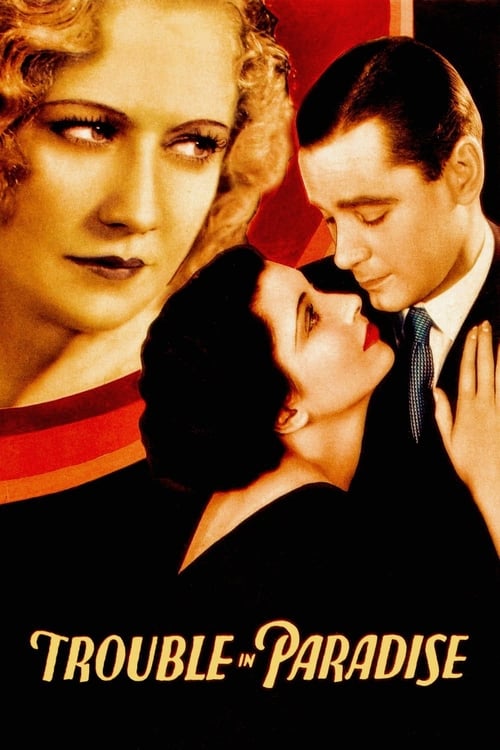
Trouble in Paradise
1932 · Ernst Lubitsch
For a cozy, sophisticated night in when you want to be charmed — romance, wit, and beautiful people behaving badly, all in under 90 minutes. Pure comfort, zero effort required.
What it's about
A gentleman thief and a pickpocket meet, fall in love, and go into business together fleecing the rich across Venice and Paris. Their biggest mark is a glamorous, wealthy perfume widow — and the plan is going beautifully until the con man, installed as her personal secretary, starts to actually feel something.
The experience
Light as champagne and twice as fast — sly, sexy, and endlessly quotable, with jokes told through raised eyebrows and closed doors. It leaves you grinning and feeling cleverer than when you sat down.
Performances
Herbert Marshall purrs through the film with impossible poise, Miriam Hopkins gives Lily a spark of larcenous delight, and Kay Francis makes the wealthy widow warm and knowing instead of a mere mark.
The craft
This is the textbook case of the 'Lubitsch touch' — whole seductions and thefts conveyed by a cutaway, a clock, or a door left shut, so your imagination does the naughtiest work. Made in the pre-Code era, it's franker about sex and money than Hollywood would be allowed to be again for decades.
Why it matters
Widely considered Lubitsch's masterpiece and the gold standard of the sophisticated romantic comedy — the film generations of comedy writers and directors have measured elegance against.
Snapshot
Trouble in Paradise is the film most often nominated as the purest distillation of the so-called "Lubitsch touch," and Lubitsch himself is widely reported to have regarded it as his finest work for sheer style. A jewel-thief romance staged across Venice and Paris, it follows the gentleman crook Gaston Monescu (Herbert Marshall) and his pickpocket lover Lily (Miriam Hopkins) as they set out to fleece the wealthy, widowed perfume magnate Mariette Colet (Kay Francis) — only for Gaston's con to be complicated by genuine feeling. Made at Paramount at the height of the pre-Code era, it is a comedy of manners about money, desire, and the elegance of dishonesty, executed with an economy and suggestiveness that have made it a textbook case of sophisticated sound-era filmmaking. Its reputation rests less on plot than on the grace of its telling: a film in which crime is courtship, sex is conveyed by clocks and closed doors, and the Depression hovers at the edges of a champagne world.
Industry & production
The film was produced and distributed by Paramount Publix, the studio that had imported Lubitsch from Germany in the 1920s and given him latitude to develop a distinctly continental brand of comedy. It derives from the Hungarian play A becsületes megtaláló ("The Honest Finder") by László Aladár; Samson Raphaelson wrote the screenplay, with adaptation work credited to Grover Jones. Lubitsch produced as well as directed, a level of authorial control that was unusual and that he increasingly enjoyed at Paramount.
Crucially, Trouble in Paradise belongs to the pre-Code window — the years between the coming of sound and the rigorous enforcement of the Production Code in mid-1934. Its amoral premise (thieves as sympathetic heroes who are neither caught nor reformed) and its frank, unpunished sexuality were permissible in 1932 in a way they would not be eighteen months later. The well-documented consequence is that the film could not be re-released once the Code was enforced; it remained effectively out of circulation for decades and did not return to general view until the late 1960s. That suppression is central to its production history: it is a film whose very virtues made it unshowable under the regime that followed.
Technology
The picture was made early in the sound period, when synchronized dialogue, music, and effects were still relatively new and the technical apparatus comparatively cumbersome. Lubitsch had already worked through the awkwardness of the first talkies in his early-1930s musicals (The Love Parade, Monte Carlo, The Smiling Lieutenant), and Trouble in Paradise benefits from that experience: the camera moves fluidly rather than sitting locked-down beside a hidden microphone, and sound is treated as an expressive element rather than a mere record of speech. The film was shot on black-and-white nitrate stock in the Academy ratio standard to the period. Beyond these era-typical conditions, the record does not indicate that the production pioneered any specific technical apparatus; its innovations are stylistic rather than mechanical.
Technique
Cinematography
Victor Milner, one of Paramount's leading cinematographers, photographed the film, and the visual surface is one of its glories: glossy, deep-toned, with the polished sheen Paramount cultivated in its high-comedy product. The camera is mobile and discreet, gliding through the Colet mansion's art-deco spaces. Milner's lighting flatters the principals — Kay Francis in particular is photographed with a hushed glamour — while the compositions repeatedly organize the frame around significant objects: a handbag, a clock, a doorway. The cinematography is in service of Lubitsch's habit of letting the camera notice things the characters pretend not to.
Editing
The editing is the technical heart of the "Lubitsch touch." The film is built on ellipsis: scenes end a beat before their payoff, leaving the audience to complete the joke or the seduction. The most celebrated instance is the recurring use of clocks and a series of dissolves that pass time — most famously a sequence of shots tracking the deepening intimacy between Gaston and Mariette without ever depicting it, culminating in imagery (a bed, shadows, a clock) that says everything by showing nothing. Transitions are wittily motivated, and the cutting trusts the spectator to infer. This refusal to underline is what gives the picture its reputation for sophistication; the meaning lives in the gaps between shots.
Mise-en-scène / staging
Hans Dreier's art direction supplies the film's gleaming modern interiors, all curved lines and luxurious surfaces, against which the characters' schemes play out. Lubitsch stages action through doors, mirrors, and thresholds — the door is practically a co-author of his comedies, opening and closing on private business the camera declines to enter. Objects carry the narrative: a stolen wallet returned, a diamond-studded handbag, a comb, a garter. The opening gag — a Venetian "garbage gondola," the romantic image of the singing gondolier punctured by the reveal that he is collecting trash — establishes in seconds the film's method of setting up an expectation and then deflating or redirecting it. Staging is choreography here, with entrances and exits timed like music.
Sound
W. Franke Harling supplied the score, including the title song "Trouble in Paradise." Lubitsch, fresh from a run of operetta-style musicals, treats sound musically: dialogue has a rhythmic, almost sung cadence, and music, effects, and speech are woven together. The opening uses an Italianate song ironically against the garbage-gondola image; elsewhere, sound bridges and motifs carry the film across its elisions. The famous bedroom passage relies on the interplay of image and a discreet musical/aural treatment rather than dialogue. Sound is used to suggest and to pace, not merely to deliver lines.
Performance
The performances are calibrated to Lubitsch's tone of knowing understatement. Herbert Marshall plays Gaston with unflappable, slightly melancholy suavity — the gentleman thief who is most charming when most larcenous. Miriam Hopkins gives Lily a brittle, quick, jealous energy that sharpens as Gaston drifts toward Mariette; the partnership of thieves reads as the film's truest love. Kay Francis brings a languid, generous warmth to Mariette, the rich widow who is no fool and who treats her own seduction with amused candor. Edward Everett Horton and Charles Ruggles, as Mariette's flustered, ineffectual suitors, provide the comic counterweight, their fussiness setting off Gaston's cool. The ensemble plays the material light, letting innuendo register as wit rather than leer.
Narrative & dramatic mode
The film is a romantic comedy of confidence and concealment, structured as a love triangle in which the audience is in on the con from the start. Its dramatic mode is comic irony: we know Gaston and Lily are thieves, we know "Monsieur Laval" is a fiction, and the comedy arises from watching the marks fail to see, and from the genuine emotion that leaks through the deception. The tone is detached, urbane, and morally relaxed — sympathies lie entirely with the criminals. The resolution is famously unsentimental: rather than punishing the thieves or forcing a conventional redemption, the film lets Gaston choose, and lets larceny and loyalty coexist. The pleasure is in surface and timing rather than suspense; the "plot" is a frame on which to hang elegant variations.
Genre & cycle
Trouble in Paradise sits at the head of the early-1930s cycle of sophisticated, "continental" Hollywood comedies — sex comedies of manners set among the wealthy and the cosmopolitan, often with European settings and amoral charm. It is a pre-Code romantic comedy with a crime premise, blending the caper, the boudoir farce, and the romance. As a precursor it points toward the screwball comedy that would flower from the mid-1930s, though it is cooler and more languid than the manic screwballs to come. Within Lubitsch's own output it belongs to the run of Paramount comedies and musicals that defined his American style; among them it is the one most often singled out as the cycle's high-water mark.
Authorship & method
This is a Lubitsch film in the fullest auteur sense, and it is the film most frequently used to define what critics mean by the "Lubitsch touch": the conveying of meaning by indirection, the substitution of suggestion for statement, the joke built into a cut or a closed door, the worldly assumption that the audience is as sophisticated as the characters. His method was meticulous pre-planning — comedy engineered to the beat — paired with a refusal to spell anything out.
His essential collaborator here is screenwriter Samson Raphaelson, who worked with Lubitsch repeatedly across the 1930s and into the 1940s (their later collaborations include The Shop Around the Corner and Heaven Can Wait); Raphaelson's dialogue gives the film its literate, double-edged sparkle. Cinematographer Victor Milner provides the polished image; art director Hans Dreier the modern luxury; composer W. Franke Harling the musical fabric and title song. The cast — Marshall, Hopkins, Francis, Horton, Ruggles — execute the tonal control the style demands. Lubitsch's own assessment, as commonly reported from his later correspondence, was that in terms of pure style he had done nothing better; that judgment has been broadly ratified by later critics.
Movement / national cinema
The film is a product of the Hollywood studio system, made within Paramount's particular house style of glossy, European-flavored sophistication. But its sensibility is inseparable from Lubitsch's origins in German cinema: he came up in the UFA era and brought to America a continental wit and a comfort with sexual frankness that distinguished his work from the more sentimental native product. Trouble in Paradise thus represents a kind of transplanted European modernism — Mitteleuropa sophistication processed through an American studio — and stands as a leading example of the émigré contribution to 1930s Hollywood. Its Venice-and-Paris settings are studio-built dreams of Europe, fantasies of a cosmopolitan elsewhere.
Era / period
Released in 1932, the film is doubly marked by its moment. It is a pre-Code work, exploiting the brief liberty before mid-1934 enforcement to treat crime and sex without moralizing — a freedom that would soon vanish and that would, ironically, banish the film from circulation. It is also a Depression film: made in the trough of the economic crisis, it sets its featherweight comedy in a world of perfume fortunes and diamond handbags, and it does not entirely ignore the contrast. A boardroom scene in which a shareholder rails against the frivolity of the rich, and the figure of a chairman urging that wages not be cut, let the harder realities of 1932 flicker through the gilt. The escapism is knowing rather than innocent.
Themes
At its center is the equation of crime with seduction and of money with desire: Gaston and Lily fall in love by robbing each other, and the film's most charged scenes are accountings of stolen goods. Honor among thieves — loyalty as the one inviolable value in a world of liars — is its moral core, and the love triangle tests that loyalty against the lure of wealth and respectability embodied by Mariette. Class and money run throughout: the thieves are more elegant than their victims, and the rich are presented as ripe for plucking and faintly absurd. The film is also about performance and identity, the con as a kind of theater, and about the gap between what is said and what is meant — a theme that is also its formal principle. Underneath the wit is a melancholy strain about choosing between the comfortable and the true.
Reception, canon & influence
On release the film was warmly received by contemporary critics as a model of sophisticated comedy, and it consolidated Lubitsch's standing as Hollywood's reigning master of the form. Its subsequent history is unusual: Production Code enforcement effectively withdrew it from view for roughly three decades, so that its canonization came largely after its rediscovery in the late 1960s. Since then it has risen steadily in critical estimation, routinely cited among the greatest American comedies and frequently appearing on critics' polls of the finest films; it is a fixture of repertory programming and film-school curricula as the exemplary "Lubitsch touch" picture.
Looking backward, the film draws on Lubitsch's German and operetta-comedy formation and on the source play's European farce tradition; its grounding source is the Hungarian stage work by László Aladár, refracted through Raphaelson's writing. Looking forward, its influence is broad and well attested. Billy Wilder, who worked under Lubitsch and revered him — famously keeping a "How would Lubitsch do it?" reminder in view — carried the touch's indirection and worldly wit into his own comedies. The film's mode of sophisticated, ellipsis-driven romantic comedy fed the screwball tradition and a long line of later filmmakers drawn to elegant misdirection; Wes Anderson, among contemporary directors, has openly acknowledged Lubitsch and this milieu as touchstones (notably around The Grand Budapest Hotel). More diffusely, Trouble in Paradise set a durable standard for what cinematic sophistication could mean — meaning made by what is withheld — and remains the reference point against which that ideal is measured.
A Deleuzian reading
A gondola slides across the Venice night and a man is singing — the postcard arranges itself, the tenor swells, romance is imminent.
The full Deleuzian reading of Trouble in Paradise →
Reception
A hit with critics in 1932 and reportedly Lubitsch's own favorite of his films, it was effectively banished after the Production Code hardened — denied re-release in 1935 and largely unseen for decades — before re-emerging as the crown jewel of pre-Code sophistication.
How Trouble in Paradise was received, from release to now →
Influences: the films it descends from and the films it influenced
- The Marriage Circle (1924) — Lubitsch's own silent template for the touch — meaning conveyed through glances, doors, and gestural ellipsis rather than intertitles, the visual-suggestion grammar he later perfected here.
- The Oyster Princess (1919) — Lubitsch's German operetta-comedy formation — rhythmic, dance-like staging and satire of moneyed milieu that supplies the choreographed-to-the-beat comic engineering.
- The Smiling Lieutenant (1931) — Immediate precursor pairing Lubitsch with the operetta-musical mode and worldly sexual triangle, rehearsing the elegant adultery-by-suggestion that Trouble distills.
- Forbidden Paradise (1924) — Continental sophistication and aristocratic intrigue rendered through significant objects and withheld reactions — the prop-and-threshold storytelling reused as caper grammar.
- Trouble in Paradise source play 'The Honest Finder' (1931) — The Hungarian stage farce supplying the thief-romance armature of mistaken honor, refracted through Raphaelson into double-edged screen dialogue.
- A Woman of Paris: A Drama of Fate (1923) — The mature form of the same grammar — a handbag, a garter and a clock stand in for the entire sexual and criminal plot, scenes begin after their turning point, and the film ends with the moral question conspicuously unanswered.
- The Shop Around the Corner (1940) — Later Lubitsch–Raphaelson film carrying forward the literate, double-edged dialogue and emotion conveyed by what characters decline to say.
- Twentieth Century (1934) — Channels Lubitsch's velocity and worldly verbal sparring into the nascent screwball idiom — sophisticated comedy of romantic combat at engineered tempo.
- My Man Godfrey (1936) — Depression-era class-masquerade comedy descending from Trouble's premise of the impostor moving through the moneyed world by charm and disguise.
- The Lady Eve (1941) — Refines crime-as-courtship — the grifter-as-seductress and the con run as romance — with Lubitschian misdirection and significant-object gags (the cardsharp's deck).
- The Palm Beach Story (1942) — Sturges extends the elegant marital-economic comedy of manners, deploying ellipsis and the knowing wink at the sophisticated spectator.
- The Major and the Minor (1942) — Wilder's directorial debut applying his 'How would Lubitsch do it?' creed — disguise, suggestion over statement, the risqué resolved by implication.
- Some Like It Hot (1959) — Wilder's mature deployment of the touch: masquerade-driven sexual comedy where the most charged content is conveyed by indirection and the famous withheld final line.
- To Be or Not to Be (1942) — Lubitsch transposing caper-by-impersonation and tonal control to wartime farce — performance as con, danger played as drawing-room comedy.
- Charade (1963) — Continental thief-romance of shifting identities and honor among thieves, staged with elegant misdirection and significant objects in the Lubitsch caper-romance line.
- The Grand Budapest Hotel (2014) — Anderson's avowed Lubitsch homage — Mitteleuropa luxury, the gentleman-thief concierge, and comedy of decorous theft told through doors, thresholds, and precise object choreography.
- The Apartment (1960) — Wilder absorbed Lubitsch's method of encoding sexual negotiation entirely in mise-en-scène — closed doors, exchanged objects, displaced conversation — and The Apartment's whole grammar of implication (the apartment key as transaction object, the compact mirror as revelation device) is a direct technical inheritance of the Lubitsch touch's economy of disclosure.
- To Catch a Thief (1955) — Lubitsch codified the European luxury-hotel jewel-thief comedy as a genre arena for erotic play—two criminals posing as legitimate guests, theft as seduction, deception as consummation—providing the formal template Hitchcock inherits for the Riviera milieu, the complicit couple, and the romantic double-cross structure.
- One Hour with You (1932) — Same-year Lubitsch–Raphaelson collaboration using direct-address asides and musicalized dialogue to make the audience complicit in romantic deceit.
- Design for Living (1933) — Immediate follow-up extending the pre-Code ménage handled by indirection — the 'gentleman's agreement' fade and the cut-away that lets the joke happen offscreen.
- Ninotchka (1939) — Lubitsch (with Wilder co-writing) demonstrating the touch as political-romantic indirection — the joke built into a cut, luxury as comic terrain.
- A Woman Is a Woman (1961) — The 'Lubitsch touch' of eliding consummation into innuendo and sophisticated ellipsis is Godard's direct model — Belmondo's character is literally named Alfred Lubitsch as an on-screen dedication.
Similar films
- Charade (1963) — influence & lineage · same viewing thread
- To Be or Not to Be (1942) — influence & lineage
- Some Like It Hot (1959) — influence & lineage · same viewing thread
- How to Steal a Million (1966) — same viewing thread
- Midnight (1939) — same viewing thread
- Mon Oncle (1958) — often watched together
- L'Âge d'or (1930) — often watched together
- Heaven Can Wait (1943) — shared sensibility
All the films related to Trouble in Paradise →
Watch it with: curated runs of related films
- Fast Talk & Fur Coats — A run of quick-witted charmers who disguise, con, and sweet-talk their way across class lines — watch them near each other and the century between Lubitsch and Sean Baker collapses into one long, glittering grift.